1 5 0 4 2 0 1 5
NEUROENDOCRINE
NEUROENDOCRINOLOGY
 Two major homeostatic systems involved in the
control and regulation of various functions.
 systems involved are:
 NERVOUS SYSTEM AND
 ENDOCRINE SYSTEM,
 working together these system are termed as
neuroendocrine system or response
 Neuroendocrine system sense information, organize
response and deliver message to appropriate organ
 Endocrine glands release chemical messenger
(hormones) while nervous system send their
information via nerves and neurotransmitter
 Hormones are divided in several classes based on
chemical makeup
 Amino acid derivatives, peptides/proteins and
steroids
 Hormones are measured in micro(µ), Nano (symbol
n) and Pico (symbol p) gram
BLOOD HORMONE CONCENTRATION
 Hormone concentration in plasma depends on
Rate of secretion of hormone from gland
Rate of excretion or metabolism of hormone
Quantity of transport protein
Changes in the plasma protein
• Effect of hormone exerts on a tissue is directly
related to the number of active receptors
BLOOD HORMONE CONCENTRATION
 Endocrine glands release hormone directly into the blood
to alter the activity of tissues
 The plasma hormone concentration shows the
magnitude of the effect at the tissue level
 Concentration can be changed by altering the rate of
secretion or inactivation of hormone
 Alteration can be by quantity of transport protein, and
the plasma volume
Metabolism and secretion of hormones
 Concentration of hormones in plasma is influenced
by rate at which it is metabolized, inactivated or
excreted.
 Inactivation takes place at over near receptors in the
liver. “These are major sites of hormones”.
 Kidneys can metabolize and excrete varieties of
hormones in their free forms
Rate of excretion of hormone:
 In urine it has been used as indicator of its rate of
excretion during exercise.
 Blood flows to use kidney and liver during exercise
by according to their function
 Rate of excretion and inhibition decreases, and this
results in an elevation of hormones at the plasma
level.
Hormone receptor interaction:
 Tissue responses to specific hormones, have specific
protein receptors which are capable of binding those
hormones.
 Number of receptors varies from 500 to 1 lac/cell.
 No. of receptors may be decrease when exposed to a
chronically elevated level of hormone and it is called
“down regulation”
 This down regulation have diminished response for
the same hormone concentration.
 Chronically exposure to low concentration of
hormone may lead to increase in receptors number
called “up regulation”
 For example: type I diabetes
 By up regulation tissues become very responsive to
the available hormone. When concentration of
hormone is so high that all receptors are bound to
hormones is called “saturation”
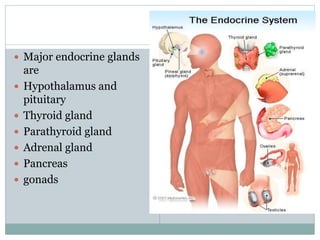
 Major endocrine glands
are
 Hypothalamus and
pituitary
 Thyroid gland
 Parathyroid gland
 Adrenal gland
 Pancreas
 gonads
HYPOTHALAMUS AND PITUITARY
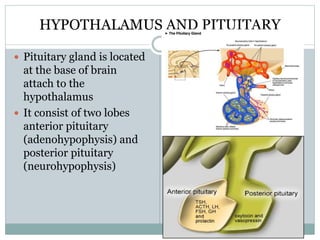
 Pituitary gland is located
at the base of brain
attach to the
hypothalamus
 It consist of two lobes
anterior pituitary
(adenohypophysis) and
posterior pituitary
(neurohypophysis)
ANTERIOR PITUITARY
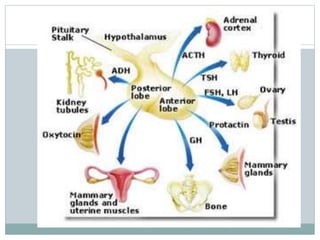
 Anterior pituitary secretes hormones under the
action of chemical signals by the hypothalamus or
positive or negative feedback system
Major hormones are:
Adrenocorticotropin (ACTH)
Growth hormone (GH)
Thyroid stimulating hormone (TSH)
Follicle-stimulating hormone (FSH)
Luteinizing hormone (LH)
Prolactin
ANTERIOR PITUITARY
 Hypothalamus controls the activity of both the ant.
Pituitary and posterior Pituitary glands
 GH released from ant. Pituitary gland & it is
essential for normal growth
 GH increases during exercise to mobilize fatty acids
from adipose tissue and to aid in the maintenance of
blood glucose
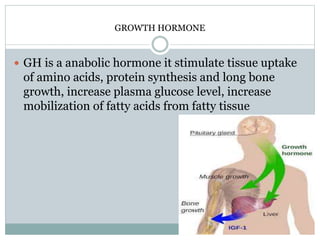
GROWTH HORMONE
 GH is a anabolic hormone it stimulate tissue uptake
of amino acids, protein synthesis and long bone
growth, increase plasma glucose level, increase
mobilization of fatty acids from fatty tissue
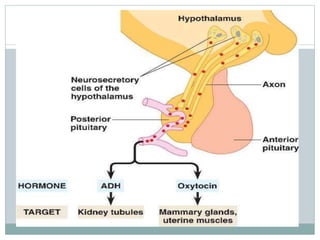
POSTERIOR PITUITARY
 Release two hormones
 Anti diuretic hormone(vasopressin) Increase water
reabsorption from the kidney tubules , to maintain
blood volume
 Oxytocin stimulator of smooth muscle , specially at
the time of labor.
THYROID GLAND
 Thyroid gland is stimulated by TSH(primary stimulus) to
synthesize two iodine –containing hormones
 Trioiodothyroxine T3 (contains 3 iodine atoms)
 Tetraiodothyrosxine (thyroxine) T4 (contains 4 iodine atoms)
 They are free hormone concentration(not bound to plasma
protein)
 T3 and T4 are important in maintaining metabolic rate of
body, it also help other hormone to exert their full affect
THYROID GLAND
 Low T3 characterized as lethargic and hypo kinetic.
 Latent period for T3 is 6-12 hours ,& 2-3 days for T4
THYROID GLAND
 During Xs free hormone conc. Increases & taken up at a
faster rate by tissues.
Calcitonin:
 Calcitonin also secreted by thyroid gland
 It involves in the regulation of plasma ca++
PARATHYROID GLAND
 Prathyroid are four small gland located on the dorsal
aspect of thyroid gland
 It is the primary hormone involved in the regulation
of plasma calcium levels,
 The hormone increase plasma calcium level by
increasing its absorption from renal tubules, GIT and
it also stimulate bone to release calcium in the blood
 It also regulate phosphate level in the blood
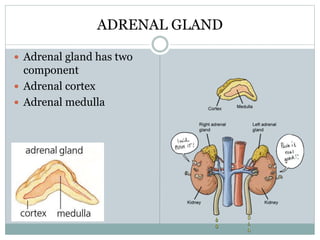
ADRENAL GLAND
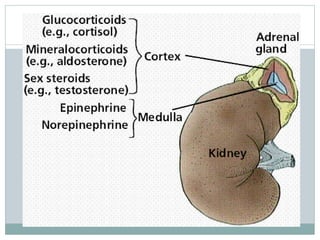
 Adrenal gland has two
component
 Adrenal cortex
 Adrenal medulla
ADRENAL MEDULLA
 Situated directly on top of each kidney and stimulated by
the sympathetic nervous system
 Secretes the catecholamines
 Epinephrine: elicits a fight or flight response
 Increase H.R. and B.P.
 Increase respiration
 Increase metabolic rate
 Increase glycogenolysis
 Vasodilation
 Norepinephrine
 Vasoconstriction increasing BP
ADRENAL CORTEX
 The three different zones of adrenal cortex release
three different types of hormone
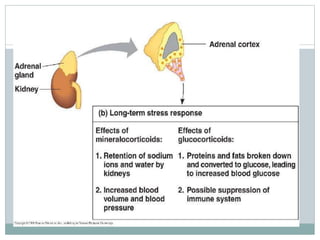
 Mineralocorticoids
 Aldosterone: maintains electrolyte balance specially Na and K
 Glucocorticoids
 Cortisol :Stimulates gluconeogenisis
 Mobilization of free fatty acids
 Glucose sparing
 Anti-inflammatory agent
 Gonadocorticoids(androgens, estrogens)
 testosterone, estrogen, progesterone
PANCREASE
 Located slightly behind the stomach , pancreases act
both as exocrine gland and endocrine gland
 Exocrine portion release digestive juices
 Endocrine portion release
 Insulin
 Gucagon (insulin antagonist)
 Pancreatic somatostatin
INSULIN
 Insulin is released from beta cells of islet of
langerhans
 Insulin stimulate tissue uptake of glucose and amino
acids, and gluconeogenesis
 Insulin secretion is influenced by plasma glucose
concentration, amino acid concentration,
sympathetic and parasympathetic stimulation
 Decreased concentration or improper functioning
insulin receptors results in raised levels of plasma
glucose called diabetes mellitus

Lec 3 neuro endocrine responce

  • 1.
    1 5 04 2 0 1 5 NEUROENDOCRINE
  • 2.
    NEUROENDOCRINOLOGY  Two majorhomeostatic systems involved in the control and regulation of various functions.  systems involved are:  NERVOUS SYSTEM AND  ENDOCRINE SYSTEM,  working together these system are termed as neuroendocrine system or response
  • 3.
     Neuroendocrine systemsense information, organize response and deliver message to appropriate organ  Endocrine glands release chemical messenger (hormones) while nervous system send their information via nerves and neurotransmitter
  • 4.
     Hormones aredivided in several classes based on chemical makeup  Amino acid derivatives, peptides/proteins and steroids  Hormones are measured in micro(µ), Nano (symbol n) and Pico (symbol p) gram
  • 5.
    BLOOD HORMONE CONCENTRATION Hormone concentration in plasma depends on Rate of secretion of hormone from gland Rate of excretion or metabolism of hormone Quantity of transport protein Changes in the plasma protein • Effect of hormone exerts on a tissue is directly related to the number of active receptors
  • 6.
    BLOOD HORMONE CONCENTRATION Endocrine glands release hormone directly into the blood to alter the activity of tissues  The plasma hormone concentration shows the magnitude of the effect at the tissue level  Concentration can be changed by altering the rate of secretion or inactivation of hormone  Alteration can be by quantity of transport protein, and the plasma volume
  • 7.
    Metabolism and secretionof hormones  Concentration of hormones in plasma is influenced by rate at which it is metabolized, inactivated or excreted.  Inactivation takes place at over near receptors in the liver. “These are major sites of hormones”.  Kidneys can metabolize and excrete varieties of hormones in their free forms
  • 8.
    Rate of excretionof hormone:  In urine it has been used as indicator of its rate of excretion during exercise.  Blood flows to use kidney and liver during exercise by according to their function  Rate of excretion and inhibition decreases, and this results in an elevation of hormones at the plasma level.
  • 9.
    Hormone receptor interaction: Tissue responses to specific hormones, have specific protein receptors which are capable of binding those hormones.  Number of receptors varies from 500 to 1 lac/cell.  No. of receptors may be decrease when exposed to a chronically elevated level of hormone and it is called “down regulation”  This down regulation have diminished response for the same hormone concentration.
  • 10.
     Chronically exposureto low concentration of hormone may lead to increase in receptors number called “up regulation”  For example: type I diabetes  By up regulation tissues become very responsive to the available hormone. When concentration of hormone is so high that all receptors are bound to hormones is called “saturation”
  • 11.
     Major endocrineglands are  Hypothalamus and pituitary  Thyroid gland  Parathyroid gland  Adrenal gland  Pancreas  gonads
  • 12.
    HYPOTHALAMUS AND PITUITARY Pituitary gland is located at the base of brain attach to the hypothalamus  It consist of two lobes anterior pituitary (adenohypophysis) and posterior pituitary (neurohypophysis)
  • 13.
    ANTERIOR PITUITARY  Anteriorpituitary secretes hormones under the action of chemical signals by the hypothalamus or positive or negative feedback system Major hormones are: Adrenocorticotropin (ACTH) Growth hormone (GH) Thyroid stimulating hormone (TSH) Follicle-stimulating hormone (FSH) Luteinizing hormone (LH) Prolactin
  • 14.
    ANTERIOR PITUITARY  Hypothalamuscontrols the activity of both the ant. Pituitary and posterior Pituitary glands  GH released from ant. Pituitary gland & it is essential for normal growth  GH increases during exercise to mobilize fatty acids from adipose tissue and to aid in the maintenance of blood glucose
  • 16.
    GROWTH HORMONE  GHis a anabolic hormone it stimulate tissue uptake of amino acids, protein synthesis and long bone growth, increase plasma glucose level, increase mobilization of fatty acids from fatty tissue
  • 17.
    POSTERIOR PITUITARY  Releasetwo hormones  Anti diuretic hormone(vasopressin) Increase water reabsorption from the kidney tubules , to maintain blood volume  Oxytocin stimulator of smooth muscle , specially at the time of labor.
  • 19.
    THYROID GLAND  Thyroidgland is stimulated by TSH(primary stimulus) to synthesize two iodine –containing hormones  Trioiodothyroxine T3 (contains 3 iodine atoms)  Tetraiodothyrosxine (thyroxine) T4 (contains 4 iodine atoms)  They are free hormone concentration(not bound to plasma protein)  T3 and T4 are important in maintaining metabolic rate of body, it also help other hormone to exert their full affect
  • 20.
    THYROID GLAND  LowT3 characterized as lethargic and hypo kinetic.  Latent period for T3 is 6-12 hours ,& 2-3 days for T4
  • 21.
    THYROID GLAND  DuringXs free hormone conc. Increases & taken up at a faster rate by tissues. Calcitonin:  Calcitonin also secreted by thyroid gland  It involves in the regulation of plasma ca++
  • 22.
    PARATHYROID GLAND  Prathyroidare four small gland located on the dorsal aspect of thyroid gland  It is the primary hormone involved in the regulation of plasma calcium levels,  The hormone increase plasma calcium level by increasing its absorption from renal tubules, GIT and it also stimulate bone to release calcium in the blood  It also regulate phosphate level in the blood
  • 23.
    ADRENAL GLAND  Adrenalgland has two component  Adrenal cortex  Adrenal medulla
  • 24.
    ADRENAL MEDULLA  Situateddirectly on top of each kidney and stimulated by the sympathetic nervous system  Secretes the catecholamines  Epinephrine: elicits a fight or flight response  Increase H.R. and B.P.  Increase respiration  Increase metabolic rate  Increase glycogenolysis  Vasodilation  Norepinephrine  Vasoconstriction increasing BP
  • 26.
    ADRENAL CORTEX  Thethree different zones of adrenal cortex release three different types of hormone  Mineralocorticoids  Aldosterone: maintains electrolyte balance specially Na and K  Glucocorticoids  Cortisol :Stimulates gluconeogenisis  Mobilization of free fatty acids  Glucose sparing  Anti-inflammatory agent  Gonadocorticoids(androgens, estrogens)  testosterone, estrogen, progesterone
  • 28.
    PANCREASE  Located slightlybehind the stomach , pancreases act both as exocrine gland and endocrine gland  Exocrine portion release digestive juices  Endocrine portion release  Insulin  Gucagon (insulin antagonist)  Pancreatic somatostatin
  • 29.
    INSULIN  Insulin isreleased from beta cells of islet of langerhans  Insulin stimulate tissue uptake of glucose and amino acids, and gluconeogenesis  Insulin secretion is influenced by plasma glucose concentration, amino acid concentration, sympathetic and parasympathetic stimulation  Decreased concentration or improper functioning insulin receptors results in raised levels of plasma glucose called diabetes mellitus