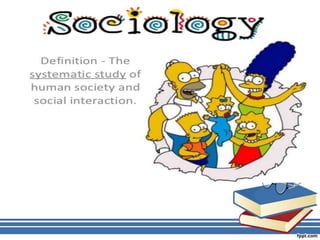
Sociology
Social action and interaction
Lecture 2
WHAT IS SOCIAL INTERACTION?
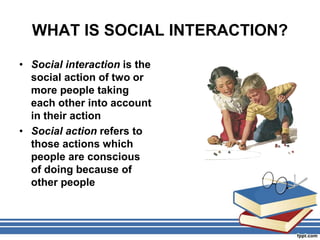
• Social interaction is the
social action of two or
more people taking
each other into account
in their action
• Social action refers to
those actions which
people are conscious
of doing because of
other people
CONTEXTS AND NORMS OF
SOCIAL INTERACTION
• The context in which a social interaction takes place
determines its meaning
• Three elements comprise the context:
• The physical setting
• The social environment
• Activities surrounding the interaction
• Norms are the rules of behavior governing the
interaction
STUDYING SOCIAL INTERACTION:
ETHNOMETHODOLOGY AND
DRAMATURGY
• Ethnomethodology is the study of the
norms governing social interaction
• This approach normally involves
purposely violating commonly
understood rules as a means to gauge
the nature of people’s response
• Dramaturgy understands social
interaction in terms of the theater
• Interacting parties are actors involved
in a performance known as impression
management
TYPES OF SOCIAL INTERACTION
• Nonverbal Behavior
• Involves forms of communication that involved body
movements, or kinesics
• Researchers focus on things such as posture, yawns, and
eye contact
• Exchange—social interaction with the express
purpose of receiving mutual rewards
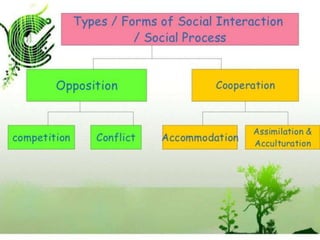
• Cooperation—social interaction engaged in to
promote common interests
• Conflict—social interaction that involves working
against each other for a commonly prized object
• Competition—form of conflict in which individuals
confine conflict to agreed-upon rules
ELEMENTS OF SOCIAL INTERACTION:
STATUSES
• A status is any socially defined position that people
occupy
• Some statuses are more influential than others in
shaping our identity and the interactions of others
around us. These are called master statuses
• Statuses can be either conferred upon us, or can be
voluntarily attained
– Ascribed statuses are conferred upon us, usually at birth.
Include our race, sex, etc.
– Achieved statuses are voluntarily attained and include our
occupation, student status, etc.
ROLES
• Roles are the “...culturally defined rules for proper
behavior that are associated with every status.”
• All of the roles attached to a particular status are called,
collectively, role sets
• Because we cannot possibly fulfill all of the roles
attached to a particular status at any given time, we
typically identify a role set as those rules that apply to
our interaction with other individuals in particular
statuses
Social action and interaction

Social action and interaction

  • 1.
    Sociology Social action andinteraction Lecture 2
  • 2.
    WHAT IS SOCIALINTERACTION? • Social interaction is the social action of two or more people taking each other into account in their action • Social action refers to those actions which people are conscious of doing because of other people
  • 3.
    CONTEXTS AND NORMSOF SOCIAL INTERACTION • The context in which a social interaction takes place determines its meaning • Three elements comprise the context: • The physical setting • The social environment • Activities surrounding the interaction • Norms are the rules of behavior governing the interaction
  • 4.
    STUDYING SOCIAL INTERACTION: ETHNOMETHODOLOGYAND DRAMATURGY • Ethnomethodology is the study of the norms governing social interaction • This approach normally involves purposely violating commonly understood rules as a means to gauge the nature of people’s response • Dramaturgy understands social interaction in terms of the theater • Interacting parties are actors involved in a performance known as impression management
  • 5.
    TYPES OF SOCIALINTERACTION • Nonverbal Behavior • Involves forms of communication that involved body movements, or kinesics • Researchers focus on things such as posture, yawns, and eye contact • Exchange—social interaction with the express purpose of receiving mutual rewards • Cooperation—social interaction engaged in to promote common interests • Conflict—social interaction that involves working against each other for a commonly prized object • Competition—form of conflict in which individuals confine conflict to agreed-upon rules
  • 6.
    ELEMENTS OF SOCIALINTERACTION: STATUSES • A status is any socially defined position that people occupy • Some statuses are more influential than others in shaping our identity and the interactions of others around us. These are called master statuses • Statuses can be either conferred upon us, or can be voluntarily attained – Ascribed statuses are conferred upon us, usually at birth. Include our race, sex, etc. – Achieved statuses are voluntarily attained and include our occupation, student status, etc.
  • 7.
    ROLES • Roles arethe “...culturally defined rules for proper behavior that are associated with every status.” • All of the roles attached to a particular status are called, collectively, role sets • Because we cannot possibly fulfill all of the roles attached to a particular status at any given time, we typically identify a role set as those rules that apply to our interaction with other individuals in particular statuses