Program Derivation of
Matrix Operations in GF
Charles Southerland
Dr. Anita Walker
East Central University
The Galois Field
● A finite field is a finite set and two operators
(analogous to addition and multiplication)
over which certain properties hold.
● An important finding in Abstract Algebra is
that all finite fields of the same order are
isomorphic.
● A finite field is also called a Galois Field in
honor of Evariste Galois, a significant
French mathematician in the area of
Abstract Algebra who died at age 20.
History of Program Derivation
● Hoare's 1969 paper An Axiomatic Basis for
Computer Programming essentially
created the field of Formal Methods in CS.
● Dijkstra's paper Guarded Commands,
Nondeterminacy and Formal Derivation of
Programs introduced the idea of program
derivation.
● Gries' book The Science of Programming
brings Dijkstra's paper to a level undergrad
CS and Math majors can understand.
Guarded Command Language
This is part of the language that Dijkstra defined:
● S1
;S2
– Perform S1
, and then perform S2
.
● x:=e – Assign the value of e to the variable x.
● if[b1
S→ 1
][b2
S→ 2
]…fi – Execute exactly one of the
guarded commands (i.e. S1
, S2
, … ) whose
corresponding guard (i.e. b1
, b2
, … ) is true, if any.
● do[b1
S→ 1
][b2
S→ 2
]…od – Execute the command
if[b1
S→ 1
][b2
S→ 2
]…fi until none of the guards are
true.
The Weakest Precondition
Predicate Transformer wp
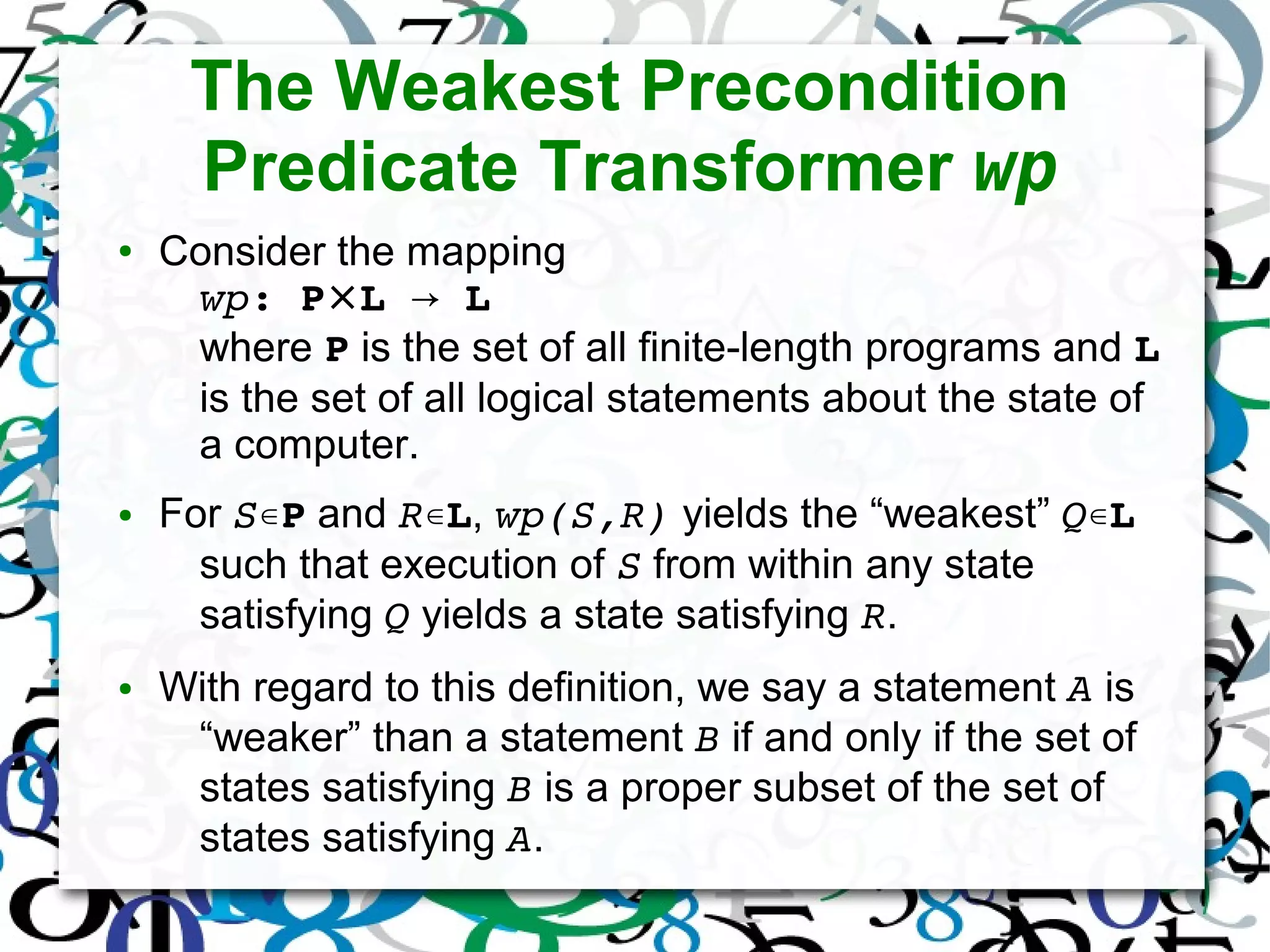
● Consider the mapping
wp: P⨯L   → L
where P is the set of all finite-length programs and L
is the set of all logical statements about the state of
a computer.
● For S∊P and R∊L, wp(S,R) yields the “weakest” Q∊L
such that execution of S from within any state
satisfying Q yields a state satisfying R.
● With regard to this definition, we say a statement A is
“weaker” than a statement B if and only if the set of
states satisfying B is a proper subset of the set of
states satisfying A.
Some Notable Properties of wp
● wp([S1
;S2
],R) = wp(S1
,wp(S2
,R))
● wp([x:=e],R) = R, substituting e for x
● wp([if[b1
S→ 1
][b2
S→ 2
]…fi],R)
= (b1
∨b2
…∨ )   (∧ b1
wp(S→ 1
,R))
    (∧ b2
wp(S→ 2
,R))   …∧
● wp([do[b1
S→ 1
][b2
S→ 2
]…od],R)
= (R ~b∧ 1
~b∧ 2
…∧ )   wp([if[b∨ 1
S→ 1
][b2
S→ 2
]…
fi],R)
    wp([if…],wp([if…],R))∨
    wp([if…],wp([if…],wp([if…],R)))∨
    …∨ (for finitely many recursions)
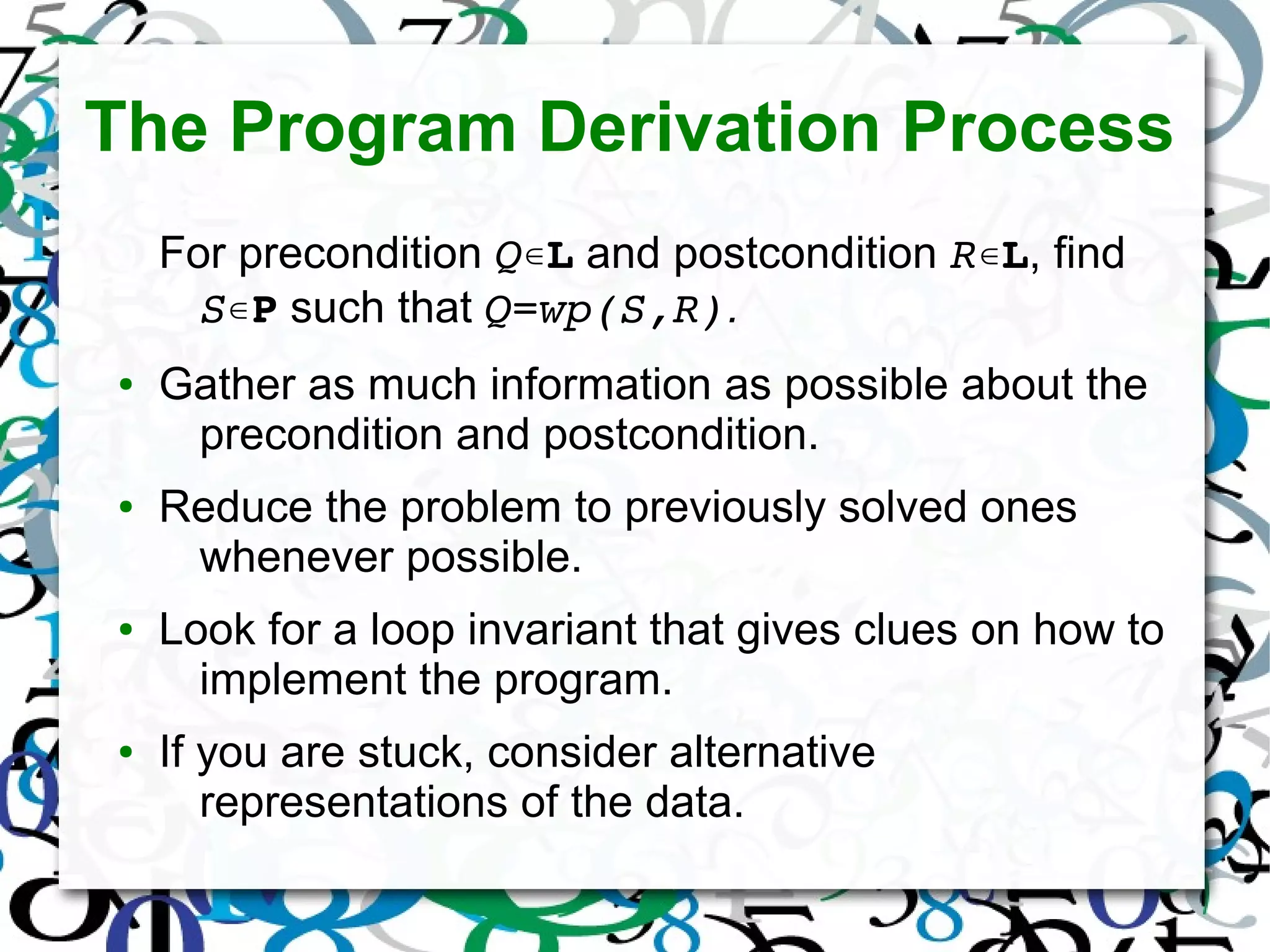
The Program Derivation Process
For precondition Q∊L and postcondition R∊L, find
S∊P such that Q=wp(S,R).
● Gather as much information as possible about the
precondition and postcondition.
● Reduce the problem to previously solved ones
whenever possible.
● Look for a loop invariant that gives clues on how to
implement the program.
● If you are stuck, consider alternative
representations of the data.
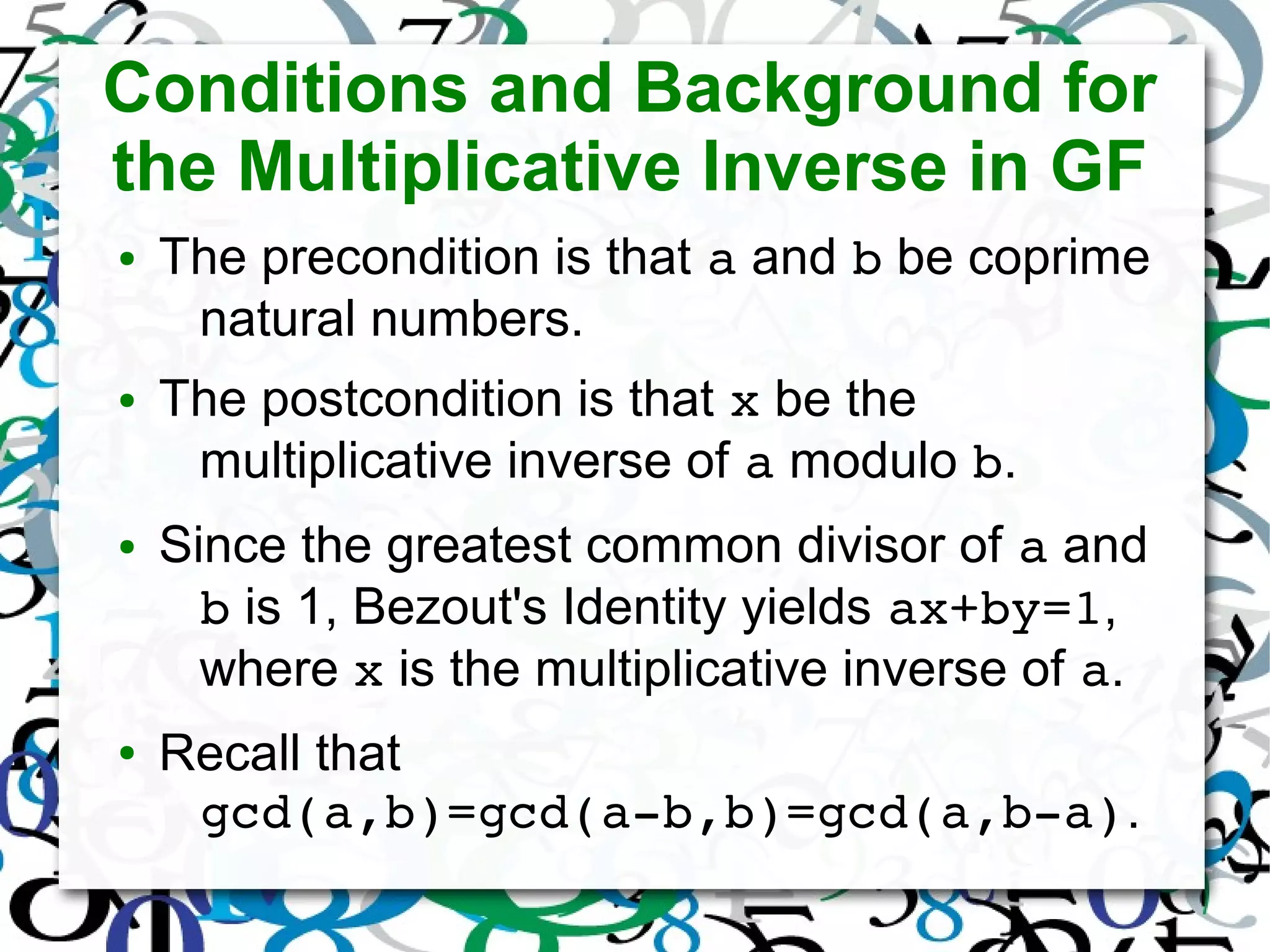
Conditions and Background for
the Multiplicative Inverse in GF
● The precondition is that a and b be coprime
natural numbers.
● The postcondition is that x be the
multiplicative inverse of a modulo b.
● Since the greatest common divisor of a and
b is 1, Bezout's Identity yields ax+by=1,
where x is the multiplicative inverse of a.
● Recall that
gcd(a,b)=gcd(a­b,b)=gcd(a,b­a).
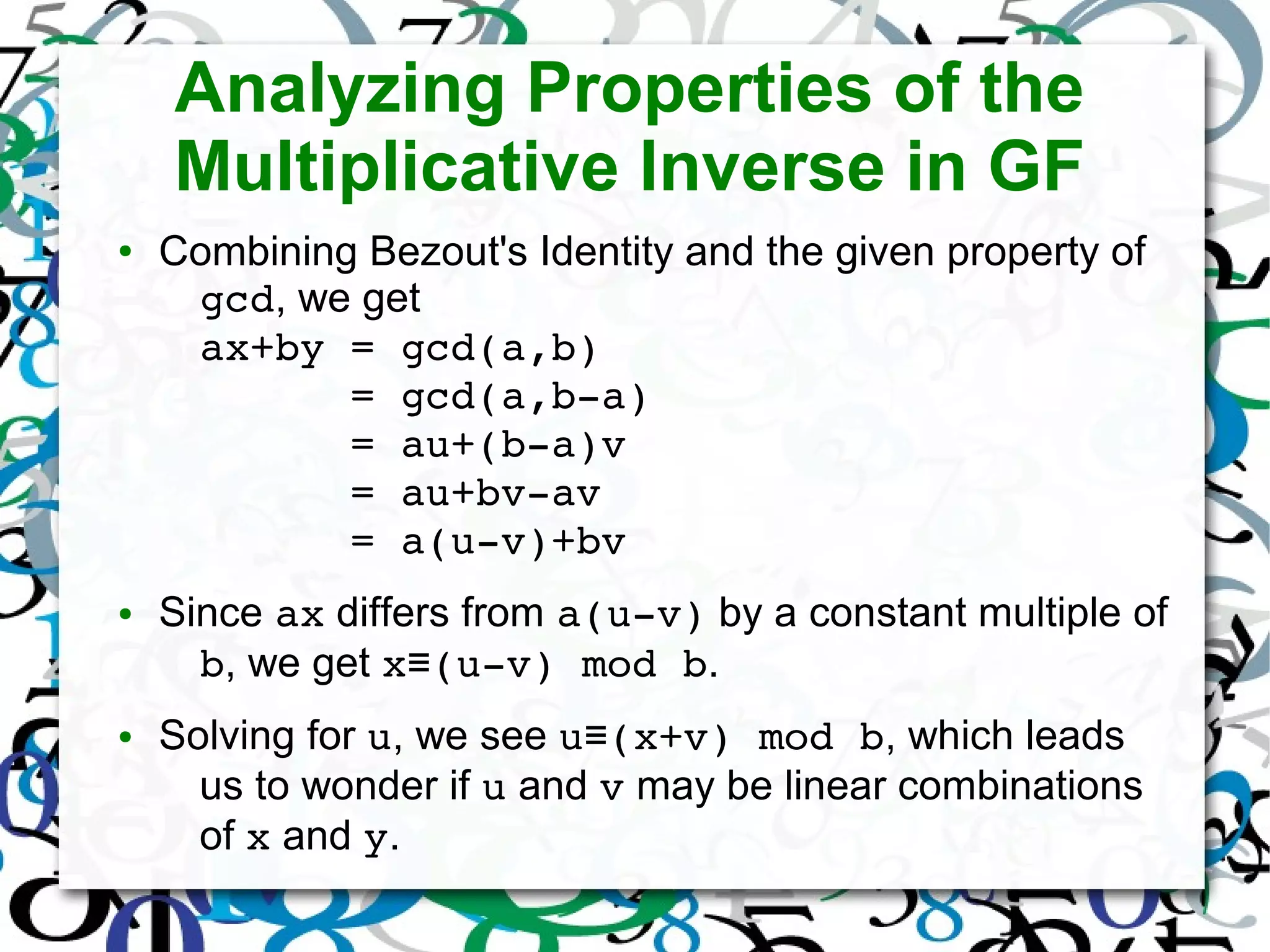
Analyzing Properties of the
Multiplicative Inverse in GF
● Combining Bezout's Identity and the given property of
gcd, we get
ax+by = gcd(a,b)
      = gcd(a,b­a)
      = au+(b­a)v
      = au+bv­av
      = a(u­v)+bv
● Since ax differs from a(u­v) by a constant multiple of
b, we get x (u­v) mod b≡ .
● Solving for u, we see u (x+v) mod b≡ , which leads
us to wonder if u and v may be linear combinations
of x and y.
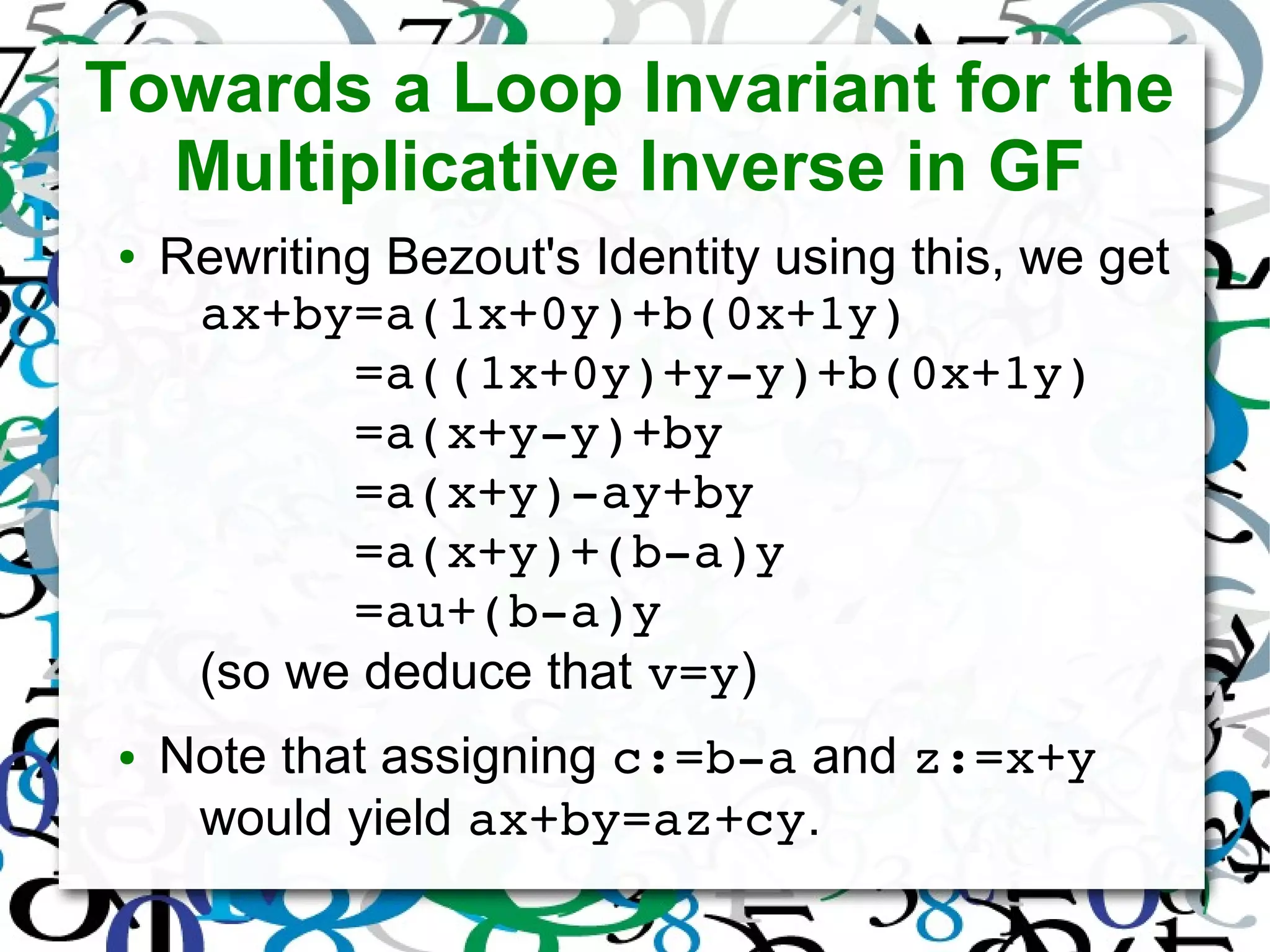
Towards a Loop Invariant for the
Multiplicative Inverse in GF
● Rewriting Bezout's Identity using this, we get
ax+by=a(1x+0y)+b(0x+1y)
     =a((1x+0y)+y­y)+b(0x+1y)
     =a(x+y­y)+by
     =a(x+y)­ay+by
     =a(x+y)+(b­a)y
     =au+(b­a)y
(so we deduce that v=y)
● Note that assigning c:=b­a and z:=x+y
would yield ax+by=az+cy.
Finding the Loop Invariant for the
Multiplicative Inverse in GF
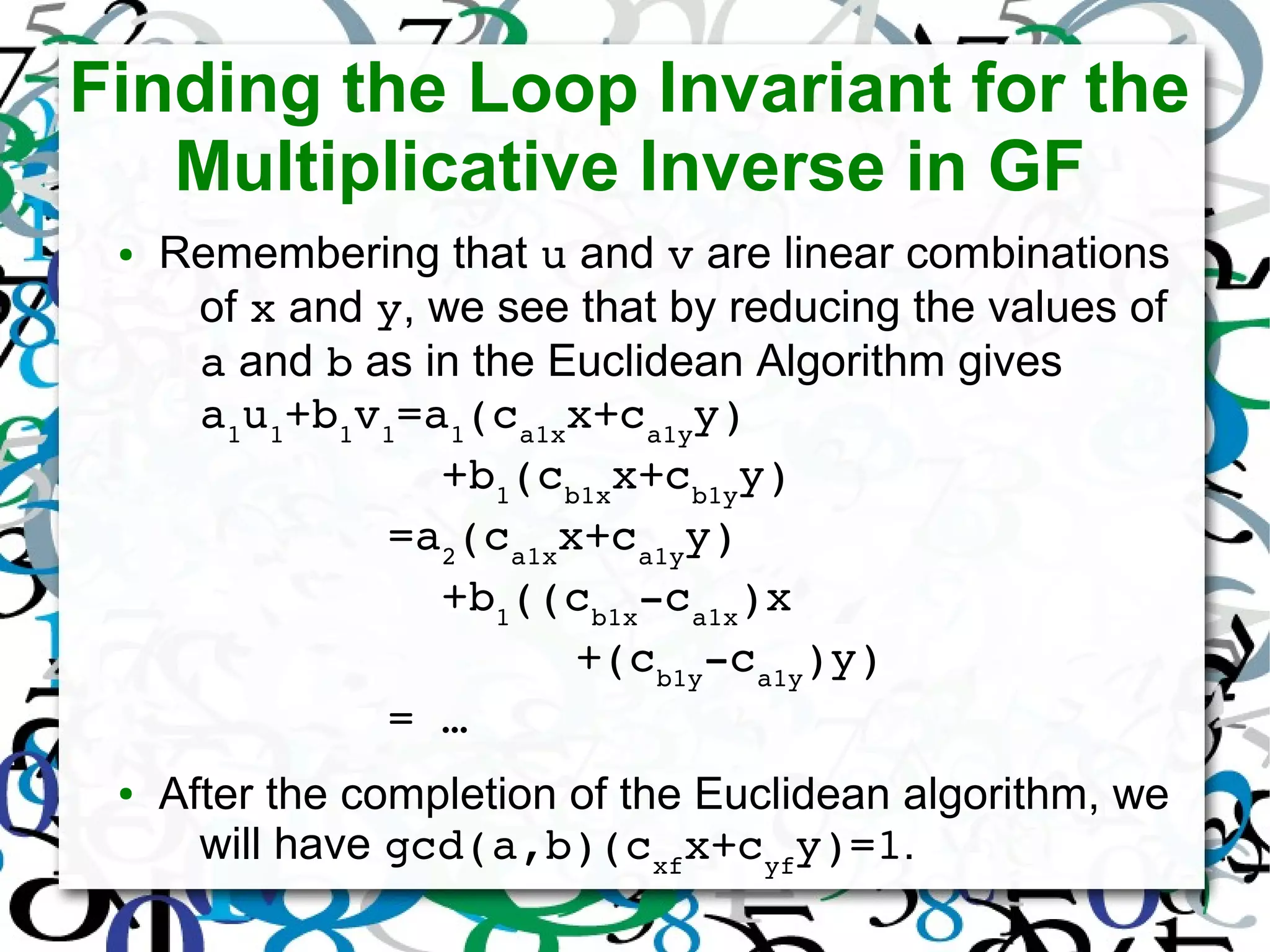
● Remembering that u and v are linear combinations
of x and y, we see that by reducing the values of
a and b as in the Euclidean Algorithm gives
a1
u1
+b1
v1
=a1
(ca1x
x+ca1y
y)
         +b1
(cb1x
x+cb1y
y)
       =a2
(ca1x
x+ca1y
y)
         +b1
((cb1x
­ca1x
)x
              +(cb1y
­ca1y
)y)
       = … 
● After the completion of the Euclidean algorithm, we
will have gcd(a,b)(cxf
x+cyf
y)=1.
Algorithm for the
Multiplicative Inverse in GF
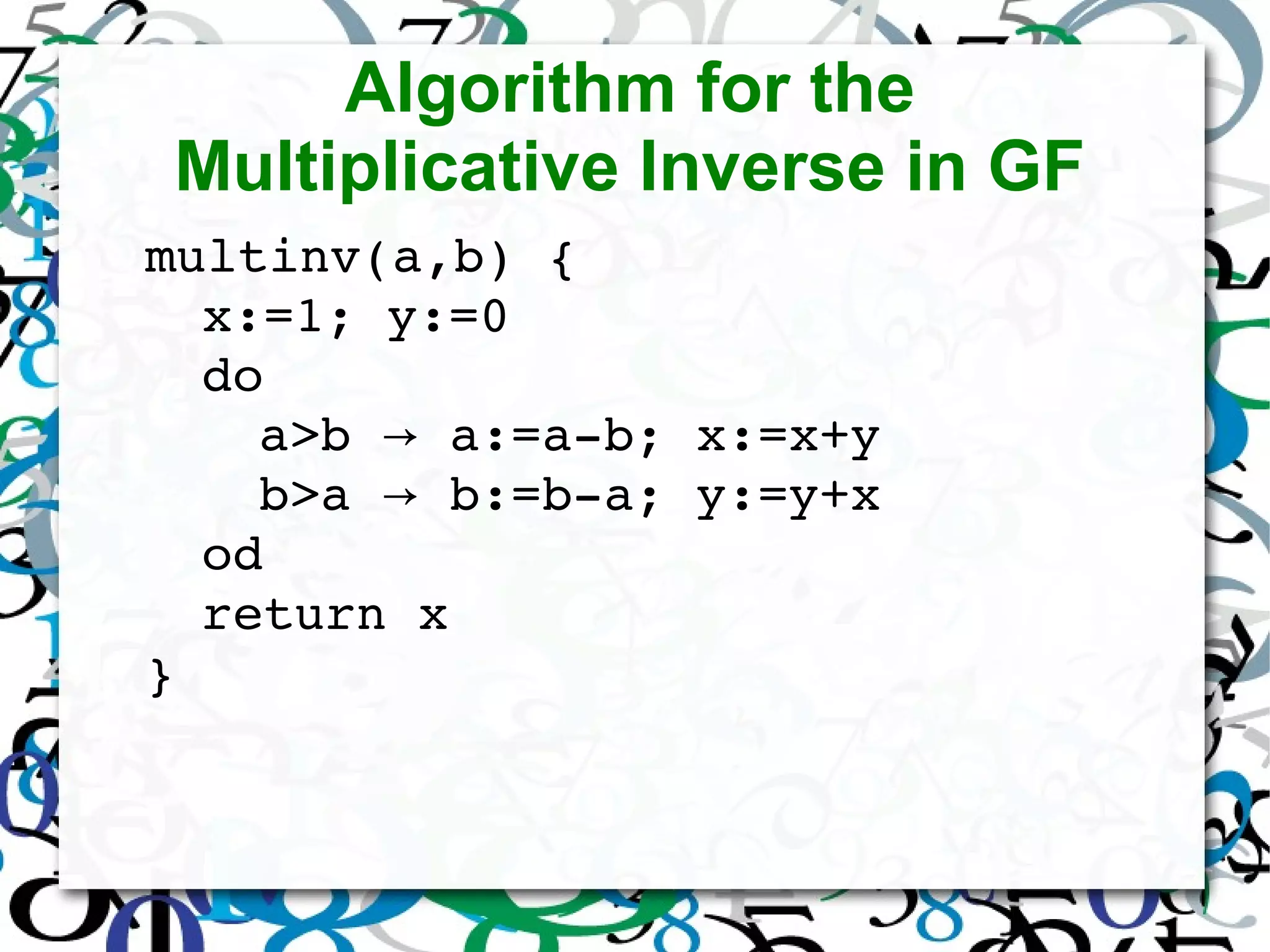
multinv(a,b) {
x:=1; y:=0
do
a>b   a:=a­b; x:=x+y→
b>a   b:=b­a; y:=y+x→
od
return x
}
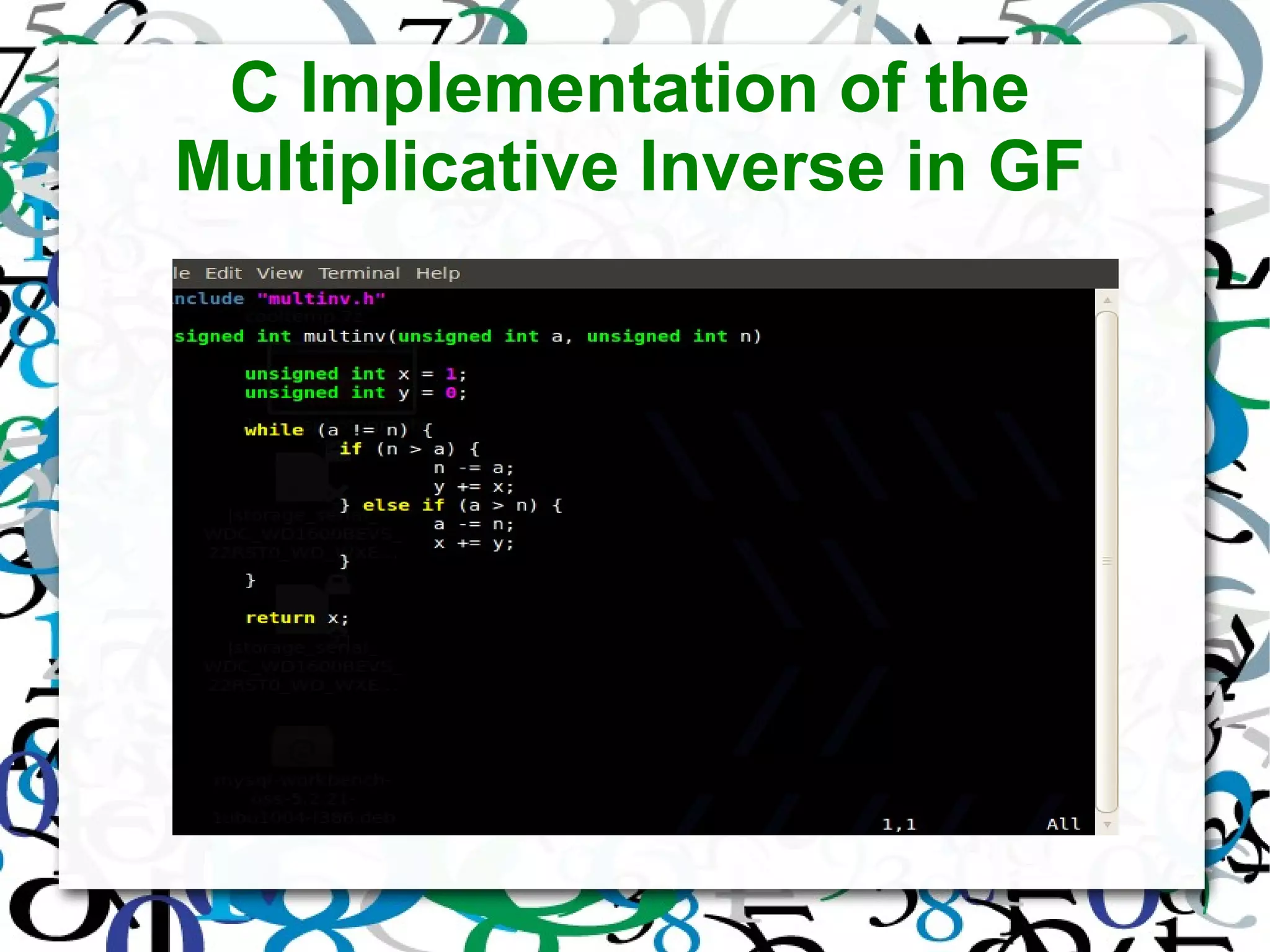
C Implementation of the
Multiplicative Inverse in GF
Conditions and Background
of the Matrix Product in GF
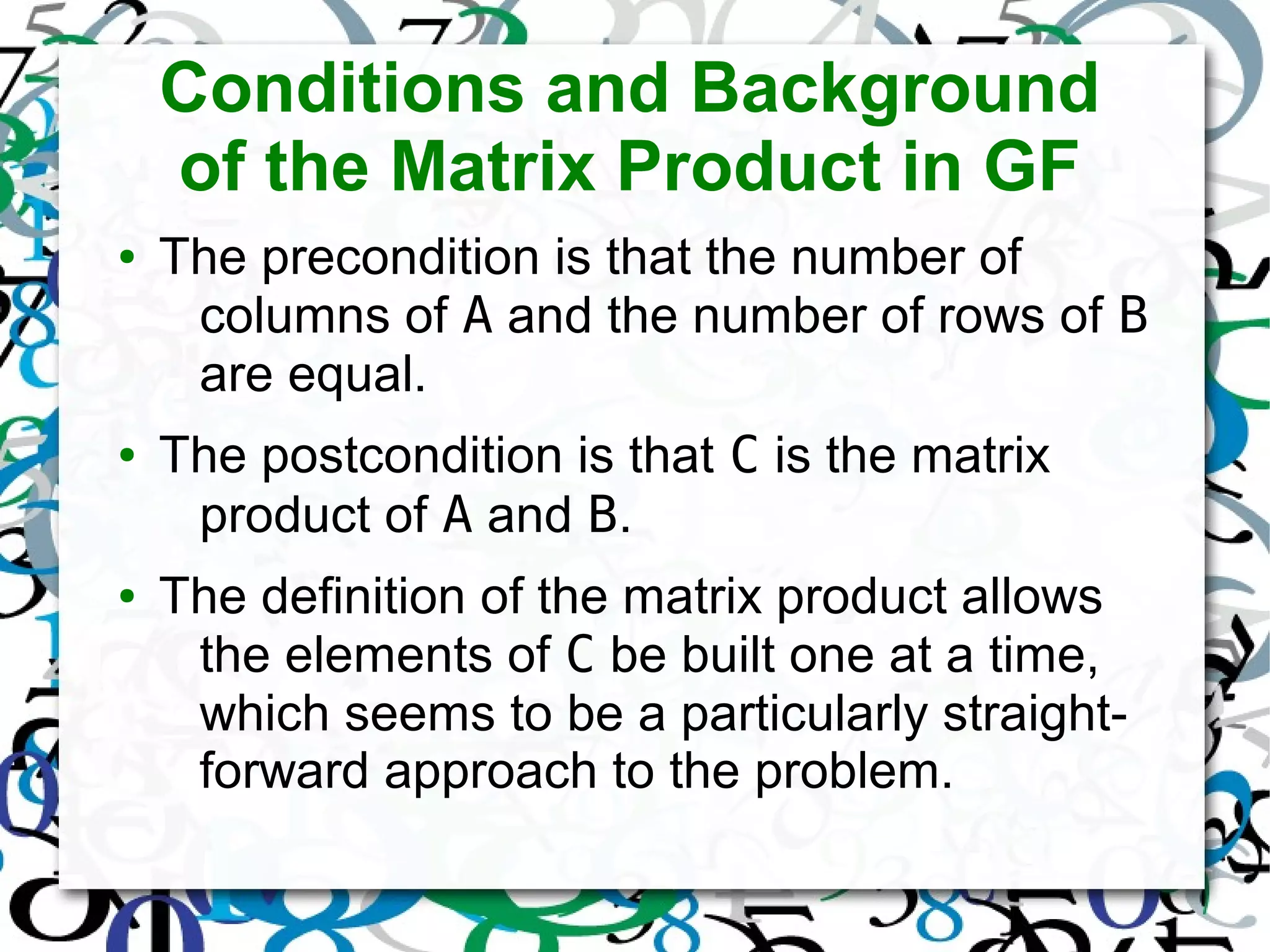
● The precondition is that the number of
columns of A and the number of rows of B
are equal.
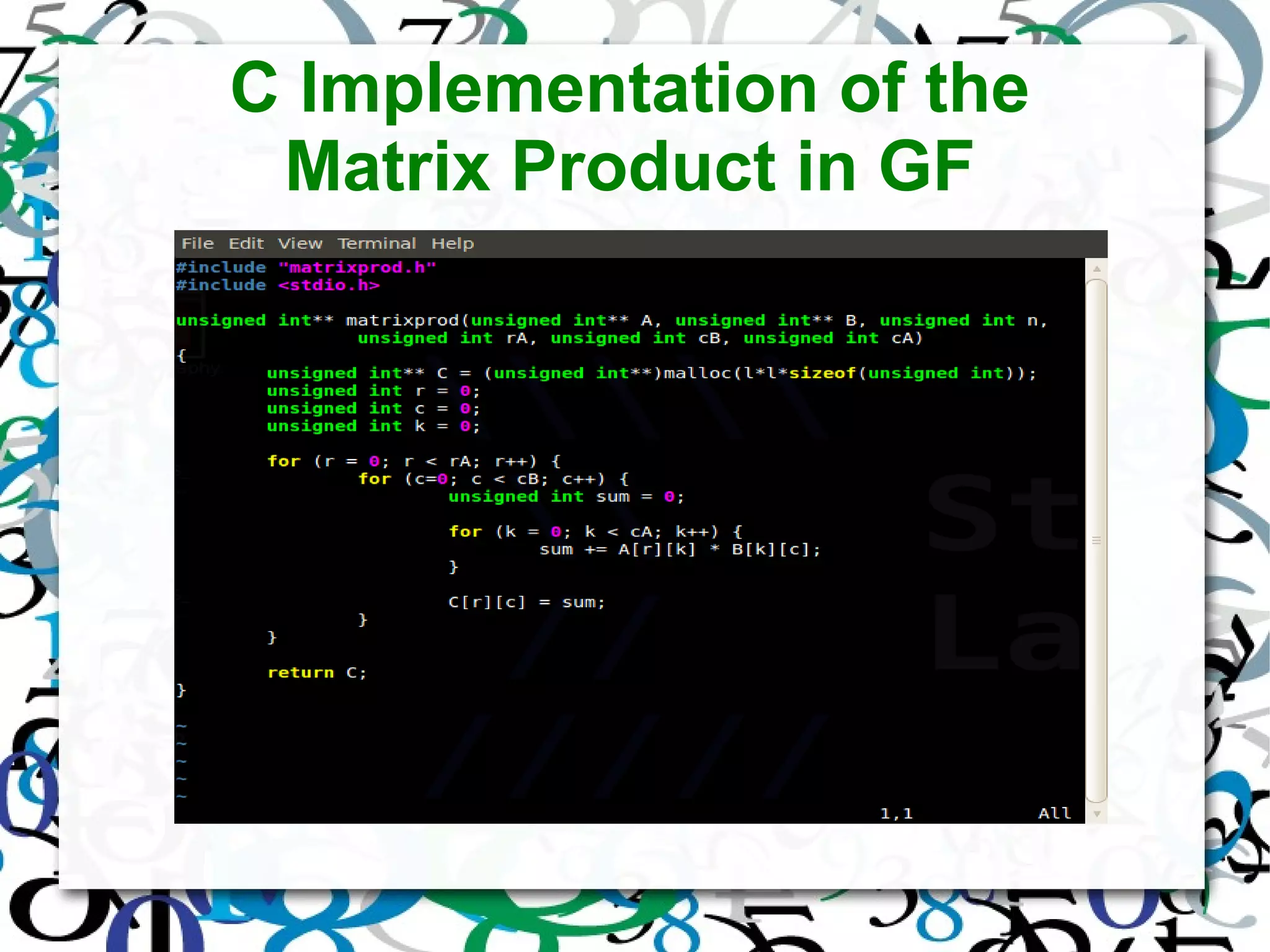
● The postcondition is that C is the matrix
product of A and B.
● The definition of the matrix product allows
the elements of C be built one at a time,
which seems to be a particularly straight-
forward approach to the problem.
Loop Invariant of the
Matrix Product in GF
● A good loop invariant would be that all elements of
C which either have a row index less than i or
else have a row index equal to i and have a
column index less than or equal to j have the
correct value.
● The loop clearly heads toward termination given
that C is filled from left to right, from top to
bottom (which will occur if the value of j is
increased modulo the number of columns after
every calculation, increasing i by 1 every time j
returns to 0).
C Implementation of the
Matrix Product in GF
Conditions and Background of
the Determinant of a Matrix in GF
● The precondition is that the number of rows
and the number of columns of A are equal.
● The postcondition is that d is the
determinant of A.
● The naive approach to the problem is not
very efficient, but it is much easier to
explain and produces cleaner code.
The Loop Invariant of the
Determinant of a Matrix in GF
● The loop invariant of the naive determinant
algorithm is that d is equal to the sum for
all k<j of the product of A1k
and the
determinant of the matrix formed by all the
elements of A except those in the first row
and kth column.
● The loop progresses toward termination so
long as the difference between the number
of columns and j decreases.
Conditions and Background of
the Cofactor Matrix in GF
● The precondition is that the number of rows
and the number of columns of A are equal.
● The postcondition is that C is the cofactor
matrix of A.
● Like the matrix product, the cofactor matrix
can readily be generated one element at a
time.
The Loop Invariant of the
Cofactor Matrix in GF
● The loop invariant of the cofactor matrix
algorithm is, like the matrix multiplication
algorithm, that for all entries in C whose
row is less than I or whose row is equal to I
and whose column is less than j.
Conditions and Background
of the Matrix Inverse in GF
● The precondition is that the number of rows
and the number of columns of A are equal,
and that the determinant of A be coprime
to the order of GF.
● The postcondition is that B is the matrix
inverse of A.
● Like the matrix product and the cofactor
matrix, the matrix inverse can readily be
generated one element at a time
Loop Invariant of the
Matrix Inverse in GF
● The loop invariant of the matrix inverse
algorithm is, like the matrix multiplication
algorithm, that for all entries in C whose
row is less than I or whose row is equal to I
and whose column is less than j.
Applications
● Matrices over GF have many applications
within Information Theory, including
Compression, Digital Signal Processing,
and Cryptography.
● The classic Hill cipher is a well-known
example of a use of matrix operations over
GF.
● Most modern block ciphers also use
matrices over GF, specifically the S-boxes
of ciphers like Rijndael (a.k.a. AES).

Program Derivation of Matrix Operations in GF

  • 1.
    Program Derivation of MatrixOperations in GF Charles Southerland Dr. Anita Walker East Central University
  • 2.
    The Galois Field ●A finite field is a finite set and two operators (analogous to addition and multiplication) over which certain properties hold. ● An important finding in Abstract Algebra is that all finite fields of the same order are isomorphic. ● A finite field is also called a Galois Field in honor of Evariste Galois, a significant French mathematician in the area of Abstract Algebra who died at age 20.
  • 3.
    History of ProgramDerivation ● Hoare's 1969 paper An Axiomatic Basis for Computer Programming essentially created the field of Formal Methods in CS. ● Dijkstra's paper Guarded Commands, Nondeterminacy and Formal Derivation of Programs introduced the idea of program derivation. ● Gries' book The Science of Programming brings Dijkstra's paper to a level undergrad CS and Math majors can understand.
  • 4.
    Guarded Command Language Thisis part of the language that Dijkstra defined: ● S1 ;S2 – Perform S1 , and then perform S2 . ● x:=e – Assign the value of e to the variable x. ● if[b1 S→ 1 ][b2 S→ 2 ]…fi – Execute exactly one of the guarded commands (i.e. S1 , S2 , … ) whose corresponding guard (i.e. b1 , b2 , … ) is true, if any. ● do[b1 S→ 1 ][b2 S→ 2 ]…od – Execute the command if[b1 S→ 1 ][b2 S→ 2 ]…fi until none of the guards are true.
  • 5.
    The Weakest Precondition PredicateTransformer wp ● Consider the mapping wp: P⨯L   → L where P is the set of all finite-length programs and L is the set of all logical statements about the state of a computer. ● For S∊P and R∊L, wp(S,R) yields the “weakest” Q∊L such that execution of S from within any state satisfying Q yields a state satisfying R. ● With regard to this definition, we say a statement A is “weaker” than a statement B if and only if the set of states satisfying B is a proper subset of the set of states satisfying A.
  • 6.
    Some Notable Propertiesof wp ● wp([S1 ;S2 ],R) = wp(S1 ,wp(S2 ,R)) ● wp([x:=e],R) = R, substituting e for x ● wp([if[b1 S→ 1 ][b2 S→ 2 ]…fi],R) = (b1 ∨b2 …∨ )   (∧ b1 wp(S→ 1 ,R))     (∧ b2 wp(S→ 2 ,R))   …∧ ● wp([do[b1 S→ 1 ][b2 S→ 2 ]…od],R) = (R ~b∧ 1 ~b∧ 2 …∧ )   wp([if[b∨ 1 S→ 1 ][b2 S→ 2 ]… fi],R)     wp([if…],wp([if…],R))∨     wp([if…],wp([if…],wp([if…],R)))∨     …∨ (for finitely many recursions)
  • 7.
    The Program DerivationProcess For precondition Q∊L and postcondition R∊L, find S∊P such that Q=wp(S,R). ● Gather as much information as possible about the precondition and postcondition. ● Reduce the problem to previously solved ones whenever possible. ● Look for a loop invariant that gives clues on how to implement the program. ● If you are stuck, consider alternative representations of the data.
  • 8.
    Conditions and Backgroundfor the Multiplicative Inverse in GF ● The precondition is that a and b be coprime natural numbers. ● The postcondition is that x be the multiplicative inverse of a modulo b. ● Since the greatest common divisor of a and b is 1, Bezout's Identity yields ax+by=1, where x is the multiplicative inverse of a. ● Recall that gcd(a,b)=gcd(a­b,b)=gcd(a,b­a).
  • 9.
    Analyzing Properties ofthe Multiplicative Inverse in GF ● Combining Bezout's Identity and the given property of gcd, we get ax+by = gcd(a,b)       = gcd(a,b­a)       = au+(b­a)v       = au+bv­av       = a(u­v)+bv ● Since ax differs from a(u­v) by a constant multiple of b, we get x (u­v) mod b≡ . ● Solving for u, we see u (x+v) mod b≡ , which leads us to wonder if u and v may be linear combinations of x and y.
  • 10.
    Towards a LoopInvariant for the Multiplicative Inverse in GF ● Rewriting Bezout's Identity using this, we get ax+by=a(1x+0y)+b(0x+1y)      =a((1x+0y)+y­y)+b(0x+1y)      =a(x+y­y)+by      =a(x+y)­ay+by      =a(x+y)+(b­a)y      =au+(b­a)y (so we deduce that v=y) ● Note that assigning c:=b­a and z:=x+y would yield ax+by=az+cy.
  • 11.
    Finding the LoopInvariant for the Multiplicative Inverse in GF ● Remembering that u and v are linear combinations of x and y, we see that by reducing the values of a and b as in the Euclidean Algorithm gives a1 u1 +b1 v1 =a1 (ca1x x+ca1y y)          +b1 (cb1x x+cb1y y)        =a2 (ca1x x+ca1y y)          +b1 ((cb1x ­ca1x )x               +(cb1y ­ca1y )y)        = …  ● After the completion of the Euclidean algorithm, we will have gcd(a,b)(cxf x+cyf y)=1.
  • 12.
    Algorithm for the MultiplicativeInverse in GF multinv(a,b) { x:=1; y:=0 do a>b   a:=a­b; x:=x+y→ b>a   b:=b­a; y:=y+x→ od return x }
  • 13.
    C Implementation ofthe Multiplicative Inverse in GF
  • 14.
    Conditions and Background ofthe Matrix Product in GF ● The precondition is that the number of columns of A and the number of rows of B are equal. ● The postcondition is that C is the matrix product of A and B. ● The definition of the matrix product allows the elements of C be built one at a time, which seems to be a particularly straight- forward approach to the problem.
  • 15.
    Loop Invariant ofthe Matrix Product in GF ● A good loop invariant would be that all elements of C which either have a row index less than i or else have a row index equal to i and have a column index less than or equal to j have the correct value. ● The loop clearly heads toward termination given that C is filled from left to right, from top to bottom (which will occur if the value of j is increased modulo the number of columns after every calculation, increasing i by 1 every time j returns to 0).
  • 16.
    C Implementation ofthe Matrix Product in GF
  • 17.
    Conditions and Backgroundof the Determinant of a Matrix in GF ● The precondition is that the number of rows and the number of columns of A are equal. ● The postcondition is that d is the determinant of A. ● The naive approach to the problem is not very efficient, but it is much easier to explain and produces cleaner code.
  • 18.
    The Loop Invariantof the Determinant of a Matrix in GF ● The loop invariant of the naive determinant algorithm is that d is equal to the sum for all k<j of the product of A1k and the determinant of the matrix formed by all the elements of A except those in the first row and kth column. ● The loop progresses toward termination so long as the difference between the number of columns and j decreases.
  • 19.
    Conditions and Backgroundof the Cofactor Matrix in GF ● The precondition is that the number of rows and the number of columns of A are equal. ● The postcondition is that C is the cofactor matrix of A. ● Like the matrix product, the cofactor matrix can readily be generated one element at a time.
  • 20.
    The Loop Invariantof the Cofactor Matrix in GF ● The loop invariant of the cofactor matrix algorithm is, like the matrix multiplication algorithm, that for all entries in C whose row is less than I or whose row is equal to I and whose column is less than j.
  • 21.
    Conditions and Background ofthe Matrix Inverse in GF ● The precondition is that the number of rows and the number of columns of A are equal, and that the determinant of A be coprime to the order of GF. ● The postcondition is that B is the matrix inverse of A. ● Like the matrix product and the cofactor matrix, the matrix inverse can readily be generated one element at a time
  • 22.
    Loop Invariant ofthe Matrix Inverse in GF ● The loop invariant of the matrix inverse algorithm is, like the matrix multiplication algorithm, that for all entries in C whose row is less than I or whose row is equal to I and whose column is less than j.
  • 23.
    Applications ● Matrices overGF have many applications within Information Theory, including Compression, Digital Signal Processing, and Cryptography. ● The classic Hill cipher is a well-known example of a use of matrix operations over GF. ● Most modern block ciphers also use matrices over GF, specifically the S-boxes of ciphers like Rijndael (a.k.a. AES).