Spring 2011 ECE 331 - Digital System Design 2
Combinational vs. Sequential
● Combinational Logic Circuit
– Output is a function only of the present inputs.
– Does not have state information.
– Does not require memory.
● Sequential Logic Circuit (aka. Finite State Machine)
– Output is a function of the present state.
– Has state information
– Requires memory.
– Uses Flip-Flops to implement memory.
Spring 2011 ECE 331 - Digital System Design 3
Synchronous vs. Asynchronous
● Synchronous Sequential Logic Circuit
– Clocked
– All Flip-Flops use the same clock and change
state on the same triggering edge.
● Asynchronous Sequential Logic Circuit
– No clock
– Can change state at any instance in time.
– Faster but more complex than synchronous
sequential circuits.
Spring 2011 ECE 331 - Digital System Design 4
Sequential Circuits: General Model
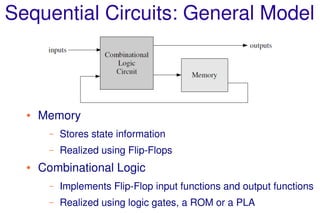
● Memory
– Stores state information
– Realized using Flip-Flops
● Combinational Logic
– Implements Flip-Flop input functions and output functions
– Realized using logic gates, a ROM or a PLA
Spring 2011 ECE 331 - Digital System Design 5
Sequential Circuits: Models
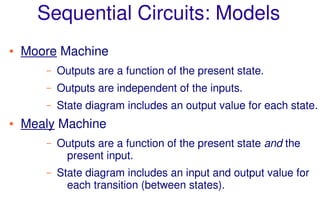
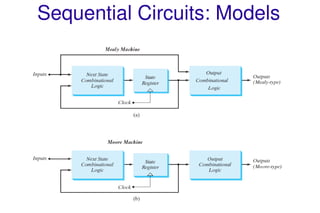
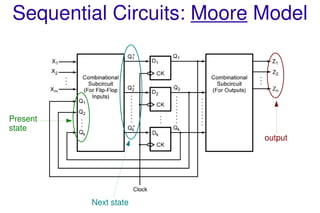
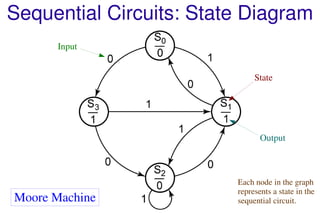
● Moore Machine
– Outputs are a function of the present state.
– Outputs are independent of the inputs.
– State diagram includes an output value for each state.
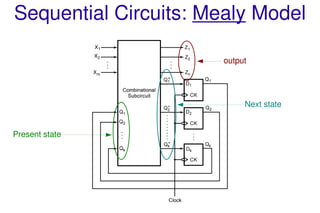
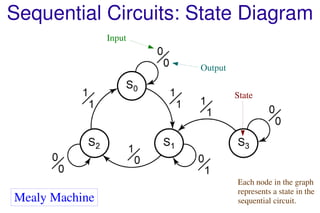
● Mealy Machine
– Outputs are a function of the present state and the
present input.
– State diagram includes an input and output value for
each transition (between states).
Spring 2011 ECE 331 - Digital System Design 6
Sequential Circuits: Models
Spring 2011 ECE 331 - Digital System Design 7
Sequential Circuits: Mealy Model
output
Present state
Next state
Spring 2011 ECE 331 - Digital System Design 8
Sequential Circuits: Moore Model
Present
state
output
Next state
Spring 2011 ECE 331 - Digital System Design 9
Sequential Circuits: State Diagram
State
Output
Input
Moore Machine
Each node in the graph
represents a state in the
sequential circuit.
Spring 2011 ECE 331 - Digital System Design 10
Sequential Circuits: State Diagram
Mealy Machine
Each node in the graph
represents a state in the
sequential circuit.
Input
State
Output
Spring 2011 ECE 331 - Digital System Design 11
Sequential Circuit Analysis
Spring 2011 ECE 331 - Digital System Design 12
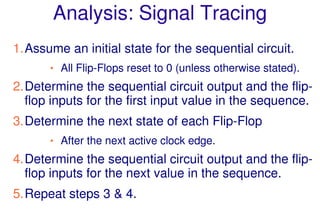
Analysis: Signal Tracing
1.Assume an initial state for the sequential circuit.
 All Flip-Flops reset to 0 (unless otherwise stated).
2.Determine the sequential circuit output and the flip-
flop inputs for the first input value in the sequence.
3.Determine the next state of each Flip-Flop
 After the next active clock edge.
4.Determine the sequential circuit output and the flip-
flop inputs for the next value in the sequence.
5.Repeat steps 3 & 4.
Spring 2011 ECE 331 - Digital System Design 13
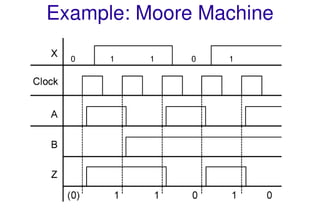
Example: Moore Machine
input
Flip-Flop inputs
output
State = AB
Spring 2011 ECE 331 - Digital System Design 14
Example: Moore Machine
0 1 1 0 1
Spring 2011 ECE 331 - Digital System Design 15
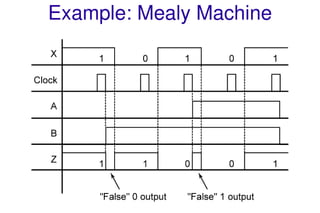
Example: Mealy Machine
Spring 2011 ECE 331 - Digital System Design 16
Example: Mealy Machine
Spring 2011 ECE 331 - Digital System Design 17
Analysis: State Tables and Graphs
Although constructing timing charts is satisfactory for small
circuits and short input sequences, the construction of state
tables and graphs provides a more systematic approach
which is useful for the analysis of larger circuits and which
leads to a general synthesis procedure for sequential
circuits.
The state table specifies the next state and output of a
sequential circuit in terms of its present state and input.
Spring 2011 ECE 331 - Digital System Design 18
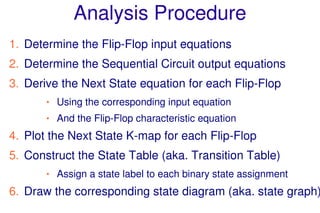
Analysis Procedure
1. Determine the Flip-Flop input equations
2. Determine the Sequential Circuit output equations
3. Derive the Next State equation for each Flip-Flop
 Using the corresponding input equation
 And the Flip-Flop characteristic equation
4. Plot the Next State K-map for each Flip-Flop
5. Construct the State Table (aka. Transition Table)
 Assign a state label to each binary state assignment
6. Draw the corresponding state diagram (aka. state graph)
Spring 2011 ECE 331 - Digital System Design 19
Example:
Analyze a sequential circuit using D Flip-Flops
Spring 2011 ECE 331 - Digital System Design 20
Example: Analysis (D FF)
Derive the State Table for the following Sequential Logic Circuit:
Spring 2011 ECE 331 - Digital System Design 21
Example: Analysis (D FF)
The flip-flop input equations are:
DA = X xor B' DB = X or A
Z = A xor B
The next-state equations for the flip-flops are:
A+
= DA = X xor B' B+
= DB = X or A
The sequential circuit output equation is:
Spring 2011 ECE 331 - Digital System Design 22
Example: Analysis (D FF)
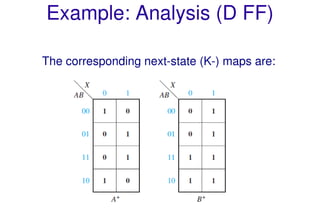
The corresponding next-state (K-) maps are:
Spring 2011 ECE 331 - Digital System Design 23
Example: Analysis (D FF)
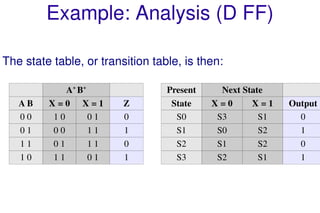
The state table, or transition table, is then:
A+
B+
A B X = 0 X = 1 Z
0 0 1 0 0 1 0
0 1 0 0 1 1 1
1 1 0 1 1 1 0
1 0 1 1 0 1 1
Present Next State
State X = 0 X = 1 Output
S0 S3 S1 0
S1 S0 S2 1
S2 S1 S2 0
S3 S2 S1 1
Spring 2011 ECE 331 - Digital System Design 24
Example: Analysis (D FF)
The state diagram can then be drawn from the state table:
Spring 2011 ECE 331 - Digital System Design 25
Example:
Analyze a sequential circuit using JK Flip-Flops
Spring 2011 ECE 331 - Digital System Design 26
Example: Analysis (JK FF)
Derive the State Table for the following Sequential Logic Circuit:
Spring 2011 ECE 331 - Digital System Design 27
Example: Analysis (JK FF)
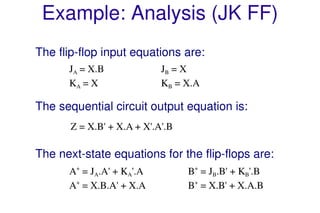
The flip-flop input equations are:
The next-state equations for the flip-flops are:
The sequential circuit output equation is:
JA = X.B JB = X
KA = X KB = X.A
Z = X.B' + X.A + X'.A'.B
A+
= JA.A' + KA'.A B+
= JB.B' + KB'.B
A+
= X.B.A' + X.A B+
= X.B' + X.A.B
Spring 2011 ECE 331 - Digital System Design 28
Example: Analysis (JK FF)
The corresponding next-state (K-) maps are
Spring 2011 ECE 331 - Digital System Design 29
Example: Analysis (JK FF)
The state table, and transition table, is then:
Spring 2011 ECE 331 - Digital System Design 30
Example: Analysis (JK FF)
The state diagram can then be drawn from the state table:
Spring 2011 ECE 331 - Digital System Design 31
Example:
Analyze a serial adder
Spring 2011 ECE 331 - Digital System Design 32
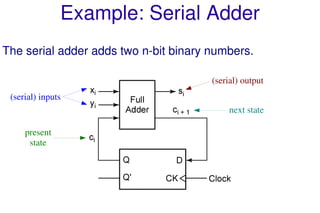
Example: Serial Adder
The serial adder adds two n-bit binary numbers.
(serial) inputs
(serial) output
present
state
next state
Spring 2011 ECE 331 - Digital System Design 33
Example: Serial Adder
Truth Table for the Full Adder:
Spring 2011 ECE 331 - Digital System Design 34
Example: Serial Adder
The state table, or transition table, is then:
Ci+1 Sum
Ci XY = 00 XY = 01 XY = 10 XY = 11 XY = 00 XY = 01 XY = 10 XY = 11
0 0 0 0 1 0 1 1 0
1 0 1 1 1 1 0 0 1
Present Next State Output
State XY = 00 XY = 01 XY = 10 XY = 11 XY = 00 XY = 01 XY = 10 XY = 11
S0 S0 S0 S0 S1 0 1 1 0
S1 S0 S1 S1 S1 1 0 0 1
Spring 2011 ECE 331 - Digital System Design 35
Example: Serial Adder
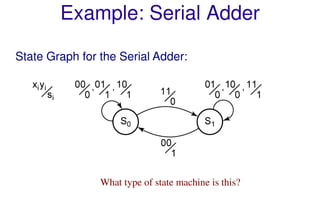
State Graph for the Serial Adder:
What type of state machine is this?
Spring 2011 ECE 331 - Digital System Design 36
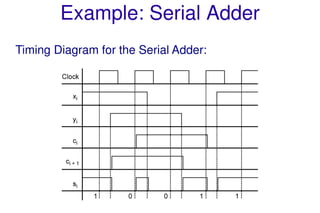
Example: Serial Adder
Timing Diagram for the Serial Adder:
Spring 2011 ECE 331 - Digital System Design 37
Example:
Analyze a state machine with multiple inputs.
Spring 2011 ECE 331 - Digital System Design 38
Example: Multiple Inputs
State Table for a state machine with multiple inputs:
Spring 2011 ECE 331 - Digital System Design 39
Example: Multiple Inputs
State Graph for a state machine with multiple inputs:
How many paths
leave each state?
What type of state
machine is this?
Spring 2011 ECE 331 - Digital System Design 40
Questions?

Analysis sequential circuits

  • 1.
    Spring 2011 ECE331 - Digital System Design 2 Combinational vs. Sequential ● Combinational Logic Circuit – Output is a function only of the present inputs. – Does not have state information. – Does not require memory. ● Sequential Logic Circuit (aka. Finite State Machine) – Output is a function of the present state. – Has state information – Requires memory. – Uses Flip-Flops to implement memory.
  • 2.
    Spring 2011 ECE331 - Digital System Design 3 Synchronous vs. Asynchronous ● Synchronous Sequential Logic Circuit – Clocked – All Flip-Flops use the same clock and change state on the same triggering edge. ● Asynchronous Sequential Logic Circuit – No clock – Can change state at any instance in time. – Faster but more complex than synchronous sequential circuits.
  • 3.
    Spring 2011 ECE331 - Digital System Design 4 Sequential Circuits: General Model ● Memory – Stores state information – Realized using Flip-Flops ● Combinational Logic – Implements Flip-Flop input functions and output functions – Realized using logic gates, a ROM or a PLA
  • 4.
    Spring 2011 ECE331 - Digital System Design 5 Sequential Circuits: Models ● Moore Machine – Outputs are a function of the present state. – Outputs are independent of the inputs. – State diagram includes an output value for each state. ● Mealy Machine – Outputs are a function of the present state and the present input. – State diagram includes an input and output value for each transition (between states).
  • 5.
    Spring 2011 ECE331 - Digital System Design 6 Sequential Circuits: Models
  • 6.
    Spring 2011 ECE331 - Digital System Design 7 Sequential Circuits: Mealy Model output Present state Next state
  • 7.
    Spring 2011 ECE331 - Digital System Design 8 Sequential Circuits: Moore Model Present state output Next state
  • 8.
    Spring 2011 ECE331 - Digital System Design 9 Sequential Circuits: State Diagram State Output Input Moore Machine Each node in the graph represents a state in the sequential circuit.
  • 9.
    Spring 2011 ECE331 - Digital System Design 10 Sequential Circuits: State Diagram Mealy Machine Each node in the graph represents a state in the sequential circuit. Input State Output
  • 10.
    Spring 2011 ECE331 - Digital System Design 11 Sequential Circuit Analysis
  • 11.
    Spring 2011 ECE331 - Digital System Design 12 Analysis: Signal Tracing 1.Assume an initial state for the sequential circuit.  All Flip-Flops reset to 0 (unless otherwise stated). 2.Determine the sequential circuit output and the flip- flop inputs for the first input value in the sequence. 3.Determine the next state of each Flip-Flop  After the next active clock edge. 4.Determine the sequential circuit output and the flip- flop inputs for the next value in the sequence. 5.Repeat steps 3 & 4.
  • 12.
    Spring 2011 ECE331 - Digital System Design 13 Example: Moore Machine input Flip-Flop inputs output State = AB
  • 13.
    Spring 2011 ECE331 - Digital System Design 14 Example: Moore Machine 0 1 1 0 1
  • 14.
    Spring 2011 ECE331 - Digital System Design 15 Example: Mealy Machine
  • 15.
    Spring 2011 ECE331 - Digital System Design 16 Example: Mealy Machine
  • 16.
    Spring 2011 ECE331 - Digital System Design 17 Analysis: State Tables and Graphs Although constructing timing charts is satisfactory for small circuits and short input sequences, the construction of state tables and graphs provides a more systematic approach which is useful for the analysis of larger circuits and which leads to a general synthesis procedure for sequential circuits. The state table specifies the next state and output of a sequential circuit in terms of its present state and input.
  • 17.
    Spring 2011 ECE331 - Digital System Design 18 Analysis Procedure 1. Determine the Flip-Flop input equations 2. Determine the Sequential Circuit output equations 3. Derive the Next State equation for each Flip-Flop  Using the corresponding input equation  And the Flip-Flop characteristic equation 4. Plot the Next State K-map for each Flip-Flop 5. Construct the State Table (aka. Transition Table)  Assign a state label to each binary state assignment 6. Draw the corresponding state diagram (aka. state graph)
  • 18.
    Spring 2011 ECE331 - Digital System Design 19 Example: Analyze a sequential circuit using D Flip-Flops
  • 19.
    Spring 2011 ECE331 - Digital System Design 20 Example: Analysis (D FF) Derive the State Table for the following Sequential Logic Circuit:
  • 20.
    Spring 2011 ECE331 - Digital System Design 21 Example: Analysis (D FF) The flip-flop input equations are: DA = X xor B' DB = X or A Z = A xor B The next-state equations for the flip-flops are: A+ = DA = X xor B' B+ = DB = X or A The sequential circuit output equation is:
  • 21.
    Spring 2011 ECE331 - Digital System Design 22 Example: Analysis (D FF) The corresponding next-state (K-) maps are:
  • 22.
    Spring 2011 ECE331 - Digital System Design 23 Example: Analysis (D FF) The state table, or transition table, is then: A+ B+ A B X = 0 X = 1 Z 0 0 1 0 0 1 0 0 1 0 0 1 1 1 1 1 0 1 1 1 0 1 0 1 1 0 1 1 Present Next State State X = 0 X = 1 Output S0 S3 S1 0 S1 S0 S2 1 S2 S1 S2 0 S3 S2 S1 1
  • 23.
    Spring 2011 ECE331 - Digital System Design 24 Example: Analysis (D FF) The state diagram can then be drawn from the state table:
  • 24.
    Spring 2011 ECE331 - Digital System Design 25 Example: Analyze a sequential circuit using JK Flip-Flops
  • 25.
    Spring 2011 ECE331 - Digital System Design 26 Example: Analysis (JK FF) Derive the State Table for the following Sequential Logic Circuit:
  • 26.
    Spring 2011 ECE331 - Digital System Design 27 Example: Analysis (JK FF) The flip-flop input equations are: The next-state equations for the flip-flops are: The sequential circuit output equation is: JA = X.B JB = X KA = X KB = X.A Z = X.B' + X.A + X'.A'.B A+ = JA.A' + KA'.A B+ = JB.B' + KB'.B A+ = X.B.A' + X.A B+ = X.B' + X.A.B
  • 27.
    Spring 2011 ECE331 - Digital System Design 28 Example: Analysis (JK FF) The corresponding next-state (K-) maps are
  • 28.
    Spring 2011 ECE331 - Digital System Design 29 Example: Analysis (JK FF) The state table, and transition table, is then:
  • 29.
    Spring 2011 ECE331 - Digital System Design 30 Example: Analysis (JK FF) The state diagram can then be drawn from the state table:
  • 30.
    Spring 2011 ECE331 - Digital System Design 31 Example: Analyze a serial adder
  • 31.
    Spring 2011 ECE331 - Digital System Design 32 Example: Serial Adder The serial adder adds two n-bit binary numbers. (serial) inputs (serial) output present state next state
  • 32.
    Spring 2011 ECE331 - Digital System Design 33 Example: Serial Adder Truth Table for the Full Adder:
  • 33.
    Spring 2011 ECE331 - Digital System Design 34 Example: Serial Adder The state table, or transition table, is then: Ci+1 Sum Ci XY = 00 XY = 01 XY = 10 XY = 11 XY = 00 XY = 01 XY = 10 XY = 11 0 0 0 0 1 0 1 1 0 1 0 1 1 1 1 0 0 1 Present Next State Output State XY = 00 XY = 01 XY = 10 XY = 11 XY = 00 XY = 01 XY = 10 XY = 11 S0 S0 S0 S0 S1 0 1 1 0 S1 S0 S1 S1 S1 1 0 0 1
  • 34.
    Spring 2011 ECE331 - Digital System Design 35 Example: Serial Adder State Graph for the Serial Adder: What type of state machine is this?
  • 35.
    Spring 2011 ECE331 - Digital System Design 36 Example: Serial Adder Timing Diagram for the Serial Adder:
  • 36.
    Spring 2011 ECE331 - Digital System Design 37 Example: Analyze a state machine with multiple inputs.
  • 37.
    Spring 2011 ECE331 - Digital System Design 38 Example: Multiple Inputs State Table for a state machine with multiple inputs:
  • 38.
    Spring 2011 ECE331 - Digital System Design 39 Example: Multiple Inputs State Graph for a state machine with multiple inputs: How many paths leave each state? What type of state machine is this?
  • 39.
    Spring 2011 ECE331 - Digital System Design 40 Questions?