CONSTRUCTIVISM IN
THEORY AND IN
PRACTICE
GROUP: TRẦN THỊ HUYỀN TRANG
NGUYỄN CHÂU MINH THƯ
What is constructivism?
- A theory of learning which posits that
students learn by actively constructing their
own knowledge(Von Glasersfeld 1996; Fosnot
1996; Duffy and Cunning-Ham 1996).
- Including 2 approaches:
+ cognitive constructivism (Piaget)
+social constructivism (Vygotsky)
Cognitive constructivism
• Concentrate on the importance of the mind in
learning.
• Piaget: the terms accommodation and
assimilation to describe the interplay of mind
and environment in the learning process
(Gleitmean 1987)
Social constructivism
• Vygotsky: the social, interpersonal aspects of
learning precede the individual, intrapersonal
aspects(Corfrey 1995)
=> The debate continues
Because:
+ not understand how individuals think without
an appreciation of the cultural context in which
their thoughts developed.
+ cognition and cultural influences are
inextricably entwined.
Principles and suggestion(wood,1995)
- Learning environment support the learner’s
contraction of knowledge
- Activities should be allowed for communicating
and exchanging ideas
- Motivation
- Teacher create a learning environment
- Reflection
- Authentic learner authorship and ownership
- Classroom interaction
EFL issues
Constructivist approach helps:
• Give sts choices and provide language
practice.
• Encourage sts to experiment freely with the
language.
• Constructivism in the class room.
Making room for constructivism in
curriculum
2 approaches:
• Construction
• instruction
DEALING WITH FACTUAL INFORMATION
Instructivist classroom
• The reading material is usually
chosen by the teacher
• Questions to accompany the text
are pre-pared by the teacher.
• Main emphasis is on the correct
answer(product orientation).
• Assessment is usually
straightforward and quick, since it
only requires comparison against
an answer key.
Constructivist classroom
• Several reading sources or choices are
given. students choose what to read.
• Generic questions that can fit a variety
of texts are provided for students to
apply to their specific texts.
• Student-initiated questions are
encouraged
• Main emphasis in on the strategies
employed to obtain the answer(
process orientation)
• Assessment requires familiarization
with multiple texts(chosen by the
students) and assessment of a variety
of responses, and is therefore time-
consuming
Flexibility and internet
• Cognitive flexibility
• Task flexibility
• Curricular flexibility
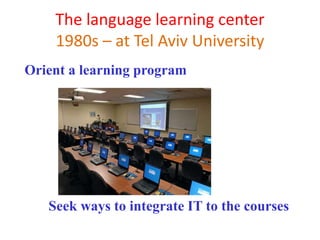
The language learning center
1980s – at Tel Aviv University
Orient a learning program
Seek ways to integrate IT to the courses
The attitudes of EFL Colleagues
Difficult & Frustrating
INTEGRATION
TECHNOLOGY
PHILOSOPHY
ASSIMILATION TAKE TIME
Teacher-training
sessions
DOC-based
program
Use the
Internet
INSTRUCTIVIST
PARADIGM
Cognitive
aspects
satisfied
Methodology
conduct
the next
workshop
conduct
constructivist
classroom session
Learning
environment
Group
discussion
Understanding
Constructivist
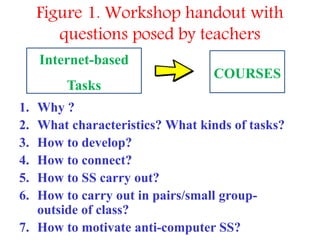
Figure 1. Workshop handout with
questions posed by teachers
1. Why ?
2. What characteristics? What kinds of tasks?
3. How to develop?
4. How to connect?
5. How to SS carry out?
6. How to carry out in pairs/small group-
outside of class?
7. How to motivate anti-computer SS?
Internet-based
Tasks
COURSES
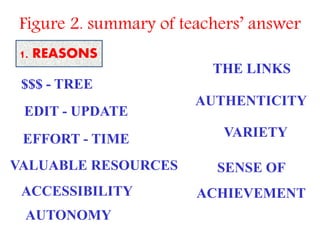
Figure 2. summary of teachers’ answer
1. REASONS
$$$ - TREE
EDIT - UPDATE
EFFORT - TIME
VALUABLE RESOURCES
ACCESSIBILITY
AUTONOMY
AUTHENTICITY
THE LINKS
SENSE OF
ACHIEVEMENT
VARIETY
2. UNIQUE CHARACTERISTICS
COMPARISON - SYNTHESIS
RELIABILITY
& BIAS
WIDE RANGE
INTERACTIONS
SYNCHRONOUSNESS
FLEXIBILITY
PROCESS
VISUALS -
GRAPHICSS
INCORPORATION
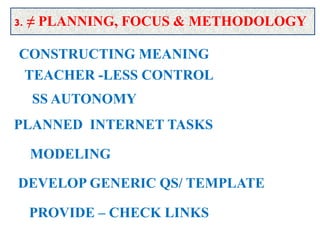
3. ≠ PLANNING, FOCUS & METHODOLOGY
CONSTRUCTING MEANING
TEACHER -LESS CONTROL
SS AUTONOMY
PLANNED INTERNET TASKS
MODELING
DEVELOP GENERIC QS/ TEMPLATE
PROVIDE – CHECK LINKS
4. RELATING/ CONNECTING
EXAMPLES - ILLUSTRATIONS
EXPAND TOPICS, UPDATE MATERIAL,
INTRODUCE VARIOUS MEDIA
5. MANAGEMENT
ORAL PRESENTATION/ WRITTEN REPORT
PAPER/ ONLINE, HOW TO TOGGLE
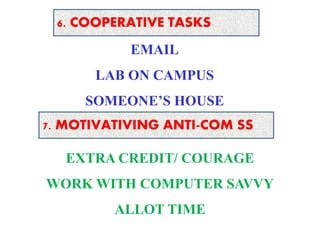
6. COOPERATIVE TASKS
7. MOTIVATIVING ANTI-COM SS
EMAIL
LAB ON CAMPUS
SOMEONE’S HOUSE
EXTRA CREDIT/ COURAGE
WORK WITH COMPUTER SAVVY
ALLOT TIME
Constructivism in theory and practice

Constructivism in theory and practice

  • 1.
    CONSTRUCTIVISM IN THEORY ANDIN PRACTICE GROUP: TRẦN THỊ HUYỀN TRANG NGUYỄN CHÂU MINH THƯ
  • 2.
    What is constructivism? -A theory of learning which posits that students learn by actively constructing their own knowledge(Von Glasersfeld 1996; Fosnot 1996; Duffy and Cunning-Ham 1996). - Including 2 approaches: + cognitive constructivism (Piaget) +social constructivism (Vygotsky)
  • 3.
    Cognitive constructivism • Concentrateon the importance of the mind in learning. • Piaget: the terms accommodation and assimilation to describe the interplay of mind and environment in the learning process (Gleitmean 1987)
  • 4.
    Social constructivism • Vygotsky:the social, interpersonal aspects of learning precede the individual, intrapersonal aspects(Corfrey 1995) => The debate continues
  • 5.
    Because: + not understandhow individuals think without an appreciation of the cultural context in which their thoughts developed. + cognition and cultural influences are inextricably entwined.
  • 6.
    Principles and suggestion(wood,1995) -Learning environment support the learner’s contraction of knowledge - Activities should be allowed for communicating and exchanging ideas - Motivation - Teacher create a learning environment - Reflection - Authentic learner authorship and ownership - Classroom interaction
  • 7.
    EFL issues Constructivist approachhelps: • Give sts choices and provide language practice. • Encourage sts to experiment freely with the language. • Constructivism in the class room.
  • 8.
    Making room forconstructivism in curriculum 2 approaches: • Construction • instruction
  • 9.
    DEALING WITH FACTUALINFORMATION Instructivist classroom • The reading material is usually chosen by the teacher • Questions to accompany the text are pre-pared by the teacher. • Main emphasis is on the correct answer(product orientation). • Assessment is usually straightforward and quick, since it only requires comparison against an answer key. Constructivist classroom • Several reading sources or choices are given. students choose what to read. • Generic questions that can fit a variety of texts are provided for students to apply to their specific texts. • Student-initiated questions are encouraged • Main emphasis in on the strategies employed to obtain the answer( process orientation) • Assessment requires familiarization with multiple texts(chosen by the students) and assessment of a variety of responses, and is therefore time- consuming
  • 10.
    Flexibility and internet •Cognitive flexibility • Task flexibility • Curricular flexibility
  • 12.
    The language learningcenter 1980s – at Tel Aviv University Orient a learning program Seek ways to integrate IT to the courses
  • 13.
    The attitudes ofEFL Colleagues Difficult & Frustrating
  • 14.
  • 15.
  • 17.
  • 18.
  • 19.
    Figure 1. Workshophandout with questions posed by teachers 1. Why ? 2. What characteristics? What kinds of tasks? 3. How to develop? 4. How to connect? 5. How to SS carry out? 6. How to carry out in pairs/small group- outside of class? 7. How to motivate anti-computer SS? Internet-based Tasks COURSES
  • 20.
    Figure 2. summaryof teachers’ answer 1. REASONS $$$ - TREE EDIT - UPDATE EFFORT - TIME VALUABLE RESOURCES ACCESSIBILITY AUTONOMY AUTHENTICITY THE LINKS SENSE OF ACHIEVEMENT VARIETY
  • 21.
    2. UNIQUE CHARACTERISTICS COMPARISON- SYNTHESIS RELIABILITY & BIAS WIDE RANGE INTERACTIONS SYNCHRONOUSNESS FLEXIBILITY PROCESS VISUALS - GRAPHICSS INCORPORATION
  • 22.
    3. ≠ PLANNING,FOCUS & METHODOLOGY CONSTRUCTING MEANING TEACHER -LESS CONTROL SS AUTONOMY PLANNED INTERNET TASKS MODELING DEVELOP GENERIC QS/ TEMPLATE PROVIDE – CHECK LINKS
  • 23.
    4. RELATING/ CONNECTING EXAMPLES- ILLUSTRATIONS EXPAND TOPICS, UPDATE MATERIAL, INTRODUCE VARIOUS MEDIA 5. MANAGEMENT ORAL PRESENTATION/ WRITTEN REPORT PAPER/ ONLINE, HOW TO TOGGLE
  • 24.
    6. COOPERATIVE TASKS 7.MOTIVATIVING ANTI-COM SS EMAIL LAB ON CAMPUS SOMEONE’S HOUSE EXTRA CREDIT/ COURAGE WORK WITH COMPUTER SAVVY ALLOT TIME