Objectives: 
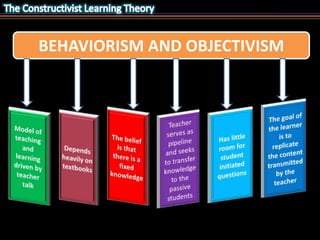
1. Compare the characteristics of behaviorism/objectivism and 
constructivism and identify its students outcomes. 
2. Define constructivism and identify its students outcomes. 
3. Recall the history of constructivism and the ideas of major 
constructivist 
4. Identify the underlying ideas of constructivism 
5. Explain the advantages and cost of constructivism. 
6. Appreciate and apply constructivist theories and concepts in 
the teaching learning process.
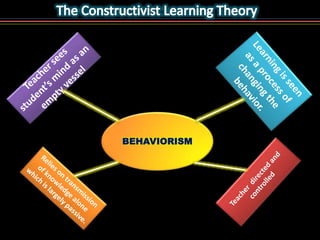
BEHAVIORISM
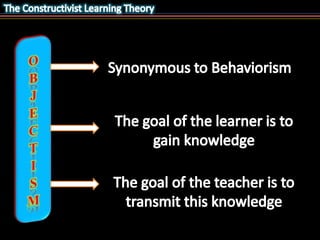
BEHAVIORISM AND OBJECTIVISM
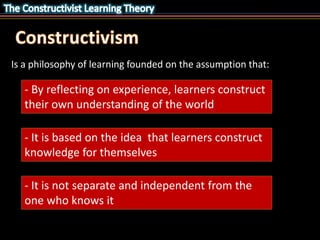
Is a philosophy of learning founded on the assumption that: 
- By reflecting on experience, learners construct 
their own understanding of the world 
- It is based on the idea that learners construct 
knowledge for themselves 
- It is not separate and independent from the 
one who knows it
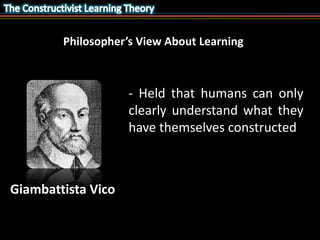
Philosopher’s View About Learning 
- Held that humans can only 
clearly understand what they 
have themselves constructed 
Giambattista Vico
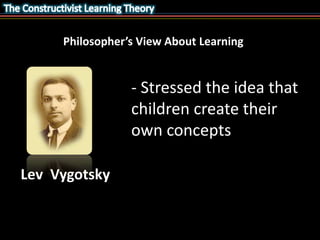
Philosopher’s View About Learning 
- Stressed the idea that 
children create their 
own concepts 
Lev Vygotsky
Philosopher’s View About Learning 
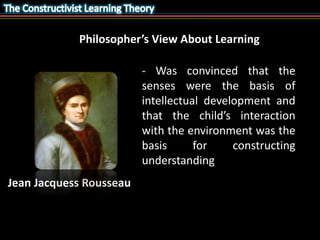
- Was convinced that the 
senses were the basis of 
intellectual development and 
that the child’s interaction 
with the environment was the 
basis for constructing 
understanding 
Jean Jacquess Rousseau
Philosopher’s View About Learning 
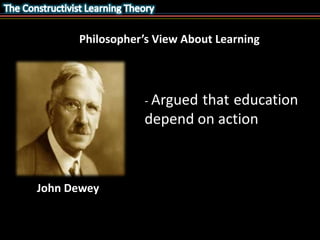
- Argued that education 
depend on action 
John Dewey
Philosopher’s View About Learning 
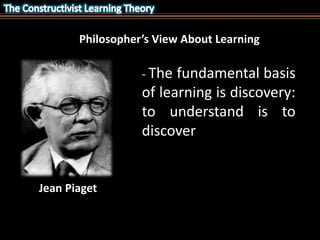
- The fundamental basis 
of learning is discovery: 
to understand is to 
discover 
Jean Piaget
Philosopher’s View About Learning 
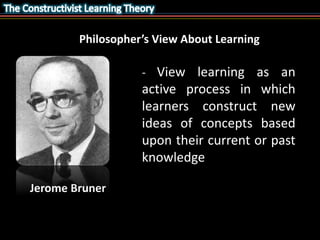
- View learning as an 
active process in which 
learners construct new 
ideas of concepts based 
upon their current or past 
knowledge 
Jerome Bruner
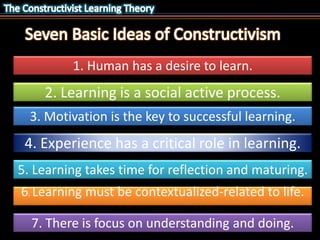
1. Human has a desire to learn. 
2. Learning is a social active process. 
3. Motivation is the key to successful learning. 
4. Experience has a critical role in learning. 
5. Learning takes time for reflection and maturing. 
6. Learning must be contextualized-related to life. 
7. There is focus on understanding and doing.
Constructivism
Constructivism
Constructivism

Constructivism

  • 1.
    Objectives: 1. Comparethe characteristics of behaviorism/objectivism and constructivism and identify its students outcomes. 2. Define constructivism and identify its students outcomes. 3. Recall the history of constructivism and the ideas of major constructivist 4. Identify the underlying ideas of constructivism 5. Explain the advantages and cost of constructivism. 6. Appreciate and apply constructivist theories and concepts in the teaching learning process.
  • 2.
  • 4.
  • 5.
    Is a philosophyof learning founded on the assumption that: - By reflecting on experience, learners construct their own understanding of the world - It is based on the idea that learners construct knowledge for themselves - It is not separate and independent from the one who knows it
  • 6.
    Philosopher’s View AboutLearning - Held that humans can only clearly understand what they have themselves constructed Giambattista Vico
  • 7.
    Philosopher’s View AboutLearning - Stressed the idea that children create their own concepts Lev Vygotsky
  • 8.
    Philosopher’s View AboutLearning - Was convinced that the senses were the basis of intellectual development and that the child’s interaction with the environment was the basis for constructing understanding Jean Jacquess Rousseau
  • 9.
    Philosopher’s View AboutLearning - Argued that education depend on action John Dewey
  • 10.
    Philosopher’s View AboutLearning - The fundamental basis of learning is discovery: to understand is to discover Jean Piaget
  • 11.
    Philosopher’s View AboutLearning - View learning as an active process in which learners construct new ideas of concepts based upon their current or past knowledge Jerome Bruner
  • 12.
    1. Human hasa desire to learn. 2. Learning is a social active process. 3. Motivation is the key to successful learning. 4. Experience has a critical role in learning. 5. Learning takes time for reflection and maturing. 6. Learning must be contextualized-related to life. 7. There is focus on understanding and doing.