Adult Learners in the Online Environment: What Creates SUCCESS?Angela M. Gibson, Ed.D.American Public University System Lori Kupczynski, Ed.D.Texas A&M University-Kingsville15th Annual Sloan-C InternationalConference on Online LearningFriday, October 30, 2009
IntroductionsAndragogy and Applications for Higher EducationIllustrate Value of AndragogyExemplification of Learning Type Within Online ClassroomsDiscussion with Audience on Personal Experiences & Best Practices for Adult Learners in Online LearningSmall Group BreakoutWhole AudienceQuestions & AnswersAdult Learners in the Online Environment - Agenda
Adult Learners - IntroductionsAngela M. Gibson, Ed.D.Angela serves as the Instructional Design Project Leader for American Public University System’s Instructional Design and Development Team.  With a background in educational leadership, adult education, community colleges, and student affairs, her research interests include student engagement and success, the role of technology in course design and instruction, and Hispanic student success.Lori Kupczynski, Ed.D.Lori Kupczynski, Ed.D. serves as an educational consultant across the United States at multiple institutions of higher learning. She is an adjunct instructor of Adult Education at Texas A&M University-Kingsville.  Her research interests center upon Internet-based instruction and the role of the adult learner, with emphasis in instructional design.
There is one way to teachThere is one way to learnAll students can be taught the sameAll students learn the sameAll learning can be delivered in the same wayAll students use one delivery system to learnAndragogy & Applications in Higher Education
Andragogy & Applications in Higher EducationAndragogy is DIFFERENT from pedagogyBut first – some things to considerWe want our students to understand how their learning can impact their entire lives, not just their gradesWe want our students to excel beyond the minimum standardsWe want our students to be socially consciousWe expect education to come first in their schedulesWe want them to be motivated
How do we do the things we want our students to do when there are obstacles?Students & faculty/staff are busyOften the least amount of efforts are put into workThe “why should I” is always presentWe want it and we want it now Andragogy & Applications in Higher Education
Know your studentAndragogy & Applications in Higher Education
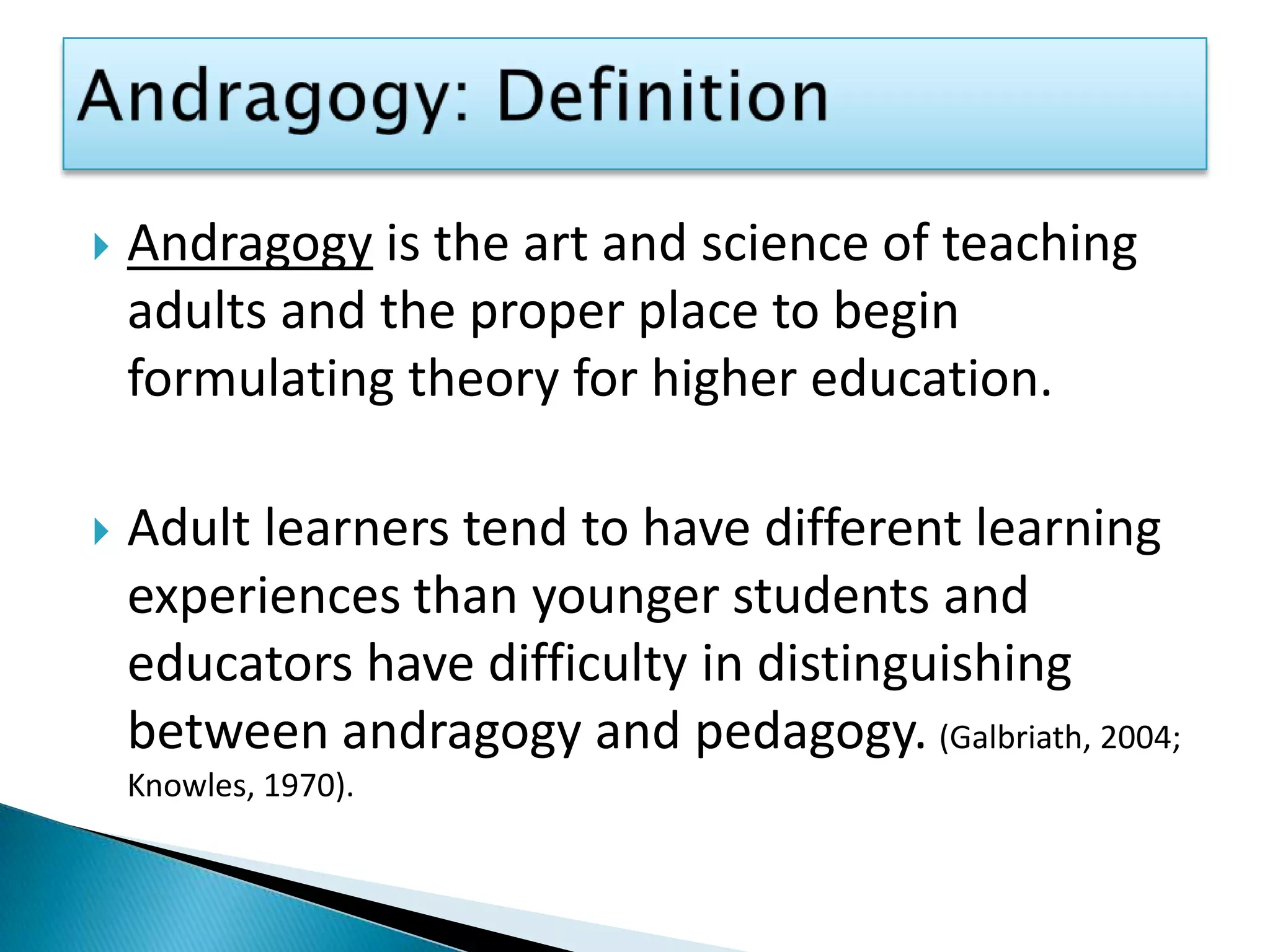
Andragogy: DefinitionAndragogy is the art and science of teaching adults and the proper place to begin formulating theory for higher education. Adult learners tend to have different learning experiences than younger students and educators have difficulty in distinguishing between andragogy and pedagogy.(Galbriath, 2004; Knowles, 1970).
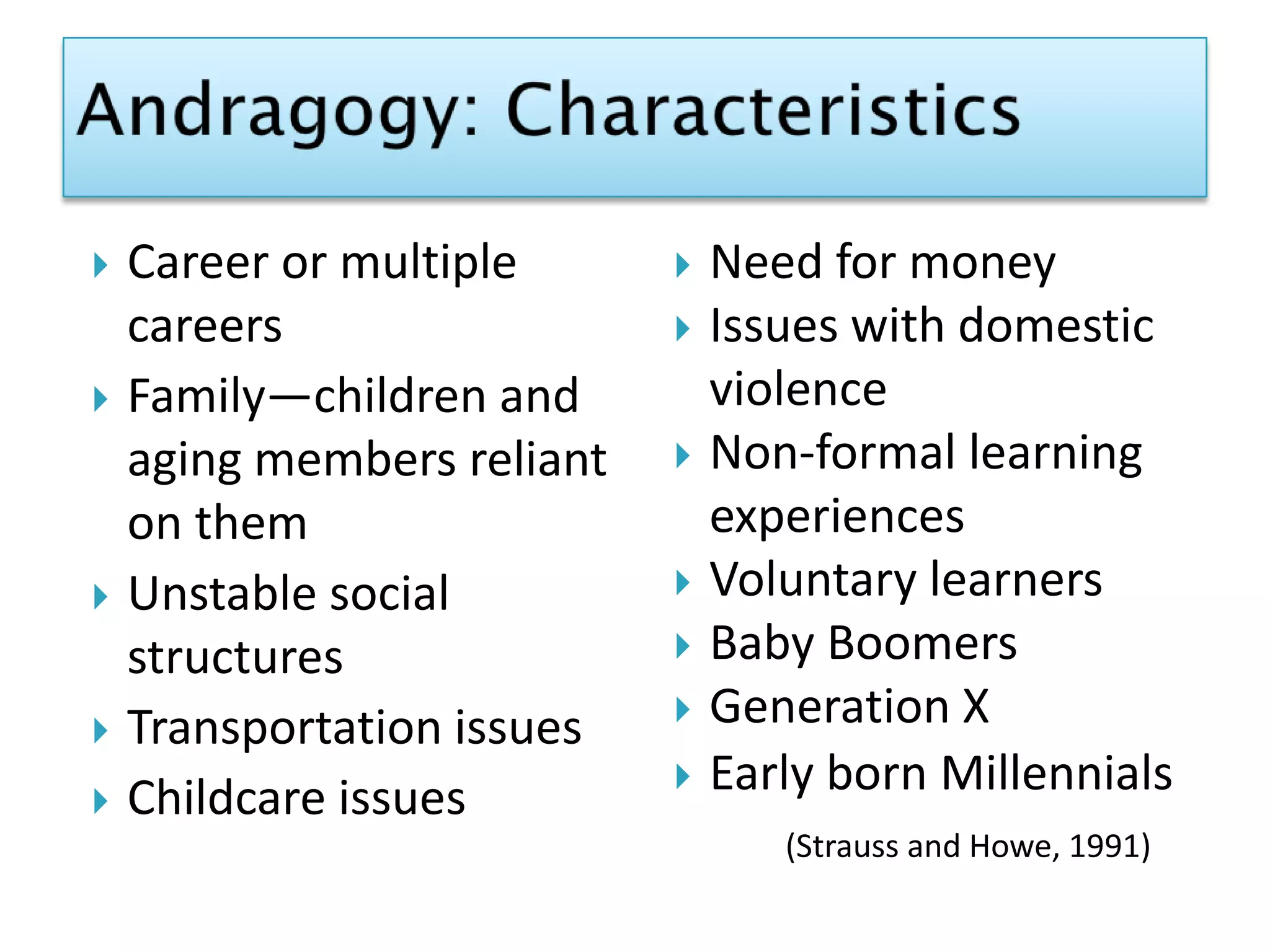
Andragogy: CharacteristicsCareer or multiple careersFamily—children and aging members reliant on themUnstable social structures	Transportation issuesChildcare issuesNeed for moneyIssues with domestic violenceNon-formal learning experiencesVoluntary learnersBaby BoomersGeneration XEarly born Millennials(Strauss and Howe, 1991)
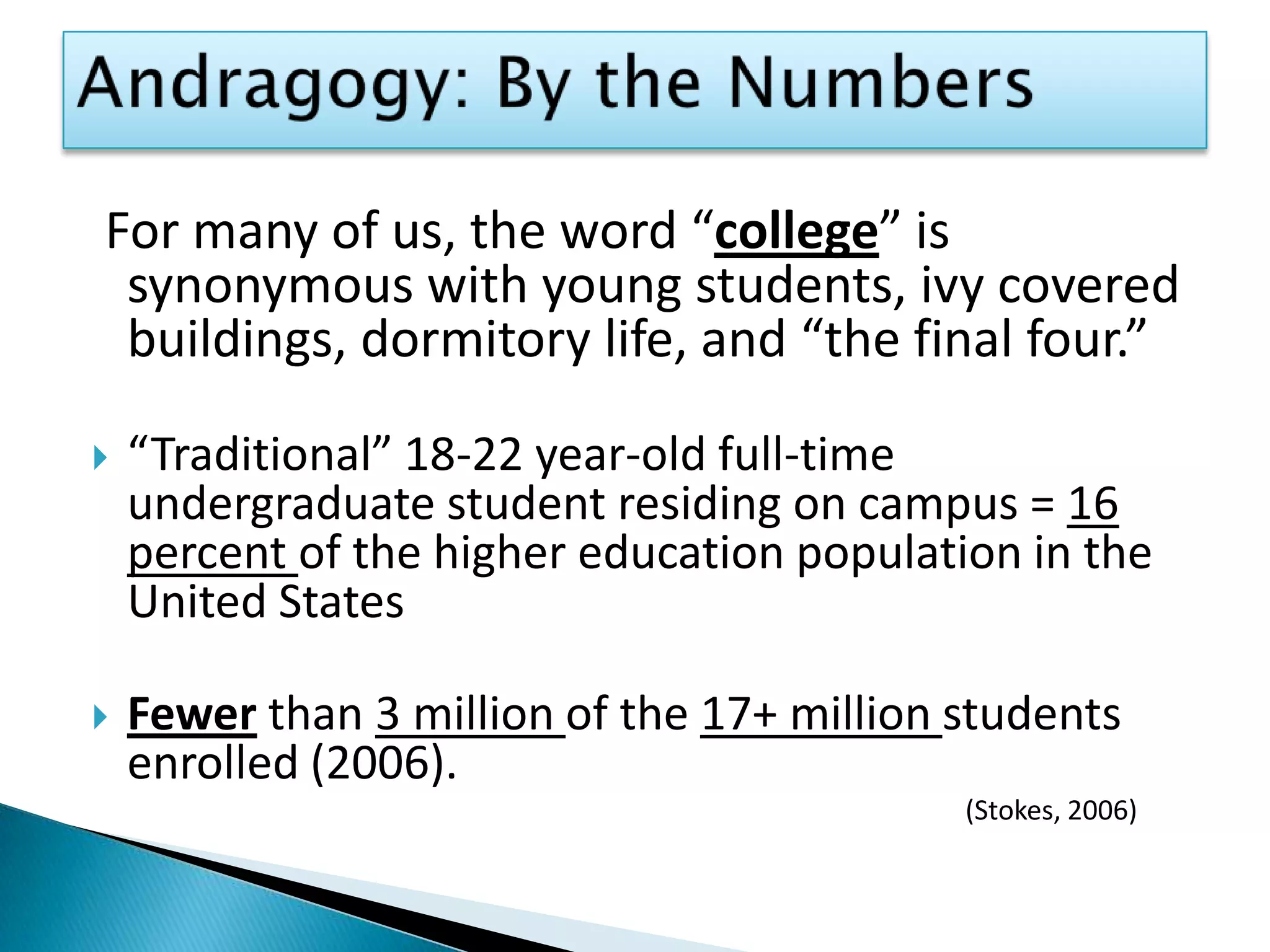
Andragogy: By the NumbersFor many of us, the word “college” is synonymous with young students, ivy covered buildings, dormitory life, and “the final four.” “Traditional” 18-22 year-old full-time undergraduate student residing on campus = 16 percent of the higher education population in the United StatesFewer than 3 million of the 17+ million students enrolled (2006).  								(Stokes, 2006)
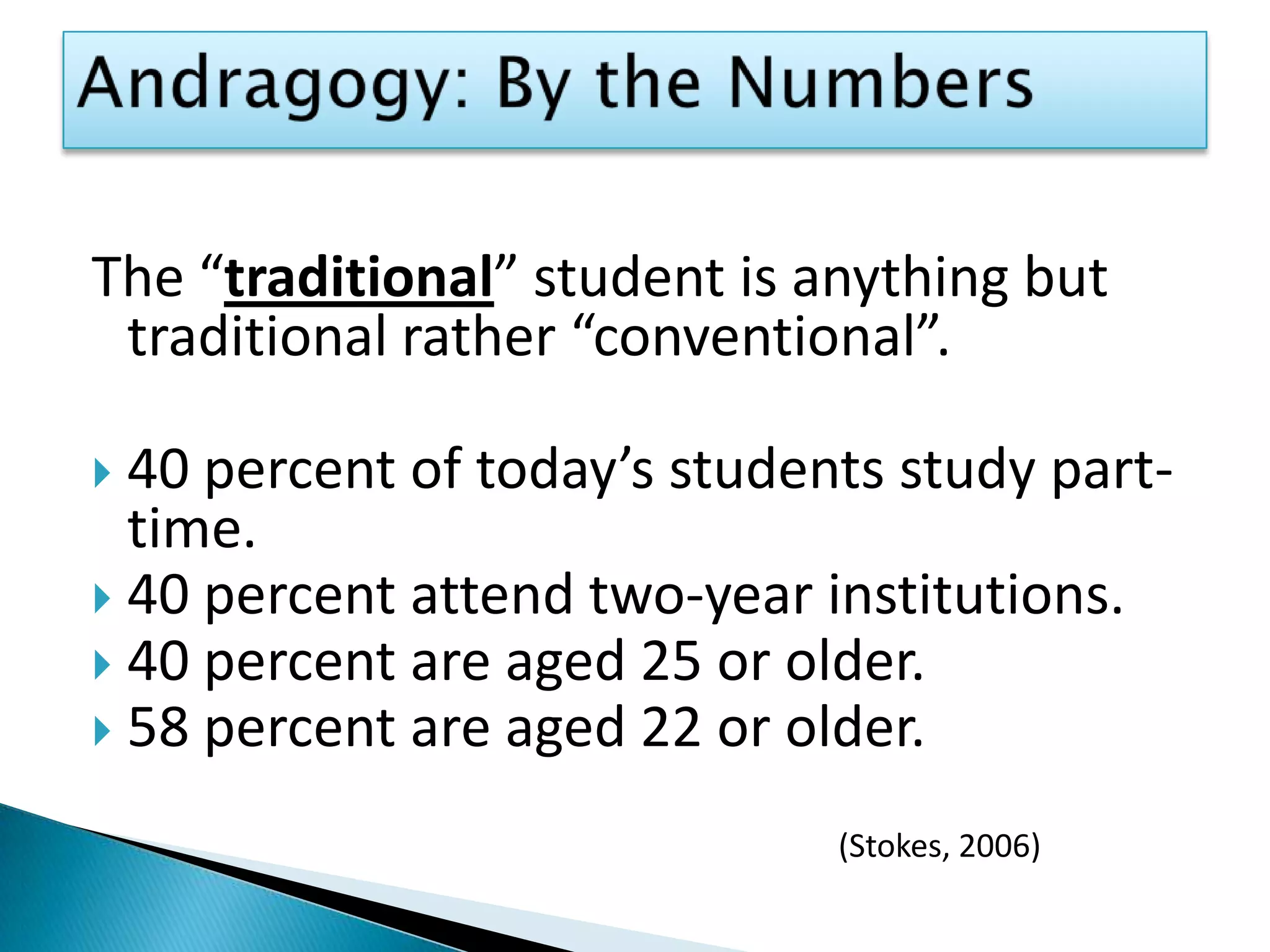
Andragogy: By the NumbersThe “traditional” student is anything but traditional rather “conventional”.40 percent of today’s students study part-time. 40 percent attend two-year institutions. 40 percent are aged 25 or older. 58 percent are aged 22 or older.(Stokes, 2006)
Concepts in Andragogy to Consider for Application to Online LearningExperiential learningKnowledge of concepts, facts, information, and experience; Prior knowledge applied to current, ongoing events; and Reflection  with a thoughtful analysis and assessment of learners’ activity that contributes to personal growth. (Cercone, 2008)
Concepts: Application – cont.Self-directed learningLocus of control in learning lies with the adult learner, who may initiate learning with or without assistance from others.(Lowry, 1989)Transformative learningA constructivist theory of adult learningIndividual transformation includes a change in one’s frame of reference or way of seeing the world. (Mezirow, 1997; Palloff& Pratt, 1999)
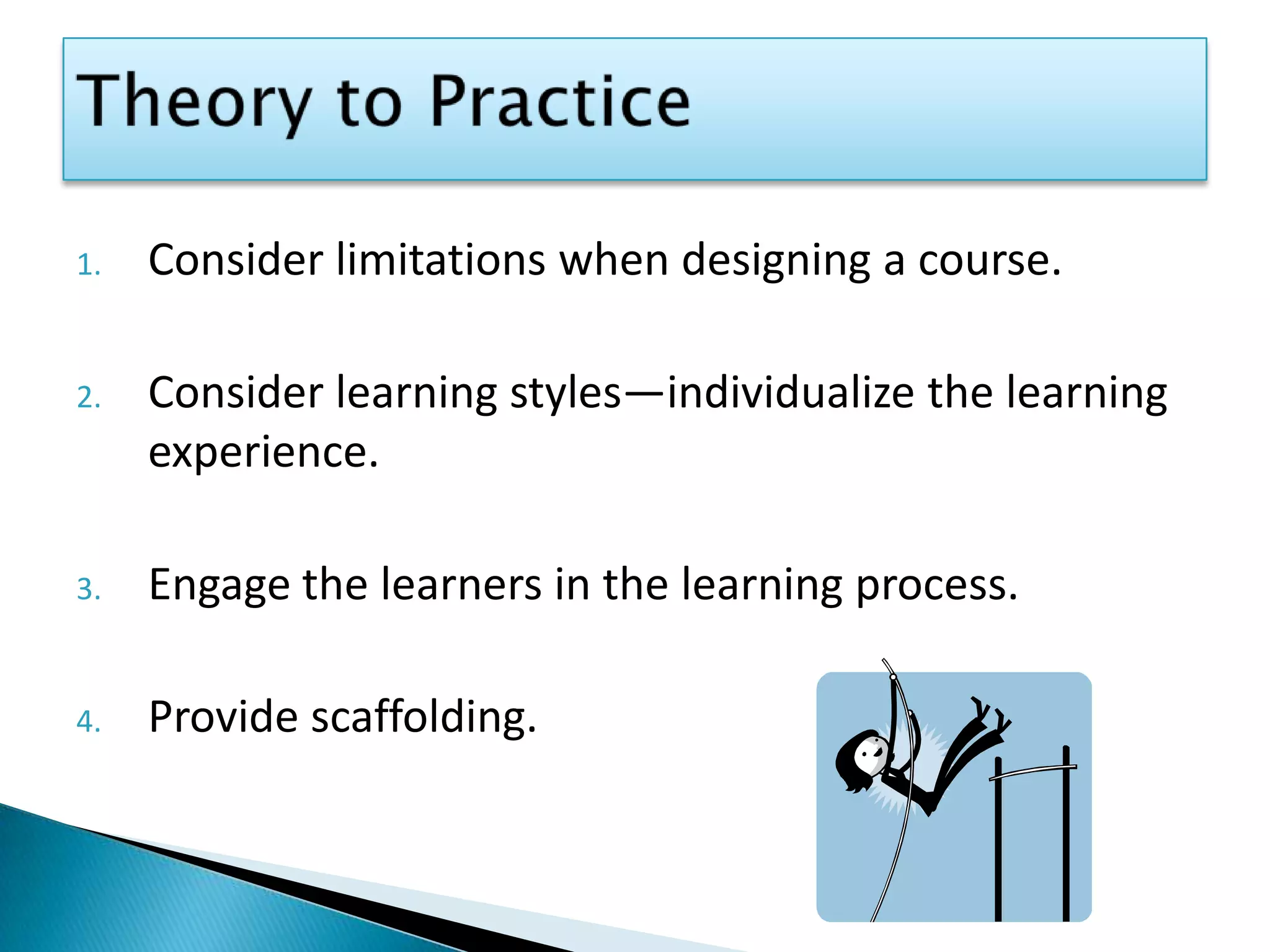
Theory to PracticeConsider limitations when designing a course.Consider learning styles—individualize the learning experience. Engage the learners in the learning process.Provide scaffolding.
Theory to Practice – cont.Support the shift to a learner-centered paradigm.Facilitate.Consider the learner’s prior experience.Ensure there is a link to the learning and the students’ lives.Focus on issues that directly concern them. Tell them what, how, and why they are learning.
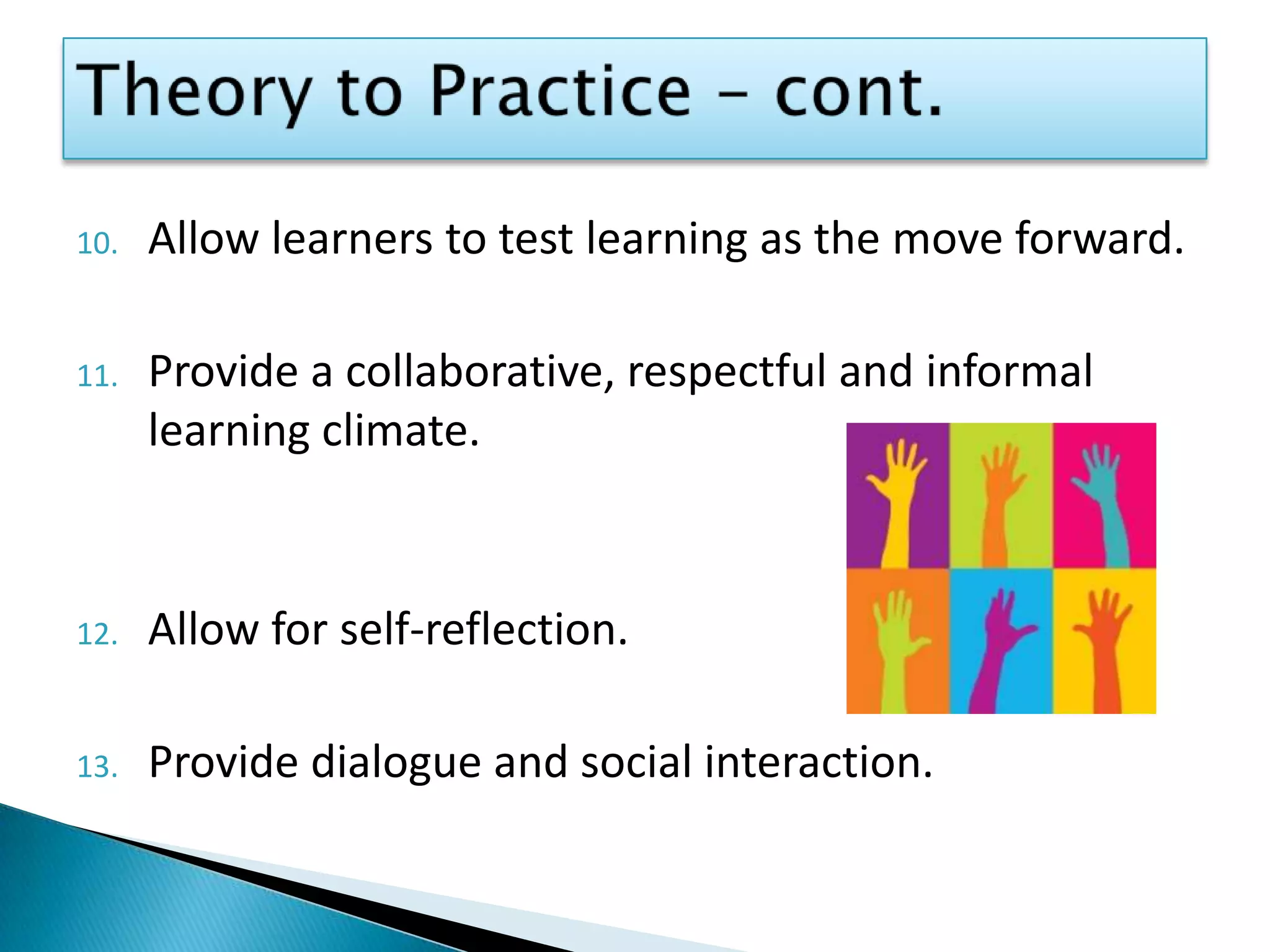
Theory to Practice – cont.Allow learners to test learning as the move forward.Provide a collaborative, respectful and informal learning climate. Allow for self-reflection.Provide dialogue and social interaction.
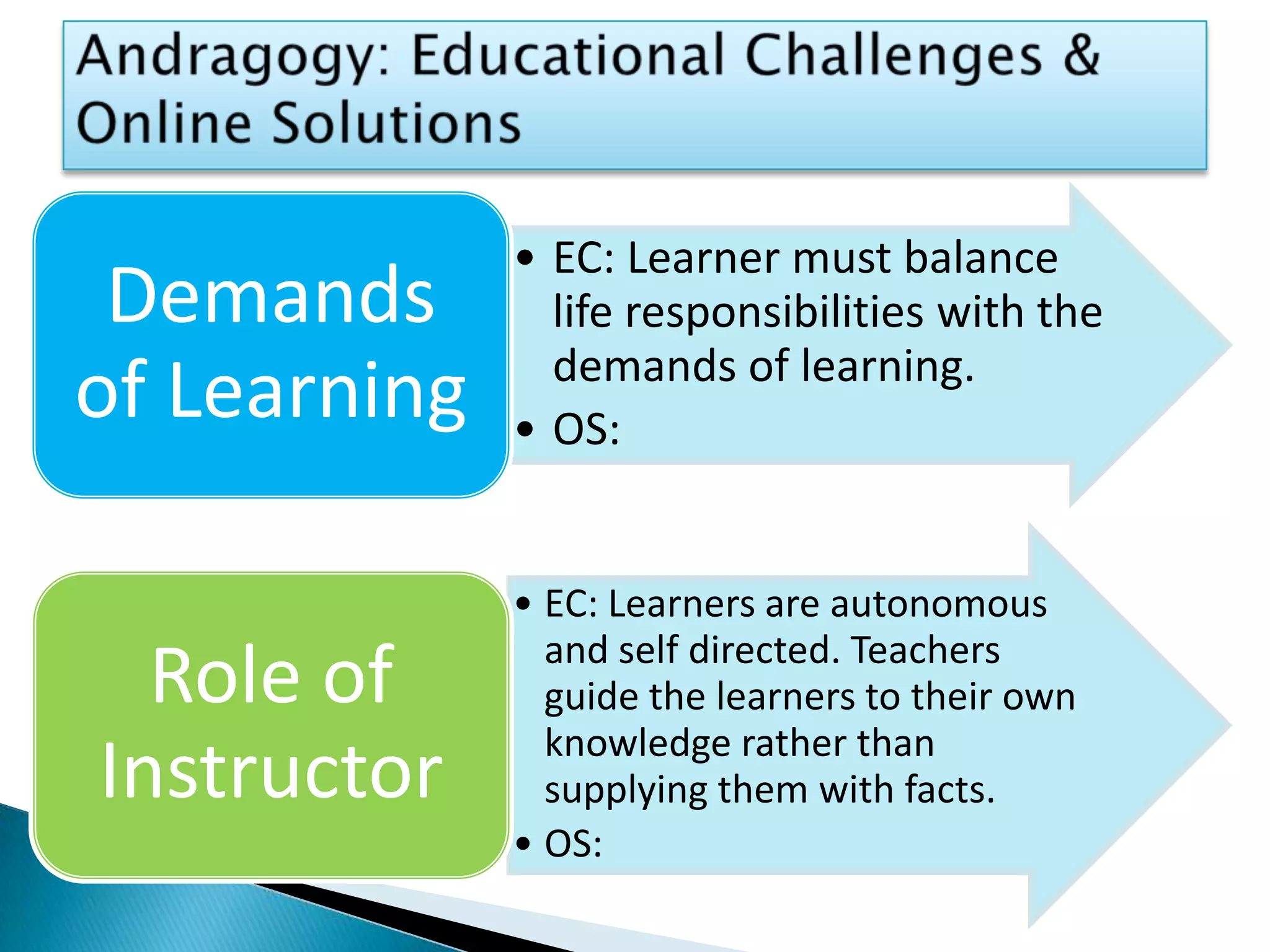
Andragogy: Educational Challenges & Online Solutions
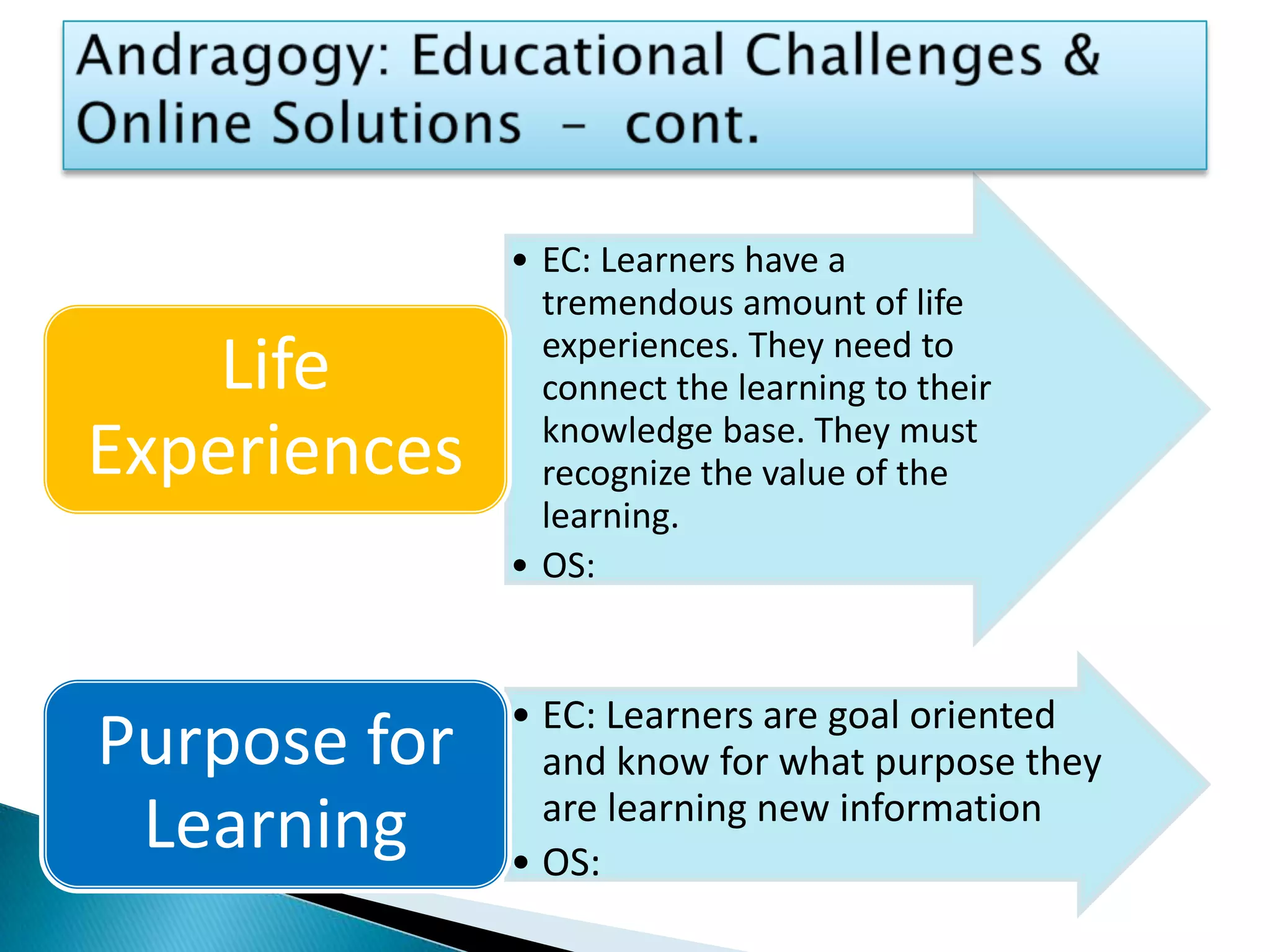
Andragogy: Educational Challenges & Online Solutions  –  cont.
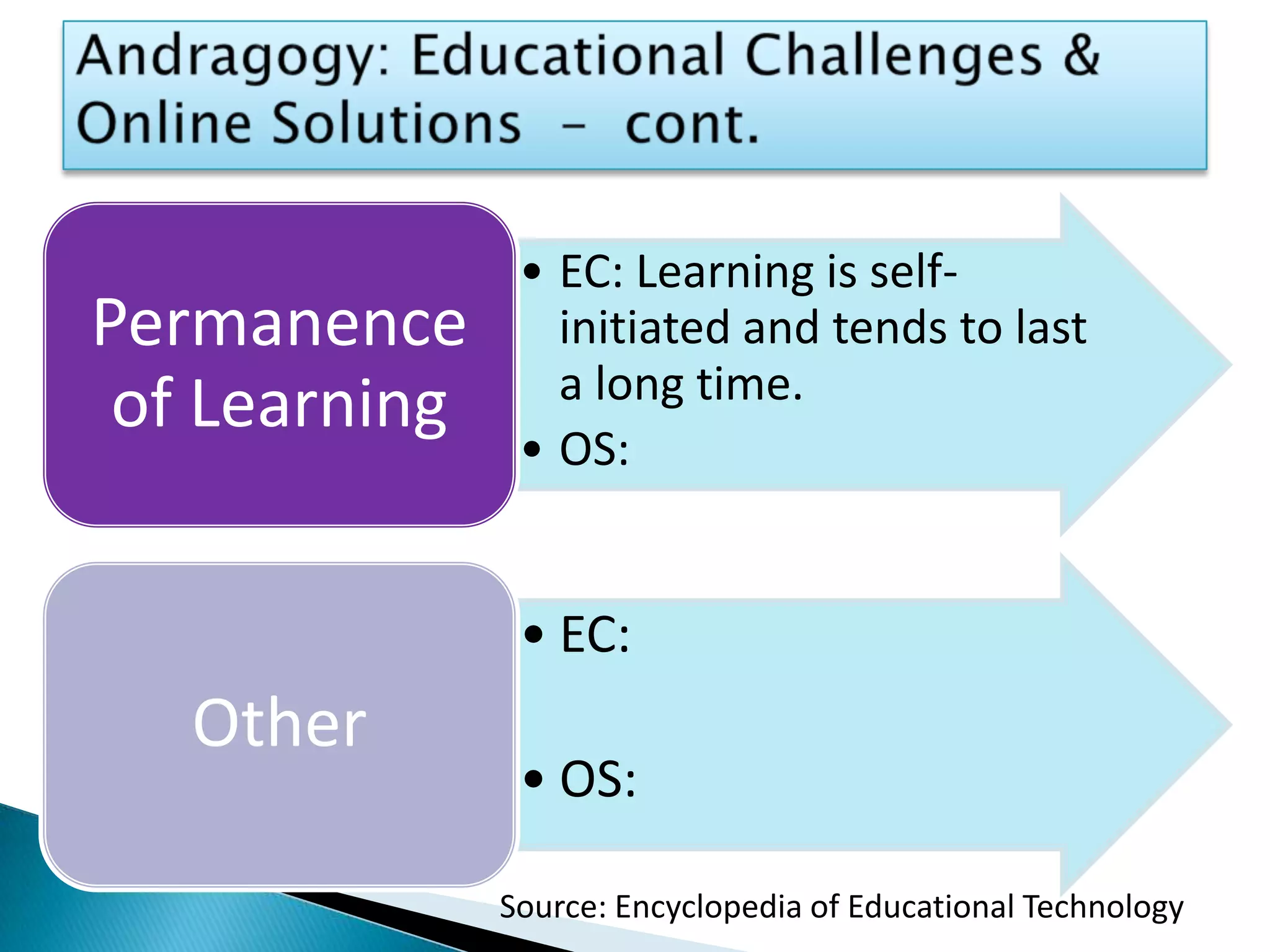
Andragogy: Educational Challenges & Online Solutions  –  cont.Source: Encyclopedia of Educational Technology
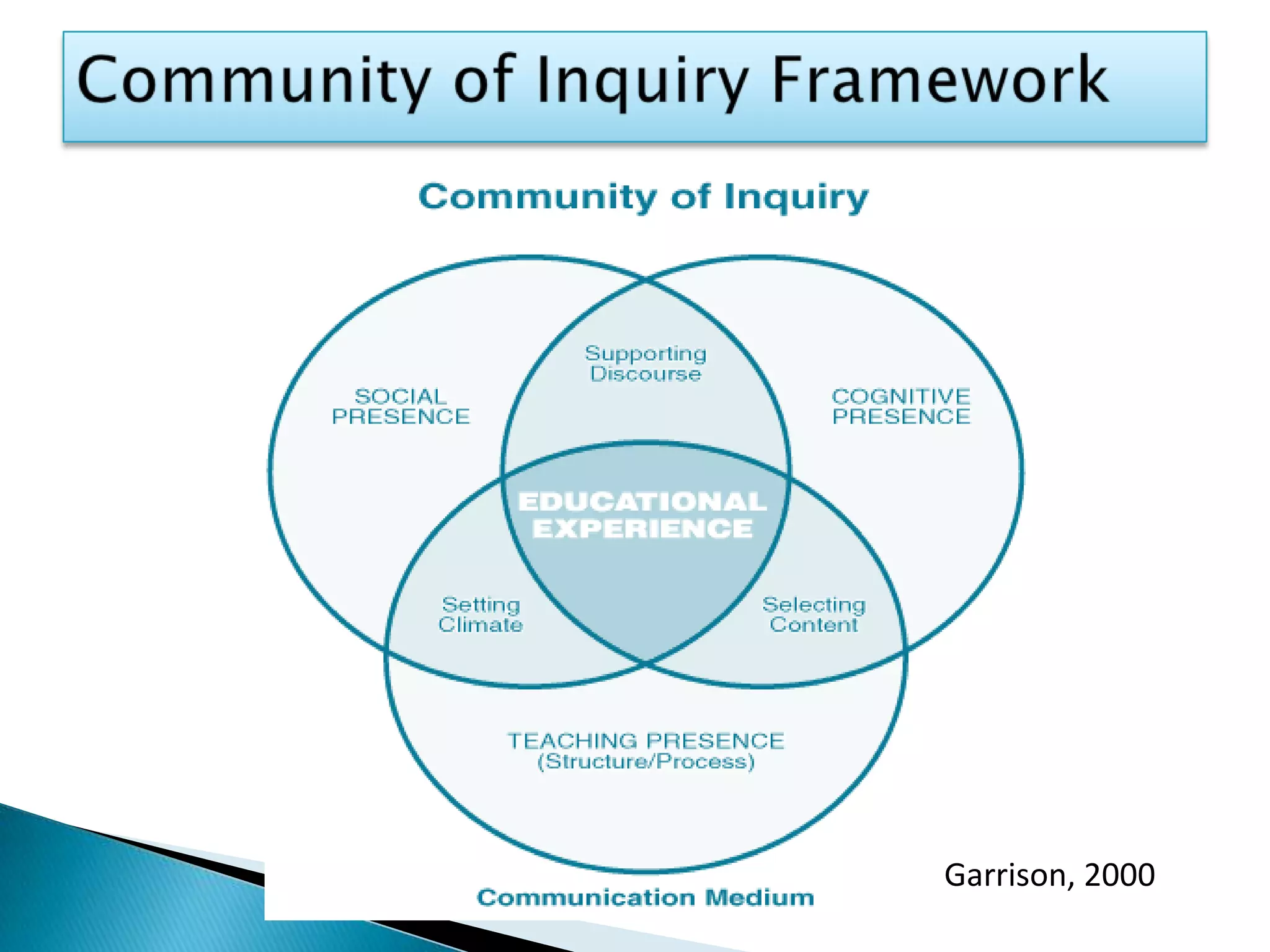
Community of Inquiry FrameworkGarrison, 2000
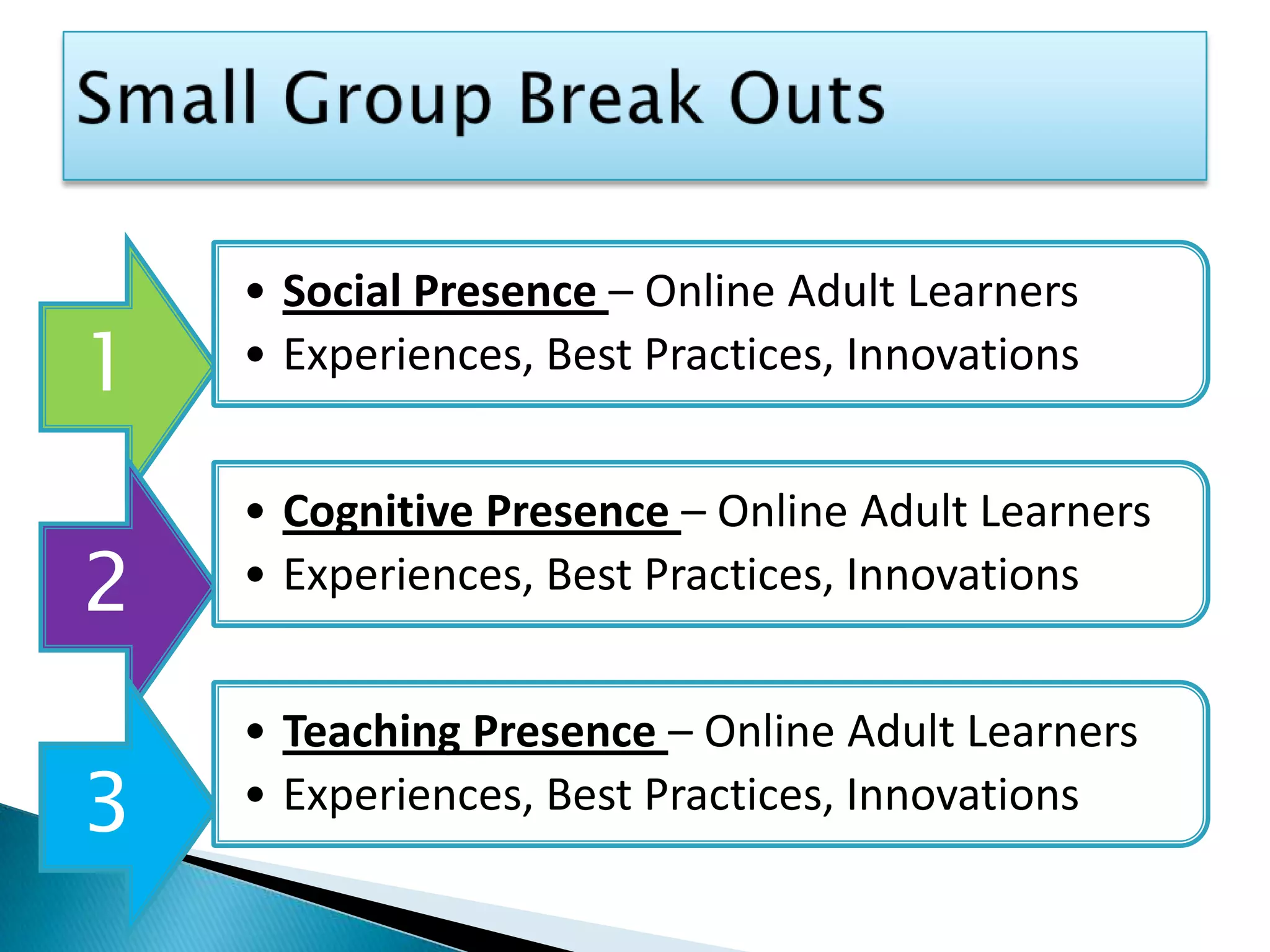
Small Group Break Outs
ConclusionAdult learners are important, yet neglectedStrategies for online learning include course development to community engagement to class settingsPedagogy and Andragogy can mixKnow your students
Questions & AnswersThank You!!!!
Contact InformationAngela M. Gibson, Ed.D.American Public University System111 W. Congress St.Charles Town, WV 25414o) 304-724-2804  agibson@apus.edu Lori Kupczynski, Ed.D.Texas A&M University - Kingsville12206 Stable Pond Dr.San Antonio, TX 78249c) 956-648-7617   capitola16@yahoo.com
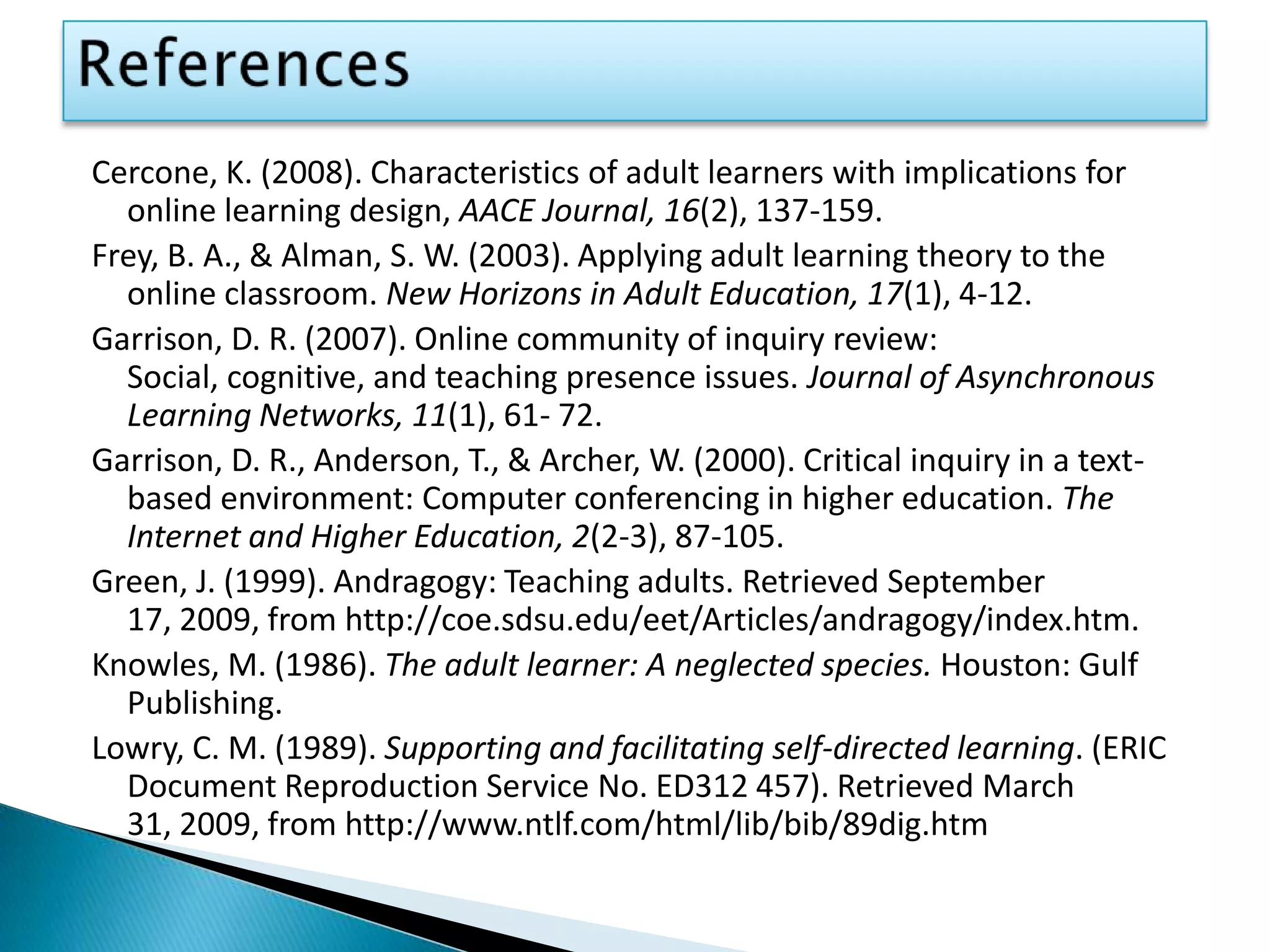
ReferencesCercone, K. (2008). Characteristics of adult learners with implications for online learning design, AACE Journal, 16(2), 137-159.Frey, B. A., & Alman, S. W. (2003). Applying adult learning theory to the online classroom. New Horizons in Adult Education, 17(1), 4-12.Garrison, D. R. (2007). Online community of inquiry review: Social, cognitive, and teaching presence issues. Journal of Asynchronous Learning Networks, 11(1), 61- 72.Garrison, D. R., Anderson, T., & Archer, W. (2000). Critical inquiry in a text-based environment: Computer conferencing in higher education. The Internet and Higher Education, 2(2-3), 87-105.Green, J. (1999). Andragogy: Teaching adults. Retrieved September 17, 2009, from http://coe.sdsu.edu/eet/Articles/andragogy/index.htm.Knowles, M. (1986). The adult learner: A neglected species. Houston: Gulf Publishing.Lowry, C. M. (1989). Supporting and facilitating self-directed learning. (ERIC Document Reproduction Service No. ED312 457). Retrieved March 31, 2009, from http://www.ntlf.com/html/lib/bib/89dig.htm
References – cont.Mezirow, J. (1997). Transformative learning. New Directions for Adult and Continuing Education, 74, 5-12.Merriam, S. B., & Caffarella, R. S. (1999). Learning in adulthood (2nd ed.). San Francisco: Jossey-Bass.Moore, M. G., & Kearsley, G. (1996). Distance education a systems view. Belmont, CA: Wadsworth.Palloff, R. M., & Pratt, K. (1999). Building learning communities in cyberspace. San Francisco: Jossey-Bass.Schapiro, S.A. (2003). From andragogy to collaborative, critical pedagogy: Learning for academic, personal, and social empowerment in a distance-learning, Ph.D. program. Journal of Transformative Education,1(2), 150-166.Strauss, W., & Howe, N. (1991). Generations: The History of America's Future, 1584 to 2069. New York: William Morrow & Company, Inc.Stokes, P. (2006). Hidden in Plain Sight: Adult Learners Forge a New Tradition in Higher Education. A National Dialogue: The Secretary of Education’s Commission on the Future of Higher Education [Issue Paper]. Retrieved July 7, 2009, from http://www.ed.gov/about/bdscomm/list/hiedfuture/reports/stokes.pdf
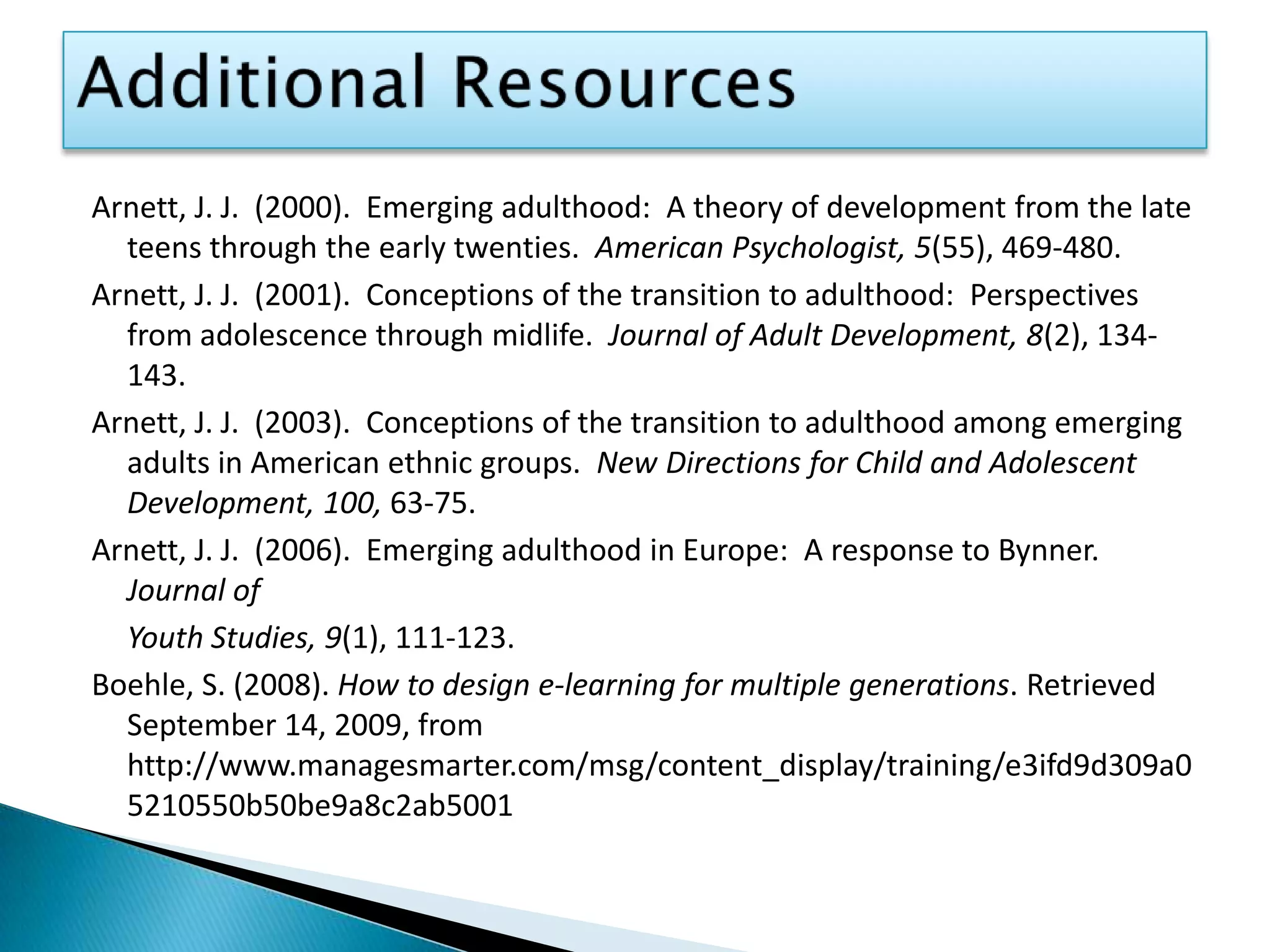
Additional ResourcesArnett, J. J.  (2000).  Emerging adulthood:  A theory of development from the late teens through the early twenties.  American Psychologist, 5(55), 469-480.Arnett, J. J.  (2001).  Conceptions of the transition to adulthood:  Perspectives from adolescence through midlife.  Journal of Adult Development, 8(2), 134-143.Arnett, J. J.  (2003).  Conceptions of the transition to adulthood among emerging adults in American ethnic groups.  New Directions for Child and Adolescent Development, 100, 63-75.Arnett, J. J.  (2006).  Emerging adulthood in Europe:  A response to Bynner.  Journal of 	Youth Studies, 9(1), 111-123. Boehle, S. (2008). How to design e-learning for multiple generations. Retrieved September 14, 2009, from http://www.managesmarter.com/msg/content_display/training/e3ifd9d309a05210550b50be9a8c2ab5001
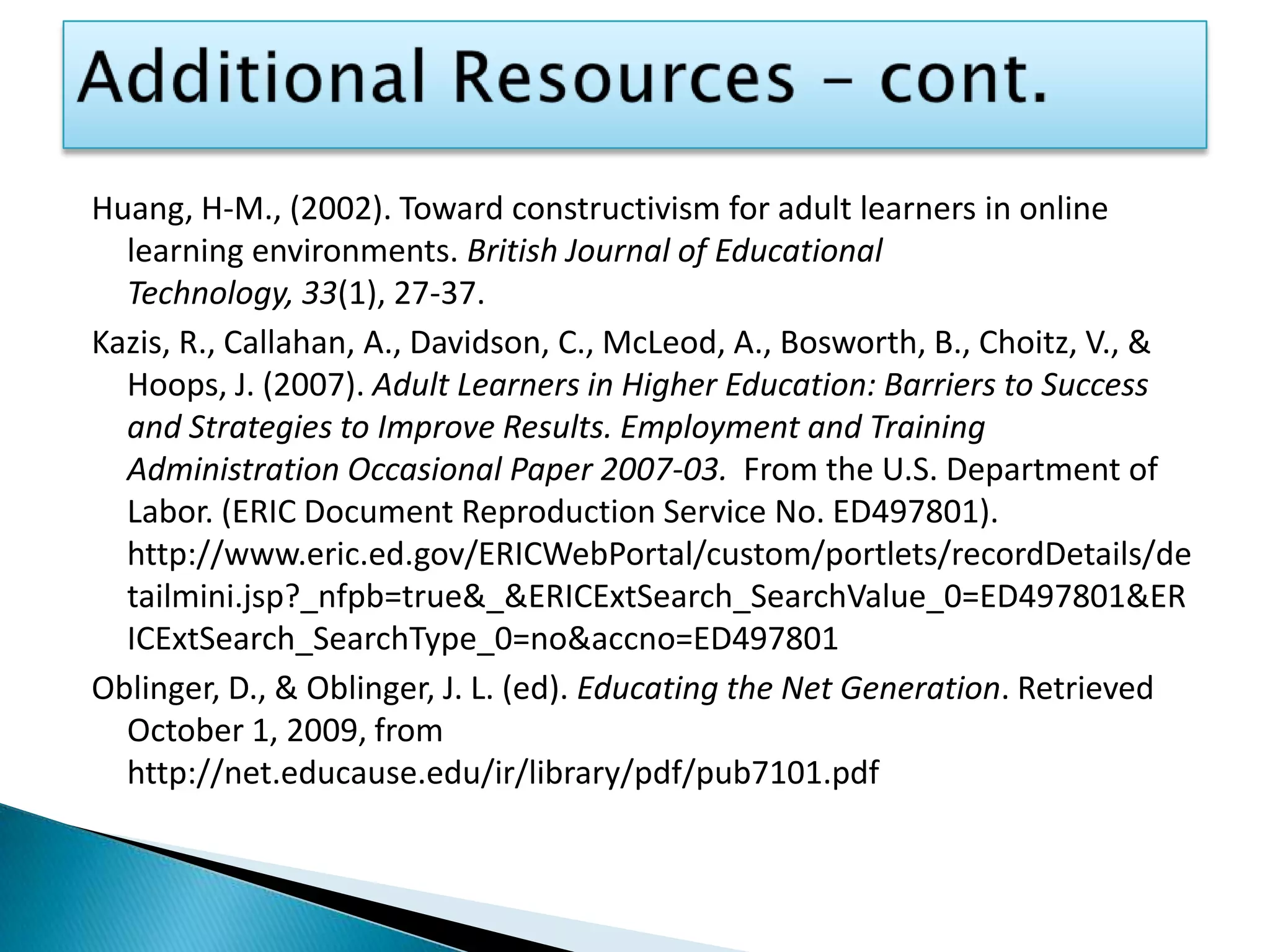
Additional Resources – cont.Huang, H-M., (2002). Toward constructivism for adult learners in online learning environments. British Journal of Educational Technology, 33(1), 27-37.Kazis, R., Callahan, A., Davidson, C., McLeod, A., Bosworth, B., Choitz, V., & Hoops, J. (2007). Adult Learners in Higher Education: Barriers to Success and Strategies to Improve Results. Employment and Training Administration Occasional Paper 2007-03.  From the U.S. Department of Labor. (ERIC Document Reproduction Service No. ED497801). http://www.eric.ed.gov/ERICWebPortal/custom/portlets/recordDetails/detailmini.jsp?_nfpb=true&_&ERICExtSearch_SearchValue_0=ED497801&ERICExtSearch_SearchType_0=no&accno=ED497801Oblinger, D., & Oblinger, J. L. (ed). Educating the Net Generation. Retrieved October 1, 2009, from http://net.educause.edu/ir/library/pdf/pub7101.pdf

Learning Theories and Instructional Pathways for Adult Learners in the Online Environment

  • 1.
    Adult Learners inthe Online Environment: What Creates SUCCESS?Angela M. Gibson, Ed.D.American Public University System Lori Kupczynski, Ed.D.Texas A&M University-Kingsville15th Annual Sloan-C InternationalConference on Online LearningFriday, October 30, 2009
  • 2.
    IntroductionsAndragogy and Applicationsfor Higher EducationIllustrate Value of AndragogyExemplification of Learning Type Within Online ClassroomsDiscussion with Audience on Personal Experiences & Best Practices for Adult Learners in Online LearningSmall Group BreakoutWhole AudienceQuestions & AnswersAdult Learners in the Online Environment - Agenda
  • 3.
    Adult Learners -IntroductionsAngela M. Gibson, Ed.D.Angela serves as the Instructional Design Project Leader for American Public University System’s Instructional Design and Development Team. With a background in educational leadership, adult education, community colleges, and student affairs, her research interests include student engagement and success, the role of technology in course design and instruction, and Hispanic student success.Lori Kupczynski, Ed.D.Lori Kupczynski, Ed.D. serves as an educational consultant across the United States at multiple institutions of higher learning. She is an adjunct instructor of Adult Education at Texas A&M University-Kingsville.  Her research interests center upon Internet-based instruction and the role of the adult learner, with emphasis in instructional design.
  • 4.
    There is oneway to teachThere is one way to learnAll students can be taught the sameAll students learn the sameAll learning can be delivered in the same wayAll students use one delivery system to learnAndragogy & Applications in Higher Education
  • 6.
    Andragogy & Applicationsin Higher EducationAndragogy is DIFFERENT from pedagogyBut first – some things to considerWe want our students to understand how their learning can impact their entire lives, not just their gradesWe want our students to excel beyond the minimum standardsWe want our students to be socially consciousWe expect education to come first in their schedulesWe want them to be motivated
  • 7.
    How do wedo the things we want our students to do when there are obstacles?Students & faculty/staff are busyOften the least amount of efforts are put into workThe “why should I” is always presentWe want it and we want it now Andragogy & Applications in Higher Education
  • 8.
    Know your studentAndragogy& Applications in Higher Education
  • 9.
    Andragogy: DefinitionAndragogy isthe art and science of teaching adults and the proper place to begin formulating theory for higher education. Adult learners tend to have different learning experiences than younger students and educators have difficulty in distinguishing between andragogy and pedagogy.(Galbriath, 2004; Knowles, 1970).
  • 10.
    Andragogy: CharacteristicsCareer ormultiple careersFamily—children and aging members reliant on themUnstable social structures Transportation issuesChildcare issuesNeed for moneyIssues with domestic violenceNon-formal learning experiencesVoluntary learnersBaby BoomersGeneration XEarly born Millennials(Strauss and Howe, 1991)
  • 11.
    Andragogy: By theNumbersFor many of us, the word “college” is synonymous with young students, ivy covered buildings, dormitory life, and “the final four.” “Traditional” 18-22 year-old full-time undergraduate student residing on campus = 16 percent of the higher education population in the United StatesFewer than 3 million of the 17+ million students enrolled (2006). (Stokes, 2006)
  • 12.
    Andragogy: By theNumbersThe “traditional” student is anything but traditional rather “conventional”.40 percent of today’s students study part-time. 40 percent attend two-year institutions. 40 percent are aged 25 or older. 58 percent are aged 22 or older.(Stokes, 2006)
  • 13.
    Concepts in Andragogyto Consider for Application to Online LearningExperiential learningKnowledge of concepts, facts, information, and experience; Prior knowledge applied to current, ongoing events; and Reflection with a thoughtful analysis and assessment of learners’ activity that contributes to personal growth. (Cercone, 2008)
  • 14.
    Concepts: Application –cont.Self-directed learningLocus of control in learning lies with the adult learner, who may initiate learning with or without assistance from others.(Lowry, 1989)Transformative learningA constructivist theory of adult learningIndividual transformation includes a change in one’s frame of reference or way of seeing the world. (Mezirow, 1997; Palloff& Pratt, 1999)
  • 15.
    Theory to PracticeConsiderlimitations when designing a course.Consider learning styles—individualize the learning experience. Engage the learners in the learning process.Provide scaffolding.
  • 16.
    Theory to Practice– cont.Support the shift to a learner-centered paradigm.Facilitate.Consider the learner’s prior experience.Ensure there is a link to the learning and the students’ lives.Focus on issues that directly concern them. Tell them what, how, and why they are learning.
  • 17.
    Theory to Practice– cont.Allow learners to test learning as the move forward.Provide a collaborative, respectful and informal learning climate. Allow for self-reflection.Provide dialogue and social interaction.
  • 18.
  • 19.
    Andragogy: Educational Challenges& Online Solutions – cont.
  • 20.
    Andragogy: Educational Challenges& Online Solutions – cont.Source: Encyclopedia of Educational Technology
  • 21.
    Community of InquiryFrameworkGarrison, 2000
  • 22.
  • 23.
    ConclusionAdult learners areimportant, yet neglectedStrategies for online learning include course development to community engagement to class settingsPedagogy and Andragogy can mixKnow your students
  • 24.
  • 25.
    Contact InformationAngela M.Gibson, Ed.D.American Public University System111 W. Congress St.Charles Town, WV 25414o) 304-724-2804 agibson@apus.edu Lori Kupczynski, Ed.D.Texas A&M University - Kingsville12206 Stable Pond Dr.San Antonio, TX 78249c) 956-648-7617 capitola16@yahoo.com
  • 26.
    ReferencesCercone, K. (2008).Characteristics of adult learners with implications for online learning design, AACE Journal, 16(2), 137-159.Frey, B. A., & Alman, S. W. (2003). Applying adult learning theory to the online classroom. New Horizons in Adult Education, 17(1), 4-12.Garrison, D. R. (2007). Online community of inquiry review: Social, cognitive, and teaching presence issues. Journal of Asynchronous Learning Networks, 11(1), 61- 72.Garrison, D. R., Anderson, T., & Archer, W. (2000). Critical inquiry in a text-based environment: Computer conferencing in higher education. The Internet and Higher Education, 2(2-3), 87-105.Green, J. (1999). Andragogy: Teaching adults. Retrieved September 17, 2009, from http://coe.sdsu.edu/eet/Articles/andragogy/index.htm.Knowles, M. (1986). The adult learner: A neglected species. Houston: Gulf Publishing.Lowry, C. M. (1989). Supporting and facilitating self-directed learning. (ERIC Document Reproduction Service No. ED312 457). Retrieved March 31, 2009, from http://www.ntlf.com/html/lib/bib/89dig.htm
  • 27.
    References – cont.Mezirow,J. (1997). Transformative learning. New Directions for Adult and Continuing Education, 74, 5-12.Merriam, S. B., & Caffarella, R. S. (1999). Learning in adulthood (2nd ed.). San Francisco: Jossey-Bass.Moore, M. G., & Kearsley, G. (1996). Distance education a systems view. Belmont, CA: Wadsworth.Palloff, R. M., & Pratt, K. (1999). Building learning communities in cyberspace. San Francisco: Jossey-Bass.Schapiro, S.A. (2003). From andragogy to collaborative, critical pedagogy: Learning for academic, personal, and social empowerment in a distance-learning, Ph.D. program. Journal of Transformative Education,1(2), 150-166.Strauss, W., & Howe, N. (1991). Generations: The History of America's Future, 1584 to 2069. New York: William Morrow & Company, Inc.Stokes, P. (2006). Hidden in Plain Sight: Adult Learners Forge a New Tradition in Higher Education. A National Dialogue: The Secretary of Education’s Commission on the Future of Higher Education [Issue Paper]. Retrieved July 7, 2009, from http://www.ed.gov/about/bdscomm/list/hiedfuture/reports/stokes.pdf
  • 28.
    Additional ResourcesArnett, J.J. (2000). Emerging adulthood: A theory of development from the late teens through the early twenties. American Psychologist, 5(55), 469-480.Arnett, J. J. (2001). Conceptions of the transition to adulthood: Perspectives from adolescence through midlife. Journal of Adult Development, 8(2), 134-143.Arnett, J. J. (2003). Conceptions of the transition to adulthood among emerging adults in American ethnic groups. New Directions for Child and Adolescent Development, 100, 63-75.Arnett, J. J. (2006). Emerging adulthood in Europe: A response to Bynner. Journal of Youth Studies, 9(1), 111-123. Boehle, S. (2008). How to design e-learning for multiple generations. Retrieved September 14, 2009, from http://www.managesmarter.com/msg/content_display/training/e3ifd9d309a05210550b50be9a8c2ab5001
  • 29.
    Additional Resources –cont.Huang, H-M., (2002). Toward constructivism for adult learners in online learning environments. British Journal of Educational Technology, 33(1), 27-37.Kazis, R., Callahan, A., Davidson, C., McLeod, A., Bosworth, B., Choitz, V., & Hoops, J. (2007). Adult Learners in Higher Education: Barriers to Success and Strategies to Improve Results. Employment and Training Administration Occasional Paper 2007-03. From the U.S. Department of Labor. (ERIC Document Reproduction Service No. ED497801). http://www.eric.ed.gov/ERICWebPortal/custom/portlets/recordDetails/detailmini.jsp?_nfpb=true&_&ERICExtSearch_SearchValue_0=ED497801&ERICExtSearch_SearchType_0=no&accno=ED497801Oblinger, D., & Oblinger, J. L. (ed). Educating the Net Generation. Retrieved October 1, 2009, from http://net.educause.edu/ir/library/pdf/pub7101.pdf