
Maurice Eugene Dawson Jr.,  M.S., B.S. Master of Science in Management concentration Information Systems Security June 2006 Bachelor of Science in Applied Technology concentration Information Systems May 2004 Presentation About The Research Proposal Submitted to The Graduate Council in Partial Fulfillment of The Requirement for the Degree of Doctor of Computer Science with a concentration  in Enterprise Information Systems
Doctoral Committee Mentor Jeff Stevens, Ph.D. Reader(s) David Leasure, Ph.D. Cynthia Cologne, Ph.D
Dissertation Topic Developing a Hiring Framework for Decision Support Systems to Facilitate a Transition from Military to Civilian within the Acquisition Program Management Career Field
Dissertation Outline Abstract Dedication Acknowledgements CHAPTER 1.  INTRODUCTION CHAPTER 2.  LITERATURE REVIEW CHAPTER 3. METHODOLOGY CHAPTER 4.  RESULTS CHAPTER 5. RECOMMENDATIONS REFERENCES
Table of Contents Abstract Introduction Model for Effective Transitional Leadership Acquisition & Technology Defined Leadership & Management Defined Business Development Defined Strategies of Inquiry Mixed Methods Approach Step 1: Quantitative Step 1: Method of  Data Collection Step 2: Qualitative Step 2: Method of  Data Collection Former Servicemen Interviews Step 2: Cross-Case Analysis Method Choice for My Research & Reflections Validity Issues Ethical Issues Preliminary Results
Abstract Defense & Aerospace companies such as Boeing, Raytheon, Rockwell Collins, Harris,  COLSA, and many other defense related companies continuously seek well educated, high energy, and dynamic soldiers to lead within in their organizations.
Introduction The purpose of this paper is to understand the transitional process for leadership within  program management in the Defense & Aerospace industry through a mixed methodology approach.
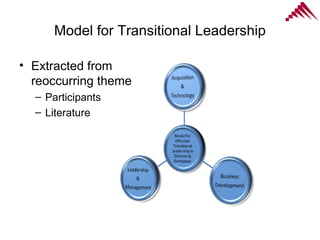
Model for Transitional Leadership Extracted from reoccurring theme Participants Literature
Acquisition & Technology Addresses the individual’s ability to understand the acquisition life cycle  and technology utilized by the end user.
Leadership & Management This portion addresses an individual’s ability to lead employees and manage work.  Managing can be in the form of direct-first line management, matrix management, or a combination of the two.  Leadership focuses on the individual’s leadership ability and capability.  Leadership utilizes the strategic, conceptual, an analytical thinking skills.  Communication focuses on the individual’s ability to communicate masterfully.  This also means the ability to advise on complex matters to non-specialists.  Diagram created by Maurice E. Dawson Jr., MS, CPD
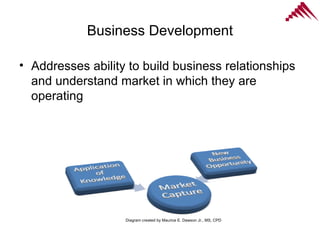
Business Development Addresses ability to build business relationships and understand market in which they are operating Diagram created by Maurice E. Dawson Jr., MS, CPD
Strategies of Inquiry Quantitative Qualitative Mixed Methods Taken from Creswell, J. W. (2003). Research  Design: Qualitative, Quantitative, and Mixed Methods Approaches . Thousand Oaks, CA: Sage Publications. Alternatives Strategies of Inquiry Quantitative Qualitative Mixed Methods Experimental designs Non-experimental designs, such as surveys or polls Narratives  Phenomenology Ethnographies  Ground theory Case studies Sequential  Concurrent Transformative
Mixed Methods Approach Step 1: Quantitative Weighted factor scoring method in which the weights are individually placed upon the various items to get an output  Diagram created by Maurice E. Dawson Jr., MS, CPD
Mixed Methods Approach Step 1: Method of Data Collection Minimum undergraduate degree Defense Acquisition University training Activity working in the Acquisition Field  Table created by Maurice E. Dawson Jr., MS, CPD Name Current/Role Position Participant 1 Missile Defense & Ground Midcourse Defense Test Support Participant 2 Military Program Analyst Participant 3 Principle Business Analyst/ Business Development Participant 4 Manager, Contracts Participant 5 Special Operations Aviation Flight Test Director Participant 6 Ch-47F Flight Test Lead, SOA Flight Test Director Participant 7 Manager, Central Region Security Participant 8 Retired Sergeants Major/Military Instructor  Participant 9 Mechanical Engineer Co-op Participant 10 Senior Director of International Marketing  Participant 11 Software Engineer/ 2 nd  Lieutenant in Army National Guard (Intelligence PM Support) Participant 12 Senior Program Manager Participant 13 Retired Ltc [Director Equivalent] ./ Self Employed Business Owner Participant 14 Manager, Strategic Analysis Advanced Logistics Support Systems
Mixed Methods Approach Step 2: Qualitative Unlike quantitative research, qualitative research relies on reasons behind various aspects of behavior as well as the human interaction within their environment
Mixed Methods Approach Step 2: Method of Data Collection Four in depth servicemen interview
Mixed Methods Approach Step 2: Cross Case Analysis Upon completion of the interviews, I will compare the cases.  The first step will be constructing a conceptual framework of the identified military leadership skills and develop another framework for transfer of leadership abilities in the civilian sector.  Utilizing the “two example” process will allow you to provide validation to you qualitative process. The goal will be to uncover patterns and themes through cross-case analysis.
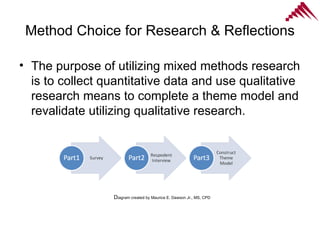
Method Choice for Research & Reflections The purpose of utilizing mixed methods research is to collect quantitative data and use qualitative research means to complete a theme model and revalidate utilizing qualitative research.  D iagram created by Maurice E. Dawson Jr., MS, CPD
Validity Issues Validity issues rest upon the quality of interview questions and the selection of interviewees.  Since my data set is comprised of  interviews of approximately four individuals, the quality of my emergent theory and insight will be delimited by the depth and breath of the interview questions.  While the individuals chosen for the interviews comprise various military backgrounds, they all have experienced similar leadership training and hold leadership positions within the same company, my results will be case specific.
Ethical Issues Problem:  Due to my long term involvement, personal relationships, and interviewing I have the potential for variances in my field research due to the human interaction.  Mitigation:  The quantitative part of the research allows me to remain unbiased in my findings. CTU ethical items for conducting research Competing companies Personal relationship Level to say no or involuntary or obligation Disclosure of risk that may be inherent in this study
Preliminary Results Educational Links Majority with graduate education in management/business Intense military training beyond that of Basic Combat Training (BCT) and Advanced Individual Training (AIT) Taken coursework with Defense Acquisition Corps (DAU) Traits Displayed the Army’s LDRSHIP Model Motivated Determined Took ownership  Understood the company’s vision  Understood the business focus Knew when to follow Knew when to lead
Action Items (AI) AI: How far can I go into giving specific guidance? AI: Can this be applied to a specific market segment? AI: Is it easier to talk about the leadership and management section? AI: Get model from D.Steven’s dissertation? HYPOTHESIS:  I can build a model that is useful.  Building and/or improving upon former models.

Doctorate Dissertation Proposal

  • 1.
    Maurice Eugene DawsonJr., M.S., B.S. Master of Science in Management concentration Information Systems Security June 2006 Bachelor of Science in Applied Technology concentration Information Systems May 2004 Presentation About The Research Proposal Submitted to The Graduate Council in Partial Fulfillment of The Requirement for the Degree of Doctor of Computer Science with a concentration in Enterprise Information Systems
  • 2.
    Doctoral Committee MentorJeff Stevens, Ph.D. Reader(s) David Leasure, Ph.D. Cynthia Cologne, Ph.D
  • 3.
    Dissertation Topic Developinga Hiring Framework for Decision Support Systems to Facilitate a Transition from Military to Civilian within the Acquisition Program Management Career Field
  • 4.
    Dissertation Outline AbstractDedication Acknowledgements CHAPTER 1. INTRODUCTION CHAPTER 2. LITERATURE REVIEW CHAPTER 3. METHODOLOGY CHAPTER 4. RESULTS CHAPTER 5. RECOMMENDATIONS REFERENCES
  • 5.
    Table of ContentsAbstract Introduction Model for Effective Transitional Leadership Acquisition & Technology Defined Leadership & Management Defined Business Development Defined Strategies of Inquiry Mixed Methods Approach Step 1: Quantitative Step 1: Method of Data Collection Step 2: Qualitative Step 2: Method of Data Collection Former Servicemen Interviews Step 2: Cross-Case Analysis Method Choice for My Research & Reflections Validity Issues Ethical Issues Preliminary Results
  • 6.
    Abstract Defense &Aerospace companies such as Boeing, Raytheon, Rockwell Collins, Harris, COLSA, and many other defense related companies continuously seek well educated, high energy, and dynamic soldiers to lead within in their organizations.
  • 7.
    Introduction The purposeof this paper is to understand the transitional process for leadership within program management in the Defense & Aerospace industry through a mixed methodology approach.
  • 8.
    Model for TransitionalLeadership Extracted from reoccurring theme Participants Literature
  • 9.
    Acquisition & TechnologyAddresses the individual’s ability to understand the acquisition life cycle and technology utilized by the end user.
  • 10.
    Leadership & ManagementThis portion addresses an individual’s ability to lead employees and manage work. Managing can be in the form of direct-first line management, matrix management, or a combination of the two. Leadership focuses on the individual’s leadership ability and capability. Leadership utilizes the strategic, conceptual, an analytical thinking skills. Communication focuses on the individual’s ability to communicate masterfully. This also means the ability to advise on complex matters to non-specialists. Diagram created by Maurice E. Dawson Jr., MS, CPD
  • 11.
    Business Development Addressesability to build business relationships and understand market in which they are operating Diagram created by Maurice E. Dawson Jr., MS, CPD
  • 12.
    Strategies of InquiryQuantitative Qualitative Mixed Methods Taken from Creswell, J. W. (2003). Research Design: Qualitative, Quantitative, and Mixed Methods Approaches . Thousand Oaks, CA: Sage Publications. Alternatives Strategies of Inquiry Quantitative Qualitative Mixed Methods Experimental designs Non-experimental designs, such as surveys or polls Narratives Phenomenology Ethnographies Ground theory Case studies Sequential Concurrent Transformative
  • 13.
    Mixed Methods ApproachStep 1: Quantitative Weighted factor scoring method in which the weights are individually placed upon the various items to get an output Diagram created by Maurice E. Dawson Jr., MS, CPD
  • 14.
    Mixed Methods ApproachStep 1: Method of Data Collection Minimum undergraduate degree Defense Acquisition University training Activity working in the Acquisition Field Table created by Maurice E. Dawson Jr., MS, CPD Name Current/Role Position Participant 1 Missile Defense & Ground Midcourse Defense Test Support Participant 2 Military Program Analyst Participant 3 Principle Business Analyst/ Business Development Participant 4 Manager, Contracts Participant 5 Special Operations Aviation Flight Test Director Participant 6 Ch-47F Flight Test Lead, SOA Flight Test Director Participant 7 Manager, Central Region Security Participant 8 Retired Sergeants Major/Military Instructor Participant 9 Mechanical Engineer Co-op Participant 10 Senior Director of International Marketing Participant 11 Software Engineer/ 2 nd Lieutenant in Army National Guard (Intelligence PM Support) Participant 12 Senior Program Manager Participant 13 Retired Ltc [Director Equivalent] ./ Self Employed Business Owner Participant 14 Manager, Strategic Analysis Advanced Logistics Support Systems
  • 15.
    Mixed Methods ApproachStep 2: Qualitative Unlike quantitative research, qualitative research relies on reasons behind various aspects of behavior as well as the human interaction within their environment
  • 16.
    Mixed Methods ApproachStep 2: Method of Data Collection Four in depth servicemen interview
  • 17.
    Mixed Methods ApproachStep 2: Cross Case Analysis Upon completion of the interviews, I will compare the cases. The first step will be constructing a conceptual framework of the identified military leadership skills and develop another framework for transfer of leadership abilities in the civilian sector. Utilizing the “two example” process will allow you to provide validation to you qualitative process. The goal will be to uncover patterns and themes through cross-case analysis.
  • 18.
    Method Choice forResearch & Reflections The purpose of utilizing mixed methods research is to collect quantitative data and use qualitative research means to complete a theme model and revalidate utilizing qualitative research. D iagram created by Maurice E. Dawson Jr., MS, CPD
  • 19.
    Validity Issues Validityissues rest upon the quality of interview questions and the selection of interviewees. Since my data set is comprised of interviews of approximately four individuals, the quality of my emergent theory and insight will be delimited by the depth and breath of the interview questions. While the individuals chosen for the interviews comprise various military backgrounds, they all have experienced similar leadership training and hold leadership positions within the same company, my results will be case specific.
  • 20.
    Ethical Issues Problem: Due to my long term involvement, personal relationships, and interviewing I have the potential for variances in my field research due to the human interaction. Mitigation: The quantitative part of the research allows me to remain unbiased in my findings. CTU ethical items for conducting research Competing companies Personal relationship Level to say no or involuntary or obligation Disclosure of risk that may be inherent in this study
  • 21.
    Preliminary Results EducationalLinks Majority with graduate education in management/business Intense military training beyond that of Basic Combat Training (BCT) and Advanced Individual Training (AIT) Taken coursework with Defense Acquisition Corps (DAU) Traits Displayed the Army’s LDRSHIP Model Motivated Determined Took ownership Understood the company’s vision Understood the business focus Knew when to follow Knew when to lead
  • 22.
    Action Items (AI)AI: How far can I go into giving specific guidance? AI: Can this be applied to a specific market segment? AI: Is it easier to talk about the leadership and management section? AI: Get model from D.Steven’s dissertation? HYPOTHESIS: I can build a model that is useful. Building and/or improving upon former models.