
Did you know? http: //youtube .com/watch? v=rjKBsfk_O8c Did you know?
 
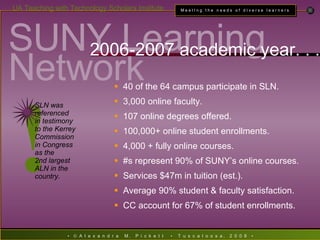
SUNY Learning Network 40 of the 64 campus participate in SLN. 3,000 online faculty. 107 online degrees offered. 100,000+ online student enrollments. 4,000 + fully online courses. #s represent 90% of SUNY’s online courses. Services $47m in tuition (est.). Average 90% student & faculty satisfaction. CC account for 67% of student enrollments. 2006-2007 academic year. . .   ! SLN was  referenced  in testimony  to the Kerrey Commission in Congress  as the  2nd largest  ALN in the  country.
Alexandra M. Pickett   Associate Director SUNY Learning Network Faculty Development & Learning Design 2001 Sloan-C Award for Excellence in ALN Faculty Development Improve Your  Online Presence Meeting the needs of diverse learners
Introduction   What are the characteristics of your F2F or blended/online students? Who are they? What do they want? What do they like/dislike?  Where are they? What do they need? What makes any learning environment effective? What works? What does not?
This presentation will provide: A discussion about pedagogy, andragogy, the new millennial student, & online students. - to understand why improving your online presence can help you meet the needs of diverse learners. A theoretical framework. An overview of “Teaching Presence.” An overview of “Class Community.”  - to provide some guidelines that are effective in addressing the needs of diverse learners. An opportunity to turn theory into practice.  - to provide ideas and inspiration to improve your online presence. Introduction
Pedagogy Andragogy Pedagogy Andragogy Pedagogy vs. Andragogy Millennials and Adult learners = diverse learners What works?  Discuss some effective strategies for meeting the needs of diverse learners and improving your online presence.
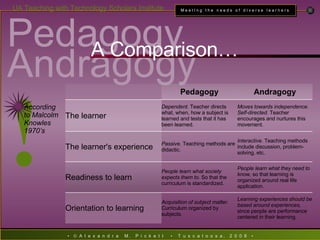
! Pedagogy Andragogy According  to Malcolm Knowles 1970’s A Comparison… Learning experiences should be based around experiences,  since people are performance centered in their learning. Acquisition of subject matter.  Curriculum organized by subjects. Orientation to learning People learn what they need to know,  so that learning is  organized around real life application. People learn what society expects them to.  So that the curriculum is standardized. Readiness to learn Interactive.  Teaching methods include discussion, problem-solving, etc. Passive.  Teaching methods are didactic. The learner's experience Moves towards independence .   Self-directed.  Teacher encourages and nurtures this movement. Dependent.  Teacher directs what, when, how a subject is learned and tests that it has been learned. The learner Andragogy Pedagogy  
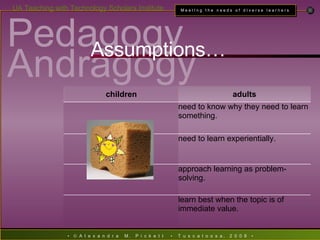
Pedagogy Andragogy Assumptions…  learn best when the topic is of immediate value. approach learning as problem-solving.  need to learn experientially.  need to know why they need to learn something.  adults children  
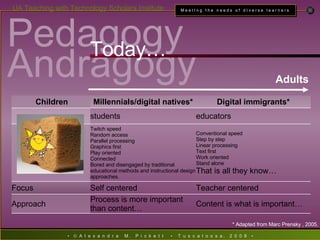
Pedagogy Andragogy Today…  * Adapted from Marc Prensky , 2005. Adults Content is what is important… Process is more important than content… Approach Teacher centered Self centered Focus Conventional speed Step by step Linear processing Text first Work oriented Stand alone That is all they know… Twitch speed Random access Parallel processing Graphics first Play oriented Connected Bored and disengaged by traditional educational methods and instructional design approaches. educators students Digital immigrants* Millennials/digital natives*   Children
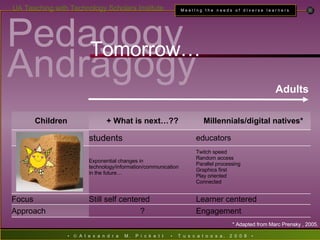
Pedagogy Andragogy Tomorrow…  Adults * Adapted from Marc Prensky , 2005. Engagement  ? Approach Learner centered Still self centered  Focus Twitch speed Random access Parallel processing Graphics first Play oriented Connected Exponential changes in technology/information/communication  in the future… educators students Millennials/digital natives* + What is next…??   Children
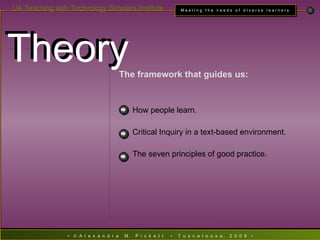
Theory Theory How people learn. Critical Inquiry in a text-based environment. The seven principles of good practice. The framework that guides us:
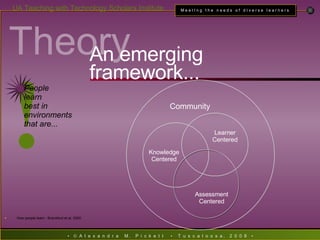
Theory How people learn - Bransford et al, 2000. An emerging framework... ! People  learn  best in  environments  that are... Community Assessment Centered Knowledge Centered Learner Centered
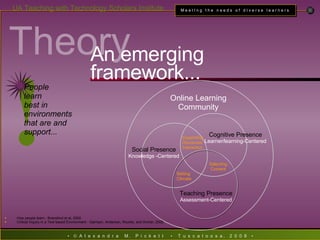
Theory An emerging framework... How people learn - Bransford et al, 2000. Critical Inquiry in a Text-based Environment - Garrison, Anderson, Rourke, and Archer, 2002. ! People  learn  best in  environments  that are and support... Online Learning Community Teaching Presence Assessment-Centered Social Presence Knowledge -Centered Cognitive Presence Learner/learning-Centered Setting  Climate Supporting Discourse/Interaction Selecting Content
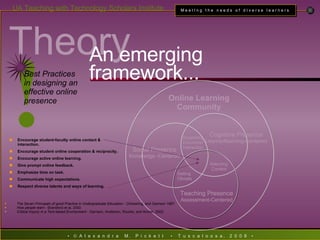
Theory An emerging framework... Encourage student-faculty online contact & interaction.   Encourage student online cooperation & reciprocity. Encourage active online learning. Give prompt online feedback. Emphasize time on task. Communicate high expectations. Respect diverse talents and ways of learning. The Seven Principals of good Practice in Undergraduate Education  - Chickering, and Gamson 1987. How people learn  - Bransford et al, 2000 Critical Inquiry in a Text-based Environment  - Garrison, Anderson, Rourke, and Archer, 2002. ! Best Practices in designing an effective online presence Online Learning Community Teaching Presence Assessment-Centered Social Presence Knowledge -Centered Cognitive Presence Learner/learning-Centered Setting  Climate Supporting Discourse/Interaction Selecting Content
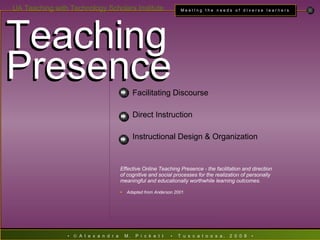
Teaching Presence Facilitating Discourse Direct Instruction Instructional Design & Organization Effective Online Teaching Presence - the facilitation and direction of cognitive and social processes for the realization of personally meaningful and educationally worthwhile learning outcomes.  Adapted from Anderson 2001. Teaching Presence
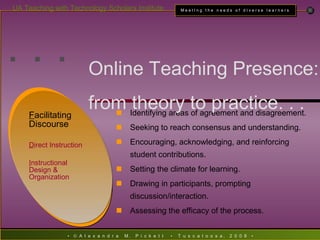
. . . Identifying areas of agreement and disagreement. Seeking to reach consensus and understanding. Encouraging, acknowledging, and reinforcing student contributions. Setting the climate for learning. Drawing in participants, prompting discussion/interaction. Assessing the efficacy of the process. Online Teaching Presence:  from theory to practice. . . F acilitating Discourse D irect Instruction I nstructional Design & Organization
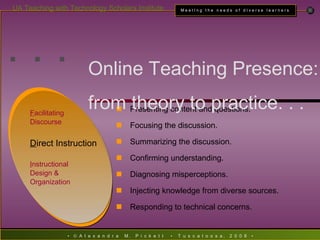
. . . F acilitating  Discourse D irect Instruction I nstructional  Design &  Organization Presenting content and questions. Focusing the discussion. Summarizing the discussion. Confirming understanding. Diagnosing misperceptions. Injecting knowledge from diverse sources. Responding to technical concerns. Online Teaching Presence:  from theory to practice. . .
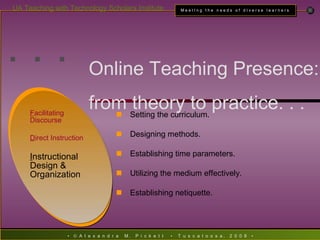
. . . F acilitating Discourse D irect Instruction I nstructional Design & Organization Setting the curriculum. Designing methods. Establishing time parameters. Utilizing the medium effectively. Establishing netiquette. Online Teaching Presence:  from theory to practice. . .
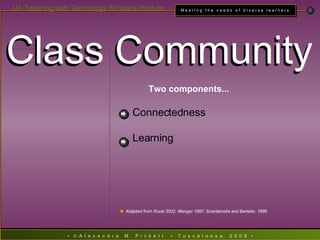
Class Community Class Community Two components... Connectedness Learning Adapted from Rovai 2002, Wenger 1997, Scardamalia and Berieter, 1996.
. . . C onnectedness L earning Online Class Community:  from theory to practice. . . Building social/group spirit. Establishing trust.
. . . Online Class Community:  from theory to practice. . . Engaging in supportive contact and interaction. Sharing educational expectations. C onnectedness L earning
. . . Online Class Community:  from theory to practice. . . C onnectedness L earning Create ample opportunities for interaction Create activities that build a sense of class community. Design activities that create a sense of connectedness between the students & the instructor. Create a learning environment that is engaging with supportive contact & interaction.
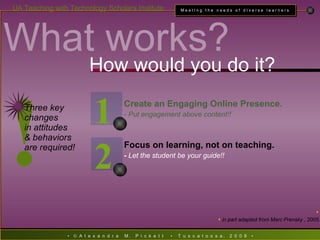
How would you do it? Create an Engaging Online Presence. - Put engagement above content!! in part  adapted from Marc Prensky , 2005. ! Three key  changes  in attitudes  & behaviors  are required! What works? 1
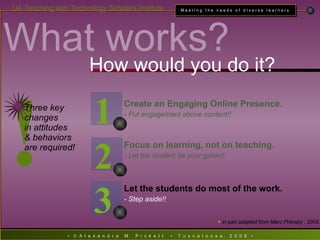
How would you do it? Create an Engaging Online Presence. - Put engagement above content!! Focus on learning, not on teaching. -  Let the student be your guide!! in part  adapted from Marc Prensky , 2005. ! Three key  changes  in attitudes  & behaviors  are required! What works? 1 2
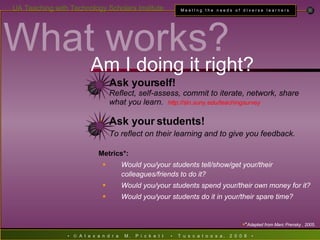
How would you do it? Create an Engaging Online Presence. -  Put engagement above content!! Focus on learning, not on teaching. - Let the student be your guide!! Let the students do most of the work. - Step aside!! in part  adapted from Marc Prensky , 2005. ! Three key  changes  in attitudes  & behaviors  are required! What works? 1 2 3
Ask yourself! Reflect, self-assess, commit to iterate, network, share what you learn.  http: //sln . suny . edu/teachingsurvey Ask your students! To reflect on their learning and to give you feedback.  Metrics*: Would you/your students tell/show/get your/their colleagues/friends to do it? Would you/your students spend your/their own money for it? Would you/your students do it in your/their spare time? * Adapted from Marc Prensky , 2005 . What works? Am I doing it right?
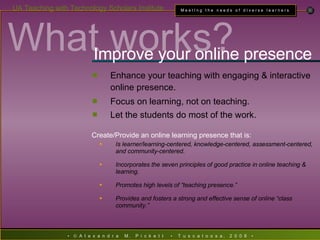
What works? Improve your online presence Enhance your teaching with engaging & interactive online presence. Focus on learning, not on teaching. Let the students do most of the work. Create/Provide an online learning presence that is: Is learner/learning-centered, knowledge-centered, assessment-centered, and community-centered. Incorporates the seven principles of good practice in online teaching & learning. Promotes high levels of “teaching presence.” Provides and fosters a strong and effective sense of online “class community.”
? Any questions Any questions ?
Thank you! Alexandra M. Pickett alexandra . [email_address] . suny . edu Join my network! http://www.twitter.com/alexpickett http://www.slideshare.net/alexandrapickett/slideshows http://www.youtube.com/user/alexandrapickett http://parkerk1.edublogs.org http://slnsummit.sln.suny.edu http://etap687.edublogs.org http://twitter.com/slnsolsummit http://flickr.com/photos/alexandrapickett http://www.spock.com/Alexandra-M.-Pickett-TFZBh10F http://www.linkedin.com/in/alexandrapickett http://www.pownce.com/alexandrapickett/ http://www.pandora.com/people/alexandra.pickett http://del.icio.us/alexandrapickett/ http://www.blinklist.com/alexandrapickett/ Alejandra Subagja in Second Life http://slurl.com/secondlife/SUNY%20Learning%20Network/128/128/0 Skype: alexandrapickett

Diverselearners2008

  • 1.
    Did you know?http: //youtube .com/watch? v=rjKBsfk_O8c Did you know?
  • 2.
  • 3.
    SUNY Learning Network40 of the 64 campus participate in SLN. 3,000 online faculty. 107 online degrees offered. 100,000+ online student enrollments. 4,000 + fully online courses. #s represent 90% of SUNY’s online courses. Services $47m in tuition (est.). Average 90% student & faculty satisfaction. CC account for 67% of student enrollments. 2006-2007 academic year. . . ! SLN was referenced in testimony to the Kerrey Commission in Congress as the 2nd largest ALN in the country.
  • 4.
    Alexandra M. Pickett Associate Director SUNY Learning Network Faculty Development & Learning Design 2001 Sloan-C Award for Excellence in ALN Faculty Development Improve Your Online Presence Meeting the needs of diverse learners
  • 5.
    Introduction What are the characteristics of your F2F or blended/online students? Who are they? What do they want? What do they like/dislike? Where are they? What do they need? What makes any learning environment effective? What works? What does not?
  • 6.
    This presentation willprovide: A discussion about pedagogy, andragogy, the new millennial student, & online students. - to understand why improving your online presence can help you meet the needs of diverse learners. A theoretical framework. An overview of “Teaching Presence.” An overview of “Class Community.” - to provide some guidelines that are effective in addressing the needs of diverse learners. An opportunity to turn theory into practice. - to provide ideas and inspiration to improve your online presence. Introduction
  • 7.
    Pedagogy Andragogy PedagogyAndragogy Pedagogy vs. Andragogy Millennials and Adult learners = diverse learners What works? Discuss some effective strategies for meeting the needs of diverse learners and improving your online presence.
  • 8.
    ! Pedagogy AndragogyAccording to Malcolm Knowles 1970’s A Comparison… Learning experiences should be based around experiences, since people are performance centered in their learning. Acquisition of subject matter. Curriculum organized by subjects. Orientation to learning People learn what they need to know, so that learning is organized around real life application. People learn what society expects them to. So that the curriculum is standardized. Readiness to learn Interactive. Teaching methods include discussion, problem-solving, etc. Passive. Teaching methods are didactic. The learner's experience Moves towards independence . Self-directed. Teacher encourages and nurtures this movement. Dependent. Teacher directs what, when, how a subject is learned and tests that it has been learned. The learner Andragogy Pedagogy  
  • 9.
    Pedagogy Andragogy Assumptions… learn best when the topic is of immediate value. approach learning as problem-solving. need to learn experientially. need to know why they need to learn something. adults children  
  • 10.
    Pedagogy Andragogy Today… * Adapted from Marc Prensky , 2005. Adults Content is what is important… Process is more important than content… Approach Teacher centered Self centered Focus Conventional speed Step by step Linear processing Text first Work oriented Stand alone That is all they know… Twitch speed Random access Parallel processing Graphics first Play oriented Connected Bored and disengaged by traditional educational methods and instructional design approaches. educators students Digital immigrants* Millennials/digital natives*   Children
  • 11.
    Pedagogy Andragogy Tomorrow… Adults * Adapted from Marc Prensky , 2005. Engagement ? Approach Learner centered Still self centered Focus Twitch speed Random access Parallel processing Graphics first Play oriented Connected Exponential changes in technology/information/communication in the future… educators students Millennials/digital natives* + What is next…??   Children
  • 12.
    Theory Theory Howpeople learn. Critical Inquiry in a text-based environment. The seven principles of good practice. The framework that guides us:
  • 13.
    Theory How peoplelearn - Bransford et al, 2000. An emerging framework... ! People learn best in environments that are... Community Assessment Centered Knowledge Centered Learner Centered
  • 14.
    Theory An emergingframework... How people learn - Bransford et al, 2000. Critical Inquiry in a Text-based Environment - Garrison, Anderson, Rourke, and Archer, 2002. ! People learn best in environments that are and support... Online Learning Community Teaching Presence Assessment-Centered Social Presence Knowledge -Centered Cognitive Presence Learner/learning-Centered Setting Climate Supporting Discourse/Interaction Selecting Content
  • 15.
    Theory An emergingframework... Encourage student-faculty online contact & interaction. Encourage student online cooperation & reciprocity. Encourage active online learning. Give prompt online feedback. Emphasize time on task. Communicate high expectations. Respect diverse talents and ways of learning. The Seven Principals of good Practice in Undergraduate Education - Chickering, and Gamson 1987. How people learn - Bransford et al, 2000 Critical Inquiry in a Text-based Environment - Garrison, Anderson, Rourke, and Archer, 2002. ! Best Practices in designing an effective online presence Online Learning Community Teaching Presence Assessment-Centered Social Presence Knowledge -Centered Cognitive Presence Learner/learning-Centered Setting Climate Supporting Discourse/Interaction Selecting Content
  • 16.
    Teaching Presence FacilitatingDiscourse Direct Instruction Instructional Design & Organization Effective Online Teaching Presence - the facilitation and direction of cognitive and social processes for the realization of personally meaningful and educationally worthwhile learning outcomes. Adapted from Anderson 2001. Teaching Presence
  • 17.
    . . .Identifying areas of agreement and disagreement. Seeking to reach consensus and understanding. Encouraging, acknowledging, and reinforcing student contributions. Setting the climate for learning. Drawing in participants, prompting discussion/interaction. Assessing the efficacy of the process. Online Teaching Presence: from theory to practice. . . F acilitating Discourse D irect Instruction I nstructional Design & Organization
  • 18.
    . . .F acilitating Discourse D irect Instruction I nstructional Design & Organization Presenting content and questions. Focusing the discussion. Summarizing the discussion. Confirming understanding. Diagnosing misperceptions. Injecting knowledge from diverse sources. Responding to technical concerns. Online Teaching Presence: from theory to practice. . .
  • 19.
    . . .F acilitating Discourse D irect Instruction I nstructional Design & Organization Setting the curriculum. Designing methods. Establishing time parameters. Utilizing the medium effectively. Establishing netiquette. Online Teaching Presence: from theory to practice. . .
  • 20.
    Class Community ClassCommunity Two components... Connectedness Learning Adapted from Rovai 2002, Wenger 1997, Scardamalia and Berieter, 1996.
  • 21.
    . . .C onnectedness L earning Online Class Community: from theory to practice. . . Building social/group spirit. Establishing trust.
  • 22.
    . . .Online Class Community: from theory to practice. . . Engaging in supportive contact and interaction. Sharing educational expectations. C onnectedness L earning
  • 23.
    . . .Online Class Community: from theory to practice. . . C onnectedness L earning Create ample opportunities for interaction Create activities that build a sense of class community. Design activities that create a sense of connectedness between the students & the instructor. Create a learning environment that is engaging with supportive contact & interaction.
  • 24.
    How would youdo it? Create an Engaging Online Presence. - Put engagement above content!! in part adapted from Marc Prensky , 2005. ! Three key changes in attitudes & behaviors are required! What works? 1
  • 25.
    How would youdo it? Create an Engaging Online Presence. - Put engagement above content!! Focus on learning, not on teaching. - Let the student be your guide!! in part adapted from Marc Prensky , 2005. ! Three key changes in attitudes & behaviors are required! What works? 1 2
  • 26.
    How would youdo it? Create an Engaging Online Presence. - Put engagement above content!! Focus on learning, not on teaching. - Let the student be your guide!! Let the students do most of the work. - Step aside!! in part adapted from Marc Prensky , 2005. ! Three key changes in attitudes & behaviors are required! What works? 1 2 3
  • 27.
    Ask yourself! Reflect,self-assess, commit to iterate, network, share what you learn. http: //sln . suny . edu/teachingsurvey Ask your students! To reflect on their learning and to give you feedback. Metrics*: Would you/your students tell/show/get your/their colleagues/friends to do it? Would you/your students spend your/their own money for it? Would you/your students do it in your/their spare time? * Adapted from Marc Prensky , 2005 . What works? Am I doing it right?
  • 28.
    What works? Improveyour online presence Enhance your teaching with engaging & interactive online presence. Focus on learning, not on teaching. Let the students do most of the work. Create/Provide an online learning presence that is: Is learner/learning-centered, knowledge-centered, assessment-centered, and community-centered. Incorporates the seven principles of good practice in online teaching & learning. Promotes high levels of “teaching presence.” Provides and fosters a strong and effective sense of online “class community.”
  • 29.
    ? Any questionsAny questions ?
  • 30.
    Thank you! AlexandraM. Pickett alexandra . [email_address] . suny . edu Join my network! http://www.twitter.com/alexpickett http://www.slideshare.net/alexandrapickett/slideshows http://www.youtube.com/user/alexandrapickett http://parkerk1.edublogs.org http://slnsummit.sln.suny.edu http://etap687.edublogs.org http://twitter.com/slnsolsummit http://flickr.com/photos/alexandrapickett http://www.spock.com/Alexandra-M.-Pickett-TFZBh10F http://www.linkedin.com/in/alexandrapickett http://www.pownce.com/alexandrapickett/ http://www.pandora.com/people/alexandra.pickett http://del.icio.us/alexandrapickett/ http://www.blinklist.com/alexandrapickett/ Alejandra Subagja in Second Life http://slurl.com/secondlife/SUNY%20Learning%20Network/128/128/0 Skype: alexandrapickett

Editor's Notes

  • #2 I have seen this video dozens of times and every time I get very emotional ….