Sonja K. Rogers Proposal Oral Defense May 25, 2011 Walden University Richard W. Riley College of Educational Leadership Dr. Barbara Calabro Committee Chairperson Dr. Mel Finkenberg Committee Member
·  Introduction · Literature Review · Background of Study · Research Design · Nature of the Study · Setting and Sample · Research Question · Instrumentation · Purpose of Study · Data Collection & Analysis  · Theoretical Framework · Participant Rights · Assumptions/Delimitations/ · Dissemination of Findings Limitations · Social Change
Researcher Middle School Reading Teacher Six sections of Middle School Reading Reading is a lifelong learning tool Background of the Study   · Low reading scores   · Lack of motivation to read independently
Student’s lack of motivation to read independently is affecting the amount of knowledge students could be obtaining.  Because reading for pleasure has declined among school-aged Americans, the United States may face the possibility of a less informed, active, and independent-minded society (Roberts & Wilson, 2006).  Reading attitude plays a significant role in the development of lifelong reading skills by affecting one’s motivation and overall achievement (Roberts & Wilson, 2006).  There is a need for increased understanding of strategies middle school teachers could implement to promote young adult literature and recreation reading.
Purpose This quasi-experimental quantitative study will use the Northwest Evaluation Association’s Measures of Academic Progress test to explore the academic achievement of middle school students. The survey design is quasi-experimental because the control and experimental groups were not selected randomly (Creswell, 2003). Research Design Winter and Spring MAP results will be collected in order to correlate and determine if there is a difference in testing scores after intrinsic reading strategies have been implemented. Data will be analyzed to determine whether student scores from the experimental group improved during the implementation time of this study compared to the sample that did not participate.  During the study, students in the control group will be encouraged to read independently using a variety of methods implemented in the classroom.
Is there a correlation between student motivation to read independently and student test scores on NWEA’s Measures of Academic Progress testing?
The purpose of this quasi-experimental study is to determine if there is a correlation between providing students with a reading program to increase student’s motivation to read extra-curricular material and improvement in test results as students spend more time reading.  Variables Independent Variable   BEAR reading program to improve student motivation    to read independently. Dependent Variable   Northwest Evaluation Association’s Measures of     Academic Progress student test scores.
The constructivist learning theory will be applied to this study.  One of the principles of constructivism is that social activity and shared inquiry be an important part of the learning (Lambert et al., 2002).  Students are able to increase their learning with “more depth and understanding when they are able to share ideas with others, engage in the dynamic and synergistic process of thinking together, consider other points of view, and broaden their own perspectives” (Lambert et al., 2002, p 27).
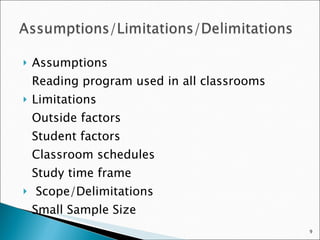
Assumptions Reading program used in all classrooms Limitations Outside factors Student factors Classroom schedules Study time frame Scope/Delimitations Small Sample Size
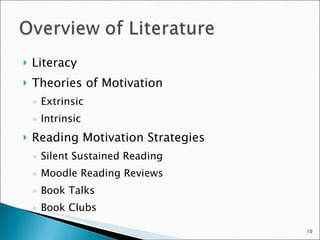
Literacy Theories of Motivation Extrinsic Intrinsic Reading Motivation Strategies Silent Sustained Reading Moodle Reading Reviews Book Talks Book Clubs
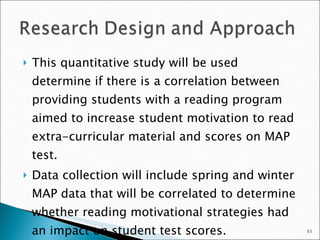
This quantitative study will be used determine if there is a correlation between providing students with a reading program aimed to increase student motivation to read extra-curricular material and scores on MAP test. Data collection will include spring and winter MAP data that will be correlated to determine whether reading motivational strategies had an impact on student test scores.
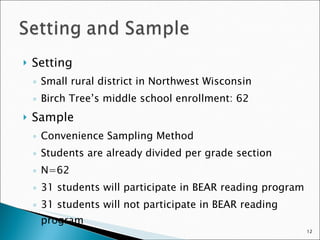
Setting Small rural district in Northwest Wisconsin Birch Tree’s middle school enrollment: 62 Sample Convenience Sampling Method Students are already divided per grade section N=62 31 students will participate in BEAR reading program 31 students will not participate in BEAR reading program
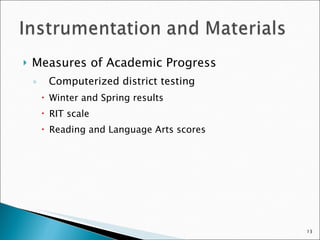
Measures of Academic Progress Computerized district testing Winter and Spring results RIT scale Reading and Language Arts scores
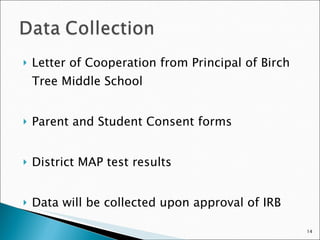
Letter of Cooperation from Principal of Birch Tree Middle School Parent and Student Consent forms District MAP test results Data will be collected upon approval of IRB
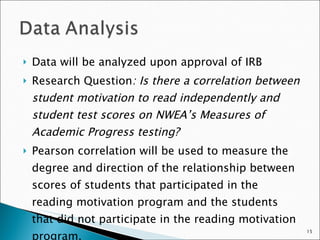
Data will be analyzed upon approval of IRB Research Question : Is there a correlation between student motivation to read independently and student test scores on NWEA’s Measures of Academic Progress testing?  Pearson correlation will be used to measure the degree and direction of the relationship between scores of students that participated in the reading motivation program and the students that did not participate in the reading motivation program.
No new participants will be added Letter of Cooperation Parent and Student Letters of Consent Anonymity Stored electronically Removal of personal identifying information Secure data storage Password protected  District principal’s office
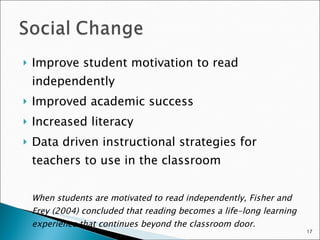
Improve student motivation to read independently Improved academic success Increased literacy Data driven instructional strategies for teachers to use in the classroom When students are motivated to read independently, Fisher and Frey (2004) concluded that reading becomes a life-long learning experience that continues beyond the classroom door.
Questions Regarding Study?
Fisher, D. & Frey, N. (2004).  Improving Adolescent Literacy: Strategies at Work . New Jersey: Pearson Education, Inc. Lambert, L. Walker, D., Zimmerman, Cooper, D.P., Lambert, M.D., Gardner, M.E.,Szabo, M. (2002).  The constructivist leader (2 nd  ed.) . New York: Teachers College Press. Roberts, M. S., & Wilson, J.D. (2006). Reading attitudes and instructional methodology: How might achievement become affected?  Reading Improvement, 43( 2)\, 64-69.

Oral proposaldefense

  • 1.
    Sonja K. RogersProposal Oral Defense May 25, 2011 Walden University Richard W. Riley College of Educational Leadership Dr. Barbara Calabro Committee Chairperson Dr. Mel Finkenberg Committee Member
  • 2.
    · Introduction· Literature Review · Background of Study · Research Design · Nature of the Study · Setting and Sample · Research Question · Instrumentation · Purpose of Study · Data Collection & Analysis · Theoretical Framework · Participant Rights · Assumptions/Delimitations/ · Dissemination of Findings Limitations · Social Change
  • 3.
    Researcher Middle SchoolReading Teacher Six sections of Middle School Reading Reading is a lifelong learning tool Background of the Study · Low reading scores · Lack of motivation to read independently
  • 4.
    Student’s lack ofmotivation to read independently is affecting the amount of knowledge students could be obtaining. Because reading for pleasure has declined among school-aged Americans, the United States may face the possibility of a less informed, active, and independent-minded society (Roberts & Wilson, 2006). Reading attitude plays a significant role in the development of lifelong reading skills by affecting one’s motivation and overall achievement (Roberts & Wilson, 2006). There is a need for increased understanding of strategies middle school teachers could implement to promote young adult literature and recreation reading.
  • 5.
    Purpose This quasi-experimentalquantitative study will use the Northwest Evaluation Association’s Measures of Academic Progress test to explore the academic achievement of middle school students. The survey design is quasi-experimental because the control and experimental groups were not selected randomly (Creswell, 2003). Research Design Winter and Spring MAP results will be collected in order to correlate and determine if there is a difference in testing scores after intrinsic reading strategies have been implemented. Data will be analyzed to determine whether student scores from the experimental group improved during the implementation time of this study compared to the sample that did not participate. During the study, students in the control group will be encouraged to read independently using a variety of methods implemented in the classroom.
  • 6.
    Is there acorrelation between student motivation to read independently and student test scores on NWEA’s Measures of Academic Progress testing?
  • 7.
    The purpose ofthis quasi-experimental study is to determine if there is a correlation between providing students with a reading program to increase student’s motivation to read extra-curricular material and improvement in test results as students spend more time reading. Variables Independent Variable BEAR reading program to improve student motivation to read independently. Dependent Variable Northwest Evaluation Association’s Measures of Academic Progress student test scores.
  • 8.
    The constructivist learningtheory will be applied to this study. One of the principles of constructivism is that social activity and shared inquiry be an important part of the learning (Lambert et al., 2002). Students are able to increase their learning with “more depth and understanding when they are able to share ideas with others, engage in the dynamic and synergistic process of thinking together, consider other points of view, and broaden their own perspectives” (Lambert et al., 2002, p 27).
  • 9.
    Assumptions Reading programused in all classrooms Limitations Outside factors Student factors Classroom schedules Study time frame Scope/Delimitations Small Sample Size
  • 10.
    Literacy Theories ofMotivation Extrinsic Intrinsic Reading Motivation Strategies Silent Sustained Reading Moodle Reading Reviews Book Talks Book Clubs
  • 11.
    This quantitative studywill be used determine if there is a correlation between providing students with a reading program aimed to increase student motivation to read extra-curricular material and scores on MAP test. Data collection will include spring and winter MAP data that will be correlated to determine whether reading motivational strategies had an impact on student test scores.
  • 12.
    Setting Small ruraldistrict in Northwest Wisconsin Birch Tree’s middle school enrollment: 62 Sample Convenience Sampling Method Students are already divided per grade section N=62 31 students will participate in BEAR reading program 31 students will not participate in BEAR reading program
  • 13.
    Measures of AcademicProgress Computerized district testing Winter and Spring results RIT scale Reading and Language Arts scores
  • 14.
    Letter of Cooperationfrom Principal of Birch Tree Middle School Parent and Student Consent forms District MAP test results Data will be collected upon approval of IRB
  • 15.
    Data will beanalyzed upon approval of IRB Research Question : Is there a correlation between student motivation to read independently and student test scores on NWEA’s Measures of Academic Progress testing? Pearson correlation will be used to measure the degree and direction of the relationship between scores of students that participated in the reading motivation program and the students that did not participate in the reading motivation program.
  • 16.
    No new participantswill be added Letter of Cooperation Parent and Student Letters of Consent Anonymity Stored electronically Removal of personal identifying information Secure data storage Password protected District principal’s office
  • 17.
    Improve student motivationto read independently Improved academic success Increased literacy Data driven instructional strategies for teachers to use in the classroom When students are motivated to read independently, Fisher and Frey (2004) concluded that reading becomes a life-long learning experience that continues beyond the classroom door.
  • 18.
  • 19.
    Fisher, D. &Frey, N. (2004). Improving Adolescent Literacy: Strategies at Work . New Jersey: Pearson Education, Inc. Lambert, L. Walker, D., Zimmerman, Cooper, D.P., Lambert, M.D., Gardner, M.E.,Szabo, M. (2002). The constructivist leader (2 nd ed.) . New York: Teachers College Press. Roberts, M. S., & Wilson, J.D. (2006). Reading attitudes and instructional methodology: How might achievement become affected? Reading Improvement, 43( 2)\, 64-69.