

TAEDEL402A Plan, organise and
facilitate learning in the
workplace
Teresa O'Brien
Principal Lecturer
C.Y. O’Connor Institute


May 8 2012
Learning in the Workplace
Reflect for a moment on your own workplace?
What did you learn?

Why did you learn it

Where did you learn?

When did you learn?

How did you learn?
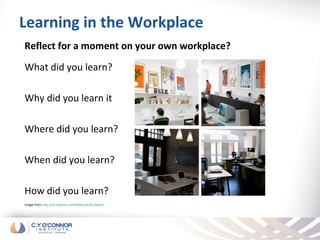
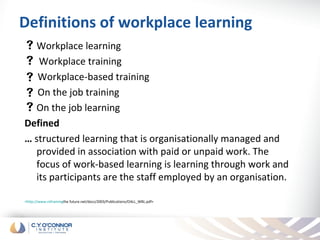
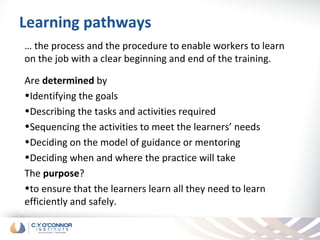
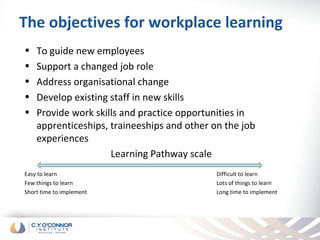
Image from http://ex.maqina.ro/creative-work-places/
Definitions of workplace learning
 Workplace learning
 Workplace training
 Workplace-based training
 On the job training
 On the job learning
Defined
… structured learning that is organisationally managed and
  provided in association with paid or unpaid work. The
  focus of work-based learning is learning through work and
  its participants are the staff employed by an organisation.

<http://www.reframingthe future.net/docs/2003/Publications/OALL_WBL.pdf>
Learning pathways
… the process and the procedure to enable workers to learn
on the job with a clear beginning and end of the training.

Are determined by
•Identifying the goals
•Describing the tasks and activities required
•Sequencing the activities to meet the learners’ needs
•Deciding on the model of guidance or mentoring
•Deciding when and where the practice will take
The purpose?
•to ensure that the learners learn all they need to learn
efficiently and safely.
The objectives for workplace learning
•   To guide new employees
•   Support a changed job role
•   Address organisational change
•   Develop existing staff in new skills
•   Provide work skills and practice opportunities in
    apprenticeships, traineeships and other on the job
    experiences
                     Learning Pathway scale
Easy to learn                                Difficult to learn
Few things to learn                          Lots of things to learn
Short time to implement                      Long time to implement
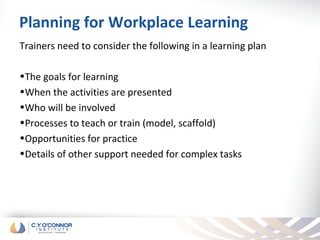
Planning for Workplace Learning
Trainers need to consider the following in a learning plan

•The goals for learning
•When the activities are presented
•Who will be involved
•Processes to teach or train (model, scaffold)
•Opportunities for practice
•Details of other support needed for complex tasks
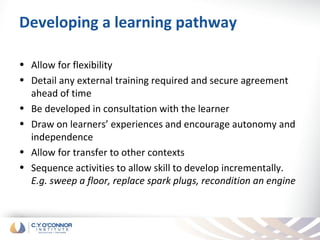
Developing a learning pathway

• Allow for flexibility
• Detail any external training required and secure agreement
  ahead of time
• Be developed in consultation with the learner
• Draw on learners’ experiences and encourage autonomy and
  independence
• Allow for transfer to other contexts
• Sequence activities to allow skill to develop incrementally.
  E.g. sweep a floor, replace spark plugs, recondition an engine
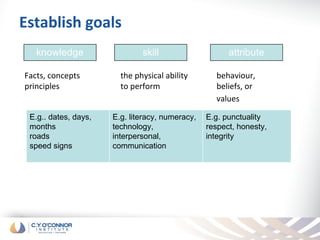
Establish goals


Facts, concepts         the physical ability       behaviour,
principles              to perform                 beliefs, or
                                                   values

 E.g.. dates, days,   E.g. literacy, numeracy,   E.g. punctuality
 months               technology,                respect, honesty,
 roads                interpersonal,             integrity
 speed signs          communication
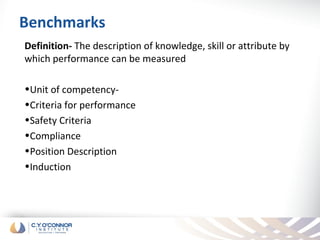
Benchmarks
Definition- The description of knowledge, skill or attribute by
which performance can be measured

•Unit of competency-
•Criteria for performance
•Safety Criteria
•Compliance
•Position Description
•Induction
Reviewing the Learning Pathway

•      to continue or not
•      to improve planning, content, resources…
•      to allow learners to reflect
•      to self assess and reflect
•      to ensure accountability, legitimacy and promotion
•      to meet needs of external stakeholders
•      to comply with legislative or regulatory requirements


Image adapted
http://blogs.adobe.com/captivate/2011/06/captivate-training-reviewing-elearning-courses-made-easy-with-adobe-captivate-5-5.html

Learning Pathways

  • 1.
    TAEDEL402A Plan, organiseand facilitate learning in the workplace Teresa O'Brien Principal Lecturer C.Y. O’Connor Institute May 8 2012
  • 2.
    Learning in theWorkplace Reflect for a moment on your own workplace? What did you learn? Why did you learn it Where did you learn? When did you learn? How did you learn? Image from http://ex.maqina.ro/creative-work-places/
  • 3.
    Definitions of workplacelearning  Workplace learning  Workplace training  Workplace-based training  On the job training  On the job learning Defined … structured learning that is organisationally managed and provided in association with paid or unpaid work. The focus of work-based learning is learning through work and its participants are the staff employed by an organisation. <http://www.reframingthe future.net/docs/2003/Publications/OALL_WBL.pdf>
  • 4.
    Learning pathways … theprocess and the procedure to enable workers to learn on the job with a clear beginning and end of the training. Are determined by •Identifying the goals •Describing the tasks and activities required •Sequencing the activities to meet the learners’ needs •Deciding on the model of guidance or mentoring •Deciding when and where the practice will take The purpose? •to ensure that the learners learn all they need to learn efficiently and safely.
  • 5.
    The objectives forworkplace learning • To guide new employees • Support a changed job role • Address organisational change • Develop existing staff in new skills • Provide work skills and practice opportunities in apprenticeships, traineeships and other on the job experiences Learning Pathway scale Easy to learn Difficult to learn Few things to learn Lots of things to learn Short time to implement Long time to implement
  • 6.
    Planning for WorkplaceLearning Trainers need to consider the following in a learning plan •The goals for learning •When the activities are presented •Who will be involved •Processes to teach or train (model, scaffold) •Opportunities for practice •Details of other support needed for complex tasks
  • 7.
    Developing a learningpathway • Allow for flexibility • Detail any external training required and secure agreement ahead of time • Be developed in consultation with the learner • Draw on learners’ experiences and encourage autonomy and independence • Allow for transfer to other contexts • Sequence activities to allow skill to develop incrementally. E.g. sweep a floor, replace spark plugs, recondition an engine
  • 8.
    Establish goals Facts, concepts the physical ability behaviour, principles to perform beliefs, or values E.g.. dates, days, E.g. literacy, numeracy, E.g. punctuality months technology, respect, honesty, roads interpersonal, integrity speed signs communication
  • 9.
    Benchmarks Definition- The descriptionof knowledge, skill or attribute by which performance can be measured •Unit of competency- •Criteria for performance •Safety Criteria •Compliance •Position Description •Induction
  • 10.
    Reviewing the LearningPathway • to continue or not • to improve planning, content, resources… • to allow learners to reflect • to self assess and reflect • to ensure accountability, legitimacy and promotion • to meet needs of external stakeholders • to comply with legislative or regulatory requirements Image adapted http://blogs.adobe.com/captivate/2011/06/captivate-training-reviewing-elearning-courses-made-easy-with-adobe-captivate-5-5.html