TAADEL403B
Facilitate individual
learning
What TRAINING NEEDS
• Skill development – using new equipment, or doing
something in a new way
• People development – gaining management skills, or
improving people’s work ability in some way
• Organisational change – changing the way that work is
done by people, such as introducing new procedures,
policies and standards
• Meet legal requirements – doing things the right way,
such as fire evacuations and other OHS requirements
• Modification of an existing learning program – changing a
new-employee induction program to reflect other
changes in the workplace
Focus
• Short courses
• Professional development program
• Community education program
• Apprenticeship/traineeship component
• Work-transition program
Group or
Individual?
Learning Program
The Learning Program provides a documented guide to support a cohesive
and integrated learning process for the learner and includes:
The competencies or other benchmarks
The specific learning outcomes
An overview of the content to be covered in each chunk or segment
learning resources, learning materials and activities for each chunk or
segment
Number and duration of training sessions or classes required and overall
timelines delivery methods for each chunk
Identification of assessment points to measure learner progress
assessment methods
Tools to be used to collect evidence of competency, where assessment is
required.
The Delivery Plan is used by the trainer or facilitator to guide and manage delivery to
a group. It includes:
Individual and group learning objectives or outcomes for the segment of the learning
Program to be addressed ,the number of learners and their specific support
requirements
Content of sessions as specified in the Session Plans
Timelines or duration of activities within sessions
Learning resources, learning materials and learning
Activities to be used in sessions
Other resource requirements
OHS considerations, including incident or hazard
Reporting and emergency procedures.
Common groups of learners
•
Employees
• School leavers and people who are new to the
workforce
• Apprentices & trainees
• Redundant workers
• Individuals wanting to improve their own skills
• Unemployed people
• New arrivals to Australia
• Employees requiring skills to meet legal
requirements
Where will the training take place
• determined by the area of learning
• determined by the trainer or facilitator and the learner
• defined by the work or learning activities
• in a classroom, tutorial room, meeting room, office, or
any agreed meeting place
• in a workplace, training or assessment organisation,
college, community, university or school
• defined by the time requirements for individual
facilitation and how these will be built into learning
activities
• impacted by the health, safety and welfare of the learner.
Support needs Formal and Informal
These include looking at:
Information provided on the enrolment forms
Talking with other trainers or supervising
Staff referrals from other agencies e.g. Job
Services, rehabilitation organisations
Talking with the learners and observing the
learners
Equity Support needs
• English language, literacy and numeracy support
• disability support
• Aboriginal and Torres Strait Islander (ATSI)
support
• ethnic support services
• interpreting services
• counselling services
• community support.
Individual goals for the
learner?
• New skills
• Advancement of career
• Change of career direction
Examples of documents that could be
mutually developed include:
• Training plans
• Attendance records
• Records of discussions or contact
• Documents that have been adjusted
to meet special needs
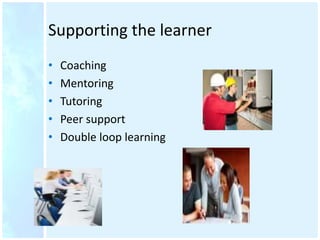
Supporting the learner
• Coaching
• Mentoring
• Tutoring
• Peer support
• Double loop learning
The roles and responsibilities of the
trainer or facilitator
• The roles and responsibilities of the learner
• The extent and limits of the relationship
• The techniques and processes to be used
• Confidentiality
• The range of expertise of the trainer or
facilitator
• The involvement of others
• Organisational expectations
• Reporting requirements
Individualised work based plans for:
• traineeships
• apprenticeships
• workplace planning
• distance learning
• off-the-job training
• flexible learning
What does the individual plan contain?
• the learning goals to be achieved
• the contingency plans (for when things go wrong - and they will!)
• the logistics
– duration
– frequency of meetings and the length of meetings
– locations of meetings
– the nature of face-to-face contacts (ie, what are they for?)
• the structure of the learning relationship, eg:
– the activities that we will do
– how progress will be monitored
– the equipment and/or resources that are needed
• OHS considerations
Applying the knowledge and those
skills
• Deliver the information that the learner needs to
know, and in a way that assists them to learn it
• Allow the learner to apply that information, and in
ways that reflect how it could be applied in a real
situation
• Give feedback to the learner about what they are
doing that is correct, and what is incorrect, and
(perhaps most importantly!) what makes it correct
or incorrect
• Guide the learner through a reflection on their
learning.
Knowledge-Based
• Design activities which enable the learner to do
something with the knowledge, for example simulate
a real life situation
• Show a link between the learning objectives and the
knowledge and activity
• Encourage the learner to participate in the activity
by providing clear instructions and guidelines
• Give feedback to confirm or correct the learner's
understanding
• Provide a key point summary.
Effective Communication Skills
• use ice-breakers as appropriate
• build rapport with the learner
• use effective verbal and body language
• demonstrate a capacity to communicate clearly to facilitate the
learning
• use critical listening and questioning techniques
• provide constructive and supportive feedback
• accurately interpret nonverbal messages
• assist learners to paraphrase advice or instructions to the trainer or
facilitator
• provide clear and concrete options and advice
• use appropriate terminology and language of the industry or
profession
• ensure language, literacy and numeracy (LLN.) used is appropriate to
the learner
Adult learning principles:
need to be self-directed and want to decide
for themselves what to learn
have a range of experiences that should be
linked to the learning content
need to know why they are learning
something
prefer learning that is practical and relevant
need to be involved in the learning process
Skills-Based
For a new skill, follow the demonstration process:
Do It Fast - demonstrate the new skill at the speed at which it is normally
performed while the learner is observing.
Do It Slow - then break the skill down into steps, completing each step slowly
as you give a clear and detailed explanation of what you are doing and why it
must be done that way.
Do It With Them - the learner and yourself then complete the skill together;
provide assistance and further demonstration and explanation where
necessary. Repeat as many times as necessary.
Let Them Go - observe the learner as they demonstrate the new skills
independently, provide positive feedback first (compliment, then correct).
Using appropriate interpersonal and
communication skills
• Using appropriate interpersonal and communication
skills
• Seeking feedback from the learner about the
outcomes achieved
• Seeking feedback from the learner and the value of
the learning to them
• Determining the learner's readiness for closure of
the individual learning and facilitation relationship
• Referring them to:
– Another agency
– Another learning program
Styles of teaching and training
Which style we choose to adopt commonly depends on
a combination of:
the style of the trainer or facilitator and their range
of leadership skills
• how the trainer or facilitator and the learning
situation are perceived by the learners
• how the learners perceive themselves
• the approach or philosophy the learner takes to the
learning situation
• the context within which the learning or facilitation
takes place.
Using a Variety of Learning Activities
Avoid the plunging attention span - three that take 20 minutes each
Group-based activities
Role plays
Written activities
Case studies
Simulation
Audio or visual activities
Practice or demonstration
Individual assignments
Group projects
Workplace practice
Research
Panel discussions
Brainstorming
Demonstrations
Measuring the learning is called
‘Assessment.’
• Direct – usually evidence that is observed by the
assessor themselves
•
Indirect – usually evidence that is observed by
someone else
•
Supplementary – evidence that is found in
written assessments, video recordings,
questioning, and documented evidence of past
performance
Tools to collect evidence
Real work
and time
activities
Structured
activities
Questioning
Portfolios
Recognition of prior learning
Historical
evidence
Tools and signals to determine closure
• Self-assessment taken by the learner
• A measure of improvement in a particular area
• Readiness for formal assessment
• Level of independence in learning
• Readiness to maintain learning through other
• Agreed time period or course duration is over
Learner’s records
Records may be paper-based or electronic
 Training plans
 Delivery plans
 Records of discussions and consultations
 Records of payment
 Learner evaluation sheets
 Assessment records
 Documentation of competencies achieved
Maintaining records
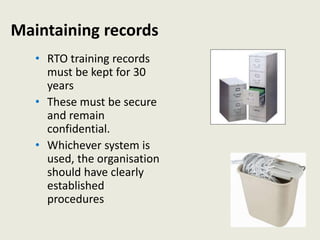
• RTO training records
must be kept for 30
years
• These must be secure
and remain
confidential.
• Whichever system is
used, the organisation
should have clearly
established
procedures
Getting feedback
Feedback from learners can be collected
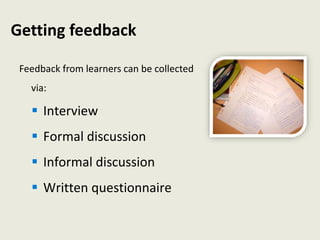
via:
 Interview
 Formal discussion
 Informal discussion
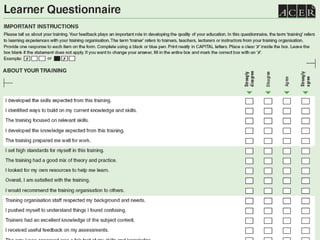
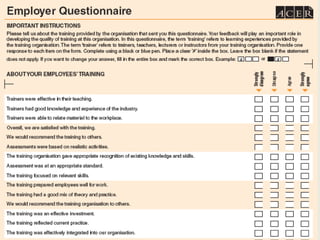
 Written questionnaire
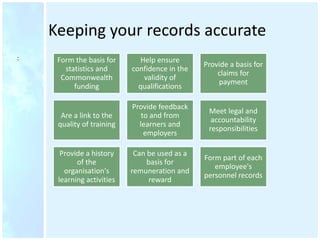
Keeping your records accurate
: Form the basis for
statistics and
Commonwealth
funding
Help ensure
confidence in the
validity of
qualifications
Provide a basis for
claims for
payment
Are a link to the
quality of training
Provide feedback
to and from
learners and
employers
Meet legal and
accountability
responsibilities
Provide a history
of the
organisation's
learning activities
Can be used as a
basis for
remuneration and
reward
Form part of each
employee's
personnel records

TAADEL403B Facilitate individual learning

  • 1.
  • 2.
    What TRAINING NEEDS •Skill development – using new equipment, or doing something in a new way • People development – gaining management skills, or improving people’s work ability in some way • Organisational change – changing the way that work is done by people, such as introducing new procedures, policies and standards • Meet legal requirements – doing things the right way, such as fire evacuations and other OHS requirements • Modification of an existing learning program – changing a new-employee induction program to reflect other changes in the workplace
  • 3.
    Focus • Short courses •Professional development program • Community education program • Apprenticeship/traineeship component • Work-transition program
  • 4.
  • 5.
    Learning Program The LearningProgram provides a documented guide to support a cohesive and integrated learning process for the learner and includes: The competencies or other benchmarks The specific learning outcomes An overview of the content to be covered in each chunk or segment learning resources, learning materials and activities for each chunk or segment Number and duration of training sessions or classes required and overall timelines delivery methods for each chunk Identification of assessment points to measure learner progress assessment methods Tools to be used to collect evidence of competency, where assessment is required.
  • 6.
    The Delivery Planis used by the trainer or facilitator to guide and manage delivery to a group. It includes: Individual and group learning objectives or outcomes for the segment of the learning Program to be addressed ,the number of learners and their specific support requirements Content of sessions as specified in the Session Plans Timelines or duration of activities within sessions Learning resources, learning materials and learning Activities to be used in sessions Other resource requirements OHS considerations, including incident or hazard Reporting and emergency procedures.
  • 7.
    Common groups oflearners • Employees • School leavers and people who are new to the workforce • Apprentices & trainees • Redundant workers • Individuals wanting to improve their own skills • Unemployed people • New arrivals to Australia • Employees requiring skills to meet legal requirements
  • 8.
    Where will thetraining take place • determined by the area of learning • determined by the trainer or facilitator and the learner • defined by the work or learning activities • in a classroom, tutorial room, meeting room, office, or any agreed meeting place • in a workplace, training or assessment organisation, college, community, university or school • defined by the time requirements for individual facilitation and how these will be built into learning activities • impacted by the health, safety and welfare of the learner.
  • 9.
    Support needs Formaland Informal These include looking at: Information provided on the enrolment forms Talking with other trainers or supervising Staff referrals from other agencies e.g. Job Services, rehabilitation organisations Talking with the learners and observing the learners
  • 10.
    Equity Support needs •English language, literacy and numeracy support • disability support • Aboriginal and Torres Strait Islander (ATSI) support • ethnic support services • interpreting services • counselling services • community support.
  • 11.
    Individual goals forthe learner? • New skills • Advancement of career • Change of career direction
  • 12.
    Examples of documentsthat could be mutually developed include: • Training plans • Attendance records • Records of discussions or contact • Documents that have been adjusted to meet special needs
  • 13.
    Supporting the learner •Coaching • Mentoring • Tutoring • Peer support • Double loop learning
  • 14.
    The roles andresponsibilities of the trainer or facilitator • The roles and responsibilities of the learner • The extent and limits of the relationship • The techniques and processes to be used • Confidentiality • The range of expertise of the trainer or facilitator • The involvement of others • Organisational expectations • Reporting requirements
  • 15.
    Individualised work basedplans for: • traineeships • apprenticeships • workplace planning • distance learning • off-the-job training • flexible learning
  • 16.
    What does theindividual plan contain? • the learning goals to be achieved • the contingency plans (for when things go wrong - and they will!) • the logistics – duration – frequency of meetings and the length of meetings – locations of meetings – the nature of face-to-face contacts (ie, what are they for?) • the structure of the learning relationship, eg: – the activities that we will do – how progress will be monitored – the equipment and/or resources that are needed • OHS considerations
  • 17.
    Applying the knowledgeand those skills • Deliver the information that the learner needs to know, and in a way that assists them to learn it • Allow the learner to apply that information, and in ways that reflect how it could be applied in a real situation • Give feedback to the learner about what they are doing that is correct, and what is incorrect, and (perhaps most importantly!) what makes it correct or incorrect • Guide the learner through a reflection on their learning.
  • 18.
    Knowledge-Based • Design activitieswhich enable the learner to do something with the knowledge, for example simulate a real life situation • Show a link between the learning objectives and the knowledge and activity • Encourage the learner to participate in the activity by providing clear instructions and guidelines • Give feedback to confirm or correct the learner's understanding • Provide a key point summary.
  • 19.
    Effective Communication Skills •use ice-breakers as appropriate • build rapport with the learner • use effective verbal and body language • demonstrate a capacity to communicate clearly to facilitate the learning • use critical listening and questioning techniques • provide constructive and supportive feedback • accurately interpret nonverbal messages • assist learners to paraphrase advice or instructions to the trainer or facilitator • provide clear and concrete options and advice • use appropriate terminology and language of the industry or profession • ensure language, literacy and numeracy (LLN.) used is appropriate to the learner
  • 20.
    Adult learning principles: needto be self-directed and want to decide for themselves what to learn have a range of experiences that should be linked to the learning content need to know why they are learning something prefer learning that is practical and relevant need to be involved in the learning process
  • 21.
    Skills-Based For a newskill, follow the demonstration process: Do It Fast - demonstrate the new skill at the speed at which it is normally performed while the learner is observing. Do It Slow - then break the skill down into steps, completing each step slowly as you give a clear and detailed explanation of what you are doing and why it must be done that way. Do It With Them - the learner and yourself then complete the skill together; provide assistance and further demonstration and explanation where necessary. Repeat as many times as necessary. Let Them Go - observe the learner as they demonstrate the new skills independently, provide positive feedback first (compliment, then correct).
  • 22.
    Using appropriate interpersonaland communication skills • Using appropriate interpersonal and communication skills • Seeking feedback from the learner about the outcomes achieved • Seeking feedback from the learner and the value of the learning to them • Determining the learner's readiness for closure of the individual learning and facilitation relationship • Referring them to: – Another agency – Another learning program
  • 23.
    Styles of teachingand training Which style we choose to adopt commonly depends on a combination of: the style of the trainer or facilitator and their range of leadership skills • how the trainer or facilitator and the learning situation are perceived by the learners • how the learners perceive themselves • the approach or philosophy the learner takes to the learning situation • the context within which the learning or facilitation takes place.
  • 24.
    Using a Varietyof Learning Activities Avoid the plunging attention span - three that take 20 minutes each Group-based activities Role plays Written activities Case studies Simulation Audio or visual activities Practice or demonstration Individual assignments Group projects Workplace practice Research Panel discussions Brainstorming Demonstrations
  • 25.
    Measuring the learningis called ‘Assessment.’ • Direct – usually evidence that is observed by the assessor themselves • Indirect – usually evidence that is observed by someone else • Supplementary – evidence that is found in written assessments, video recordings, questioning, and documented evidence of past performance
  • 26.
    Tools to collectevidence Real work and time activities
  • 27.
  • 28.
  • 29.
  • 30.
    Recognition of priorlearning Historical evidence
  • 31.
    Tools and signalsto determine closure • Self-assessment taken by the learner • A measure of improvement in a particular area • Readiness for formal assessment • Level of independence in learning • Readiness to maintain learning through other • Agreed time period or course duration is over
  • 32.
    Learner’s records Records maybe paper-based or electronic  Training plans  Delivery plans  Records of discussions and consultations  Records of payment  Learner evaluation sheets  Assessment records  Documentation of competencies achieved
  • 33.
    Maintaining records • RTOtraining records must be kept for 30 years • These must be secure and remain confidential. • Whichever system is used, the organisation should have clearly established procedures
  • 34.
    Getting feedback Feedback fromlearners can be collected via:  Interview  Formal discussion  Informal discussion  Written questionnaire
  • 37.
    Keeping your recordsaccurate : Form the basis for statistics and Commonwealth funding Help ensure confidence in the validity of qualifications Provide a basis for claims for payment Are a link to the quality of training Provide feedback to and from learners and employers Meet legal and accountability responsibilities Provide a history of the organisation's learning activities Can be used as a basis for remuneration and reward Form part of each employee's personnel records

Editor's Notes

  • #3 For example, if the learning program is intended to introduce a new procedure to all staff within a large workplace, then we would plan it very differently to when a learning program is intended to develop the machinery operating skills of a single person in a small business.
  • #4 The other thing that will influence the design of our learning program is its specific focus. Common focuses include: WHAT??
  • #9 The influence of any particular characteristic on a learner's training experience will very much depend of the situation in which that training occurs. If the person is comfortable and supported, then it will have a lesser effect than if the learner is placed in an unfamiliar environment with little idea of what is going on. This means that when we think about the possible impact of a learner's characteristics, we should do so with an understanding of the context of learning in mind. In this way, the effect of a person's particular characteristics could be:
  • #10 Outside the workplace, there are many specialist support services that can help us to further understand - and meet - the needs of our learner/s. These include: case managers. Advocay groups, government agencies. We do often find that we do not need to know all of these. This is because quite often a learner may already have support systems in place, and know of people who we can call upon to assist us.
  • #11 Learners can have many different support needs and you must correctly identify these needs before you can plan effective support mechanisms. Equity or additional support needs may include:
  • #24 Often trainers to be successful need a strong sense of themselves, be able to lead and guide but also mange the dynamics of the group
  • #25 Mix up the activities to maintain the attention span and choose activities that suit the learning context and the learner group
  • #27 Performed in the actual workplace in real time; examples are direct observation and third party reports
  • #28 These include simulation exercises, demonstrations, activity sheets
  • #29 Learners responding to targeted knowledge or skill area questions (these may be done via computer/online, verbally, or in a written format such as question/answer sheets, examinations and so on)
  • #30 Where the learner gathers pieces of evidence to build a collection of relevant tasks, activities and such to demonstrate competence across a range of skills and knowledge
  • #31 Evidence such as previously acquired qualifications, certificates of learning and so on which show proof of having already gained the skills
  • #34 Mention that RTOs must have procedures for protecting privacy and sensitive documents must be stored in lockable filing cabinets, and shredding and not binning- show the system at westvic for recycling and disposal