Securing a Return on
Your Investment In
Professional
Development
• Chart Your Course
• Prepare for the
Journey
• Treasure Hunt –
Digging Deep for
Learning
• Bring the Treasure
Daila Boufford
AAFCS Director of
Professional Development
Chart Your Course
Photo Credit: http://blog.cricpa.com
Your I. D. P.
(Individual Development Plan)
• A self-development plan that covers a specific
timeframe.
• Typically reviewed and discussed with supervisor to
match individual goals to company goals.
• Some focus on short term goals, others on long-term.
• Reviewed regularly to assess progression and revised
as needed.
• For best results the individuals must have total
ownership over their plan. Do not focus on trying to
appease the boss.
Key Questions to Ask
• What areas of my work do I want to develop?
• What areas of my work do I need to improve?
• What are the new demands in my job that require
development of new skills?
• In what direction is my department going and
how can I grow with it?
• What can I do to find out about other career
opportunities?
www.hr.ucdavis.edu
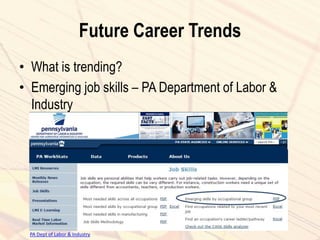
Future Career Trends
• What is trending?
• Emerging job skills – PA Department of Labor &
Industry
PA Dept of Labor & Industry
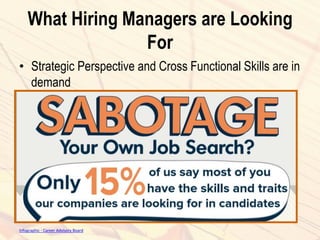
What Hiring Managers are Looking
For
• Strategic Perspective and Cross Functional Skills are in
demand
Infographic - Career Advisory Board
Personal Passion
Scott Dinsmore
“How to Find and Do Work You Love”
Become a Self Expert
• Develop an in-depth understanding of your unique
strengths
• Examine your values, they are your framework for
making decisions
• Carefully consider what you learn from
experiences
• Ask yourself: What is the work you cannot not
do?
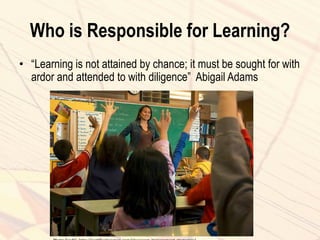
Who is Responsible for Learning?
• “Learning is not attained by chance; it must be sought for with
ardor and attended to with diligence” Abigail Adams
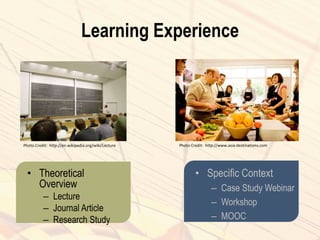
Learning Experience
• Theoretical
Overview
– Lecture
– Journal Article
– Research Study
• Specific Context
– Case Study Webinar
– Workshop
– MOOC
Photo Credit: http://en.wikipedia.org/wiki/Lecture Photo Credit: http://www.asia-destinations.com
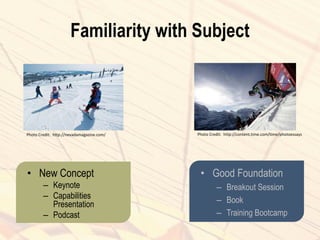
Familiarity with Subject
• New Concept
– Keynote
– Capabilities
Presentation
– Podcast
• Good Foundation
– Breakout Session
– Book
– Training Bootcamp
Photo Credit: http://nevadamagazine.com/ Photo Credit: http://content.time.com/time/photoessays
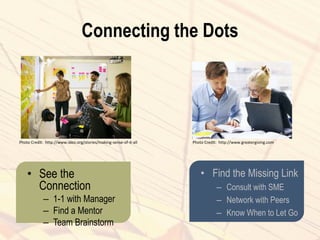
Connecting the Dots
• See the
Connection
– 1-1 with Manager
– Find a Mentor
– Team Brainstorm
• Find the Missing Link
– Consult with SME
– Network with Peers
– Know When to Let Go
Photo Credit: http://www.ideo.org/stories/making-sense-of-it-all Photo Credit: http://www.greatergiving.com
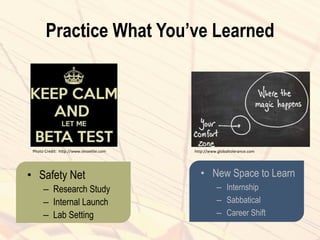
Practice What You’ve Learned
• Safety Net
– Research Study
– Internal Launch
– Lab Setting
• New Space to Learn
– Internship
– Sabbatical
– Career Shift
Photo Credit: http://www.tesoelite.com http://www.globaltolerance.com
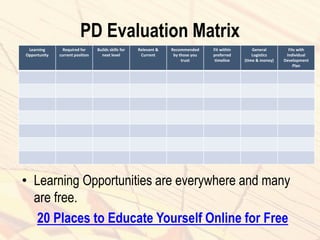
PD Evaluation Matrix
Learning
Opportunity
Required for
current position
Builds skills for
next level
Relevant &
Current
Recommended
by those you
trust
Fit within
preferred
timeline
General
Logistics
(time & money)
Fits with
Individual
Development
Plan
• Learning Opportunities are everywhere and many
are free.
20 Places to Educate Yourself Online for Free
Prepare for the
Journey
Photo Credit:
http://www2.ups.edu/faculty/velez/Comedia/html/unit1/galeones.htm
Develop Your Learning Goals
• What problem do you need to solve now?
• Skills needed for new department initiatives?
• Identify areas for improvement.
• Who do you want to meet and network with?
• What is the intended ripple effect?
• What does your career look like next year? 3 yrs?
Guidelines for Learning Goals
• Be realistic with the number and scope of your
goals
• Categorize “nice to have” and “must have”
• Look at goals often and revise as needed
• Bring your goals with you to the event
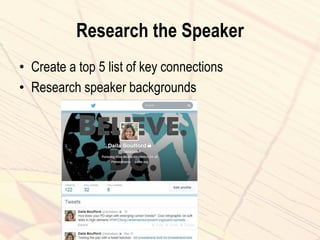
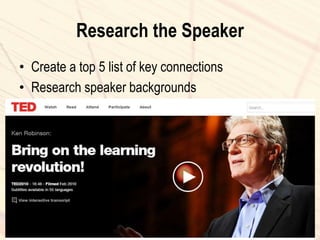
Research the Speaker
• Create a top 5 list of key connections
• Research speaker backgrounds
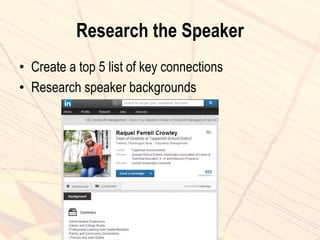
Research the Speaker
• Create a top 5 list of key connections
• Research speaker backgrounds
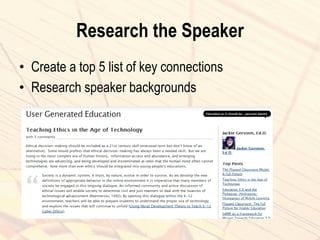
Research the Speaker
• Create a top 5 list of key connections
• Research speaker backgrounds
Research the Speaker
• Create a top 5 list of key connections
• Research speaker backgrounds
Research the Speaker
• Create a top 5 list of key connections
• Research speaker backgrounds
• Develop questions based on the speaker’s interests
• Explore connected areas of expertise
• Leverage their network
• Activity: If you have a smart phone or tablet, what
can you find out about me? What am I passionate
about?
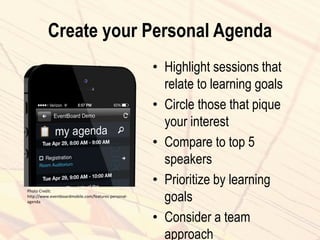
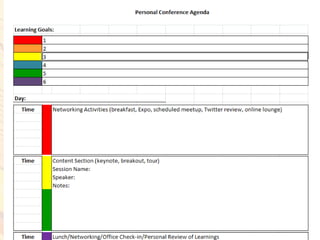
Create your Personal Agenda
• Highlight sessions that
relate to learning goals
• Circle those that pique
your interest
• Compare to top 5
speakers
• Prioritize by learning
goals
• Consider a team
approach
Photo Credit:
http://www.eventboardmobile.com/features-personal-
agenda
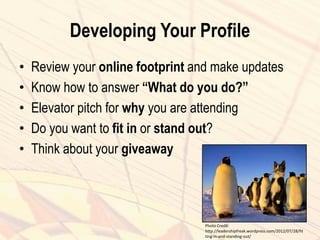
Developing Your Profile
• Review your online footprint and make updates
• Know how to answer “What do you do?”
• Elevator pitch for why you are attending
• Do you want to fit in or stand out?
• Think about your giveaway
Photo Credit:
http://leadershipfreak.wordpress.com/2012/07/28/fit
ting-in-and-standing-out/
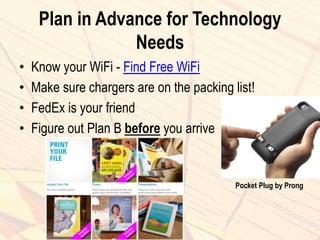
Plan in Advance for Technology
Needs
• Know your WiFi - Find Free WiFi
• Make sure chargers are on the packing list!
• FedEx is your friend
• Figure out Plan B before you arrive
Pocket Plug by Prong
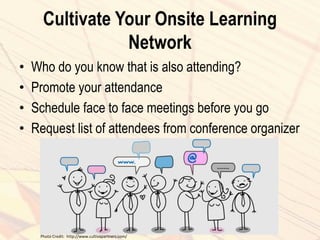
Cultivate Your Onsite Learning
Network
• Who do you know that is also attending?
• Promote your attendance
• Schedule face to face meetings before you go
• Request list of attendees from conference organizer
Photo Credit: http://www.cultivapartners.com/
Treasure Hunt
Digging Deep For
Learning
Challenge
Make a mental note right now of one person in this
room you want to interact with in some way before
you leave this room.
Questions Create the Quest
• There are no stupid questions, but some generate
better responses than others.
– Focus – decide in advance what you hope to achieve
with your question
– Be direct and clear – ask one question at a time
– Ask empowering questions – people enjoy talking
about their experiences
– Get clarification when needed – but consider the
timing
http://business.financialpost.com/2013/06/18/asking-good-questions-is-a-skill-worth-learning/
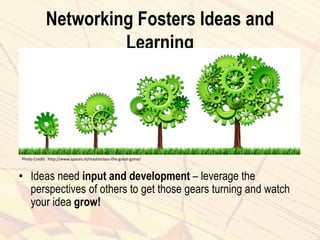
Networking Fosters Ideas and
Learning
• Ideas need input and development – leverage the
perspectives of others to get those gears turning and watch
your idea grow!
Photo Credit: http://www.spaces.nl/masterclass-the-great-game/
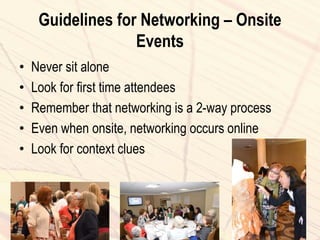
Guidelines for Networking – Onsite
Events
• Never sit alone
• Look for first time attendees
• Remember that networking is a 2-way process
• Even when onsite, networking occurs online
• Look for context clues
Guidelines for Networking – Online
Events
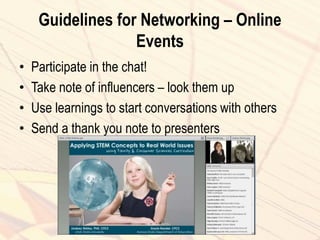
• Participate in the chat!
• Take note of influencers – look them up
• Use learnings to start conversations with others
• Send a thank you note to presenters
Using the Backchannel
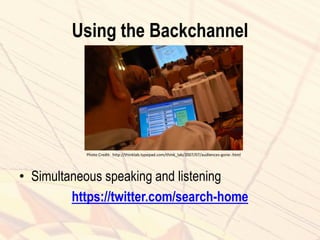
• Simultaneous speaking and listening
https://twitter.com/search-home
Photo Credit: http://thinklab.typepad.com/think_lab/2007/07/audiences-gone-.html
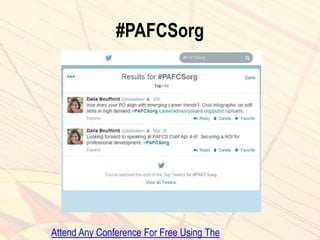
#PAFCSorg
Attend Any Conference For Free Using The
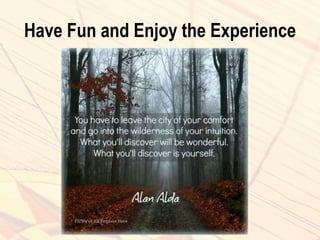
Have Fun and Enjoy the Experience
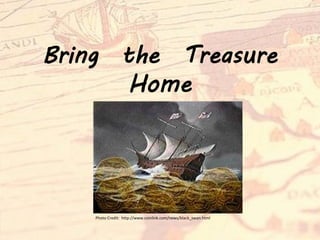
Bring the Treasure
Home
Photo Credit: http://www.coinlink.com/news/black_swan.html
Build Relationships with Key
Contacts
• Review your stack of business cards
• Connect through social media channels
• Create and maintain a contacts database
• Follow up on beginning conversations, suggest a
next point of contact
• Pay it forward
Conduct Further Research on
Learnings
Activity:
Connect with a person at your table and share an idea
or tool you’ve heard about at the conference so far.
What else can you learn from those at your table?
If this is your first day, share a session you plan on
attending and see what you can find out about the
content or the speaker.
Conduct Further Research on
Learnings
• Create new learning objectives based on new
knowledge
• Get creative and acquire knowledge from different
perspectives
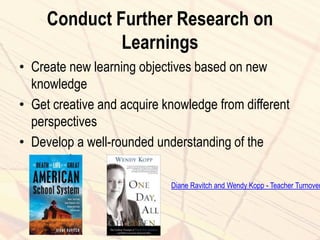
• Develop a well-rounded understanding of the
concept
Diane Ravitch and Wendy Kopp - Teacher Turnover
Create an Implementation Plan
• Charles DuHigg, The Power of Habit: Why We Do
What We Do In Life
– Cue – trigger that tells the brain what habit to use
– Routine – the process that is engaged
– Reward – helps your brain determine if it was worthwhile
• Key Point – keep the cue and the reward the same,
while changing the routine
• Most of all, you have to BELIEVE that change is
possible.
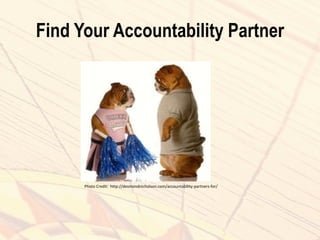
Find Your Accountability Partner
Photo Credit: http://desmondnicholson.com/accountability-partners-for/
Share the Treasure
Sharing Knowledge Helps Solidify
Learnings
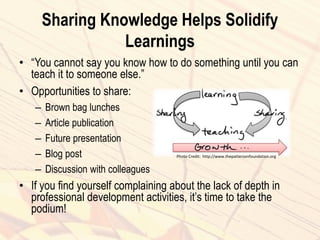
• “You cannot say you know how to do something until you can
teach it to someone else.”
• Opportunities to share:
– Brown bag lunches
– Article publication
– Future presentation
– Blog post
– Discussion with colleagues
• If you find yourself complaining about the lack of depth in
professional development activities, it’s time to take the
podium!
Photo Credit: http://www.thepattersonfoundation.org
Learni.st
Upcoming AAFCS Professional
Development
• Wednesday, April 30th
– Free Webinar for Members: Utilizing Web-Based
Content for Continued Learning
• June 25-28, 2014
– AAFCS Annual Conference in St. Louis
“Family and Consumer Sciences: Global Gateway to
Healthy and Sustainable Families”
Thank You!
Daila Boufford
AAFCS Director of Professional Development
@dailadawn
www.linkedin.com/in/daila/
dboufford@aafcs.org
Resource List
• How to Select the Right Professional Development Program for You - http://www.pce.uw.edu/newsroom.aspx?id=3937
• Individual Development Plan (UC Davis) - http://www.hr.ucdavis.edu/sdps/forms/IDP%20Final%2010.14.11.pdf
• PA Department of Labor and Industry -
http://www.portal.state.pa.us/portal/server.pt?open=514&objID=1674726&mode=2
• Career Advisory Board - http://careeradvisoryboard.org/
• Career Advisory Board Infographic - http://careeradvisoryboard.org/public/uploads/2013/10/cab-2013-jpi-info.pdf
• Scott Dinsmore TED Talk - https://www.youtube.com/watch?v=jpe-LKn-4gM
• 20 Places to Educate Yourself Online for Free -http://www.lifehack.org/articles/productivity/20-places-educate-yourself-
online-for-free.html
• How to Find Free WiFi - http://lifehacker.com/5340435/the-definitive-guide-to-finding-free-wi-fi/all
• Guideline for Asking Questions - http://business.financialpost.com/2013/06/18/asking-good-questions-is-a-skill-worth-
learning/
• Twitter Search - https://twitter.com/search-home
• Attend any Conference for Free Using the Backchannel - http://learnstreaming.com/attend-any-conference-for-free-
using-the-backchannel/
• Wendy Kopp and Diane Ravitch Discuss Teacher Turnover - https://www.youtube.com/watch?v=MjFX9J2i-SQ
• Hacking Habits: How to Make New Behaviors Last for Good - http://99u.com/articles/7230/hacking-habits-how-to-
make-new-behaviors-last-for-good
• Learni.st – http://learni.st
• AAFCS Annual Conference, June 25-28, St. Louis - http://www.aafcs.org/meetings/14/reg.html

Secure an ROI on Professional Development

  • 1.
    Securing a Returnon Your Investment In Professional Development • Chart Your Course • Prepare for the Journey • Treasure Hunt – Digging Deep for Learning • Bring the Treasure Daila Boufford AAFCS Director of Professional Development
  • 2.
    Chart Your Course PhotoCredit: http://blog.cricpa.com
  • 3.
    Your I. D.P. (Individual Development Plan) • A self-development plan that covers a specific timeframe. • Typically reviewed and discussed with supervisor to match individual goals to company goals. • Some focus on short term goals, others on long-term. • Reviewed regularly to assess progression and revised as needed. • For best results the individuals must have total ownership over their plan. Do not focus on trying to appease the boss.
  • 4.
    Key Questions toAsk • What areas of my work do I want to develop? • What areas of my work do I need to improve? • What are the new demands in my job that require development of new skills? • In what direction is my department going and how can I grow with it? • What can I do to find out about other career opportunities? www.hr.ucdavis.edu
  • 5.
    Future Career Trends •What is trending? • Emerging job skills – PA Department of Labor & Industry PA Dept of Labor & Industry
  • 6.
    What Hiring Managersare Looking For • Strategic Perspective and Cross Functional Skills are in demand Infographic - Career Advisory Board
  • 7.
    Personal Passion Scott Dinsmore “Howto Find and Do Work You Love”
  • 8.
    Become a SelfExpert • Develop an in-depth understanding of your unique strengths • Examine your values, they are your framework for making decisions • Carefully consider what you learn from experiences • Ask yourself: What is the work you cannot not do?
  • 9.
    Who is Responsiblefor Learning? • “Learning is not attained by chance; it must be sought for with ardor and attended to with diligence” Abigail Adams
  • 10.
    Learning Experience • Theoretical Overview –Lecture – Journal Article – Research Study • Specific Context – Case Study Webinar – Workshop – MOOC Photo Credit: http://en.wikipedia.org/wiki/Lecture Photo Credit: http://www.asia-destinations.com
  • 11.
    Familiarity with Subject •New Concept – Keynote – Capabilities Presentation – Podcast • Good Foundation – Breakout Session – Book – Training Bootcamp Photo Credit: http://nevadamagazine.com/ Photo Credit: http://content.time.com/time/photoessays
  • 12.
    Connecting the Dots •See the Connection – 1-1 with Manager – Find a Mentor – Team Brainstorm • Find the Missing Link – Consult with SME – Network with Peers – Know When to Let Go Photo Credit: http://www.ideo.org/stories/making-sense-of-it-all Photo Credit: http://www.greatergiving.com
  • 13.
    Practice What You’veLearned • Safety Net – Research Study – Internal Launch – Lab Setting • New Space to Learn – Internship – Sabbatical – Career Shift Photo Credit: http://www.tesoelite.com http://www.globaltolerance.com
  • 14.
    PD Evaluation Matrix Learning Opportunity Requiredfor current position Builds skills for next level Relevant & Current Recommended by those you trust Fit within preferred timeline General Logistics (time & money) Fits with Individual Development Plan • Learning Opportunities are everywhere and many are free. 20 Places to Educate Yourself Online for Free
  • 15.
    Prepare for the Journey PhotoCredit: http://www2.ups.edu/faculty/velez/Comedia/html/unit1/galeones.htm
  • 16.
    Develop Your LearningGoals • What problem do you need to solve now? • Skills needed for new department initiatives? • Identify areas for improvement. • Who do you want to meet and network with? • What is the intended ripple effect? • What does your career look like next year? 3 yrs?
  • 17.
    Guidelines for LearningGoals • Be realistic with the number and scope of your goals • Categorize “nice to have” and “must have” • Look at goals often and revise as needed • Bring your goals with you to the event
  • 18.
    Research the Speaker •Create a top 5 list of key connections • Research speaker backgrounds
  • 19.
    Research the Speaker •Create a top 5 list of key connections • Research speaker backgrounds
  • 20.
    Research the Speaker •Create a top 5 list of key connections • Research speaker backgrounds
  • 21.
    Research the Speaker •Create a top 5 list of key connections • Research speaker backgrounds
  • 22.
    Research the Speaker •Create a top 5 list of key connections • Research speaker backgrounds • Develop questions based on the speaker’s interests • Explore connected areas of expertise • Leverage their network • Activity: If you have a smart phone or tablet, what can you find out about me? What am I passionate about?
  • 23.
    Create your PersonalAgenda • Highlight sessions that relate to learning goals • Circle those that pique your interest • Compare to top 5 speakers • Prioritize by learning goals • Consider a team approach Photo Credit: http://www.eventboardmobile.com/features-personal- agenda
  • 25.
    Developing Your Profile •Review your online footprint and make updates • Know how to answer “What do you do?” • Elevator pitch for why you are attending • Do you want to fit in or stand out? • Think about your giveaway Photo Credit: http://leadershipfreak.wordpress.com/2012/07/28/fit ting-in-and-standing-out/
  • 26.
    Plan in Advancefor Technology Needs • Know your WiFi - Find Free WiFi • Make sure chargers are on the packing list! • FedEx is your friend • Figure out Plan B before you arrive Pocket Plug by Prong
  • 27.
    Cultivate Your OnsiteLearning Network • Who do you know that is also attending? • Promote your attendance • Schedule face to face meetings before you go • Request list of attendees from conference organizer Photo Credit: http://www.cultivapartners.com/
  • 28.
  • 29.
    Challenge Make a mentalnote right now of one person in this room you want to interact with in some way before you leave this room.
  • 30.
    Questions Create theQuest • There are no stupid questions, but some generate better responses than others. – Focus – decide in advance what you hope to achieve with your question – Be direct and clear – ask one question at a time – Ask empowering questions – people enjoy talking about their experiences – Get clarification when needed – but consider the timing http://business.financialpost.com/2013/06/18/asking-good-questions-is-a-skill-worth-learning/
  • 31.
    Networking Fosters Ideasand Learning • Ideas need input and development – leverage the perspectives of others to get those gears turning and watch your idea grow! Photo Credit: http://www.spaces.nl/masterclass-the-great-game/
  • 32.
    Guidelines for Networking– Onsite Events • Never sit alone • Look for first time attendees • Remember that networking is a 2-way process • Even when onsite, networking occurs online • Look for context clues
  • 33.
    Guidelines for Networking– Online Events • Participate in the chat! • Take note of influencers – look them up • Use learnings to start conversations with others • Send a thank you note to presenters
  • 34.
    Using the Backchannel •Simultaneous speaking and listening https://twitter.com/search-home Photo Credit: http://thinklab.typepad.com/think_lab/2007/07/audiences-gone-.html
  • 35.
  • 36.
    Have Fun andEnjoy the Experience
  • 37.
    Bring the Treasure Home PhotoCredit: http://www.coinlink.com/news/black_swan.html
  • 38.
    Build Relationships withKey Contacts • Review your stack of business cards • Connect through social media channels • Create and maintain a contacts database • Follow up on beginning conversations, suggest a next point of contact • Pay it forward
  • 39.
    Conduct Further Researchon Learnings Activity: Connect with a person at your table and share an idea or tool you’ve heard about at the conference so far. What else can you learn from those at your table? If this is your first day, share a session you plan on attending and see what you can find out about the content or the speaker.
  • 40.
    Conduct Further Researchon Learnings • Create new learning objectives based on new knowledge • Get creative and acquire knowledge from different perspectives • Develop a well-rounded understanding of the concept Diane Ravitch and Wendy Kopp - Teacher Turnover
  • 41.
    Create an ImplementationPlan • Charles DuHigg, The Power of Habit: Why We Do What We Do In Life – Cue – trigger that tells the brain what habit to use – Routine – the process that is engaged – Reward – helps your brain determine if it was worthwhile • Key Point – keep the cue and the reward the same, while changing the routine • Most of all, you have to BELIEVE that change is possible.
  • 42.
    Find Your AccountabilityPartner Photo Credit: http://desmondnicholson.com/accountability-partners-for/
  • 43.
  • 44.
    Sharing Knowledge HelpsSolidify Learnings • “You cannot say you know how to do something until you can teach it to someone else.” • Opportunities to share: – Brown bag lunches – Article publication – Future presentation – Blog post – Discussion with colleagues • If you find yourself complaining about the lack of depth in professional development activities, it’s time to take the podium! Photo Credit: http://www.thepattersonfoundation.org
  • 45.
  • 46.
    Upcoming AAFCS Professional Development •Wednesday, April 30th – Free Webinar for Members: Utilizing Web-Based Content for Continued Learning • June 25-28, 2014 – AAFCS Annual Conference in St. Louis “Family and Consumer Sciences: Global Gateway to Healthy and Sustainable Families”
  • 47.
    Thank You! Daila Boufford AAFCSDirector of Professional Development @dailadawn www.linkedin.com/in/daila/ dboufford@aafcs.org
  • 48.
    Resource List • Howto Select the Right Professional Development Program for You - http://www.pce.uw.edu/newsroom.aspx?id=3937 • Individual Development Plan (UC Davis) - http://www.hr.ucdavis.edu/sdps/forms/IDP%20Final%2010.14.11.pdf • PA Department of Labor and Industry - http://www.portal.state.pa.us/portal/server.pt?open=514&objID=1674726&mode=2 • Career Advisory Board - http://careeradvisoryboard.org/ • Career Advisory Board Infographic - http://careeradvisoryboard.org/public/uploads/2013/10/cab-2013-jpi-info.pdf • Scott Dinsmore TED Talk - https://www.youtube.com/watch?v=jpe-LKn-4gM • 20 Places to Educate Yourself Online for Free -http://www.lifehack.org/articles/productivity/20-places-educate-yourself- online-for-free.html • How to Find Free WiFi - http://lifehacker.com/5340435/the-definitive-guide-to-finding-free-wi-fi/all • Guideline for Asking Questions - http://business.financialpost.com/2013/06/18/asking-good-questions-is-a-skill-worth- learning/ • Twitter Search - https://twitter.com/search-home • Attend any Conference for Free Using the Backchannel - http://learnstreaming.com/attend-any-conference-for-free- using-the-backchannel/ • Wendy Kopp and Diane Ravitch Discuss Teacher Turnover - https://www.youtube.com/watch?v=MjFX9J2i-SQ • Hacking Habits: How to Make New Behaviors Last for Good - http://99u.com/articles/7230/hacking-habits-how-to- make-new-behaviors-last-for-good • Learni.st – http://learni.st • AAFCS Annual Conference, June 25-28, St. Louis - http://www.aafcs.org/meetings/14/reg.html