
TAEDEL402A Plan, organise and
facilitate learning in the
workplace
Teresa O'Brien
Principal Lecturer
C.Y. O’Connor Institute


May 8 2012
Workplace Legislation and Regulation
• Each workplace is governed by both legislative and regulatory
  requirements of which you, as a trainer need to be aware
• Individual workplaces have their own policies and procedures,
  particularly with regard to OHS

Examples
• Racial Vilification
• Anti-discrimination
• Equal Opportunity
• AQTF Units of Competency Australian Core Skills Framework
• OHS Industry requirements: licensing, awards and agreements
• Duty of Care
AQTF Requirements
• guide regulate and monitor the VET system
• set the standards for
training and assessment by registered training organisations
state and territories that register and audit RTOs
• made up of 9 conditions and 3 standards
• access this framework at
http://
      www.training.com.au/documents/Dezem_AQTF%20Essential%20Conditions%20and%20Standards%20for%20Continuing%20Registratio
Australian Apprenticeships
• A way to get a head start in a chosen career
• Involve paid work and structured training that can be on-the-
  job, off-the-job or a combination of both
• Represent ‘Competency based’ training which means
  individuals can complete their training faster when they reach
  the required skills level
• Enable existing skills and prior experience to be recognised
  and course credit granted, potentially reducing formal
  training time.
• Lead to nationally recognised qualifications and skills
• Are also an important pathway from school to work.
Australian Apprenticeships                                                             cont.


• Involve RTO, employees and the apprentice
• Funding dependent on training plans and record
  keeping
• Employees manage the apprentice and meet
  legal requirements such as record keeping
• Trainers provide the training and adhere to plan
• Apprentices maintain paperwork
Website: http://www.australianapprenticeships.gov.au

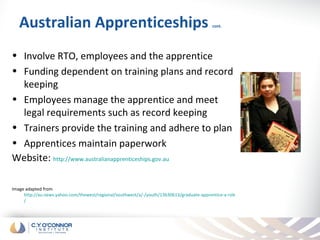
Image adapted from
     http://au.news.yahoo.com/thewest/regional/southwest/a/-/youth/13630613/graduate-apprentice-a-role-model
     /
OHS rules and regulations
• Your responsibility is to ensure that the learning environment
  is healthy and safe
• Legal framework-the need to eliminate or avoid workplace
  injury, illness and death
• Exercise duty of care
• OHS is state responsibility except in commonwealth
  jurisdictions
• Acts govern how OHS is addressed
• Regulations- support OHS Acts and provide implementation
  of the legislation
• Regulatory authorities manage OHS compliance
Safe Work Australia
•  develops national policy
•  prepares code of practice
•  prepares OHS material
•  Monitors the adoption of approved OHS
•  Collects statistics and records workers compensation
•  Provides guidance
•  Assist regulatory authorities
Standards
Eliminate, reduce and manage specific workplace hazards
Prescribe preventative action to avert injury and death
http://www.standards.org.au/Pages/default.aspx
Codes of Practice
•   should be followed unless there is a better way
•   act as a ‘should do’
•   cannot be prosecuted
•   developed and adopted at all levels; organisational, state and
    national

• Safe Work Australia has developed many codes of practice
(eg. dangerous goods, constructions’ white card)
Guidance Material
Available form many sources
•Safe Work Australia
•OHS Authorities
•WorkSafe
•Industry employer bodies
•Professional organisations
•libraries
•workplaces
•unions
OHS and workplace learning
Many people may be involved in workplace learning

•Employers/supervisors
•Training directors
•OHS Officers
•Human resources
•OHS Committees
•Other workplaces
Duty of Care
• Exists where there is a relationship-Employer/employee,
  trainer/assessor, RTO/Client
• Owed personally to individuals
• Applies to all risks that are foreseeable and preventable
• Includes the concept of ‘reasonable’
Learner’s role is duty of care to self and others
• Follow procedures
• Use equipment safely
• Attend OHS training
• Identify hazards

Workplace Regulation and Legislation

  • 1.
    TAEDEL402A Plan, organiseand facilitate learning in the workplace Teresa O'Brien Principal Lecturer C.Y. O’Connor Institute May 8 2012
  • 2.
    Workplace Legislation andRegulation • Each workplace is governed by both legislative and regulatory requirements of which you, as a trainer need to be aware • Individual workplaces have their own policies and procedures, particularly with regard to OHS Examples • Racial Vilification • Anti-discrimination • Equal Opportunity • AQTF Units of Competency Australian Core Skills Framework • OHS Industry requirements: licensing, awards and agreements • Duty of Care
  • 3.
    AQTF Requirements • guideregulate and monitor the VET system • set the standards for training and assessment by registered training organisations state and territories that register and audit RTOs • made up of 9 conditions and 3 standards • access this framework at http:// www.training.com.au/documents/Dezem_AQTF%20Essential%20Conditions%20and%20Standards%20for%20Continuing%20Registratio
  • 4.
    Australian Apprenticeships • Away to get a head start in a chosen career • Involve paid work and structured training that can be on-the- job, off-the-job or a combination of both • Represent ‘Competency based’ training which means individuals can complete their training faster when they reach the required skills level • Enable existing skills and prior experience to be recognised and course credit granted, potentially reducing formal training time. • Lead to nationally recognised qualifications and skills • Are also an important pathway from school to work.
  • 5.
    Australian Apprenticeships cont. • Involve RTO, employees and the apprentice • Funding dependent on training plans and record keeping • Employees manage the apprentice and meet legal requirements such as record keeping • Trainers provide the training and adhere to plan • Apprentices maintain paperwork Website: http://www.australianapprenticeships.gov.au Image adapted from http://au.news.yahoo.com/thewest/regional/southwest/a/-/youth/13630613/graduate-apprentice-a-role-model /
  • 6.
    OHS rules andregulations • Your responsibility is to ensure that the learning environment is healthy and safe • Legal framework-the need to eliminate or avoid workplace injury, illness and death • Exercise duty of care • OHS is state responsibility except in commonwealth jurisdictions • Acts govern how OHS is addressed • Regulations- support OHS Acts and provide implementation of the legislation • Regulatory authorities manage OHS compliance
  • 7.
    Safe Work Australia • develops national policy • prepares code of practice • prepares OHS material • Monitors the adoption of approved OHS • Collects statistics and records workers compensation • Provides guidance • Assist regulatory authorities Standards Eliminate, reduce and manage specific workplace hazards Prescribe preventative action to avert injury and death http://www.standards.org.au/Pages/default.aspx
  • 8.
    Codes of Practice • should be followed unless there is a better way • act as a ‘should do’ • cannot be prosecuted • developed and adopted at all levels; organisational, state and national • Safe Work Australia has developed many codes of practice (eg. dangerous goods, constructions’ white card)
  • 9.
    Guidance Material Available formmany sources •Safe Work Australia •OHS Authorities •WorkSafe •Industry employer bodies •Professional organisations •libraries •workplaces •unions
  • 10.
    OHS and workplacelearning Many people may be involved in workplace learning •Employers/supervisors •Training directors •OHS Officers •Human resources •OHS Committees •Other workplaces
  • 11.
    Duty of Care •Exists where there is a relationship-Employer/employee, trainer/assessor, RTO/Client • Owed personally to individuals • Applies to all risks that are foreseeable and preventable • Includes the concept of ‘reasonable’ Learner’s role is duty of care to self and others • Follow procedures • Use equipment safely • Attend OHS training • Identify hazards