Modular or part time learning programEng.p.n.k.dias
End of this session…    Specifically, this learning session will help you develop skills and    knowledge to enable you to:Identify the parameters of the learning program with    clientsGenerate options and determine the learning program    designOutline the content and structure of the learning    programReview its effectiveness.
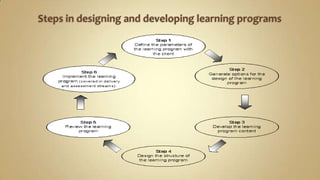
Learning topicsOverview of the learning program design processDefine the parameters of the modular/part time learning program with the clientGenerate options for designing the modular/part time learning programDevelop the modular/part timelearning program contentDesign the modular/part time learning program structureReview the modular/part time learning program
Benefit to you..“you will   be able to design a range of learning programs to meet different learner needs and learning contexts”
AssessmentYou will produce the one learning program required for assessment and it should identify the learner and client needsbe clearly mapped to the benchmarksbe structured and sequenced to maximise learningbe logical and innovative to engage the learner groupinclude delivery methods which enhance flexibilityidentify resources needed to deliver and assess the    training
learning program defined?A learning program provides the basis for a cohesive and integrated learning process by outlining the processes of learning and assessment
A learning program should identifyits purpose the target group, their needs and characteristicsthe outcomes to be achieved, such as the units of competency or other benchmarks the learning and assessment activities including any     flexibilities with thisany required resources. 
Steps in designing and developing learning programs
Planning    "If you do not know where you are going you will                             end up somewhere else'
Essential Considerationsissue/problem/need what),characteristics and needs of learners (target audience   who),changes intended for learners (intended    outcomes what the learners will be able to do),the important and relevant content (what),methods to accomplish intended outcomes (how),evaluation strategies for methods, content, and intended     outcomes (What works)
Step 1:Analyse –define the parameters‘why, who and what’ of your learning programWhen designing a learning program, be sure you are    clear on its purpose. That is, why does it need to be designed? In broad     terms, what outcomes will it achieve, how will it be    used, and who will be involved?
Phase I(1) Identify The Issue / Problem / Needs(2) Form Curriculum Development Team(3) Conduct Needs Assessment and Analysis
IDENTIFY THE ISSUE / PROBLEM / NEEDSwho is affected or involved,the scope of the problem (issue) to be addressed by    the curriculum, andthe consequences.
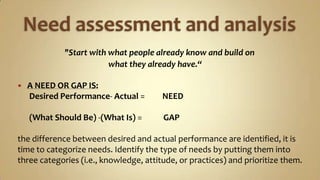
Need assessment and analysis"Start with what people already know and build on                                                 what they already have.“A NEED OR GAP IS:      Desired Performance- Actual =         NEED(What Should Be) -(What Is) =           GAPthe difference between desired and actual performance are identified, it is time to categorize needs. Identify the type of needs by putting them into three categories (i.e., knowledge, attitude, or practices) and prioritize them.
Analysis phaseProblem analysisJob analysisTarget group analysis
Analyse training needsIdentify the problem –case study-which one needs training      Need for training fall into two categoriesChanges and developments in the          companyCurrent work performance not up to          expectation3/04/2011pnkdias sri lanka16
Changes and developmentCorporate growthProduct changeTechnical changesNew legislation personal changes3/04/2011pnkdias sri lanka17
Current work performanceindicatorsOut putScrap and wastageQuality of workTime to complete workUtilization of machines3/04/2011pnkdias sri lanka18
Current work performance…Accident rateLabour turnoverAbsenteeismDelays and bottlenecksCustomer complaintsRecruitment problem3/04/2011pnkdias sri lanka19
Training should be the last???Lack of skills                                                      Unattainable targetLack of motivationUnsuitable equipmentInappropriate methodsPoor work environmentPoor healthPoor managementPoor attitudes                       what will justify the training?3/04/2011pnkdias sri lanka20
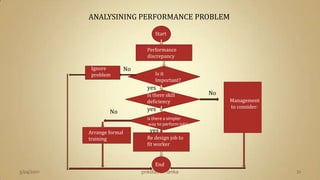
3/04/2011pnkdias sri lanka21ANALYSINING PERFORMANCE PROBLEMStartPerformance discrepancyIgnore problemNoIs it Important?yesNoIs there skill deficiencyManagement to consider:yesNois there a simpler way to perform job?yesArrange formal trainingRe design job to fit workerEnd
Activity	 -Program purpose Conduct some research by communicating with clients and other stakeholders and determine the purpose of the program.Note the purpose of your program on the learning program plan proforma. 
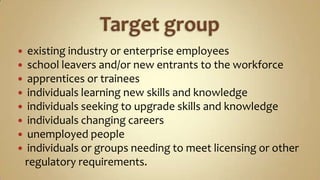
Target group existing industry or enterprise employeesschool leavers and/or new entrants to the workforceapprentices or traineesindividuals learning new skills and knowledgeindividuals seeking to upgrade skills and knowledgeindividuals changing careersunemployed peopleindividuals or groups needing to meet licensing or other   regulatory requirements.
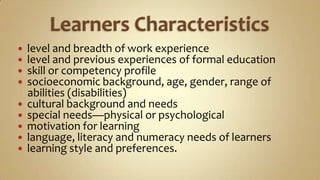
Learners Characteristicslevel and breadth of work experiencelevel and previous experiences of formal educationskill or competency profilesocioeconomic background, age, gender, range of      abilities (disabilities)cultural background and needsspecial needs—physical or psychologicalmotivation for learninglanguage, literacy and numeracy needs of learnerslearning style and preferences.
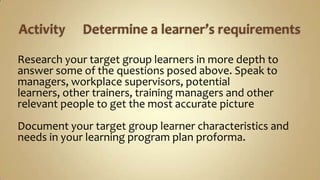
Activity	Determine a learner’s requirementsResearch your target group learners in more depth to answer some of the questions posed above. Speak to managers, workplace supervisors, potential learners, other trainers, training managers and other relevant people to get the most accurate picture Document your target group learner characteristics and needs in your learning program plan proforma. 
Benchmark?You have to work out exactly what level or standard    of learning is required. You need standards on    which to base the programHow do you work this out?
Benchmark soursesFor your learning program, select the benchmark    sources that you are going to useWhere can you access them? If possible, collect     them to use in your development.Activity:	Benchmark sources
Delivery methods for your programface-to-face deliveryonline deliverydistance learningcoaching or mentoringworkplace applicationssimulated workplace applicationsblended delivery.
Language, literacy and numeracy requirementsDo the target group learners require a certain level of LLN skills to be able to use and interpret the documentation used in the learning program? Analyse the level of mathematical skill required. Is there any mathematical process or calculation which has to be carried out as part of the learning program?
Generating options You have spent a lot of time gathering information and researching and analysing the parameters of the learning program. Now it is time to use that information to come up with some options for the type of learning program that will be designed.
Activity	 Program structureConsider your learning program. Is there one particular option shown above that best matches the way information should be clustered in your learning program? Document the structure your learning program will adopt on your learning program plan proforma.
Options for learning program content Activity	Learning program contentGenerate ideas for possible content for your learning program, using an appropriate format to present your options. You should include:activitieslearning stylespossible assessment methodsdelivery modesexisting resourceslearning resources to be developedwork-based taskson-the-job learning. 
Identify resources handouts for learnersworksheetsworkbooksprepared case studiesprepared task sheetsprepared activity sheetsprepared topic, unit, subject information sheetsprepared role-playsprepared presentations and overheadsprepared scenarios, projects, assignmentsmaterials sourced from the workplace, for example, workplace     documentation, operating procedures, specifications
Timeframes The amount of time that will be allocated to the learning program will influence what your learning program covers, the extent of detail and how it can be broken down into sections or chunks to enhance learning. Your planning may be guided by a number of factors.
Budget and costs Costs are almost always an important factor in any      learning program. Management may see learning programs as an     ‘extra’ rather than a ‘must have’ when running their    business.     When times are tough, learning programs may be      postponed or reduced.
Activity	Timeframes, costs and logisticsEstimate timeframes, possible costs and logistics ofyour proposed learning program.This information can be recorded on your learning program plan
Activity-	Justify your optionJustify to your client and/or colleagues the option you have chosen for the learning program content. Present a learning program proposal that clarifies the following about the learning program content:
Develop the learning program content Adult learning principles Adults have a need to be self-directing.Adults have a range of life experience, so connecting learning to      experience is meaningfulAdults have a need to know why they are learning something.Training needs to be learner-centred to engage learners.The learning process needs to support increasing learner      independence.Emphasis on experimental and participative learning.Reflecting individual circumstances.
Learning stylesVisual, auditory and kinaesthetic learning stylesLeft brain Right brainPART learning stylesGlobal and analytical learner model
Activity	Learning program contentProvide samples of learning program content for your learning program. It can be contextualised from existing resources or newly developed materials.
learning program structure A program delivery plan A program delivery plan is a tool to use for    designing and developing a learning program. It    outlines each component of the program, so you    can see a clear breakdown of the program. It may    be set against a timeline or it may show a series of    sessions that make up the learning program.
the competencies or other benchmarks to be achievedthe specific learning outcomes for each session or part of the learning     programthe content and learning activities for each sessionthe delivery methods for each session workplace tasks or applicationspractice opportunitiesassessment points in the program where the learners’ progress is     measuredassessment methods and tools used to gather evidence of competencythe personnel assigned to facilitate the implementation of each session.
Activity-Proformas for program delivery plansConsider the sample proformas that could be used to design a learning program delivery plan. Use these as a guide to developing a proforma to best suit your own requirements. Ask your colleagues if there is a format endorsed by your organisation.
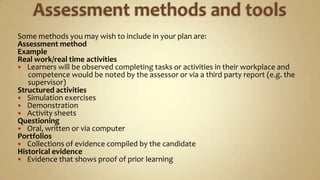
Assessment methods and toolsSome methods you may wish to include in your plan are:Assessment methodExampleReal work/real time activitiesLearners will be observed completing tasks or activities in their workplace and  competence would be noted by the assessor or via a third party report (e.g. the  supervisor)Structured activitiesSimulation exercisesDemonstrationActivity sheetsQuestioningOral, written or via computerPortfoliosCollections of evidence compiled by the candidateHistorical evidenceEvidence that shows proof of prior learning
Implementation requirements VenueIndustry, workplace, organisational cultureAllowable time for trainingManagement expectationsPeople to be involvedReporting requirementsAccess needs
Review the learning program content and structure addresses all aspects required by the units       of competency or other benchmarkssequence provides effective and manageable blocks of learningactivities are interesting, relevant and appropriate to outcomes       and learner characteristicsassessment points, methods and tools are appropriate and effectiveeffectively addresses equity needs identifies risk areas and contingencies.
Evaluation toolsa questionnaire—with open or closed questionsa mapping toola checklista focus group discussiona structured interview.
Adjusting a learning programAfter undertaking the review process, there may be a number of recommendations made by reviewers. The designer of the program, together with the client or other appropriate personnel, needs to determine what adjustments should be made to the learning program to reflect the review outcomes.
Final approvalOnce adjustments are made, the designer needs to gain final approval for the learning program from the appropriate personnel. Depending on your practice environment, this may be a:program managerhead of departmentsenior teacherapprenticeship or traineeship supervisortraining coordinator, manager human resource manager.
Documenting the learning programActivity	Storage of documentationFind out how learning program documentation is held safely and securely in your practice environment and ensure you know your responsibilities for documentation control. 
ImplementationYou now are in a good position to implement your learning program, confident that your planning is thorough and meets the identified needs of your learners.Good luck!

Modular or part time learning program

  • 1.
    Modular or parttime learning programEng.p.n.k.dias
  • 2.
    End of thissession… Specifically, this learning session will help you develop skills and knowledge to enable you to:Identify the parameters of the learning program with clientsGenerate options and determine the learning program designOutline the content and structure of the learning programReview its effectiveness.
  • 3.
    Learning topicsOverview ofthe learning program design processDefine the parameters of the modular/part time learning program with the clientGenerate options for designing the modular/part time learning programDevelop the modular/part timelearning program contentDesign the modular/part time learning program structureReview the modular/part time learning program
  • 4.
    Benefit to you..“youwill be able to design a range of learning programs to meet different learner needs and learning contexts”
  • 5.
    AssessmentYou will producethe one learning program required for assessment and it should identify the learner and client needsbe clearly mapped to the benchmarksbe structured and sequenced to maximise learningbe logical and innovative to engage the learner groupinclude delivery methods which enhance flexibilityidentify resources needed to deliver and assess the training
  • 6.
    learning program defined?Alearning program provides the basis for a cohesive and integrated learning process by outlining the processes of learning and assessment
  • 7.
    A learning programshould identifyits purpose the target group, their needs and characteristicsthe outcomes to be achieved, such as the units of competency or other benchmarks the learning and assessment activities including any flexibilities with thisany required resources. 
  • 8.
    Steps in designingand developing learning programs
  • 9.
    Planning "If you do not know where you are going you will end up somewhere else'
  • 10.
    Essential Considerationsissue/problem/need what),characteristicsand needs of learners (target audience  who),changes intended for learners (intended outcomes what the learners will be able to do),the important and relevant content (what),methods to accomplish intended outcomes (how),evaluation strategies for methods, content, and intended outcomes (What works)
  • 11.
    Step 1:Analyse –definethe parameters‘why, who and what’ of your learning programWhen designing a learning program, be sure you are clear on its purpose. That is, why does it need to be designed? In broad terms, what outcomes will it achieve, how will it be used, and who will be involved?
  • 12.
    Phase I(1) IdentifyThe Issue / Problem / Needs(2) Form Curriculum Development Team(3) Conduct Needs Assessment and Analysis
  • 13.
    IDENTIFY THE ISSUE/ PROBLEM / NEEDSwho is affected or involved,the scope of the problem (issue) to be addressed by the curriculum, andthe consequences.
  • 14.
    Need assessment andanalysis"Start with what people already know and build on what they already have.“A NEED OR GAP IS: Desired Performance- Actual = NEED(What Should Be) -(What Is) = GAPthe difference between desired and actual performance are identified, it is time to categorize needs. Identify the type of needs by putting them into three categories (i.e., knowledge, attitude, or practices) and prioritize them.
  • 15.
    Analysis phaseProblem analysisJobanalysisTarget group analysis
  • 16.
    Analyse training needsIdentifythe problem –case study-which one needs training Need for training fall into two categoriesChanges and developments in the companyCurrent work performance not up to expectation3/04/2011pnkdias sri lanka16
  • 17.
    Changes and developmentCorporategrowthProduct changeTechnical changesNew legislation personal changes3/04/2011pnkdias sri lanka17
  • 18.
    Current work performanceindicatorsOutputScrap and wastageQuality of workTime to complete workUtilization of machines3/04/2011pnkdias sri lanka18
  • 19.
    Current work performance…AccidentrateLabour turnoverAbsenteeismDelays and bottlenecksCustomer complaintsRecruitment problem3/04/2011pnkdias sri lanka19
  • 20.
    Training should bethe last???Lack of skills Unattainable targetLack of motivationUnsuitable equipmentInappropriate methodsPoor work environmentPoor healthPoor managementPoor attitudes what will justify the training?3/04/2011pnkdias sri lanka20
  • 21.
    3/04/2011pnkdias sri lanka21ANALYSININGPERFORMANCE PROBLEMStartPerformance discrepancyIgnore problemNoIs it Important?yesNoIs there skill deficiencyManagement to consider:yesNois there a simpler way to perform job?yesArrange formal trainingRe design job to fit workerEnd
  • 22.
    Activity -Program purpose Conductsome research by communicating with clients and other stakeholders and determine the purpose of the program.Note the purpose of your program on the learning program plan proforma. 
  • 23.
    Target group existingindustry or enterprise employeesschool leavers and/or new entrants to the workforceapprentices or traineesindividuals learning new skills and knowledgeindividuals seeking to upgrade skills and knowledgeindividuals changing careersunemployed peopleindividuals or groups needing to meet licensing or other regulatory requirements.
  • 24.
    Learners Characteristicslevel andbreadth of work experiencelevel and previous experiences of formal educationskill or competency profilesocioeconomic background, age, gender, range of abilities (disabilities)cultural background and needsspecial needs—physical or psychologicalmotivation for learninglanguage, literacy and numeracy needs of learnerslearning style and preferences.
  • 25.
    Activity Determine a learner’srequirementsResearch your target group learners in more depth to answer some of the questions posed above. Speak to managers, workplace supervisors, potential learners, other trainers, training managers and other relevant people to get the most accurate picture Document your target group learner characteristics and needs in your learning program plan proforma. 
  • 26.
    Benchmark?You have towork out exactly what level or standard of learning is required. You need standards on which to base the programHow do you work this out?
  • 27.
    Benchmark soursesFor yourlearning program, select the benchmark sources that you are going to useWhere can you access them? If possible, collect them to use in your development.Activity: Benchmark sources
  • 28.
    Delivery methods foryour programface-to-face deliveryonline deliverydistance learningcoaching or mentoringworkplace applicationssimulated workplace applicationsblended delivery.
  • 29.
    Language, literacy andnumeracy requirementsDo the target group learners require a certain level of LLN skills to be able to use and interpret the documentation used in the learning program? Analyse the level of mathematical skill required. Is there any mathematical process or calculation which has to be carried out as part of the learning program?
  • 30.
    Generating options Youhave spent a lot of time gathering information and researching and analysing the parameters of the learning program. Now it is time to use that information to come up with some options for the type of learning program that will be designed.
  • 31.
    Activity Program structureConsideryour learning program. Is there one particular option shown above that best matches the way information should be clustered in your learning program? Document the structure your learning program will adopt on your learning program plan proforma.
  • 32.
    Options for learningprogram content Activity Learning program contentGenerate ideas for possible content for your learning program, using an appropriate format to present your options. You should include:activitieslearning stylespossible assessment methodsdelivery modesexisting resourceslearning resources to be developedwork-based taskson-the-job learning. 
  • 33.
    Identify resources handoutsfor learnersworksheetsworkbooksprepared case studiesprepared task sheetsprepared activity sheetsprepared topic, unit, subject information sheetsprepared role-playsprepared presentations and overheadsprepared scenarios, projects, assignmentsmaterials sourced from the workplace, for example, workplace documentation, operating procedures, specifications
  • 34.
    Timeframes The amountof time that will be allocated to the learning program will influence what your learning program covers, the extent of detail and how it can be broken down into sections or chunks to enhance learning. Your planning may be guided by a number of factors.
  • 35.
    Budget and costsCosts are almost always an important factor in any learning program. Management may see learning programs as an ‘extra’ rather than a ‘must have’ when running their business. When times are tough, learning programs may be postponed or reduced.
  • 36.
    Activity Timeframes, costs andlogisticsEstimate timeframes, possible costs and logistics ofyour proposed learning program.This information can be recorded on your learning program plan
  • 37.
    Activity- Justify your optionJustifyto your client and/or colleagues the option you have chosen for the learning program content. Present a learning program proposal that clarifies the following about the learning program content:
  • 38.
    Develop the learningprogram content Adult learning principles Adults have a need to be self-directing.Adults have a range of life experience, so connecting learning to experience is meaningfulAdults have a need to know why they are learning something.Training needs to be learner-centred to engage learners.The learning process needs to support increasing learner independence.Emphasis on experimental and participative learning.Reflecting individual circumstances.
  • 39.
    Learning stylesVisual, auditoryand kinaesthetic learning stylesLeft brain Right brainPART learning stylesGlobal and analytical learner model
  • 40.
    Activity Learning program contentProvidesamples of learning program content for your learning program. It can be contextualised from existing resources or newly developed materials.
  • 41.
    learning program structureA program delivery plan A program delivery plan is a tool to use for designing and developing a learning program. It outlines each component of the program, so you can see a clear breakdown of the program. It may be set against a timeline or it may show a series of sessions that make up the learning program.
  • 42.
    the competencies orother benchmarks to be achievedthe specific learning outcomes for each session or part of the learning programthe content and learning activities for each sessionthe delivery methods for each session workplace tasks or applicationspractice opportunitiesassessment points in the program where the learners’ progress is measuredassessment methods and tools used to gather evidence of competencythe personnel assigned to facilitate the implementation of each session.
  • 43.
    Activity-Proformas for programdelivery plansConsider the sample proformas that could be used to design a learning program delivery plan. Use these as a guide to developing a proforma to best suit your own requirements. Ask your colleagues if there is a format endorsed by your organisation.

  • 44.
    Assessment methods andtoolsSome methods you may wish to include in your plan are:Assessment methodExampleReal work/real time activitiesLearners will be observed completing tasks or activities in their workplace and competence would be noted by the assessor or via a third party report (e.g. the supervisor)Structured activitiesSimulation exercisesDemonstrationActivity sheetsQuestioningOral, written or via computerPortfoliosCollections of evidence compiled by the candidateHistorical evidenceEvidence that shows proof of prior learning
  • 45.
    Implementation requirements VenueIndustry,workplace, organisational cultureAllowable time for trainingManagement expectationsPeople to be involvedReporting requirementsAccess needs
  • 46.
    Review the learningprogram content and structure addresses all aspects required by the units of competency or other benchmarkssequence provides effective and manageable blocks of learningactivities are interesting, relevant and appropriate to outcomes and learner characteristicsassessment points, methods and tools are appropriate and effectiveeffectively addresses equity needs identifies risk areas and contingencies.
  • 47.
    Evaluation toolsa questionnaire—withopen or closed questionsa mapping toola checklista focus group discussiona structured interview.
  • 48.
    Adjusting a learningprogramAfter undertaking the review process, there may be a number of recommendations made by reviewers. The designer of the program, together with the client or other appropriate personnel, needs to determine what adjustments should be made to the learning program to reflect the review outcomes.
  • 49.
    Final approvalOnce adjustmentsare made, the designer needs to gain final approval for the learning program from the appropriate personnel. Depending on your practice environment, this may be a:program managerhead of departmentsenior teacherapprenticeship or traineeship supervisortraining coordinator, manager human resource manager.
  • 50.
    Documenting the learningprogramActivity Storage of documentationFind out how learning program documentation is held safely and securely in your practice environment and ensure you know your responsibilities for documentation control. 
  • 51.
    ImplementationYou now arein a good position to implement your learning program, confident that your planning is thorough and meets the identified needs of your learners.Good luck!