MEMORY AND LEARNING
Presented by-
Shreyansh Srivastava
Roll no-82
LEARNING-It is the process of acquiring knowledge abot the world
MEMORY-Encoding,storage and later retrieval of knowledge.It is a
storage mechanism for what is learned.
DEFINITION
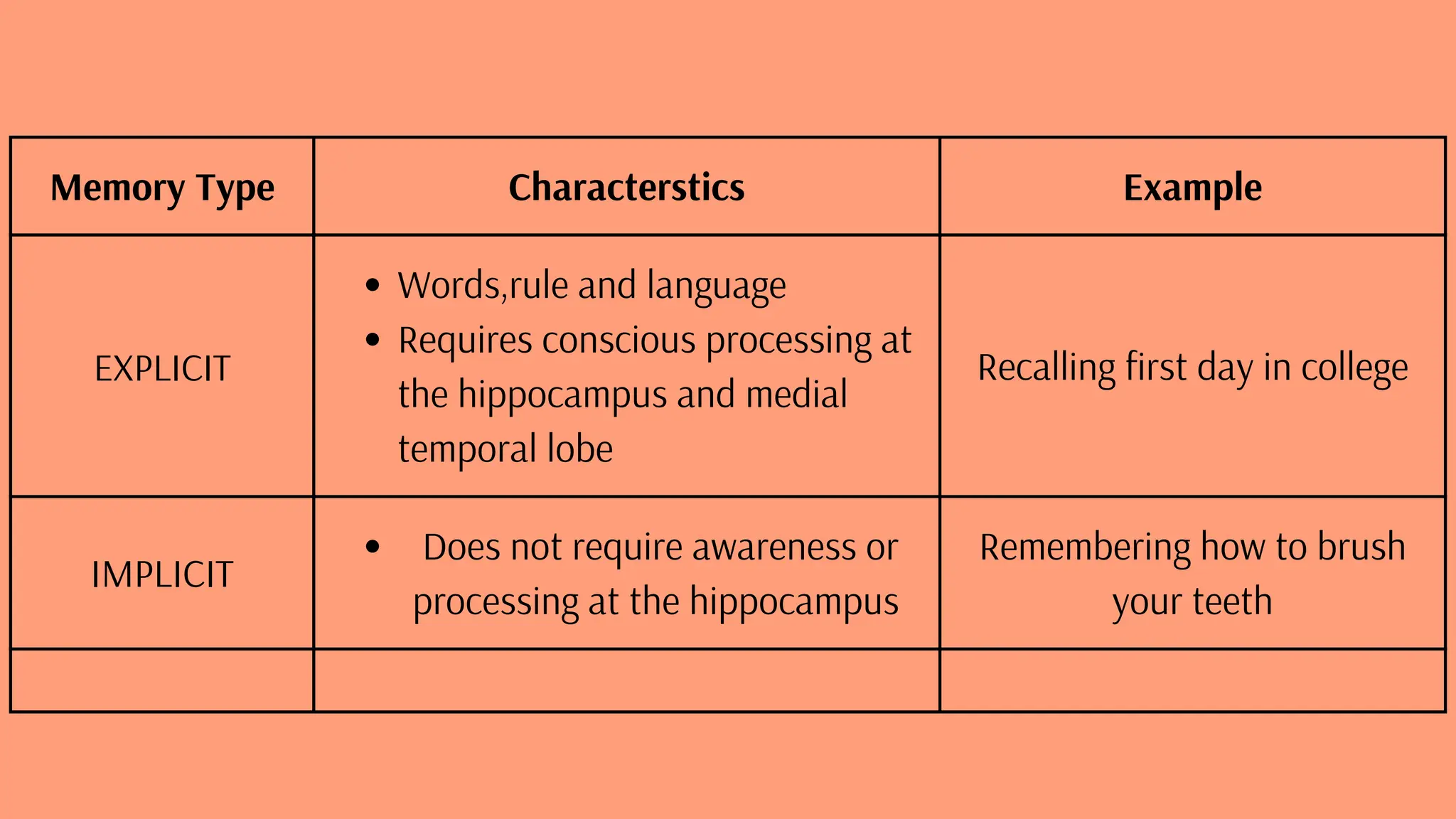
Memory Type Characterstics Example
EXPLICIT
Words,rule and language
Requires conscious processing at
the hippocampus and medial
temporal lobe
Recalling first day in college
IMPLICIT
Does not require awareness or
processing at the hippocampus
Remembering how to brush
your teeth
EXPLICIT MEMORY
Explicit memory is subdivided into two types-
Semantic memory-temporal and prefrontal cortex is more
important
Episodic memory-Hippocampus is more important while the
temporal and neo-cortex are also used
IMPLICIT MEMORY
Implicit memory is subdivided into 4 types-
Priming memory-the part of the brain responsible for this memory
is Neocortex. It is used when a clue is given to brain to retrieve the
required information information.
Procedural memory-It is used when learning certain skills or
habits. The Striatumof the basal ganglia and cerebellum are two
very important brain areas.
associative learning -it is when the organism associates, two
things together that is stimulus, behaviour, stimulus, stimulus, etc.
the area responsible for associative learning are the Amygdala and
cerebellum
forms of memory
Working memory-it is a form of short-term memory.
it last only about 18 to 20 seconds, that is in information that will be lost
without revision
the part of the brain responsible for working memory is the pre-frontal
cortex. Upon revision, this information may turn into longer lasting
memory, called short memory.
Short term memory-information can last from second to several hours.
the part of the brain Responsible for short-term memory is the ventral
hippocampus. Upon revision, this information can be converted into
long-term memory.
long-term memory-information can last for years or sometimes for life.
The centre for long-term memory is Neocortex
Case of Henry molaison
Henry was a child of 7 to 8 years when he met with an accident,
which resulted in epilepsy, that wasn’t the generalised type initially
At the age of 16 to 17 years epilepsy became a generalised type
The doctors unsuccessfully attempted to control his epilepsy
through various drugs
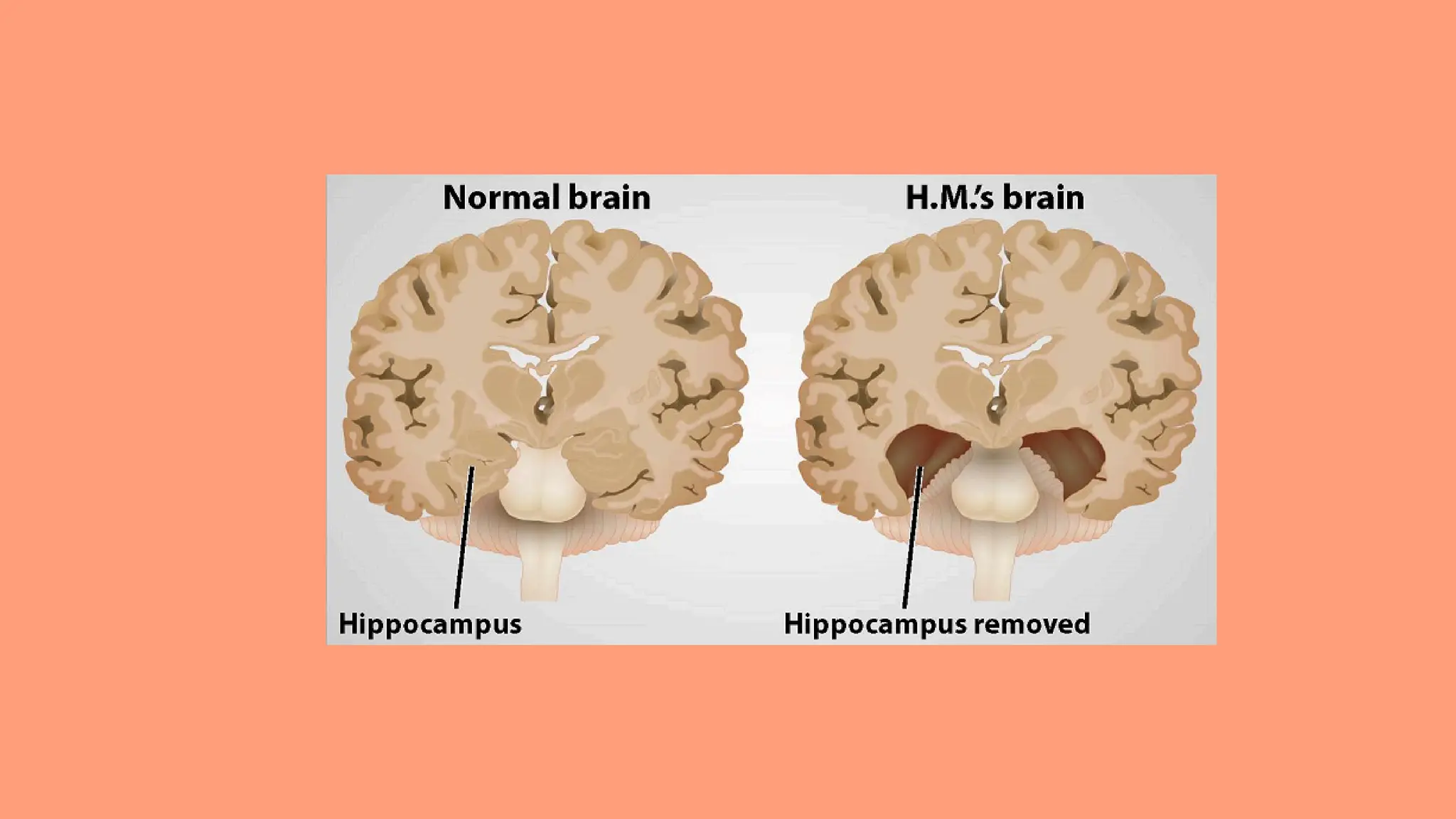
At the age of 27, the doctor decided to remove the part of the brain
responsible for epilepsy. They performed bilateral removal of
amygdala hippocampus, and some part of temporal lobe. The result
of the surgery-
No retrograde amnesia
Anterograde amnesia
intact intellectual activity and other cognitive functions
mechanism of memory formation
it is synaptic plasticity that is strengthening or weakening of
synapse due to increased activity
Synapse hold all the information in the brain when a new
memory is formed. Thus, there is no special cell to hold
information, only the change of synapse.
positive memory leads to strengthening of synapse whereas
negative memory leads to weakening of synapse
There are three mechanisms through which synaptic plasticity
might occur-
Post tetanic potentiation
Long term potentiation
Long term depression
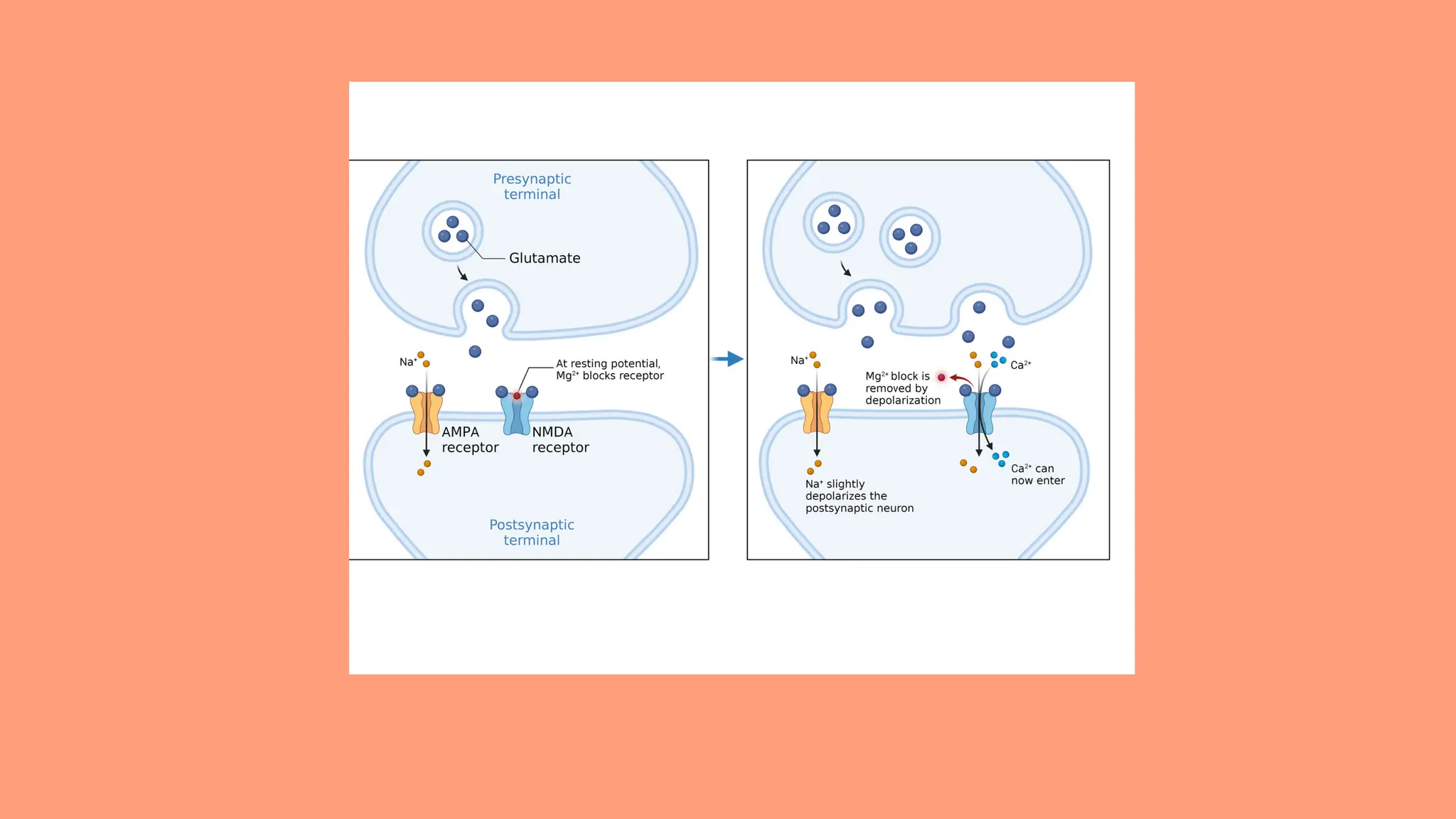
Long term potentiation
it is seen mainly at the level of the hippocampus and cerebellum
Consider a neuron at the level of hippocampus CA3 to CA1 region
This branching of neon is known as Schaffer’s collateral
This synapse need on neuron is known as glutamic synapse.
Two glutamate receptors are important for the generation that is
AMPA and NMDA
The changes are-
increase in number of presynaptic knobs
increase in the release site area
Increase in number of neurotransmitters containing vesicles
Long-term depression
It is also seen mainly at the level of hippocampus and cerebellum
Calcium influx is much less than long term potentiation
Although neurotransmitter is same, that is glutamate The channel
responsible is metabotropic receptor.
This receptor, in gluta causes very low influx of calcium in the post
synaptic neuron
In the presence of low calcium the phosphatase enzyme is activated
instead of kinase resulting in dephosphorylation of AMPA and eventually
shut down of synapse
Post Tetanic Potentiation
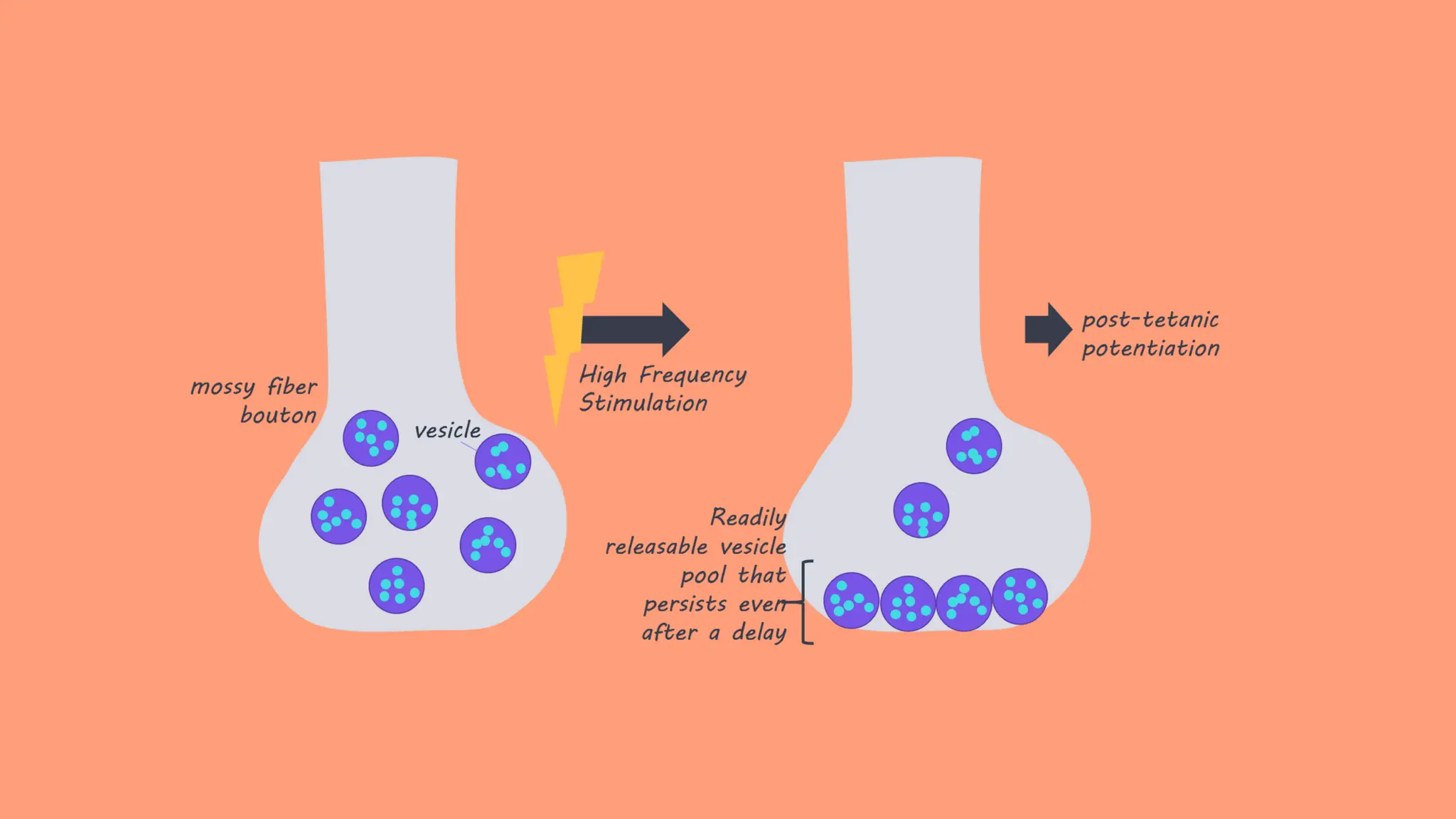
Stimulation of the pre-synaptic neurons with high frequency
stimulation it results in a huge influx of calcium in the presynaptic
terminal.
The calcium is so high that it will continue to release
neurotransmitters, even after the stimulation is stopped. Ultimately,
the synapse is strengthened since it is constantly active.
Memory and learning_20240611_202122_0000.pdf

Memory and learning_20240611_202122_0000.pdf

  • 1.
    MEMORY AND LEARNING Presentedby- Shreyansh Srivastava Roll no-82
  • 2.
    LEARNING-It is theprocess of acquiring knowledge abot the world MEMORY-Encoding,storage and later retrieval of knowledge.It is a storage mechanism for what is learned. DEFINITION
  • 3.
    Memory Type CharactersticsExample EXPLICIT Words,rule and language Requires conscious processing at the hippocampus and medial temporal lobe Recalling first day in college IMPLICIT Does not require awareness or processing at the hippocampus Remembering how to brush your teeth
  • 4.
    EXPLICIT MEMORY Explicit memoryis subdivided into two types- Semantic memory-temporal and prefrontal cortex is more important Episodic memory-Hippocampus is more important while the temporal and neo-cortex are also used
  • 5.
    IMPLICIT MEMORY Implicit memoryis subdivided into 4 types- Priming memory-the part of the brain responsible for this memory is Neocortex. It is used when a clue is given to brain to retrieve the required information information. Procedural memory-It is used when learning certain skills or habits. The Striatumof the basal ganglia and cerebellum are two very important brain areas. associative learning -it is when the organism associates, two things together that is stimulus, behaviour, stimulus, stimulus, etc. the area responsible for associative learning are the Amygdala and cerebellum
  • 6.
    forms of memory Workingmemory-it is a form of short-term memory. it last only about 18 to 20 seconds, that is in information that will be lost without revision the part of the brain responsible for working memory is the pre-frontal cortex. Upon revision, this information may turn into longer lasting memory, called short memory. Short term memory-information can last from second to several hours. the part of the brain Responsible for short-term memory is the ventral hippocampus. Upon revision, this information can be converted into long-term memory. long-term memory-information can last for years or sometimes for life. The centre for long-term memory is Neocortex
  • 7.
    Case of Henrymolaison Henry was a child of 7 to 8 years when he met with an accident, which resulted in epilepsy, that wasn’t the generalised type initially At the age of 16 to 17 years epilepsy became a generalised type The doctors unsuccessfully attempted to control his epilepsy through various drugs At the age of 27, the doctor decided to remove the part of the brain responsible for epilepsy. They performed bilateral removal of amygdala hippocampus, and some part of temporal lobe. The result of the surgery- No retrograde amnesia Anterograde amnesia intact intellectual activity and other cognitive functions
  • 9.
    mechanism of memoryformation it is synaptic plasticity that is strengthening or weakening of synapse due to increased activity Synapse hold all the information in the brain when a new memory is formed. Thus, there is no special cell to hold information, only the change of synapse. positive memory leads to strengthening of synapse whereas negative memory leads to weakening of synapse There are three mechanisms through which synaptic plasticity might occur- Post tetanic potentiation Long term potentiation Long term depression
  • 10.
    Long term potentiation itis seen mainly at the level of the hippocampus and cerebellum Consider a neuron at the level of hippocampus CA3 to CA1 region This branching of neon is known as Schaffer’s collateral This synapse need on neuron is known as glutamic synapse. Two glutamate receptors are important for the generation that is AMPA and NMDA The changes are- increase in number of presynaptic knobs increase in the release site area Increase in number of neurotransmitters containing vesicles
  • 12.
    Long-term depression It isalso seen mainly at the level of hippocampus and cerebellum Calcium influx is much less than long term potentiation Although neurotransmitter is same, that is glutamate The channel responsible is metabotropic receptor. This receptor, in gluta causes very low influx of calcium in the post synaptic neuron In the presence of low calcium the phosphatase enzyme is activated instead of kinase resulting in dephosphorylation of AMPA and eventually shut down of synapse
  • 13.
    Post Tetanic Potentiation Stimulationof the pre-synaptic neurons with high frequency stimulation it results in a huge influx of calcium in the presynaptic terminal. The calcium is so high that it will continue to release neurotransmitters, even after the stimulation is stopped. Ultimately, the synapse is strengthened since it is constantly active.