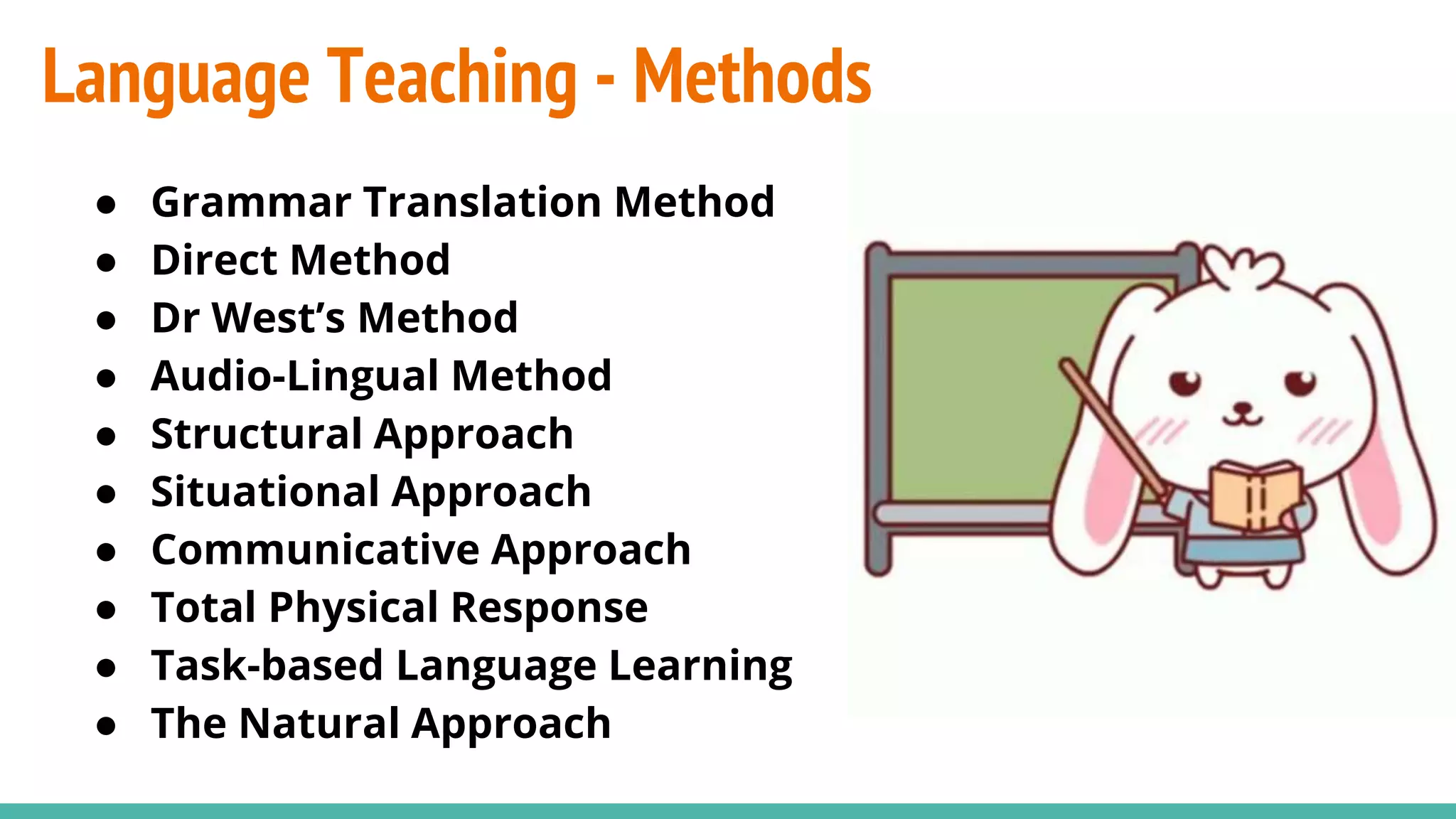
The document discusses English language teaching and methods. It outlines that English language teaching involves teaching English to those whose first language is not English, and encourages innovative approaches and methods. It then discusses language in general, noting that language is a means of communication and expression that varies across the world. The document also outlines various aims, principles, types of teaching methods, and specific methods for language teaching.
Lt Dr B.Ajantha Parthasarathi
Assistant Professor, Research Department of English
Sri SRNM College, Sattur.
ajantha@srnmcollege.ac.in
ENGLISH LANGUAGE TEACHING
2.
English Language Teaching
●Teaching of English to
people whose first
language is not English
● Encourages approaches/
methods to the study of
language with
methodological
innovations
3.
Language
● A mediumthrough which one can
express one’s ideas, thoughts,
feelings etc.
● Different languages are spoken in
the world
● Very difficult to ascertain how these
languages originated
● People started conveying message
through signals, postures, gestures,
etc
● A human system of communication
that uses arbitrary signals such as
voice, sounds, gestures and written
symbols
Language - Importance
●3 phases of human knowledge -
preservation, transmission &
advancement - possible only with the help
of a language
● Best source of social & cultural
development
● Primary languages of press & internet
● Only language in which maximum
resources are available
● An international language, makes travel &
business convenient to others
● In India - English is the second language &
its importance cannot be undermined
6.
Language Teaching -Aims
● Understand the speaker’s language
● Read along with understanding
● Express fluently and diversely using different
skills
● Present or write views in a coherent manner
● Learn technological language used in
teaching of other subjects such as music,
computers or sports
● Understand the scientific aspect of a
language
● Development of creative skills
● Development of learner’s sensitivity towards
national issues, cultural heritage and
different aspects of contemporary life
7.
Language Teaching -Principles
● Theory of Motivation & Interest
● Theory of Imitation
● Theory of Habit Formation
● Theory of Exercise
● Theory of Individual Differences
● Theory of Using Mother Tongue
● Correlation with Life
● Theory of Oral Approach
● Theory of Selection & Gradation