Classification
&
Description of
Consonant
Sounds
Lt. Dr. B. Ajantha Parthasarathi
Assistant Professor of English &
Associate NCC Officer,
Sri SRNM College, Sattur.
Consonant SOUND
▪ Produced by escaping air
through the mouth or
nostrils with friction
⮚ Air-stream Mechanism
⮚ The State of the Glottis
⮚ The Position of the Soft
Palate
⮚ Place of Articulation – Active
& Passive
⮚ Manner of Articulation –
Strictures involved
Air-stream mechanism
⮚Airflow is created in the
vocal tract
⮚Air expelled –
mouth/nostrils
⮚Pulmonic air
⮚Egressive Air-Stream
⮚Pulmonic Egressive Air-
Stream
State of the glottis
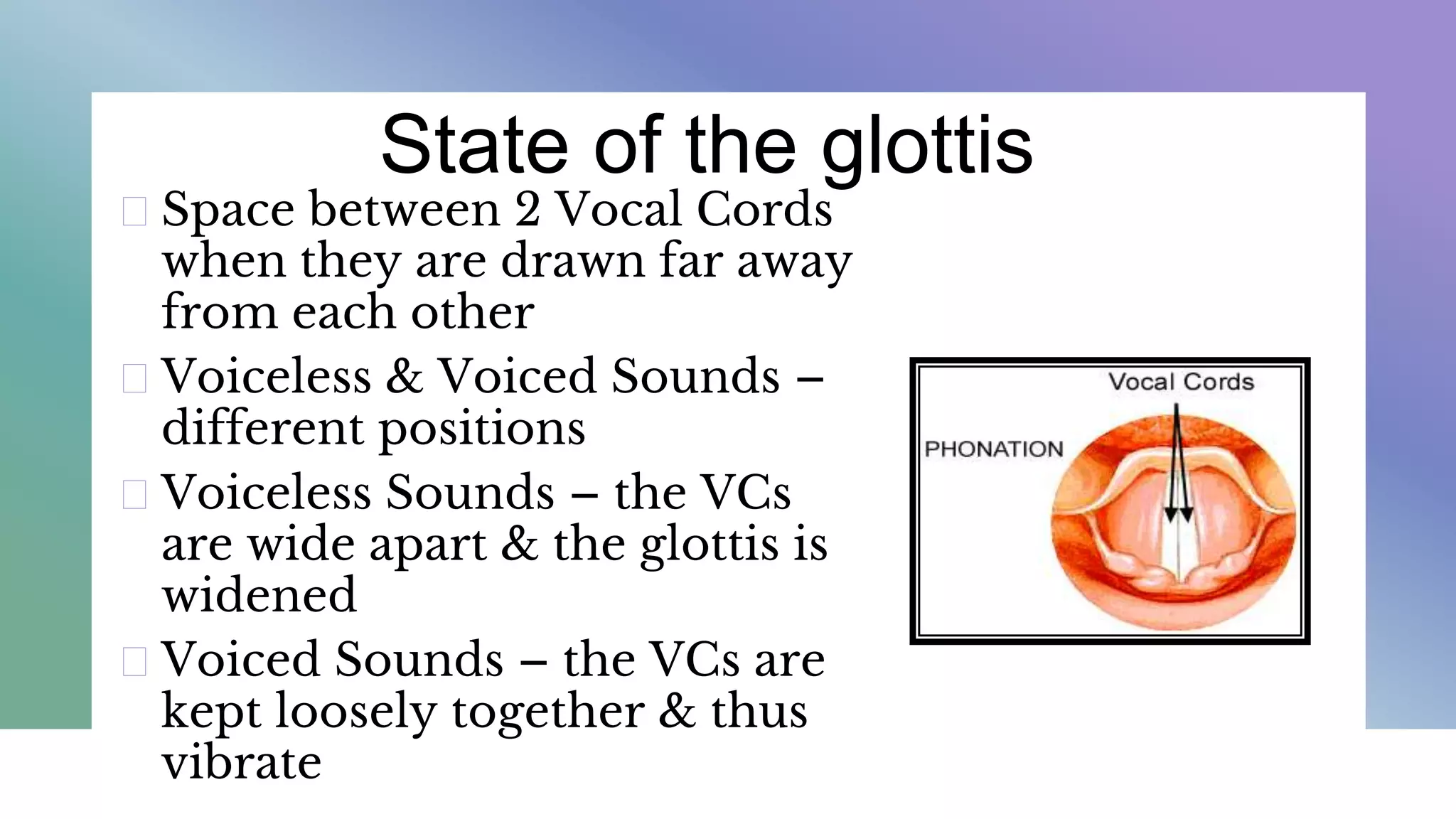
⮚ Space between 2 Vocal Cords
when they are drawn far away
from each other
⮚ Voiceless & Voiced Sounds –
different positions
⮚ Voiceless Sounds – the VCs
are wide apart & the glottis is
widened
⮚ Voiced Sounds – the VCs are
kept loosely together & thus
vibrate
Position of the soft palate
▪ Oral sounds & Nasal sounds
▪ Oral Sound
⮚ SP can be moved up/raised
⮚SP touches the backwall of the Pharynx
⮚Shuts off the nasal passage of air
⮚Sound articulated through the mouth
▪ Nasal Sound
⮚SP is lowered
⮚SP comes away from the backwall of the
Pharynx
⮚Opens the nasal passage of air
⮚Sound articulated through the nasal passage
Place of articulation
⮚ 2 kinds of articulators – active
articulator & passive articulator
⮚ Active Articulators
▪ Articulators move during the production
of speech sounds
▪ the lower lip & the different parts of the
tongue
⮚ Passive Articulators
▪ Articulators remain passive & the active
articulators articulate in the direction of
these passive articulators
▪ the upper lip, the upper front teeth &
the roof of the mouth
Place of articulation
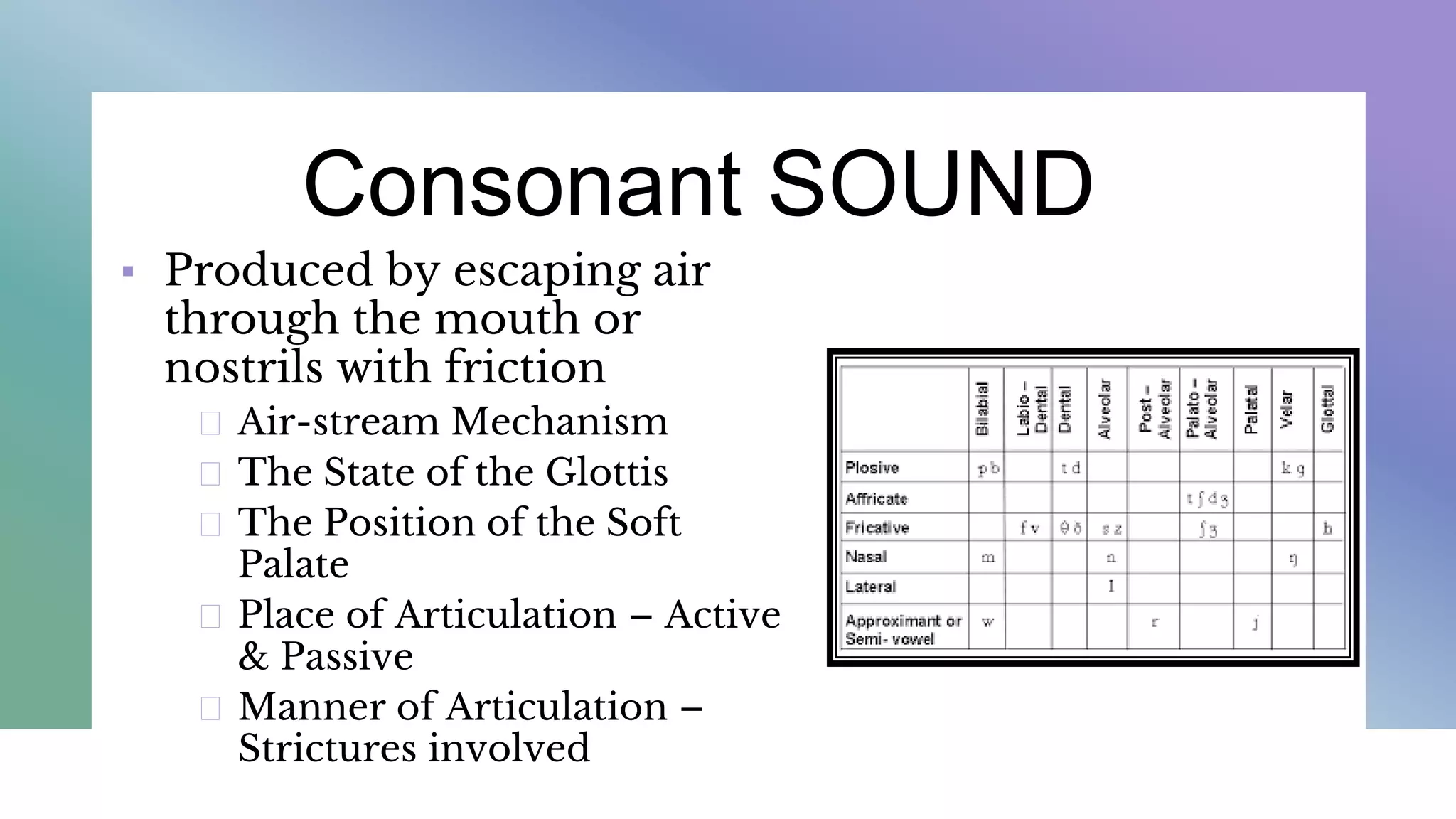
⮚ Bilabial - /p/, /b/, /m/
❑ AA & PA – Lips
⮚ Labio-dental - /f/, /v/
❑ AA – Lower lip
❑ PA – Upper front teeth
⮚ Dental/ Inter-dental - /θ/, /ð/
❑ AA – Tip/Blade of the tongue
❑ PA – Upper front teeth
⮚ Alveolar - /t/, /d/, /n/, /s/, /z/, /l/
❑ AA – Tip/Blade of the tongue
❑ PA – Teeth-ridge
Place of articulation
⮚ Post-alveolar - /r/
❑ AA – Tip of the tongue
❑ PA – Part of the roof of the mouth that is just behind
the teeth ridge
⮚ Palatal - /j/
❑ AA – Front of the tongue
❑ PA – Hard Palate
⮚ Palato-alveolar - /ʧ/, /ʤ/, /ʃ/, /ʒ/
❑ AA – Blade and front of the tongue
❑ PA – Teeth-ridge and Hard Palate
⮚ Velar - /k/, /g/, /ŋ/
❑ AA – Back of the tongue
❑ PA – Soft Palate
Place of articulation
⮚ Glottal - /h/
❑ AA & PA – Vocal Cords
⮚ Labial – velar - /w/
❑ AA – Lower lip & back of the tongue
❑ PA – Upper lip & Soft palate
Manner of articulation
Plosives – Complete Closure
& Sudden Release
/p/, /b/, /t/, /d/, /k/, /g/
⮚ Produced by stopping the
airflow using the lips, teeth
or palate
⮚ Followed by a sudden
release of air
Manner of articulation
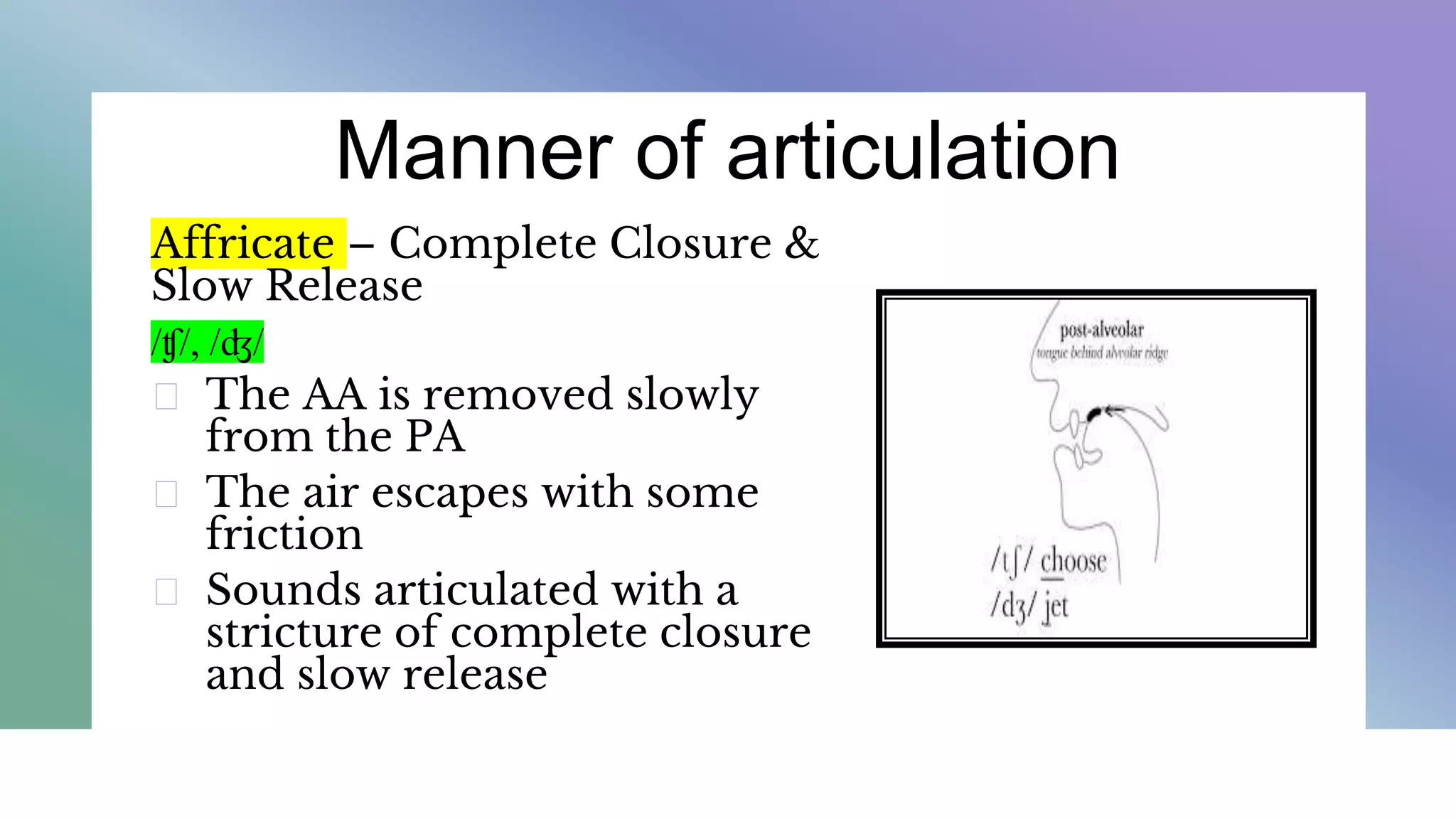
Affricate – Complete Closure &
Slow Release
/ʧ/, /ʤ/
⮚ The AA is removed slowly
from the PA
⮚ The air escapes with some
friction
⮚ Sounds articulated with a
stricture of complete closure
and slow release
Manner of articulation
Nasal– Complete Oral Closure
/m/, /n/, /ŋ/
⮚ An oral closure is made by the
AA (lower lip and tongue) –
making a firm contact with the
corresponding PA (upper lip,
teeth ridge, hard palate)
⮚ The soft palate is lowered &
comes away from the pharynx to
leave a nasal passage of air
⮚ The air from the lungs escapes
without any friction through the
nostrils
Manner of articulation
Fricative– Close Approximation
/f/, /v/, /θ/, /ð/, /s/, /z/, /ʃ/, /ʒ/, /h/
⮚ The soft palate is raised to
close the nasal passage
completely
⮚ AA is drawn closer to the PA &
a narrow passage between
them
⮚ The sound is escaped through
this narrow gap with friction
Manner of articulation
Frictionless Continuants &
Semi-Vowels–
/j/, /w/
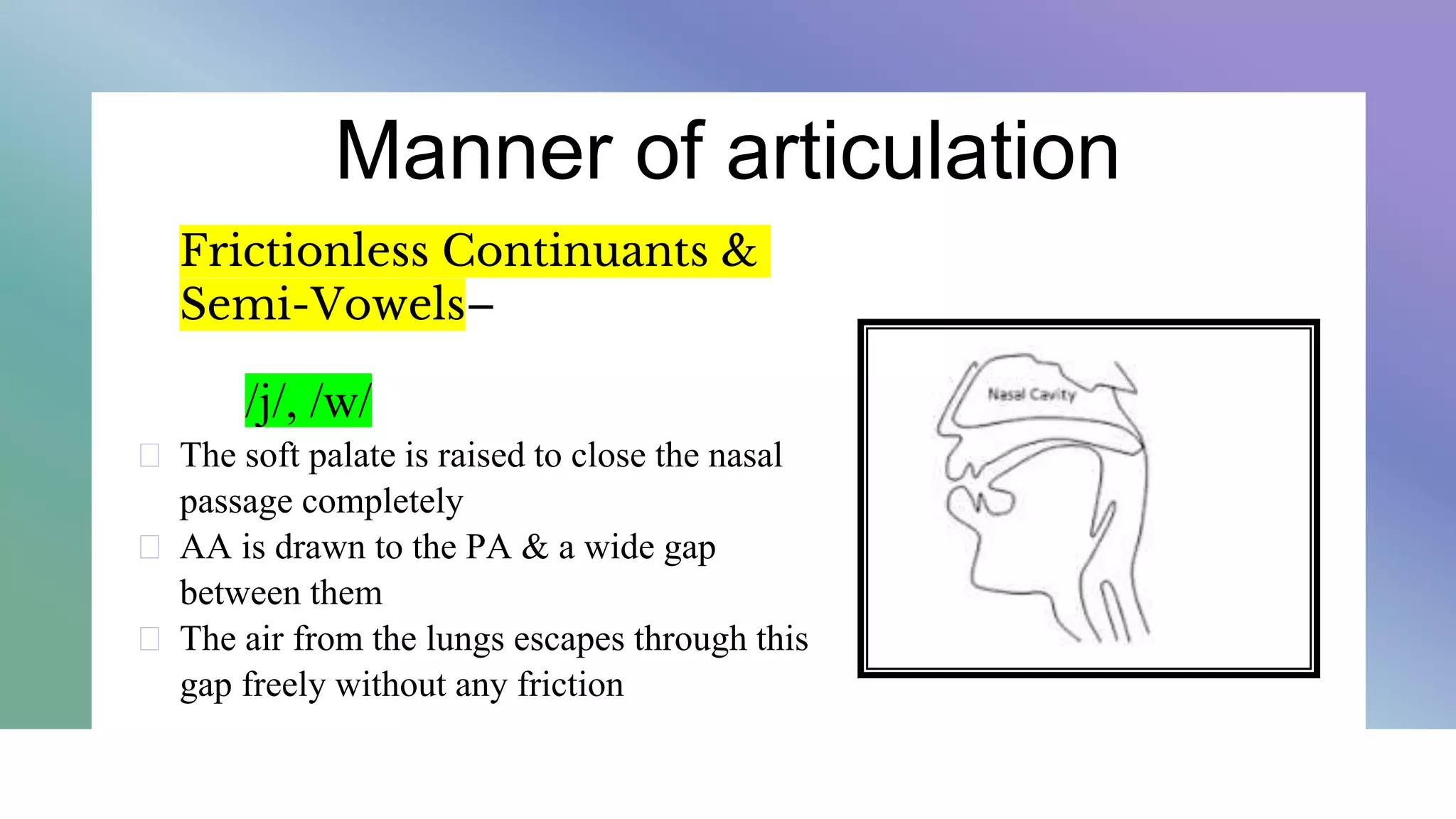
⮚ The soft palate is raised to close the nasal
passage completely
⮚ AA is drawn to the PA & a wide gap
between them
⮚ The air from the lungs escapes through this
gap freely without any friction
Manner of articulation
Lateral
/l/
⮚ The soft palate is raised to close the
nasal passage completely
⮚ AA & PA – firm contact
⮚ The sounds articulated freely along
the sides of the tongue which is
lowered
Manner of articulation
Trill/ Rolled Sounds –
Intermittent Closure
/r/
⮚ The velum is raised to close the nasal
passage
⮚ The AA strikes against the PA several
times in quick succession
⮚ The air from the lungs escapes through
the space between the articulators
intermittently
Three-term descriptions /
Three-term labels
⮚State of the Glottis
⮚Place of Articulation
⮚Manner of Articulation
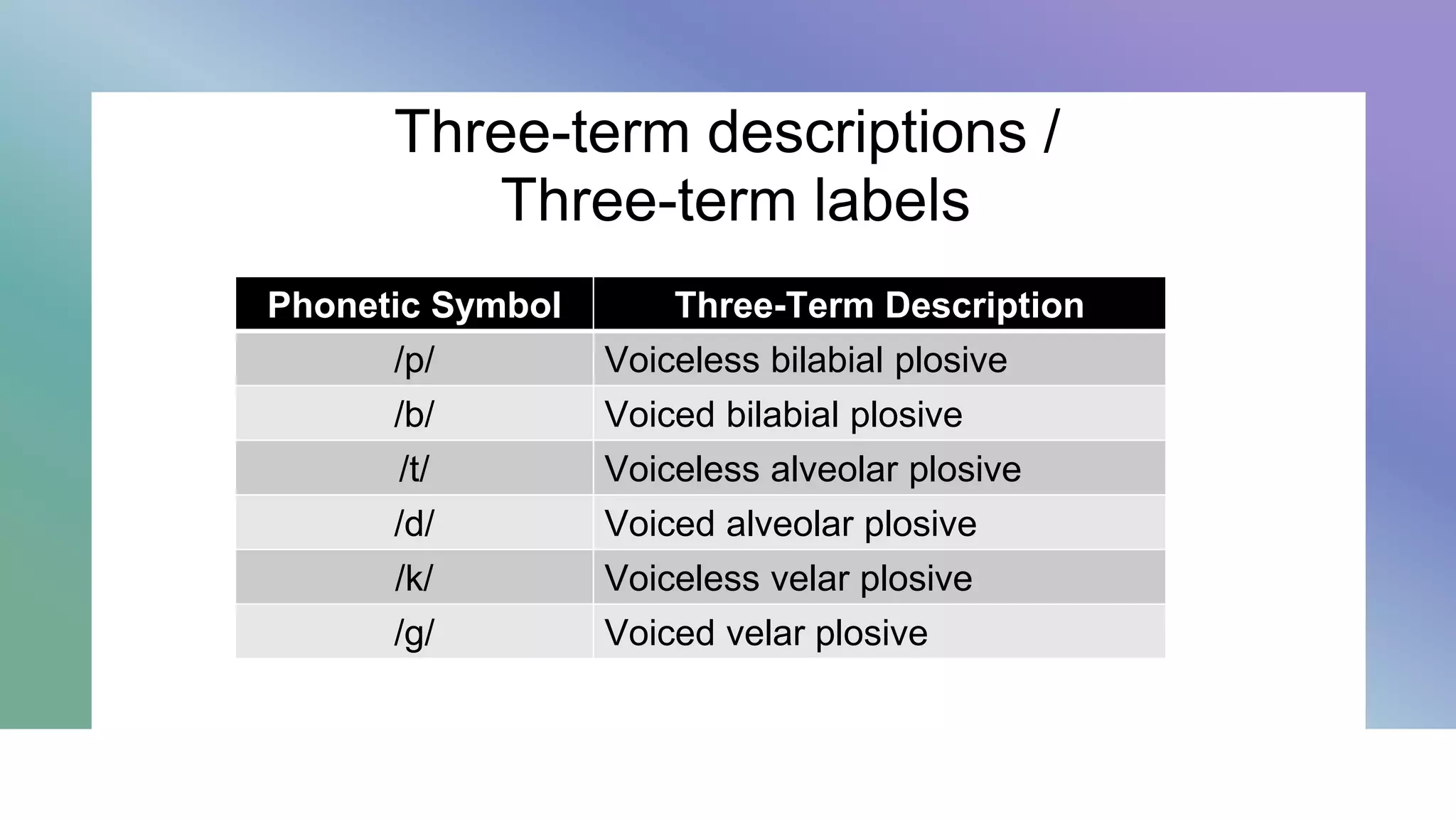
Three-term descriptions /
Three-term labels
Phonetic Symbol Three-Term Description
/p/ Voiceless bilabial plosive
/b/ Voiced bilabial plosive
/t/ Voiceless alveolar plosive
/d/ Voiced alveolar plosive
/k/ Voiceless velar plosive
/g/ Voiced velar plosive
Three-term descriptions /
Three-term labels
Phonetic Symbol Three-Term Description
/ʧ/ Voiceless palato-alveolar affricate
/ʤ/ Voiced palato-alveolar affricate
/m/ Voiced bilabial nasal
/n/ Voiced alveolar nasal
/ŋ/ Voiced velar nasal
Three-term descriptions /
Three-term labels
Phonetic Symbol Three-Term Description
/f/ Voiceless labio-dental fricative
/v/ Voiced labio-dental fricative
/θ/ Voiceless dental or interdental fricative
/ð/ Voiced dental or interdental fricative
/s/ Voiceless alveolar fricative
/z/ Voiced alveolar fricative
/ʃ/ Voiceless palato-alveolar fricative
/ʒ/ Voiced palato-alveolar fricative
/h/ Voiceless glottal fricative
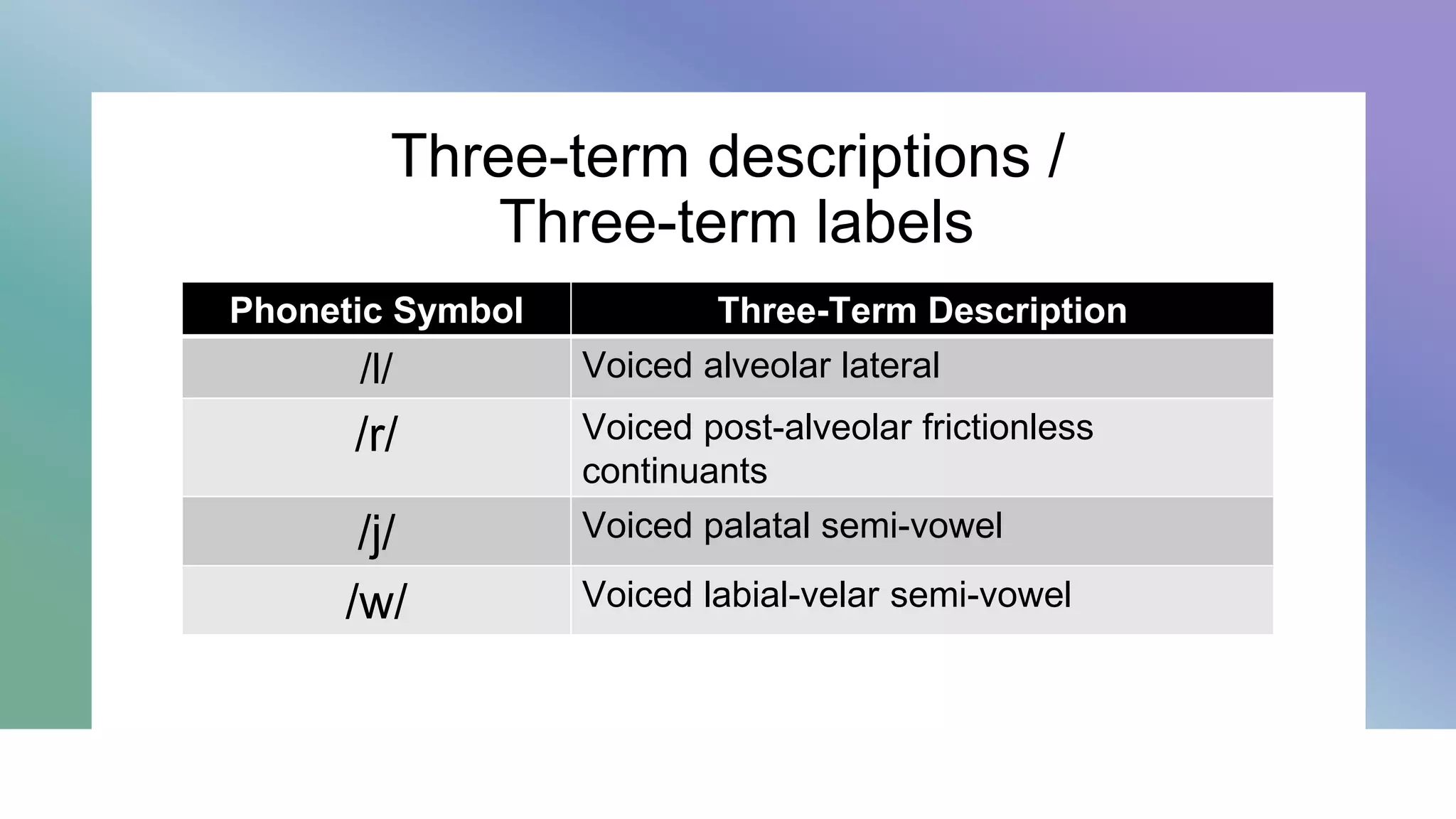
Three-term descriptions /
Three-term labels
Phonetic Symbol Three-Term Description
/l/ Voiced alveolar lateral
/r/ Voiced post-alveolar frictionless
continuants
/j/ Voiced palatal semi-vowel
/w/ Voiced labial-velar semi-vowel

Classification & Description of Consonant Sounds.pptx

  • 1.
    Classification & Description of Consonant Sounds Lt. Dr.B. Ajantha Parthasarathi Assistant Professor of English & Associate NCC Officer, Sri SRNM College, Sattur.
  • 2.
    Consonant SOUND ▪ Producedby escaping air through the mouth or nostrils with friction ⮚ Air-stream Mechanism ⮚ The State of the Glottis ⮚ The Position of the Soft Palate ⮚ Place of Articulation – Active & Passive ⮚ Manner of Articulation – Strictures involved
  • 3.
    Air-stream mechanism ⮚Airflow iscreated in the vocal tract ⮚Air expelled – mouth/nostrils ⮚Pulmonic air ⮚Egressive Air-Stream ⮚Pulmonic Egressive Air- Stream
  • 4.
    State of theglottis ⮚ Space between 2 Vocal Cords when they are drawn far away from each other ⮚ Voiceless & Voiced Sounds – different positions ⮚ Voiceless Sounds – the VCs are wide apart & the glottis is widened ⮚ Voiced Sounds – the VCs are kept loosely together & thus vibrate
  • 5.
    Position of thesoft palate ▪ Oral sounds & Nasal sounds ▪ Oral Sound ⮚ SP can be moved up/raised ⮚SP touches the backwall of the Pharynx ⮚Shuts off the nasal passage of air ⮚Sound articulated through the mouth ▪ Nasal Sound ⮚SP is lowered ⮚SP comes away from the backwall of the Pharynx ⮚Opens the nasal passage of air ⮚Sound articulated through the nasal passage
  • 6.
    Place of articulation ⮚2 kinds of articulators – active articulator & passive articulator ⮚ Active Articulators ▪ Articulators move during the production of speech sounds ▪ the lower lip & the different parts of the tongue ⮚ Passive Articulators ▪ Articulators remain passive & the active articulators articulate in the direction of these passive articulators ▪ the upper lip, the upper front teeth & the roof of the mouth
  • 7.
    Place of articulation ⮚Bilabial - /p/, /b/, /m/ ❑ AA & PA – Lips ⮚ Labio-dental - /f/, /v/ ❑ AA – Lower lip ❑ PA – Upper front teeth ⮚ Dental/ Inter-dental - /θ/, /ð/ ❑ AA – Tip/Blade of the tongue ❑ PA – Upper front teeth ⮚ Alveolar - /t/, /d/, /n/, /s/, /z/, /l/ ❑ AA – Tip/Blade of the tongue ❑ PA – Teeth-ridge
  • 8.
    Place of articulation ⮚Post-alveolar - /r/ ❑ AA – Tip of the tongue ❑ PA – Part of the roof of the mouth that is just behind the teeth ridge ⮚ Palatal - /j/ ❑ AA – Front of the tongue ❑ PA – Hard Palate ⮚ Palato-alveolar - /ʧ/, /ʤ/, /ʃ/, /ʒ/ ❑ AA – Blade and front of the tongue ❑ PA – Teeth-ridge and Hard Palate ⮚ Velar - /k/, /g/, /ŋ/ ❑ AA – Back of the tongue ❑ PA – Soft Palate
  • 9.
    Place of articulation ⮚Glottal - /h/ ❑ AA & PA – Vocal Cords ⮚ Labial – velar - /w/ ❑ AA – Lower lip & back of the tongue ❑ PA – Upper lip & Soft palate
  • 10.
    Manner of articulation Plosives– Complete Closure & Sudden Release /p/, /b/, /t/, /d/, /k/, /g/ ⮚ Produced by stopping the airflow using the lips, teeth or palate ⮚ Followed by a sudden release of air
  • 11.
    Manner of articulation Affricate– Complete Closure & Slow Release /ʧ/, /ʤ/ ⮚ The AA is removed slowly from the PA ⮚ The air escapes with some friction ⮚ Sounds articulated with a stricture of complete closure and slow release
  • 12.
    Manner of articulation Nasal–Complete Oral Closure /m/, /n/, /ŋ/ ⮚ An oral closure is made by the AA (lower lip and tongue) – making a firm contact with the corresponding PA (upper lip, teeth ridge, hard palate) ⮚ The soft palate is lowered & comes away from the pharynx to leave a nasal passage of air ⮚ The air from the lungs escapes without any friction through the nostrils
  • 13.
    Manner of articulation Fricative–Close Approximation /f/, /v/, /θ/, /ð/, /s/, /z/, /ʃ/, /ʒ/, /h/ ⮚ The soft palate is raised to close the nasal passage completely ⮚ AA is drawn closer to the PA & a narrow passage between them ⮚ The sound is escaped through this narrow gap with friction
  • 14.
    Manner of articulation FrictionlessContinuants & Semi-Vowels– /j/, /w/ ⮚ The soft palate is raised to close the nasal passage completely ⮚ AA is drawn to the PA & a wide gap between them ⮚ The air from the lungs escapes through this gap freely without any friction
  • 15.
    Manner of articulation Lateral /l/ ⮚The soft palate is raised to close the nasal passage completely ⮚ AA & PA – firm contact ⮚ The sounds articulated freely along the sides of the tongue which is lowered
  • 16.
    Manner of articulation Trill/Rolled Sounds – Intermittent Closure /r/ ⮚ The velum is raised to close the nasal passage ⮚ The AA strikes against the PA several times in quick succession ⮚ The air from the lungs escapes through the space between the articulators intermittently
  • 17.
    Three-term descriptions / Three-termlabels ⮚State of the Glottis ⮚Place of Articulation ⮚Manner of Articulation
  • 18.
    Three-term descriptions / Three-termlabels Phonetic Symbol Three-Term Description /p/ Voiceless bilabial plosive /b/ Voiced bilabial plosive /t/ Voiceless alveolar plosive /d/ Voiced alveolar plosive /k/ Voiceless velar plosive /g/ Voiced velar plosive
  • 19.
    Three-term descriptions / Three-termlabels Phonetic Symbol Three-Term Description /ʧ/ Voiceless palato-alveolar affricate /ʤ/ Voiced palato-alveolar affricate /m/ Voiced bilabial nasal /n/ Voiced alveolar nasal /ŋ/ Voiced velar nasal
  • 20.
    Three-term descriptions / Three-termlabels Phonetic Symbol Three-Term Description /f/ Voiceless labio-dental fricative /v/ Voiced labio-dental fricative /θ/ Voiceless dental or interdental fricative /ð/ Voiced dental or interdental fricative /s/ Voiceless alveolar fricative /z/ Voiced alveolar fricative /ʃ/ Voiceless palato-alveolar fricative /ʒ/ Voiced palato-alveolar fricative /h/ Voiceless glottal fricative
  • 21.
    Three-term descriptions / Three-termlabels Phonetic Symbol Three-Term Description /l/ Voiced alveolar lateral /r/ Voiced post-alveolar frictionless continuants /j/ Voiced palatal semi-vowel /w/ Voiced labial-velar semi-vowel