Dr. Michael
West’s New
Method
Lt. Dr. B. Ajantha Parthasarathi
Assistant Professor of English &
Associate NCC Officer
Sri SRNM College, Sattur.
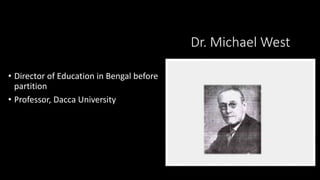
Dr. Michael West
• Director of Education in Bengal before
partition
• Professor, Dacca University
Aims of teaching English to Indian children
• English being an international language, promotes
internationalism and a feeling of brotherhood among
different people of the world. It provides an easy channel
for communication with the people all over the world and
thus broadens the outlook
•In the field of science no Indian language is as rich as
English
• English enriches the minds of the Indian people who can
get good reading material through English from all over
the world.
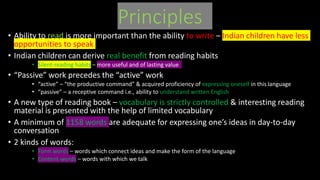
Principles
• Ability to read is more important than the ability to write – Indian children have less
opportunities to speak
• Indian children can derive real benefit from reading habits
• Silent-reading habits – more useful and of lasting value
• “Passive” work precedes the “active” work
• “active” – “the productive command” & acquired proficiency of expressing oneself in this language
• “passive” – a receptive command i.e., ability to understand written English
• A new type of reading book – vocabulary is strictly controlled & interesting reading
material is presented with the help of limited vocabulary
• A minimum of 1158 words are adequate for expressing one’s ideas in day-to-day
conversation
• 2 kinds of words:
• Form words – words which connect ideas and make the form of the language
• Content-words – words with which we talk
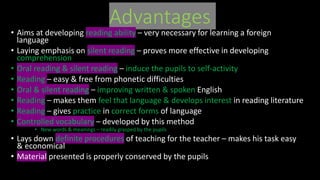
Advantages
• Aims at developing reading ability – very necessary for learning a foreign
language
• Laying emphasis on silent reading – proves more effective in developing
comprehension
• Oral reading & silent reading – induce the pupils to self-activity
• Reading – easy & free from phonetic difficulties
• Oral & silent reading – improving written & spoken English
• Reading – makes them feel that language & develops interest in reading literature
• Reading – gives practice in correct forms of language
• Controlled vocabulary – developed by this method
• New words & meanings – readily grasped by the pupils
• Lays down definite procedures of teaching for the teacher – makes his task easy
& economical
• Material presented is properly conserved by the pupils
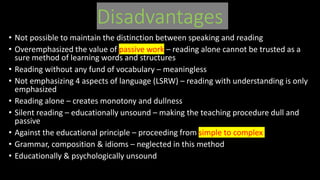
Disadvantages
• Not possible to maintain the distinction between speaking and reading
• Overemphasized the value of passive work – reading alone cannot be trusted as a
sure method of learning words and structures
• Reading without any fund of vocabulary – meaningless
• Not emphasizing 4 aspects of language (LSRW) – reading with understanding is only
emphasized
• Reading alone – creates monotony and dullness
• Silent reading – educationally unsound – making the teaching procedure dull and
passive
• Against the educational principle – proceeding from simple to complex
• Grammar, composition & idioms – neglected in this method
• Educationally & psychologically unsound

Dr. Michael west's new method

  • 1.
    Dr. Michael West’s New Method Lt.Dr. B. Ajantha Parthasarathi Assistant Professor of English & Associate NCC Officer Sri SRNM College, Sattur.
  • 2.
    Dr. Michael West •Director of Education in Bengal before partition • Professor, Dacca University
  • 3.
    Aims of teachingEnglish to Indian children • English being an international language, promotes internationalism and a feeling of brotherhood among different people of the world. It provides an easy channel for communication with the people all over the world and thus broadens the outlook •In the field of science no Indian language is as rich as English • English enriches the minds of the Indian people who can get good reading material through English from all over the world.
  • 4.
    Principles • Ability toread is more important than the ability to write – Indian children have less opportunities to speak • Indian children can derive real benefit from reading habits • Silent-reading habits – more useful and of lasting value • “Passive” work precedes the “active” work • “active” – “the productive command” & acquired proficiency of expressing oneself in this language • “passive” – a receptive command i.e., ability to understand written English • A new type of reading book – vocabulary is strictly controlled & interesting reading material is presented with the help of limited vocabulary • A minimum of 1158 words are adequate for expressing one’s ideas in day-to-day conversation • 2 kinds of words: • Form words – words which connect ideas and make the form of the language • Content-words – words with which we talk
  • 5.
    Advantages • Aims atdeveloping reading ability – very necessary for learning a foreign language • Laying emphasis on silent reading – proves more effective in developing comprehension • Oral reading & silent reading – induce the pupils to self-activity • Reading – easy & free from phonetic difficulties • Oral & silent reading – improving written & spoken English • Reading – makes them feel that language & develops interest in reading literature • Reading – gives practice in correct forms of language • Controlled vocabulary – developed by this method • New words & meanings – readily grasped by the pupils • Lays down definite procedures of teaching for the teacher – makes his task easy & economical • Material presented is properly conserved by the pupils
  • 6.
    Disadvantages • Not possibleto maintain the distinction between speaking and reading • Overemphasized the value of passive work – reading alone cannot be trusted as a sure method of learning words and structures • Reading without any fund of vocabulary – meaningless • Not emphasizing 4 aspects of language (LSRW) – reading with understanding is only emphasized • Reading alone – creates monotony and dullness • Silent reading – educationally unsound – making the teaching procedure dull and passive • Against the educational principle – proceeding from simple to complex • Grammar, composition & idioms – neglected in this method • Educationally & psychologically unsound