Learner-Centered Teaching:
FOUNDATIONS AND
CHARACTERISTICS
UNIT 1
OBJECTIVES
In this unit, you are expected to:
✓ Determine the characteristics and
fundamentals of learner-centered teaching
✓ Relate to the importance of the five key
dimensions of learner-centered teaching
✓ Generate new classroom activities responsive
to learner-centered paradigm shift.
• Let us well-up what you already
know. On a 1/8 sheet of paper, write
what you think, or believe learner-
centered teaching is and is not. Pair
up with a partner. Take turns sharing
your thoughts and listening to each
other. Then, share this with the whole
class.
Lesson 1
Learner-Centered Teaching:
DEFINITION and CHARACTERISTICS
LESSON OBJECTIVES
At the end of this lesson, you are expected
to:
✓ Explain the nature and characteristics of learner-
centered teaching;
✓ Demonstrate understanding of the concepts and
principles of learner-centered teaching based on
educational philosophies and research and their
application in actual teaching and learning.
✓What is learner-centered learning?
✓What teaching-learning processes create
a learner-centered learning environment?
✓What is the role of the teacher in this
environment?
✓What learning activities inside and outside
the classroom promote learner-centered
learning?
These are some of the questions that this unit
lesson seeks to address.
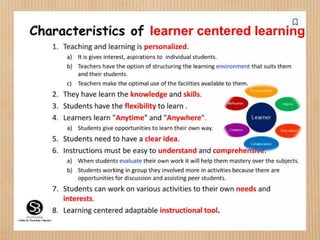
• Learner-centered learning refers to a wide
variety of educational approaches,
learning experiences, instructional
approaches, and academic-support
strategies that are intended to address the
distinct learning needs, interests,
aspirations, or cultural backgrounds of
individual students and groups of students.
What is Learner-Centered
Learning?
What is learner-centered learning?
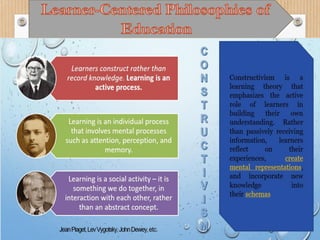
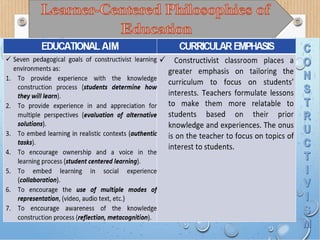
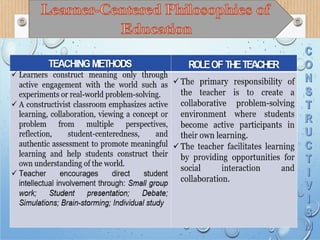
Grounded on the constructivist learning theory that
emphasizes the learners’ critical role in constructing new
meaning from new information and prior experience, the
following are the different definitions of learner centered from
multiple perspectives of educators and scholars.
Learner-centered learning has been defined most simply as an
approach to learning in which learners choose not only what to
study but also how and why that topic might be of interest. In
other words, the learning environment has learner responsibility
and activity at its heart.
The learning environment supports positive interactions among
learners and provides a supportive space in which the leaner
feels appreciated, acknowledged, respected, and validated.
Learner-centered teaching puts students' interests first,
acknowledging student voice as central to the learning experience.
What is learner-centered learning?
Grounded on the constructivist learning theory that
emphasizes the learners’ critical role in constructing new
meaning from new information and prior experience, the
following are the different definitions of learner centered from
multiple perspectives of educators and scholars.
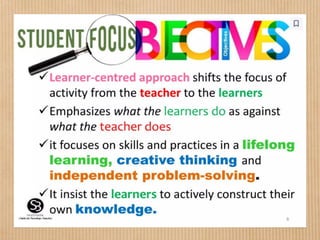
Learner-centered instruction focuses on skills and practices that
enable lifelong learning and independent problem-solving. Learner-
centered learning aims to develop learner autonomy and
independence by putting responsibility for the learning path in the
hands of students.
Learner-centered learning, also known as learner-centered
education, broadly encompasses methods of teaching that shift
the focus of instruction from the teacher to the student.
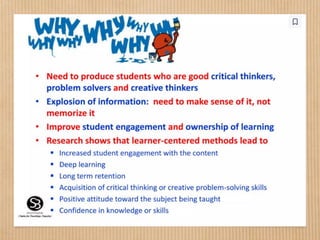
Learner-centered learning is characterized by innovative methods of
teaching which aim to promote learning in communication with
teachers and other learners and which take students seriously as active
participants in their own learning and foster transferable skills such as
problem-solving, critical thinking, and reflective thinking.
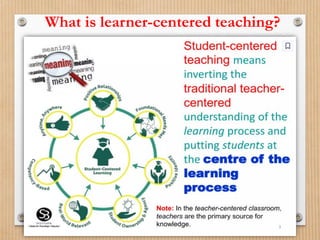
What is learner-centered teaching?
Do you remember the best
class you ever had? The class in
which you were most
confident? In which you
learned the best? How do you
characterize the learning
atmosphere in such class and
what were the implications of
these to you as a learner?
Who does what in your class?
• Who chooses the topic?
• Who chooses the activities?
• Who prepares the material for the activities?
• Who do the students speak to mostly?
• Who chooses group members?
• Who gives the instructions and explanations?
Who does what in your class?
• Who asks questions, responds, and gives
feedback?
• Who writes on the board?
• Who uses equipment?
• Who answers questions asked by the
students?
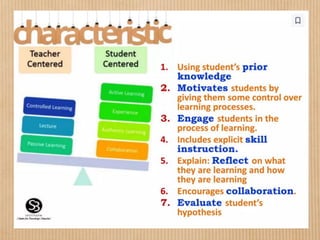
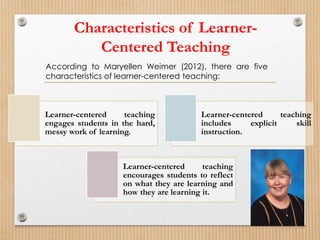
Characteristics of Learner-
Centered Teaching
According to Maryellen Weimer (2012), there are five
characteristics of learner-centered teaching:
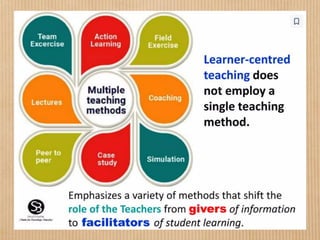
Learner-centered teaching
engages students in the hard,
messy work of learning.
Learner-centered teaching
includes explicit skill
instruction.
Learner-centered teaching
encourages students to reflect
on what they are learning and
how they are learning it.
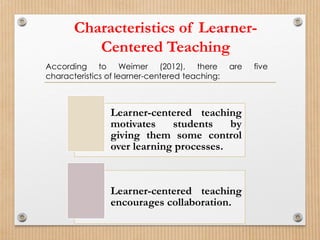
Characteristics of Learner-
Centered Teaching
According to Weimer (2012), there are five
characteristics of learner-centered teaching:
Learner-centered teaching
motivates students by
giving them some control
over learning processes.
Learner-centered teaching
encourages collaboration.
APPLICATION TASK 1
Let us find out how you could apply the concepts
and principles you learned from this lesson. Perform
the following activities.
• Teacher Jack is a language teacher and is
teaching argumentation and debate and is set to
deliver his course outline in logical fallacies via
lecture method. What learner-centered activities
could you recommend Teacher Jack to do and
Explain Why.
Lesson 2
Paradigm Shift: From Teacher-
Centered to Learner-Centered
Teaching
LESSON OBJECTIVES
At the end of this lesson, you are expected
to:
✓Differentiate learner-centered to teacher-
centered teaching
✓discuss the need to shift from teacher-centered
teaching to learner-centered teaching based
on philosophical foundations, teaching
principles and current research; and
✓Identify learning scenarios reflective of the
underscored philosophies.
Reflection Task: Let’s Debate
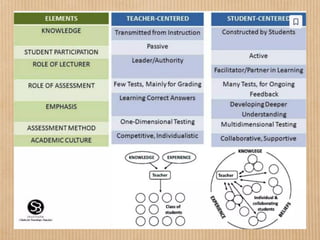
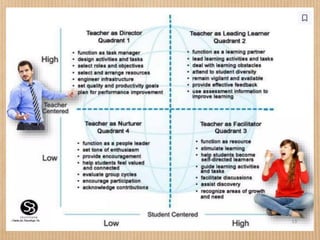
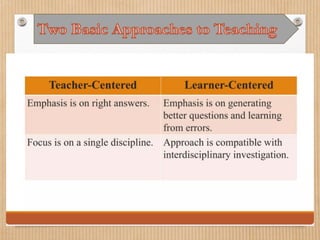
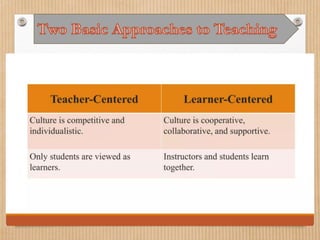
Two Basic Approaches to Teaching
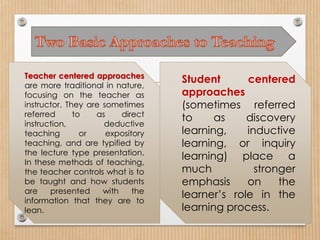
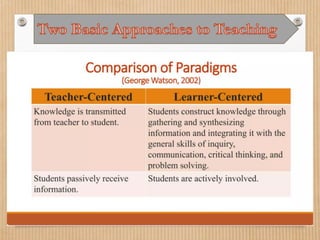
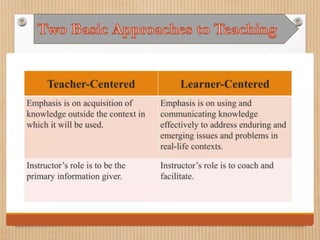
Teacher centered approaches
are more traditional in nature,
focusing on the teacher as
instructor. They are sometimes
referred to as direct
instruction, deductive
teaching or expository
teaching, and are typified by
the lecture type presentation.
In these methods of teaching,
the teacher controls what is to
be taught and how students
are presented with the
information that they are to
lean.
Student centered
approaches
(sometimes referred
to as discovery
learning, inductive
learning, or inquiry
learning) place a
much stronger
emphasis on the
learner’s role in the
learning process.
Two Basic Approaches to Teaching
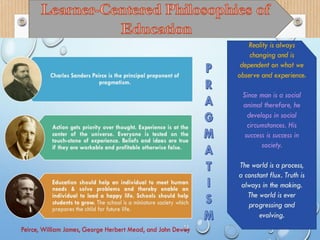
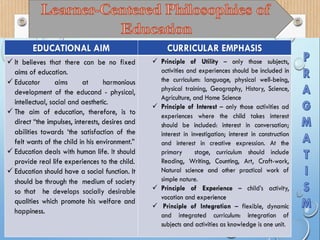
• There are teachers we love because of their
methods, techniques and strategies we love
and find unique in them that personally
inspire and kindle with us sparks of motivation
and inspiration.
• You should know that how one treats a
subject or a lesson depends on his beliefs of
teaching and learning which all springs from
his or her personal philosophy of education.
Teacher and Learner-Centered
Philosophies of Education
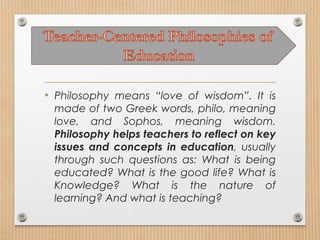
• Philosophy means “love of wisdom”. It is
made of two Greek words, philo, meaning
love, and Sophos, meaning wisdom.
Philosophy helps teachers to reflect on key
issues and concepts in education, usually
through such questions as: What is being
educated? What is the good life? What is
Knowledge? What is the nature of
learning? And what is teaching?
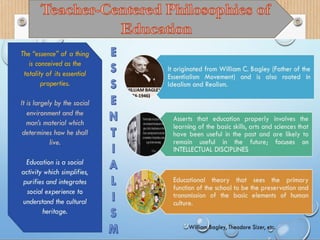
Teacher-Centered Philosophies of
Education
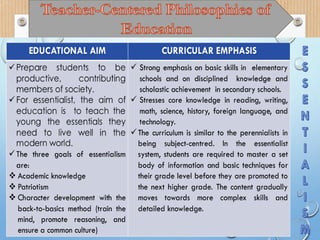
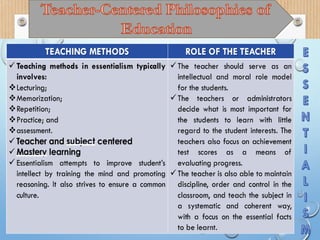
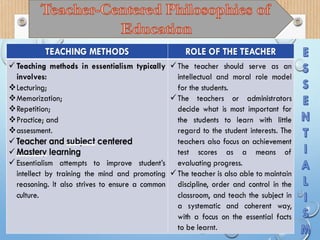
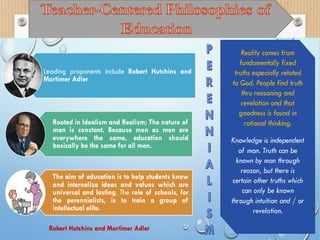
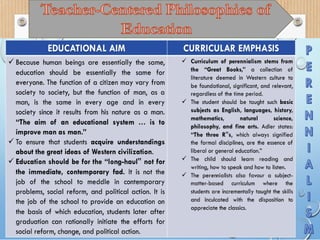
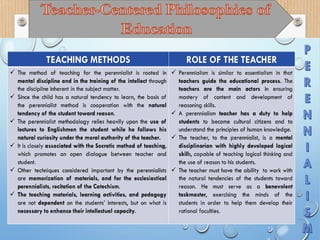
• Teacher-centered philosophies are those that
transfer knowledge from one generation of
teachers to the next.
• In teacher-centered philosophies, the teacher’s
role is to impart a respect for authority,
determination, a strong work ethic, compassion
for others, and sensibility.
• Teachers and schools succeed when students
prove, typically through taking tests, that they
have mastered the objectives they learned.
Teacher-Centered Philosophies of
Education
Teacher-Centered Philosophies of
Education
Teacher-Centered Philosophies of
Education
Teacher-Centered Philosophies of
Education
Teacher-Centered Philosophies of
Education
Teacher-Centered Philosophies of
Education
Teacher-Centered Philosophies of
Education
Teacher-Centered Philosophies of
Education
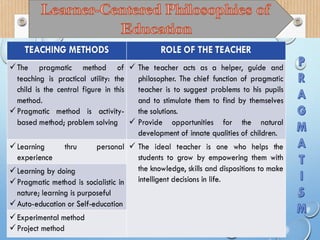
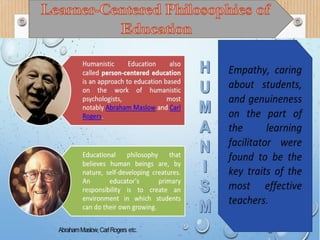
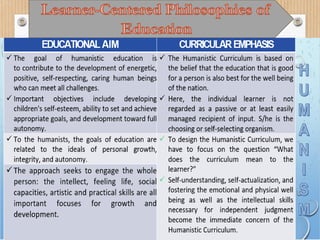
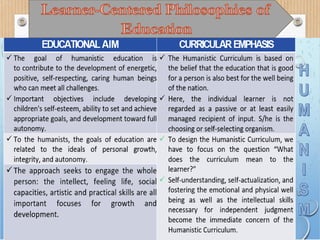
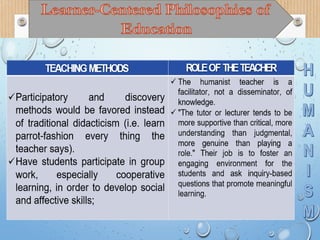
Learner-Centered Philosophies of
Education
Learner-Centered Philosophies of
Education
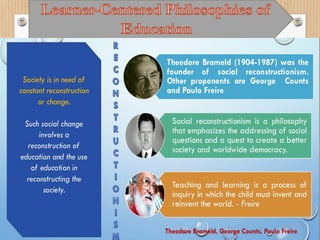
Learner-Centered Philosophies of
Education
Learner-Centered Philosophies of
Education
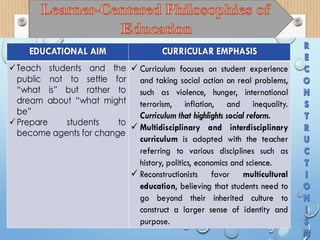
Learner-Centered Philosophies of
Education
Learner-Centered Philosophies of
Education
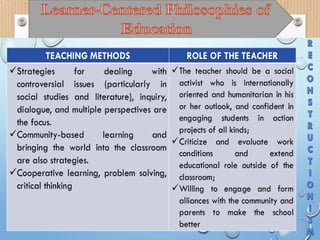
Learner-Centered Philosophies of
Education
Learner-Centered Philosophies of
Education
Learner-Centered Philosophies of
Education
Learner-Centered Philosophies of
Education
Learner-Centered Philosophies of
Education
Learner-Centered Philosophies of
Education
Learner-Centered Philosophies of
Education
Let’s Reflect!!!
Lesson 3
Dimensions of Learner-Centered
Teaching
LESSON OBJECTIVES
At the end of this lesson, you are expected
to:
✓Understand the focus of teacher-centered
and learner-centered in the different
domains of a learning environment.
✓Assess compliance of teacher-made
activities to learner-centeredness
✓Give highlights of learning on the five
dimensions of learner-centered teaching.
Dimensions of LCT
• Learner-centered instruction focuses on what students are
learning, how they are learning, and how they use the
acquired learning.
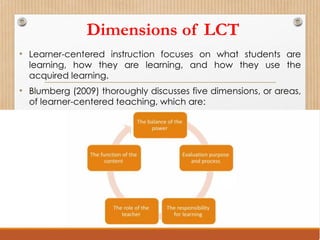
• Blumberg (2009) thoroughly discusses five dimensions, or areas,
of learner-centered teaching, which are:
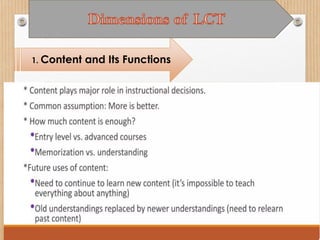
1. Content and Its Functions
Dimensions of LCT
1. Content and Its Functions
Dimensions of LCT
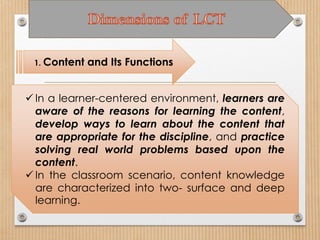
✓ In a learner-centered environment, learners are
aware of the reasons for learning the content,
develop ways to learn about the content that
are appropriate for the discipline, and practice
solving real world problems based upon the
content.
✓ In the classroom scenario, content knowledge
are characterized into two- surface and deep
learning.
1. Content and Its Functions
Dimensions of LCT
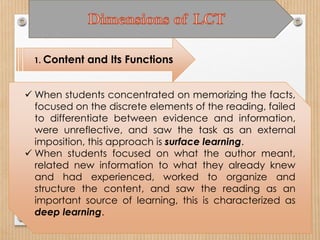
✓ When students concentrated on memorizing the facts,
focused on the discrete elements of the reading, failed
to differentiate between evidence and information,
were unreflective, and saw the task as an external
imposition, this approach is surface learning.
✓ When students focused on what the author meant,
related new information to what they already knew
and had experienced, worked to organize and
structure the content, and saw the reading as an
important source of learning, this is characterized as
deep learning.
2. Role of the Teacher
Dimensions of LCT
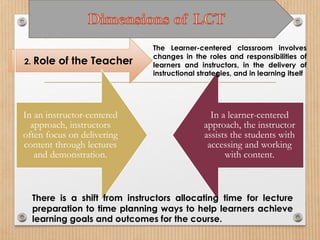
In an instructor-centered
approach, instructors
often focus on delivering
content through lectures
and demonstration.
In a learner-centered
approach, the instructor
assists the students with
accessing and working
with content.
There is a shift from instructors allocating time for lecture
preparation to time planning ways to help learners achieve
learning goals and outcomes for the course.
The Learner-centered classroom involves
changes in the roles and responsibilities of
learners and instructors, in the delivery of
instructional strategies, and in learning itself
2. Role of the Teacher
Dimensions of LCT
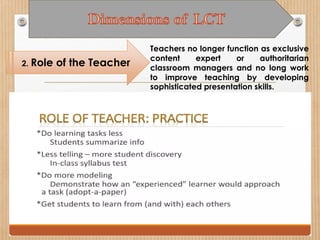
Teachers no longer function as exclusive
content expert or authoritarian
classroom managers and no long work
to improve teaching by developing
sophisticated presentation skills.
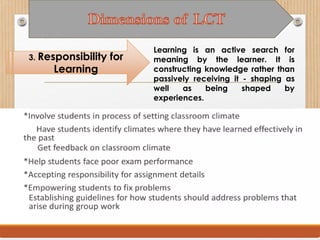
3. Responsibility for
Learning
Dimensions of LCT
Learning is an active search for
meaning by the learner. It is
constructing knowledge rather than
passively receiving it - shaping as
well as being shaped by
experiences.
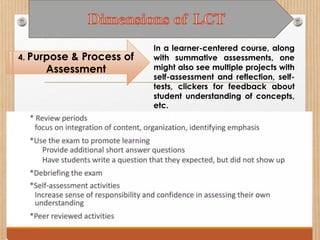
4. Purpose & Process of
Assessment
Dimensions of LCT
In a learner-centered course, along
with summative assessments, one
might also see multiple projects with
self-assessment and reflection, self-
tests, clickers for feedback about
student understanding of concepts,
etc.
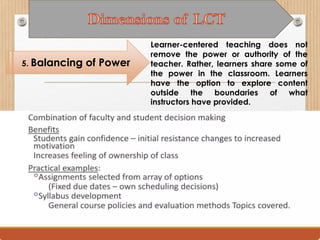
5. Balancing of Power
Dimensions of LCT
Learner-centered teaching does not
remove the power or authority of the
teacher. Rather, learners share some of
the power in the classroom. Learners
have the option to explore content
outside the boundaries of what
instructors have provided.
• Explain the highlights on the roles
and responsibilities of teachers and
learners based on the five
dimensions of learner-centered
teaching
APPLICATION TASK 2
References
• CSU FLCT Module