Leadership Styles
Leadership Styles
•   In 1930s, Kurt Lewin developed a
    leadership framework.
•   Leadership is influencing people —
    by providing purpose, direction, and
    motivation — while operating to
    accomplish the mission and
    improving the organization.
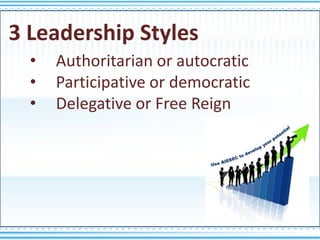
3 Leadership Styles
  •   Authoritarian or autocratic
  •   Participative or democratic
  •   Delegative or Free Reign
Authoritarian or Autocratic

 This style is used when leaders tell their
 employees what they want done and
 how they want it
 accomplished, without getting the
 advice of their followers.
Autocratic: Implications
 1. When you have all the information
    to solve the problem,
 2. You are short on time,
 3. Your employees are well motivate
Autocratic: An Example
  Making session time tables
Participative (democratic)
Most Stupid Style. Only Quantity, No Quality

   This style involves the leader
   including one or more employees in
   the decision making process
   (determining what to do and how to
   do it). However, the leader maintains
   the final decision making authority.
Participative (democratic):
Implications
1. When you have the time and
   want to gain more commitment
   and motivation from your
   employees
2. Using this style is a sign of
   weakness in information and
   decision making
Participative (democratic):
Implications
 3. When you have part of the
    information, and your employees
    have other parts.
 4. It allows employee to become
    part of the team and allows you
    to make better decisions.
Participative (democratic):
Example
  Making an extracurricular activity
  schedule
Delegative (free reign)
 In this style, the leader allows the
 employees to make the decisions.
 However, the leader is still
 responsible for the decisions that are
 made.
Delegative (free reign):
Implication
 1. This is used when employees are
    able to analyze the situation and
    determine what needs to be done
    and how to do it.
 2. When you cannot do everything
    and are forced set priorities and
    delegate certain tasks.
Delegative (free reign):
Implication
  3. When you fully trust and have
     confidence in the people below
     you
Delegative (free reign):
Implication
 Marking textbooks of a particular
 grade of particular subject
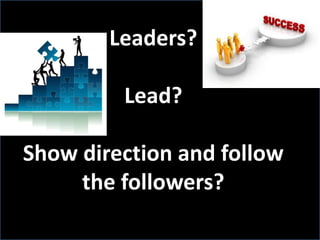
Leaders?

         Lead?

Show direction and follow
     the followers?

Leadership styles

  • 1.
  • 2.
    Leadership Styles • In 1930s, Kurt Lewin developed a leadership framework. • Leadership is influencing people — by providing purpose, direction, and motivation — while operating to accomplish the mission and improving the organization.
  • 3.
    3 Leadership Styles • Authoritarian or autocratic • Participative or democratic • Delegative or Free Reign
  • 4.
    Authoritarian or Autocratic This style is used when leaders tell their employees what they want done and how they want it accomplished, without getting the advice of their followers.
  • 5.
    Autocratic: Implications 1.When you have all the information to solve the problem, 2. You are short on time, 3. Your employees are well motivate
  • 6.
    Autocratic: An Example Making session time tables
  • 7.
    Participative (democratic) Most StupidStyle. Only Quantity, No Quality This style involves the leader including one or more employees in the decision making process (determining what to do and how to do it). However, the leader maintains the final decision making authority.
  • 8.
    Participative (democratic): Implications 1. Whenyou have the time and want to gain more commitment and motivation from your employees 2. Using this style is a sign of weakness in information and decision making
  • 9.
    Participative (democratic): Implications 3.When you have part of the information, and your employees have other parts. 4. It allows employee to become part of the team and allows you to make better decisions.
  • 10.
    Participative (democratic): Example Making an extracurricular activity schedule
  • 11.
    Delegative (free reign) In this style, the leader allows the employees to make the decisions. However, the leader is still responsible for the decisions that are made.
  • 12.
    Delegative (free reign): Implication 1. This is used when employees are able to analyze the situation and determine what needs to be done and how to do it. 2. When you cannot do everything and are forced set priorities and delegate certain tasks.
  • 13.
    Delegative (free reign): Implication 3. When you fully trust and have confidence in the people below you
  • 14.
    Delegative (free reign): Implication Marking textbooks of a particular grade of particular subject
  • 15.
    Leaders? Lead? Show direction and follow the followers?