PowerPoint Presentation by Charlie CookPowerPoint Presentation by Charlie Cook
Copyright © 2005 Prentice Hall, Inc.Copyright © 2005 Prentice Hall, Inc.
All rights reserved.All rights reserved.
8th
edition
Steven P. Robbins
Mary Coulter
Copyright © 2005 Prentice Hall, Inc. All
rights reserved. 10–2
L E A R N I N G O U T L I N E
Follow this Learning Outline as you read and study this chapter.
Defining Organizational Structure
• Discuss the traditional and contemporary view of work
specialization.
• Describe each of the five forms of departmentalization.
• Explain cross-functional teams.
• Differentiate chain of command, authority, responsibility,
and unity of command.
• Discuss the traditional and contemporary views of chain
of command.
• Discuss the traditional and contemporary views of span
of control.
Copyright © 2005 Prentice Hall, Inc. All
rights reserved. 10–3
L E A R N I N G O U T L I N E (cont’d)
Follow this Learning Outline as you read and study this chapter.
Defining Organizational Structure (cont’d)
• Tell what factors influence the amount of centralization and
decentralization.
• Explain how formalization is used in organizational design.
Organizational Design Decisions
• Contrast mechanistic and organic organizations.
• Explain the relationship between strategy and structure.
• Tell how organizational size affects organizational design.
• Discuss Woodward’s findings in the relationship of
technology and structure.
• Explain how environmental uncertainty affect
organizational design.
Copyright © 2005 Prentice Hall, Inc. All
rights reserved. 10–4
L E A R N I N G O U T L I N E (cont’d)
Follow this Learning Outline as you read and study this chapter.
Common Organizational Designs
• Contrast the three traditional organizational designs.
• Explain team-based, matrix, and project structures.
• Discuss the design of virtual, network, and modular
organizations.
• Describe the characteristics of a learning organization.
Copyright © 2005 Prentice Hall, Inc. All
rights reserved. 10–5
Defining Organizational Structure
• Organizational Structure
The formal arrangement of jobs within an organization.
• Organizational Design
A process involving decisions about six key elements:
 Work specialization
 Departmentalization
 Chain of command
 Span of control
 Centralization and decentralization
 Formalization
Copyright © 2005 Prentice Hall, Inc. All
rights reserved. 10–6
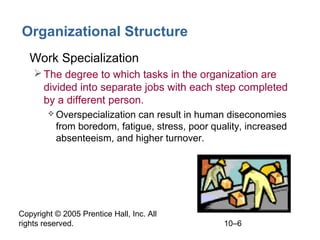
Organizational Structure
• Work Specialization
The degree to which tasks in the organization are
divided into separate jobs with each step completed
by a different person.
 Overspecialization can result in human diseconomies
from boredom, fatigue, stress, poor quality, increased
absenteeism, and higher turnover.
Copyright © 2005 Prentice Hall, Inc. All
rights reserved. 10–7
Departmentalization by Type
• Functional
 Grouping jobs by
functions performed
• Product
 Grouping jobs by product
line
• Geographic
 Grouping jobs on the
basis of territory or
geography
• Process
 Grouping jobs on the
basis of product or
customer flow
• Customer
 Grouping jobs by type of
customer and needs
Copyright © 2005 Prentice Hall, Inc. All
rights reserved. 10–8
Organization Structure (cont’d)
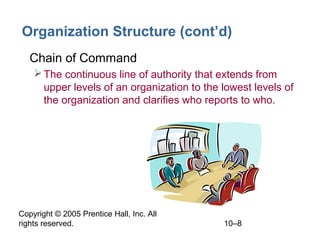
• Chain of Command
The continuous line of authority that extends from
upper levels of an organization to the lowest levels of
the organization and clarifies who reports to who.
Copyright © 2005 Prentice Hall, Inc. All
rights reserved. 10–9
Organization Structure (cont’d)
• Authority
The rights inherent in a managerial position to tell
people what to do and to expect them to do it.
• Responsibility
The obligation or expectation to perform .
• Unity of Command
The concept that a person should have one boss and
should report only to that person.
Copyright © 2005 Prentice Hall, Inc. All
rights reserved. 10–10
Organization Structure (cont’d)
• Span of Control
The number of employees who can be effectively and
efficiently supervised by a manager.
Width of span affected by:
 Skills and abilities of the manager
 Employee characteristics
 Characteristics of the work being done
 Similarity of tasks
 Complexity of tasks
 Physical proximity of subordinates
 Standardization of tasks
Copyright © 2005 Prentice Hall, Inc. All
rights reserved. 10–11
Organization Structure (cont’d)
• Centralization
The degree to which decision-making is concentrated
at a single point in the organizations.
 Organizations in which top managers make all the
decisions and lower-level employees simply carry out
those orders.
• Decentralization
Organizations in which decision-making is pushed
down to the managers who are closest to the action.
• Employee Empowerment
Increasing the decision-making,
Copyright © 2005 Prentice Hall, Inc. All
rights reserved. 10–12
Organization Structure (cont’d)
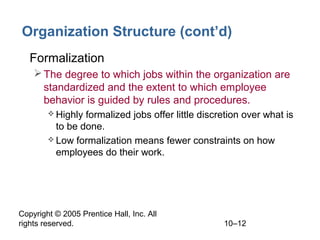
• Formalization
The degree to which jobs within the organization are
standardized and the extent to which employee
behavior is guided by rules and procedures.
 Highly formalized jobs offer little discretion over what is
to be done.
 Low formalization means fewer constraints on how
employees do their work.
Copyright © 2005 Prentice Hall, Inc. All
rights reserved. 10–13
Organizational Design Decisions
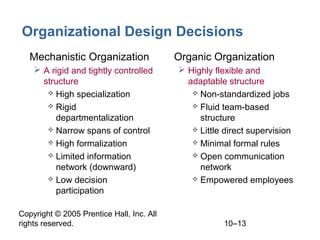
• Mechanistic Organization
 A rigid and tightly controlled
structure
 High specialization
 Rigid
departmentalization
 Narrow spans of control
 High formalization
 Limited information
network (downward)
 Low decision
participation
• Organic Organization
 Highly flexible and
adaptable structure
 Non-standardized jobs
 Fluid team-based
structure
 Little direct supervision
 Minimal formal rules
 Open communication
network
 Empowered employees
Copyright © 2005 Prentice Hall, Inc. All
rights reserved. 10–14
Structural Contingency Factors
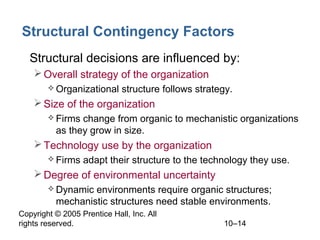
• Structural decisions are influenced by:
Overall strategy of the organization
 Organizational structure follows strategy.
Size of the organization
 Firms change from organic to mechanistic organizations
as they grow in size.
Technology use by the organization
 Firms adapt their structure to the technology they use.
Degree of environmental uncertainty
 Dynamic environments require organic structures;
mechanistic structures need stable environments.
Copyright © 2005 Prentice Hall, Inc. All
rights reserved. 10–15
Structural Contingency Factors (cont’d)
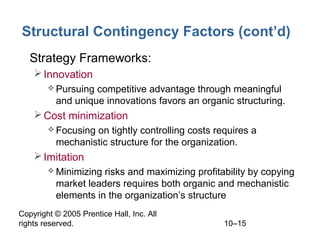
• Strategy Frameworks:
Innovation
 Pursuing competitive advantage through meaningful
and unique innovations favors an organic structuring.
Cost minimization
 Focusing on tightly controlling costs requires a
mechanistic structure for the organization.
Imitation
 Minimizing risks and maximizing profitability by copying
market leaders requires both organic and mechanistic
elements in the organization’s structure
Copyright © 2005 Prentice Hall, Inc. All
rights reserved. 10–16
Structural Contingency Factors (cont’d)
• Strategy and Structure
Achievement of strategic goals is facilitated by
changes in organizational structure that
accommodate and support change.
• Size and Structure
As an organization grows larger, its structure tends to
change from organic to mechanistic with increased
specialization, departmentalization, centralization,
and rules and regulations.
Copyright © 2005 Prentice Hall, Inc. All
rights reserved. 10–17
Structural Contingency Factors (cont’d)
• Technology and Structure
Organizations adapt their structures to their
technology.
Woodward’s classification of firms based in the
complexity of the technology employed:
 Unit production of single units or small batches
 Mass production of large batches of output
 Process production in continuous process of outputs
Routine technology = mechanistic organizations
Non-routine technology = organic organizations
Copyright © 2005 Prentice Hall, Inc. All
rights reserved. 10–18
Structural Contingency Factors (cont’d)
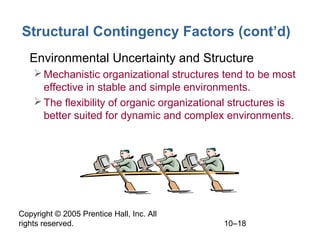
• Environmental Uncertainty and Structure
Mechanistic organizational structures tend to be most
effective in stable and simple environments.
The flexibility of organic organizational structures is
better suited for dynamic and complex environments.
Copyright © 2005 Prentice Hall, Inc. All
rights reserved. 10–19
Common Organizational Designs
• Traditional Designs
Simple structure
Functional structure
Divisional structure
Copyright © 2005 Prentice Hall, Inc. All
rights reserved. 10–20
Organizational Designs
• Traditional Designs
Simple structure
 Low departmentalization, wide spans of control,
centralized authority, little formalization
Functional structure
 Departmentalization by function
– Operations, finance, human resources, and product
research and development
Divisional structure
 Composed of separate business units or divisions with
limited autonomy under the coordination and control the
parent corporation.
Copyright © 2005 Prentice Hall, Inc. All
rights reserved. 10–21
Organizational Designs (cont’d)
• Contemporary Organizational Designs
Team structures
 The entire organization is made up of work groups or
self-managed teams of empowered employees.
Matrix and project structures
 Specialists for different functional departments are
assigned to work on projects led by project managers.
 Matrix participants have two managers.
Project structures
 Employees work continuously on projects; moving on to
another project as each project is completed.
Copyright © 2005 Prentice Hall, Inc. All
rights reserved. 10–22
Organizational Designs (cont’d)
• Contemporary Organizational Designs (cont’d)
Boundaryless Organization
 An flexible and unstructured organizational design that
is intended to break down external barriers between the
organization and its customers and suppliers.
 Removes internal (horizontal) boundaries
– Eliminates the chain of command
– Has limitless spans of control
– Uses empowered teams rather than departments
 Eliminates external boundaries
– Uses virtual, network, and modular organizational
structures to get closer to stakeholders.
Copyright © 2005 Prentice Hall, Inc. All
rights reserved. 10–23
Removing Boundaries
• Virtual Organization
 An organization that consists of a small core of full-time
employees and that temporarily hires specialists to work on
opportunities that arise.
• Network Organization
 A small core organization that outsources its major
business functions (e.g., manufacturing) in order to
concentrate what it does best.
• Modular Organization
 A manufacturing organization that uses outside suppliers to
provide product components for its final assembly
operations.
Copyright © 2005 Prentice Hall, Inc. All
rights reserved. 10–24
Organizational Designs (cont’d)
• The Learning Organization
An organization that has developed the capacity to
continuously learn, adapt, and change through the
practice of knowledge management by employees.
Characteristics of a learning organization
 An open team-based organization design that
empowers employees
 Extensive and open information sharing
 Leadership that provides a shared vision of the
organization’s future, support and encouragement
 A strong culture of shared values, trust, openness, and
a sense of community.

Organizational Structure and designe

  • 1.
    PowerPoint Presentation byCharlie CookPowerPoint Presentation by Charlie Cook Copyright © 2005 Prentice Hall, Inc.Copyright © 2005 Prentice Hall, Inc. All rights reserved.All rights reserved. 8th edition Steven P. Robbins Mary Coulter
  • 2.
    Copyright © 2005Prentice Hall, Inc. All rights reserved. 10–2 L E A R N I N G O U T L I N E Follow this Learning Outline as you read and study this chapter. Defining Organizational Structure • Discuss the traditional and contemporary view of work specialization. • Describe each of the five forms of departmentalization. • Explain cross-functional teams. • Differentiate chain of command, authority, responsibility, and unity of command. • Discuss the traditional and contemporary views of chain of command. • Discuss the traditional and contemporary views of span of control.
  • 3.
    Copyright © 2005Prentice Hall, Inc. All rights reserved. 10–3 L E A R N I N G O U T L I N E (cont’d) Follow this Learning Outline as you read and study this chapter. Defining Organizational Structure (cont’d) • Tell what factors influence the amount of centralization and decentralization. • Explain how formalization is used in organizational design. Organizational Design Decisions • Contrast mechanistic and organic organizations. • Explain the relationship between strategy and structure. • Tell how organizational size affects organizational design. • Discuss Woodward’s findings in the relationship of technology and structure. • Explain how environmental uncertainty affect organizational design.
  • 4.
    Copyright © 2005Prentice Hall, Inc. All rights reserved. 10–4 L E A R N I N G O U T L I N E (cont’d) Follow this Learning Outline as you read and study this chapter. Common Organizational Designs • Contrast the three traditional organizational designs. • Explain team-based, matrix, and project structures. • Discuss the design of virtual, network, and modular organizations. • Describe the characteristics of a learning organization.
  • 5.
    Copyright © 2005Prentice Hall, Inc. All rights reserved. 10–5 Defining Organizational Structure • Organizational Structure The formal arrangement of jobs within an organization. • Organizational Design A process involving decisions about six key elements:  Work specialization  Departmentalization  Chain of command  Span of control  Centralization and decentralization  Formalization
  • 6.
    Copyright © 2005Prentice Hall, Inc. All rights reserved. 10–6 Organizational Structure • Work Specialization The degree to which tasks in the organization are divided into separate jobs with each step completed by a different person.  Overspecialization can result in human diseconomies from boredom, fatigue, stress, poor quality, increased absenteeism, and higher turnover.
  • 7.
    Copyright © 2005Prentice Hall, Inc. All rights reserved. 10–7 Departmentalization by Type • Functional  Grouping jobs by functions performed • Product  Grouping jobs by product line • Geographic  Grouping jobs on the basis of territory or geography • Process  Grouping jobs on the basis of product or customer flow • Customer  Grouping jobs by type of customer and needs
  • 8.
    Copyright © 2005Prentice Hall, Inc. All rights reserved. 10–8 Organization Structure (cont’d) • Chain of Command The continuous line of authority that extends from upper levels of an organization to the lowest levels of the organization and clarifies who reports to who.
  • 9.
    Copyright © 2005Prentice Hall, Inc. All rights reserved. 10–9 Organization Structure (cont’d) • Authority The rights inherent in a managerial position to tell people what to do and to expect them to do it. • Responsibility The obligation or expectation to perform . • Unity of Command The concept that a person should have one boss and should report only to that person.
  • 10.
    Copyright © 2005Prentice Hall, Inc. All rights reserved. 10–10 Organization Structure (cont’d) • Span of Control The number of employees who can be effectively and efficiently supervised by a manager. Width of span affected by:  Skills and abilities of the manager  Employee characteristics  Characteristics of the work being done  Similarity of tasks  Complexity of tasks  Physical proximity of subordinates  Standardization of tasks
  • 11.
    Copyright © 2005Prentice Hall, Inc. All rights reserved. 10–11 Organization Structure (cont’d) • Centralization The degree to which decision-making is concentrated at a single point in the organizations.  Organizations in which top managers make all the decisions and lower-level employees simply carry out those orders. • Decentralization Organizations in which decision-making is pushed down to the managers who are closest to the action. • Employee Empowerment Increasing the decision-making,
  • 12.
    Copyright © 2005Prentice Hall, Inc. All rights reserved. 10–12 Organization Structure (cont’d) • Formalization The degree to which jobs within the organization are standardized and the extent to which employee behavior is guided by rules and procedures.  Highly formalized jobs offer little discretion over what is to be done.  Low formalization means fewer constraints on how employees do their work.
  • 13.
    Copyright © 2005Prentice Hall, Inc. All rights reserved. 10–13 Organizational Design Decisions • Mechanistic Organization  A rigid and tightly controlled structure  High specialization  Rigid departmentalization  Narrow spans of control  High formalization  Limited information network (downward)  Low decision participation • Organic Organization  Highly flexible and adaptable structure  Non-standardized jobs  Fluid team-based structure  Little direct supervision  Minimal formal rules  Open communication network  Empowered employees
  • 14.
    Copyright © 2005Prentice Hall, Inc. All rights reserved. 10–14 Structural Contingency Factors • Structural decisions are influenced by: Overall strategy of the organization  Organizational structure follows strategy. Size of the organization  Firms change from organic to mechanistic organizations as they grow in size. Technology use by the organization  Firms adapt their structure to the technology they use. Degree of environmental uncertainty  Dynamic environments require organic structures; mechanistic structures need stable environments.
  • 15.
    Copyright © 2005Prentice Hall, Inc. All rights reserved. 10–15 Structural Contingency Factors (cont’d) • Strategy Frameworks: Innovation  Pursuing competitive advantage through meaningful and unique innovations favors an organic structuring. Cost minimization  Focusing on tightly controlling costs requires a mechanistic structure for the organization. Imitation  Minimizing risks and maximizing profitability by copying market leaders requires both organic and mechanistic elements in the organization’s structure
  • 16.
    Copyright © 2005Prentice Hall, Inc. All rights reserved. 10–16 Structural Contingency Factors (cont’d) • Strategy and Structure Achievement of strategic goals is facilitated by changes in organizational structure that accommodate and support change. • Size and Structure As an organization grows larger, its structure tends to change from organic to mechanistic with increased specialization, departmentalization, centralization, and rules and regulations.
  • 17.
    Copyright © 2005Prentice Hall, Inc. All rights reserved. 10–17 Structural Contingency Factors (cont’d) • Technology and Structure Organizations adapt their structures to their technology. Woodward’s classification of firms based in the complexity of the technology employed:  Unit production of single units or small batches  Mass production of large batches of output  Process production in continuous process of outputs Routine technology = mechanistic organizations Non-routine technology = organic organizations
  • 18.
    Copyright © 2005Prentice Hall, Inc. All rights reserved. 10–18 Structural Contingency Factors (cont’d) • Environmental Uncertainty and Structure Mechanistic organizational structures tend to be most effective in stable and simple environments. The flexibility of organic organizational structures is better suited for dynamic and complex environments.
  • 19.
    Copyright © 2005Prentice Hall, Inc. All rights reserved. 10–19 Common Organizational Designs • Traditional Designs Simple structure Functional structure Divisional structure
  • 20.
    Copyright © 2005Prentice Hall, Inc. All rights reserved. 10–20 Organizational Designs • Traditional Designs Simple structure  Low departmentalization, wide spans of control, centralized authority, little formalization Functional structure  Departmentalization by function – Operations, finance, human resources, and product research and development Divisional structure  Composed of separate business units or divisions with limited autonomy under the coordination and control the parent corporation.
  • 21.
    Copyright © 2005Prentice Hall, Inc. All rights reserved. 10–21 Organizational Designs (cont’d) • Contemporary Organizational Designs Team structures  The entire organization is made up of work groups or self-managed teams of empowered employees. Matrix and project structures  Specialists for different functional departments are assigned to work on projects led by project managers.  Matrix participants have two managers. Project structures  Employees work continuously on projects; moving on to another project as each project is completed.
  • 22.
    Copyright © 2005Prentice Hall, Inc. All rights reserved. 10–22 Organizational Designs (cont’d) • Contemporary Organizational Designs (cont’d) Boundaryless Organization  An flexible and unstructured organizational design that is intended to break down external barriers between the organization and its customers and suppliers.  Removes internal (horizontal) boundaries – Eliminates the chain of command – Has limitless spans of control – Uses empowered teams rather than departments  Eliminates external boundaries – Uses virtual, network, and modular organizational structures to get closer to stakeholders.
  • 23.
    Copyright © 2005Prentice Hall, Inc. All rights reserved. 10–23 Removing Boundaries • Virtual Organization  An organization that consists of a small core of full-time employees and that temporarily hires specialists to work on opportunities that arise. • Network Organization  A small core organization that outsources its major business functions (e.g., manufacturing) in order to concentrate what it does best. • Modular Organization  A manufacturing organization that uses outside suppliers to provide product components for its final assembly operations.
  • 24.
    Copyright © 2005Prentice Hall, Inc. All rights reserved. 10–24 Organizational Designs (cont’d) • The Learning Organization An organization that has developed the capacity to continuously learn, adapt, and change through the practice of knowledge management by employees. Characteristics of a learning organization  An open team-based organization design that empowers employees  Extensive and open information sharing  Leadership that provides a shared vision of the organization’s future, support and encouragement  A strong culture of shared values, trust, openness, and a sense of community.