
1
I N S U R A N C E
2
 Insurance in broad terms may beInsurance in broad terms may be
described as a method of sharingdescribed as a method of sharing
financial losses of few from a commonfinancial losses of few from a common
fund who are equally exposed to thefund who are equally exposed to the
same loss.same loss.
 Say 1000 motor cars valued @ 300000/- are
observed over a period of five years. On an
average say per year two are total loss by
accident. Then the total annual loss would
be Rs.600000. If the loss is to shared by all
the thousand owners then they have to
contribute Rs.600/-
 The loss experience will be established by
taking the past experience, geographical
area in which the vehicles are used and
density of traffic.
3
4
A.Rate of contribution or premium
B.The degree of hazard it is exposed to.
C.Classification of various types of properties.
 Subject matter of insurance.
 The PERIL (risk)
 The financial loss.
5
Subject matter is property, human life,
machinery, goods etc.,
6
Peril is fire, storm, burglary, earth quake, injury,Peril is fire, storm, burglary, earth quake, injury,
explosion etc.,explosion etc.,
Financial loss is normally defined before theFinancial loss is normally defined before the
contract is signed.contract is signed.
RISK:- can be defined as the unforeseen
element which may impede your progress in
achieving the objective.
7
8
In insurance jargon they term RISK as anIn insurance jargon they term RISK as an
uncertainty regarding loss or what is termed asuncertainty regarding loss or what is termed as
a FORTUITOUS risk.a FORTUITOUS risk.
Concept of chance and risk can be expressedConcept of chance and risk can be expressed
in a single mathematical term calledin a single mathematical term called
“Probability”.“Probability”.
9
An example of impossibility can be quoted sayAn example of impossibility can be quoted say
the 9/11 incident where insurance companiesthe 9/11 incident where insurance companies
were washed out.were washed out.
Hyderabadis never in their dreams thought ofHyderabadis never in their dreams thought of
taking cover for flood. When the encroachedtaking cover for flood. When the encroached
drains could not contain rains for 2 days, thedrains could not contain rains for 2 days, the
resultant floods had washed away score ofresultant floods had washed away score of
vehicles, property etc.,vehicles, property etc.,
So, Risk is inherent in human existence. HumanSo, Risk is inherent in human existence. Human
life and material possessions are constantlylife and material possessions are constantly
exposed to loss or damage due to theexposed to loss or damage due to the
mechanizations of fortuitous circumstancesmechanizations of fortuitous circumstances
10
A RISK OF TRADE is a loss due to aA RISK OF TRADE is a loss due to a
specified event say fire, storms burglary etc.,specified event say fire, storms burglary etc.,
These are classified and their frequency inThese are classified and their frequency in
already assessed.already assessed.
A TRADE RISK is a risk of loss inherent in theA TRADE RISK is a risk of loss inherent in the
trade itself. Broadly speaking we can say losstrade itself. Broadly speaking we can say loss
of profit as a result of change due to marketof profit as a result of change due to market
collapse, political factors etc.,collapse, political factors etc.,
Risk of trade is insurable as it is alreadyRisk of trade is insurable as it is already
assessed,assessed,
Trade risk is yet to be classified and henceTrade risk is yet to be classified and hence
majority of these are not covered.majority of these are not covered.
11
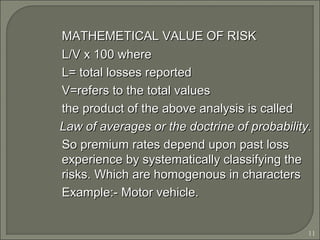
MATHEMETICAL VALUE OF RISKMATHEMETICAL VALUE OF RISK
L/V x 100 whereL/V x 100 where
L= total losses reportedL= total losses reported
V=refers to the total valuesV=refers to the total values
the product of the above analysis is calledthe product of the above analysis is called
Law of averages or the doctrine of probability.Law of averages or the doctrine of probability.
So premium rates depend upon past lossSo premium rates depend upon past loss
experience by systematically classifying theexperience by systematically classifying the
risks. Which are homogenous in charactersrisks. Which are homogenous in characters
Example:- Motor vehicle.Example:- Motor vehicle.
12
RICE INSURANCERICE INSURANCE ATFLATFL
ITCITC
EMMSONSEMMSONS
13
SCOPE OF INSURANCE:SCOPE OF INSURANCE:
General Insurance is divided into threeGeneral Insurance is divided into three
categories:categories:
FIRE,FIRE,
MARINEMARINE
&&
MISCELLANEOUSMISCELLANEOUS
FIRE INSURANCE BUSINESS:
Loss due to FIRE, LIGHTINING, EXPLOSION,
IMPLOSION,, RIOTS & STRIKES, IMPACT BY
RAIL, AIRCRAFT DAMAGE, EARTH QUAKE,
FLOOD, STORM, TEMPEST, TORNADO,
TYPHOON, CYCLONES & LAND SLIDE.
14
15
MARINE INSURANCE BUSINESS:MARINE INSURANCE BUSINESS:
This is the oldest branch of Insurance comprisingThis is the oldest branch of Insurance comprising
HULL & CARGO.HULL & CARGO.
Hull Insurance deals the Loss associated withHull Insurance deals the Loss associated with
floating crafts, Cargo insurance provides coverfloating crafts, Cargo insurance provides cover
in respect of loss or damage to goods duringin respect of loss or damage to goods during
transit by rail, road, sea or air.transit by rail, road, sea or air.
16
MISCELLENOUS INSURANCE BUSINESS:MISCELLENOUS INSURANCE BUSINESS:
Mainly includes the motor business, accident,Mainly includes the motor business, accident,
aviation , engineering and guarantee insurances.aviation , engineering and guarantee insurances.
17
CONTRACT OF INSURANCECONTRACT OF INSURANCE
In between the insured and insurerIn between the insured and insurer
INSURED:-INSURED:- Party effecting insurance,Party effecting insurance,
(Individual, Company, Firm,(Individual, Company, Firm,
Corporate body etc., withCorporate body etc., with
legal status)legal status)
INSURER:-INSURER:- Party granting the protectionParty granting the protection
under an insurance policy.under an insurance policy.
Policy:-Policy:- Is the evidence of contractIs the evidence of contract
18
Insurance contracts are governed by IndianInsurance contracts are governed by Indian
contract act 1872 which states that to becontract act 1872 which states that to be
legally valid following elements should be inlegally valid following elements should be in
order.order.
A.A. Offer and acceptanceOffer and acceptance
B.B. ConsiderationConsideration
C.C. Agreement between the partiesAgreement between the parties
D.D. Capacity of the partiesCapacity of the parties
E.E. Legality of the contractLegality of the contract
19
UTMOST GOOD FAITH:UTMOST GOOD FAITH:
The greatest degree of good faith by law, isThe greatest degree of good faith by law, is
expected from the proposer, that is the mainexpected from the proposer, that is the main
reason why good faith in case of Insurancereason why good faith in case of Insurance
contracts becomes UTMOST good faith.contracts becomes UTMOST good faith.
It is the duty of the proposer to disclose allIt is the duty of the proposer to disclose all
material facts not only already known butmaterial facts not only already known but
also extends to material facts which he oughtalso extends to material facts which he ought
to know.to know.
20
Examples of material facts:Examples of material facts:
FIRE: Construction of building, type ofFIRE: Construction of building, type of
occupancy, nature of good stored etc.occupancy, nature of good stored etc.
MARINE: method of packing, inherent viceMARINE: method of packing, inherent vice
etc.etc.
21
INSURABLE INTRESTINSURABLE INTREST
In nutshell if property is the subject matter ofIn nutshell if property is the subject matter of
insurance then the subject matter ofinsurance then the subject matter of
insurance contract is the insured’s pecuniaryinsurance contract is the insured’s pecuniary
interest in that property.interest in that property.
LEGAL RIGHT TO INSURE IS THELEGAL RIGHT TO INSURE IS THE
INSURABLE INTEREST. Insurable Interest isINSURABLE INTEREST. Insurable Interest is
required to support the contract of Insurancerequired to support the contract of Insurance
in order to make it legal, other wise thein order to make it legal, other wise the
contract is null and void.contract is null and void.
22
HOW INSURABLE INTEREST ARISES:HOW INSURABLE INTEREST ARISES:
1.1. By ownershipBy ownership
2.2. By LawBy Law
3.3. By ContractBy Contract
4.4. By Legal liabilityBy Legal liability
5.5. Interest of a Person in LifeInterest of a Person in Life
23
When insurable interest must exist:When insurable interest must exist:
For Fire or Miscellaneous policy theFor Fire or Miscellaneous policy the
insurable interest must exist at the time ofinsurable interest must exist at the time of
taking the policy and at the time of the loss.taking the policy and at the time of the loss.
For Marine policy an insurable interest needFor Marine policy an insurable interest need
not exist at the time of policy taking.not exist at the time of policy taking.
24
WARRANTY:WARRANTY:
means an assurance by the assured, that hemeans an assurance by the assured, that he
will not do some particular things or will fulfillwill not do some particular things or will fulfill
any conditions that are laid in advance.any conditions that are laid in advance.
WARRANTIES are further classified asWARRANTIES are further classified as
expressexpress
or impliedor implied
25
ASSIGNMENTASSIGNMENT
Assignment means transfer of rights andAssignment means transfer of rights and
liabilities of an insured to another personliabilities of an insured to another person
who had acquired insurable interest in thewho had acquired insurable interest in the
property insured.property insured.
Fire policies have to be assigned with theFire policies have to be assigned with the
consent of the insurers, where as Marineconsent of the insurers, where as Marine
cargo policies can be freely assignedcargo policies can be freely assigned
without the knowledge or consent of thewithout the knowledge or consent of the
insurer. This is because the ultimate buyer isinsurer. This is because the ultimate buyer is
not known at the time of taking the cover.not known at the time of taking the cover.
Marine hull policies cannot be assigned.Marine hull policies cannot be assigned.
26
INDEMINITY:INDEMINITY:
Can be defined as “ compensation for loss orCan be defined as “ compensation for loss or
injury sustained” or “ to make good the lossinjury sustained” or “ to make good the loss
or damage” .or damage” .
27
Methods of indemnification:Methods of indemnification:
1.1. Cash paymentCash payment
2.2. RepairRepair
3.3. ReplacementReplacement
4.4. Reinstatement.Reinstatement.
28
Mode of indemnity:Mode of indemnity:
Buildings:Buildings:
the cost of reinstating or repairing thethe cost of reinstating or repairing the
damaged portion, is assessed, and from thatdamaged portion, is assessed, and from that
an appropriate allowance is made towardsan appropriate allowance is made towards
depreciation, depending on the age anddepreciation, depending on the age and
condition of the building. Allowances arecondition of the building. Allowances are
made for improvement due to repairs.made for improvement due to repairs.
29
Machinery:Machinery:
HHere the method of indemnity is supposedere the method of indemnity is supposed
to be the market value for a similar machineto be the market value for a similar machine
of same age and model as determined onof same age and model as determined on
the date of loss. In practice this is difficult sothe date of loss. In practice this is difficult so
the measure of indemnity becomes thethe measure of indemnity becomes the
replacement value less depreciation. In casereplacement value less depreciation. In case
of repairs the cost of repairing is borne byof repairs the cost of repairing is borne by
the insured. However replacement of partsthe insured. However replacement of parts
is subject to an allowance towardsis subject to an allowance towards
depreciation.depreciation.
30
Household goods:Household goods:
Consideration similar to those applicable forConsideration similar to those applicable for
machines.machines.
Stocks:Stocks:
In case of wholesalers or retailers, theIn case of wholesalers or retailers, the
measure of indemnity is the price at whichmeasure of indemnity is the price at which
he will be able to replace his goods. Thehe will be able to replace his goods. The
element of profit will not be taken care of.element of profit will not be taken care of.
Fire insurance policies may be issued on
REINSTATEMENT value basis. Although the
insured gets new property which is in similar
condition and of same kind, to protect the basic
of idea of indemnity the property will not be of
superior nature.
31
32
Motor:Motor:
If the vehicle is a total loss, the sum insuredIf the vehicle is a total loss, the sum insured
or the value of the vehicle, which ever isor the value of the vehicle, which ever is
less is paid. If the vehicle is damaged theless is paid. If the vehicle is damaged the
cost of repairs or paid, if parts are replacedcost of repairs or paid, if parts are replaced
the cost of new part will be subjected tothe cost of new part will be subjected to
depreciation. In all the cases age anddepreciation. In all the cases age and
general maintenance of the vehicle aregeneral maintenance of the vehicle are
considered.considered.
33
MARINE INSURANCEMARINE INSURANCE
IIn this branch what is provided as indemnityn this branch what is provided as indemnity
becomes commercial indemnity because,becomes commercial indemnity because,
Almost all the policies issued are agreedAlmost all the policies issued are agreed
value policies.value policies.
To be precise the insured and the insurerTo be precise the insured and the insurer
agree that the sum insured is the value ofagree that the sum insured is the value of
the property insured. The agreed amount isthe property insured. The agreed amount is
then payable in case of total loss, with nothen payable in case of total loss, with no
attachments what so ever.attachments what so ever.
Miscellaneous Insurance: the insurances of
property, liability and insurance are contracts of
strict indemnity. Normally books of accounts are
referred when settling claims in this branch. ( ex.
fidelity guarantee insurance)
34
35
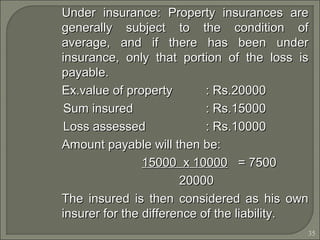
Under insurance: Property insurances areUnder insurance: Property insurances are
generally subject to the condition ofgenerally subject to the condition of
average, and if there has been underaverage, and if there has been under
insurance, only that portion of the loss isinsurance, only that portion of the loss is
payable.payable.
Ex.value of propertyEx.value of property : Rs.20000: Rs.20000
Sum insuredSum insured : Rs.15000: Rs.15000
Loss assessedLoss assessed : Rs.10000: Rs.10000
Amount payable will then be:Amount payable will then be:
15000 x 1000015000 x 10000 = 7500= 7500
2000020000
The insured is then considered as his ownThe insured is then considered as his own
insurer for the difference of the liability.insurer for the difference of the liability.
36
EXCESS OR FRANCHISEEXCESS OR FRANCHISE
In some policies an EXCESS or FRACHISE isIn some policies an EXCESS or FRACHISE is
incorporated, which means that a certainincorporated, which means that a certain
circumstances a part of the loss may have tocircumstances a part of the loss may have to
be borne by the insured.be borne by the insured.
37
SALVAGESALVAGE
Property which is saved from loss or damageProperty which is saved from loss or damage
and still has some commercial value is calledand still has some commercial value is called
salvage.salvage.
may be defined as the transfer of rights and
remedies of the insured to the insurer who has
indemnified the insured in respect of the loss.
38
39
CONTRIBUTION:CONTRIBUTION:
An insured may have taken many policies onAn insured may have taken many policies on
the same subject matter. The principal ofthe same subject matter. The principal of
contribution would lead to a situation in whichcontribution would lead to a situation in which
the insured would be able to recover his lossthe insured would be able to recover his loss
from any one insurer, who then will have tofrom any one insurer, who then will have to
effect proportionate recoveries from othereffect proportionate recoveries from other
insurers concerned. Normally the insurersinsurers concerned. Normally the insurers
seek to control additional insurances at theseek to control additional insurances at the
proposal stage itself.proposal stage itself.
Remember at no cost an infringement to theRemember at no cost an infringement to the
principle of indemnity is accepted.principle of indemnity is accepted.
The principal of contribution does not apply toThe principal of contribution does not apply to
personal accident policies.personal accident policies.
40
PROXIMATE CAUSEPROXIMATE CAUSE
Means the DIRECT, DOMINANT or effectiveMeans the DIRECT, DOMINANT or effective
cause of which the loss is the naturalcause of which the loss is the natural
consequence. It is the cause which is mostconsequence. It is the cause which is most
closely connected with the loss, not necessarilyclosely connected with the loss, not necessarily
in time but in efficiency.in time but in efficiency.
Although the doctrine is clear in theory, it isAlthough the doctrine is clear in theory, it is
difficult to determine the proximate cause, as adifficult to determine the proximate cause, as a
clear demarcation should be maintainedclear demarcation should be maintained
between insured peril, excepted peril and unbetween insured peril, excepted peril and un
insured peril.insured peril.
41
Example:Example:
An insured sustained an accident whileAn insured sustained an accident while
hunting. Due to shock and weakness, he washunting. Due to shock and weakness, he was
unable to walk and whilst lying on wet ground,unable to walk and whilst lying on wet ground,
he contracted cold which developed intohe contracted cold which developed into
pneumonia causing death ultimately.pneumonia causing death ultimately.
The proximate cause was considered to be theThe proximate cause was considered to be the
accident and not the pneumonia, the disease,accident and not the pneumonia, the disease,
which was only a remote cause. The claim waswhich was only a remote cause. The claim was
payable under personal accident policy.payable under personal accident policy.
42
MARINE INSURANCEMARINE INSURANCE
A.A. cargo insurancecargo insurance
B.B. hull insurancehull insurance
Cargo insurance provides insurance cover inCargo insurance provides insurance cover in
respect of loss of or damage to goods duringrespect of loss of or damage to goods during
transit by RAIL, ROAD, SEA, AIR ORtransit by RAIL, ROAD, SEA, AIR OR
REGISTERED POST.REGISTERED POST.
43
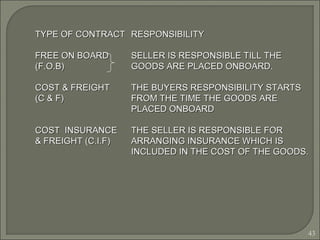
TYPE OF CONTRACTTYPE OF CONTRACT RESPONSIBILITYRESPONSIBILITY
FREE ON BOARDFREE ON BOARD SELLER IS RESPONSIBLE TILL THESELLER IS RESPONSIBLE TILL THE
(F.O.B)(F.O.B) GOODS ARE PLACED ONBOARD.GOODS ARE PLACED ONBOARD.
COST & FREIGHTCOST & FREIGHT THE BUYERS RESPONSIBILITY STARTSTHE BUYERS RESPONSIBILITY STARTS
(C & F)(C & F) FROM THE TIME THE GOODS AREFROM THE TIME THE GOODS ARE
PLACED ONBOARDPLACED ONBOARD
COST INSURANCECOST INSURANCE THE SELLER IS RESPONSIBLE FORTHE SELLER IS RESPONSIBLE FOR
& FREIGHT (C.I.F)& FREIGHT (C.I.F) ARRANGING INSURANCE WHICH ISARRANGING INSURANCE WHICH IS
INCLUDED IN THE COST OF THE GOODS.INCLUDED IN THE COST OF THE GOODS.
44
A further security in the form of insuranceA further security in the form of insurance
policy is also required by the bank to protect itspolicy is also required by the bank to protect its
interest in case of goods suffering loss orinterest in case of goods suffering loss or
damage while in transit, in which case thedamage while in transit, in which case the
importer may not make the payment.importer may not make the payment.
The terms and conditions of the insurance areThe terms and conditions of the insurance are
specified in the letter of CREDIT.specified in the letter of CREDIT.
45
The RISKS covered in a marine policy fallsThe RISKS covered in a marine policy falls
under three categoriesunder three categories
•MARINE PERILSMARINE PERILS
•EXTRANEOUS PERILSEXTRANEOUS PERILS
•WAR & STIRKES, RIOTS & CIVILWAR & STIRKES, RIOTS & CIVIL
COMMOTION RISKS (S.R.C.C)COMMOTION RISKS (S.R.C.C)
46
MARINE PERILS : are the perils associatedMARINE PERILS : are the perils associated
with rivers, seas.with rivers, seas.
EXTRANEOUS PERILS: means not relevant.EXTRANEOUS PERILS: means not relevant.
Ex: theft, pilferage non delivery are some of theEx: theft, pilferage non delivery are some of the
extraneous perils.extraneous perils.
Loss due to WAR, STRIKES and CIVILLoss due to WAR, STRIKES and CIVIL
COMMOTIONS (SRCC) can also be coveredCOMMOTIONS (SRCC) can also be covered
under a Marine policy.under a Marine policy.
The consequences of these perils may result inThe consequences of these perils may result in
total loss.total loss.
47
TOTAL LOSS IS DIVIDED INTOTOTAL LOSS IS DIVIDED INTO
ACTUALACTUAL
OROR
CONSTRUCTIVE .CONSTRUCTIVE .
This is once again divided into
PARTICULAR AVERAGE
OR
GENERAL AVERAGE
In marine insurance the word average is
synonymous with LOSS.
48
A particular average loss is a partial loss of
subject matter insured. Deductions are as per
excess and franchise clauses.
49
50
Example: If fire is discovered onboard aExample: If fire is discovered onboard a
laden vessel, the following items make upladen vessel, the following items make up
the general average loss:the general average loss:
1.1. Cost of damage caused by water or anyCost of damage caused by water or any
other methods used to extinguish the fireother methods used to extinguish the fire
2.2. Cost of repair if the ships structure has to beCost of repair if the ships structure has to be
altered to gain access to fire.altered to gain access to fire.
3.3. Value of any cargo damaged or jettisonedValue of any cargo damaged or jettisoned
during efforts to control fireduring efforts to control fire
4.4. Cost of using the ships equipment and theCost of using the ships equipment and the
wages of the crew during the generalwages of the crew during the general
average incident.average incident.
51
Example: A vessel runs aground in aExample: A vessel runs aground in a
dangerous positiondangerous position
1.1. Cost of tugs to refloat the vessel includingCost of tugs to refloat the vessel including
salvage awardsalvage award
2.2. Cost of running ships equipment whileCost of running ships equipment while
refloatingrefloating
3.3. Cost of discharging cargo into lighters andCost of discharging cargo into lighters and
reloading into vessel.reloading into vessel.
4.4. cost of pollution removal if the cargo iscost of pollution removal if the cargo is
jettisoned and the value of the cargo lost.jettisoned and the value of the cargo lost.
5.5. stores consumed and wages paid to crewstores consumed and wages paid to crew
during the general average incident.during the general average incident.
52
SALVAGE CHARGES:SALVAGE CHARGES:
With Marine cargo policies, the term isWith Marine cargo policies, the term is
often referred to as salvage loss. Ex. Sayoften referred to as salvage loss. Ex. Say
goods insured are damaged enroute, andgoods insured are damaged enroute, and
the goods are such that they deterioratethe goods are such that they deteriorate
incase of prolonged storage or by they timeincase of prolonged storage or by they time
they reach their destination. It is thenthey reach their destination. It is then
prudent and sensible to dispose of theprudent and sensible to dispose of the
same at an early date for the best pricesame at an early date for the best price
obtainable. The difference between theobtainable. The difference between the
insured value and the net proceeds of theinsured value and the net proceeds of the
sale becomes the salvage value.sale becomes the salvage value.
53
SUE & LABOUR CHARGES:SUE & LABOUR CHARGES:
These are expenses incurred by the insuredThese are expenses incurred by the insured
or his agents in order to avert minimize aor his agents in order to avert minimize a
loss covered by the policy. Example of suchloss covered by the policy. Example of such
charges are the landing cost at intermediatecharges are the landing cost at intermediate
ports , ware housing , reconditioning and reports , ware housing , reconditioning and re
forwarding. It should be noted that theforwarding. It should be noted that the
insured should always THINK AND ACT ininsured should always THINK AND ACT in
such manner as a UNINSURED would act.such manner as a UNINSURED would act.
54
INSTITUTE CARGO CLAUSES (A), (B) & (C)INSTITUTE CARGO CLAUSES (A), (B) & (C)
Risks/Contingencies Covered by ICC(A):Risks/Contingencies Covered by ICC(A):
aa)All risks of loss or damage to the subject)All risks of loss or damage to the subject
matter insured except those specificallymatter insured except those specifically
excluded. The term “all risks” is not to beexcluded. The term “all risks” is not to be
construed as embracing loss or damage,construed as embracing loss or damage,
which is inevitable. The loss or damage, inwhich is inevitable. The loss or damage, in
order to be recoverable, must have occurredorder to be recoverable, must have occurred
fortuitously.fortuitously.
b)General average and salvage chargesb)General average and salvage charges
incurred to avoid loss from any cause orincurred to avoid loss from any cause or
causes except those excluded.causes except those excluded.
c)Liability under “Both to Blame Collision”c)Liability under “Both to Blame Collision”
clause of the bill of lading.clause of the bill of lading.
55
d) Charges reasonably and properly incurred tod) Charges reasonably and properly incurred to
avert or minimize an insured loss and toavert or minimize an insured loss and to
preserve and pursue recovery rights are alsopreserve and pursue recovery rights are also
covered (as per Duty of Assured Clause).covered (as per Duty of Assured Clause).
e) In the event of termination of the transite) In the event of termination of the transit
resulting from a risk covered. EXTRAresulting from a risk covered. EXTRA
CHARGES incurred in unloading, storing andCHARGES incurred in unloading, storing and
forwarding the insured cargo to destinationforwarding the insured cargo to destination
(as per the Forwarding Charges Clause).(as per the Forwarding Charges Clause).
56
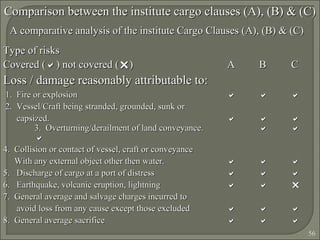
Comparison between the institute cargo clauses (A), (B) & (C)Comparison between the institute cargo clauses (A), (B) & (C)
A comparative analysis of the institute Cargo Clauses (A), (B) & (C)A comparative analysis of the institute Cargo Clauses (A), (B) & (C)
Type of risksType of risks
Covered (Covered () not covered () not covered ()) AA BB CC
Loss / damage reasonably attributable to:Loss / damage reasonably attributable to:
1. Fire or explosion1. Fire or explosion   
2. Vessel/Craft being stranded, grounded, sunk or2. Vessel/Craft being stranded, grounded, sunk or
capsized.capsized.   
3. Overturning/derailment of land conveyance.3. Overturning/derailment of land conveyance.  

4. Collision or contact of vessel, craft or conveyance4. Collision or contact of vessel, craft or conveyance
With any external object other then water.With any external object other then water.   
5. Discharge of cargo at a port of distress5. Discharge of cargo at a port of distress   
6. Earthquake, volcanic eruption, lightning6. Earthquake, volcanic eruption, lightning   
7. General average and salvage charges incurred to7. General average and salvage charges incurred to
avoid loss from any cause except those excludedavoid loss from any cause except those excluded   
8. General average sacrifice8. General average sacrifice   
57
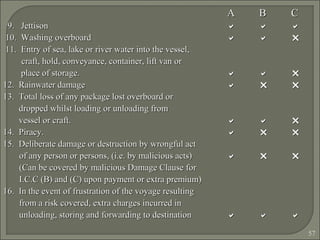
AA BB CC
9. Jettison9. Jettison   
10. Washing overboard10. Washing overboard   
11. Entry of sea, lake or river water into the vessel,11. Entry of sea, lake or river water into the vessel,
craft, hold, conveyance, container, lift van orcraft, hold, conveyance, container, lift van or
place of storage.place of storage.   
12. Rainwater damage12. Rainwater damage   
13. Total loss of any package lost overboard or13. Total loss of any package lost overboard or
dropped whilst loading or unloading fromdropped whilst loading or unloading from
vessel or craft.vessel or craft.   
14. Piracy.14. Piracy.   
15. Deliberate damage or destruction by wrongful act15. Deliberate damage or destruction by wrongful act
of any person or persons, (i.e. by malicious acts)of any person or persons, (i.e. by malicious acts)   
(Can be covered by malicious Damage Clause for(Can be covered by malicious Damage Clause for
I.C.C (B) and (C) upon payment or extra premium)I.C.C (B) and (C) upon payment or extra premium)
16. In the event of frustration of the voyage resulting16. In the event of frustration of the voyage resulting
from a risk covered, extra charges incurred infrom a risk covered, extra charges incurred in
unloading, storing and forwarding to destinationunloading, storing and forwarding to destination   
58
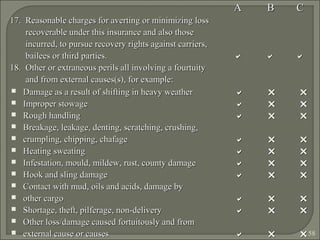
AA BB CC
17. Reasonable charges for averting or minimizing loss17. Reasonable charges for averting or minimizing loss
recoverable under this insurance and also thoserecoverable under this insurance and also those
incurred, to pursue recovery rights against carriers,incurred, to pursue recovery rights against carriers,
bailees or third parties.bailees or third parties.   
18. Other or extraneous perils all involving a fourtuity18. Other or extraneous perils all involving a fourtuity
and from external causes(s), for example:and from external causes(s), for example:
 Damage as a result of shifting in heavy weatherDamage as a result of shifting in heavy weather   
 Improper stowageImproper stowage   
 Rough handlingRough handling   
 Breakage, leakage, denting, scratching, crushing,Breakage, leakage, denting, scratching, crushing,
 crumpling, chipping, chafagecrumpling, chipping, chafage   
 Heating sweatingHeating sweating   
 Infestation, mould, mildew, rust, county damageInfestation, mould, mildew, rust, county damage   
 Hook and sling damageHook and sling damage   
 Contact with mud, oils and acids, damage byContact with mud, oils and acids, damage by
 other cargoother cargo   
 Shortage, theft, pilferage, non-deliveryShortage, theft, pilferage, non-delivery   
 Other loss/damage caused fortuitously and fromOther loss/damage caused fortuitously and from
 external cause or causesexternal cause or causes   
59
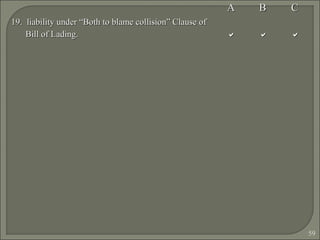
AA BB CC
19. liability under “Both to blame collision” Clause of19. liability under “Both to blame collision” Clause of
Bill of Lading.Bill of Lading.   
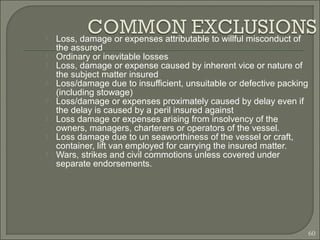
 Loss, damage or expenses attributable to willful misconduct of
the assured
 Ordinary or inevitable losses
 Loss, damage or expense caused by inherent vice or nature of
the subject matter insured
 Loss/damage due to insufficient, unsuitable or defective packing
(including stowage)
 Loss/damage or expenses proximately caused by delay even if
the delay is caused by a peril insured against
 Loss damage or expenses arising from insolvency of the
owners, managers, charterers or operators of the vessel.
 Loss damage due to un seaworthiness of the vessel or craft,
container, lift van employed for carrying the insured matter.
 Wars, strikes and civil commotions unless covered under
separate endorsements.
60
Is a mutual association operated on behalf of its
members (ship owners) by a board of Directors
appointed by and from the members of the club.
61
62
THANK YOU

Insurance

  • 1.
    1 I N SU R A N C E
  • 2.
    2  Insurance inbroad terms may beInsurance in broad terms may be described as a method of sharingdescribed as a method of sharing financial losses of few from a commonfinancial losses of few from a common fund who are equally exposed to thefund who are equally exposed to the same loss.same loss.
  • 3.
     Say 1000motor cars valued @ 300000/- are observed over a period of five years. On an average say per year two are total loss by accident. Then the total annual loss would be Rs.600000. If the loss is to shared by all the thousand owners then they have to contribute Rs.600/-  The loss experience will be established by taking the past experience, geographical area in which the vehicles are used and density of traffic. 3
  • 4.
    4 A.Rate of contributionor premium B.The degree of hazard it is exposed to. C.Classification of various types of properties.
  • 5.
     Subject matterof insurance.  The PERIL (risk)  The financial loss. 5
  • 6.
    Subject matter isproperty, human life, machinery, goods etc., 6 Peril is fire, storm, burglary, earth quake, injury,Peril is fire, storm, burglary, earth quake, injury, explosion etc.,explosion etc., Financial loss is normally defined before theFinancial loss is normally defined before the contract is signed.contract is signed.
  • 7.
    RISK:- can bedefined as the unforeseen element which may impede your progress in achieving the objective. 7
  • 8.
    8 In insurance jargonthey term RISK as anIn insurance jargon they term RISK as an uncertainty regarding loss or what is termed asuncertainty regarding loss or what is termed as a FORTUITOUS risk.a FORTUITOUS risk. Concept of chance and risk can be expressedConcept of chance and risk can be expressed in a single mathematical term calledin a single mathematical term called “Probability”.“Probability”.
  • 9.
    9 An example ofimpossibility can be quoted sayAn example of impossibility can be quoted say the 9/11 incident where insurance companiesthe 9/11 incident where insurance companies were washed out.were washed out. Hyderabadis never in their dreams thought ofHyderabadis never in their dreams thought of taking cover for flood. When the encroachedtaking cover for flood. When the encroached drains could not contain rains for 2 days, thedrains could not contain rains for 2 days, the resultant floods had washed away score ofresultant floods had washed away score of vehicles, property etc.,vehicles, property etc., So, Risk is inherent in human existence. HumanSo, Risk is inherent in human existence. Human life and material possessions are constantlylife and material possessions are constantly exposed to loss or damage due to theexposed to loss or damage due to the mechanizations of fortuitous circumstancesmechanizations of fortuitous circumstances
  • 10.
    10 A RISK OFTRADE is a loss due to aA RISK OF TRADE is a loss due to a specified event say fire, storms burglary etc.,specified event say fire, storms burglary etc., These are classified and their frequency inThese are classified and their frequency in already assessed.already assessed. A TRADE RISK is a risk of loss inherent in theA TRADE RISK is a risk of loss inherent in the trade itself. Broadly speaking we can say losstrade itself. Broadly speaking we can say loss of profit as a result of change due to marketof profit as a result of change due to market collapse, political factors etc.,collapse, political factors etc., Risk of trade is insurable as it is alreadyRisk of trade is insurable as it is already assessed,assessed, Trade risk is yet to be classified and henceTrade risk is yet to be classified and hence majority of these are not covered.majority of these are not covered.
  • 11.
    11 MATHEMETICAL VALUE OFRISKMATHEMETICAL VALUE OF RISK L/V x 100 whereL/V x 100 where L= total losses reportedL= total losses reported V=refers to the total valuesV=refers to the total values the product of the above analysis is calledthe product of the above analysis is called Law of averages or the doctrine of probability.Law of averages or the doctrine of probability. So premium rates depend upon past lossSo premium rates depend upon past loss experience by systematically classifying theexperience by systematically classifying the risks. Which are homogenous in charactersrisks. Which are homogenous in characters Example:- Motor vehicle.Example:- Motor vehicle.
  • 12.
    12 RICE INSURANCERICE INSURANCEATFLATFL ITCITC EMMSONSEMMSONS
  • 13.
    13 SCOPE OF INSURANCE:SCOPEOF INSURANCE: General Insurance is divided into threeGeneral Insurance is divided into three categories:categories: FIRE,FIRE, MARINEMARINE && MISCELLANEOUSMISCELLANEOUS
  • 14.
    FIRE INSURANCE BUSINESS: Lossdue to FIRE, LIGHTINING, EXPLOSION, IMPLOSION,, RIOTS & STRIKES, IMPACT BY RAIL, AIRCRAFT DAMAGE, EARTH QUAKE, FLOOD, STORM, TEMPEST, TORNADO, TYPHOON, CYCLONES & LAND SLIDE. 14
  • 15.
    15 MARINE INSURANCE BUSINESS:MARINEINSURANCE BUSINESS: This is the oldest branch of Insurance comprisingThis is the oldest branch of Insurance comprising HULL & CARGO.HULL & CARGO. Hull Insurance deals the Loss associated withHull Insurance deals the Loss associated with floating crafts, Cargo insurance provides coverfloating crafts, Cargo insurance provides cover in respect of loss or damage to goods duringin respect of loss or damage to goods during transit by rail, road, sea or air.transit by rail, road, sea or air.
  • 16.
    16 MISCELLENOUS INSURANCE BUSINESS:MISCELLENOUSINSURANCE BUSINESS: Mainly includes the motor business, accident,Mainly includes the motor business, accident, aviation , engineering and guarantee insurances.aviation , engineering and guarantee insurances.
  • 17.
    17 CONTRACT OF INSURANCECONTRACTOF INSURANCE In between the insured and insurerIn between the insured and insurer INSURED:-INSURED:- Party effecting insurance,Party effecting insurance, (Individual, Company, Firm,(Individual, Company, Firm, Corporate body etc., withCorporate body etc., with legal status)legal status) INSURER:-INSURER:- Party granting the protectionParty granting the protection under an insurance policy.under an insurance policy. Policy:-Policy:- Is the evidence of contractIs the evidence of contract
  • 18.
    18 Insurance contracts aregoverned by IndianInsurance contracts are governed by Indian contract act 1872 which states that to becontract act 1872 which states that to be legally valid following elements should be inlegally valid following elements should be in order.order. A.A. Offer and acceptanceOffer and acceptance B.B. ConsiderationConsideration C.C. Agreement between the partiesAgreement between the parties D.D. Capacity of the partiesCapacity of the parties E.E. Legality of the contractLegality of the contract
  • 19.
    19 UTMOST GOOD FAITH:UTMOSTGOOD FAITH: The greatest degree of good faith by law, isThe greatest degree of good faith by law, is expected from the proposer, that is the mainexpected from the proposer, that is the main reason why good faith in case of Insurancereason why good faith in case of Insurance contracts becomes UTMOST good faith.contracts becomes UTMOST good faith. It is the duty of the proposer to disclose allIt is the duty of the proposer to disclose all material facts not only already known butmaterial facts not only already known but also extends to material facts which he oughtalso extends to material facts which he ought to know.to know.
  • 20.
    20 Examples of materialfacts:Examples of material facts: FIRE: Construction of building, type ofFIRE: Construction of building, type of occupancy, nature of good stored etc.occupancy, nature of good stored etc. MARINE: method of packing, inherent viceMARINE: method of packing, inherent vice etc.etc.
  • 21.
    21 INSURABLE INTRESTINSURABLE INTREST Innutshell if property is the subject matter ofIn nutshell if property is the subject matter of insurance then the subject matter ofinsurance then the subject matter of insurance contract is the insured’s pecuniaryinsurance contract is the insured’s pecuniary interest in that property.interest in that property. LEGAL RIGHT TO INSURE IS THELEGAL RIGHT TO INSURE IS THE INSURABLE INTEREST. Insurable Interest isINSURABLE INTEREST. Insurable Interest is required to support the contract of Insurancerequired to support the contract of Insurance in order to make it legal, other wise thein order to make it legal, other wise the contract is null and void.contract is null and void.
  • 22.
    22 HOW INSURABLE INTERESTARISES:HOW INSURABLE INTEREST ARISES: 1.1. By ownershipBy ownership 2.2. By LawBy Law 3.3. By ContractBy Contract 4.4. By Legal liabilityBy Legal liability 5.5. Interest of a Person in LifeInterest of a Person in Life
  • 23.
    23 When insurable interestmust exist:When insurable interest must exist: For Fire or Miscellaneous policy theFor Fire or Miscellaneous policy the insurable interest must exist at the time ofinsurable interest must exist at the time of taking the policy and at the time of the loss.taking the policy and at the time of the loss. For Marine policy an insurable interest needFor Marine policy an insurable interest need not exist at the time of policy taking.not exist at the time of policy taking.
  • 24.
    24 WARRANTY:WARRANTY: means an assuranceby the assured, that hemeans an assurance by the assured, that he will not do some particular things or will fulfillwill not do some particular things or will fulfill any conditions that are laid in advance.any conditions that are laid in advance. WARRANTIES are further classified asWARRANTIES are further classified as expressexpress or impliedor implied
  • 25.
    25 ASSIGNMENTASSIGNMENT Assignment means transferof rights andAssignment means transfer of rights and liabilities of an insured to another personliabilities of an insured to another person who had acquired insurable interest in thewho had acquired insurable interest in the property insured.property insured. Fire policies have to be assigned with theFire policies have to be assigned with the consent of the insurers, where as Marineconsent of the insurers, where as Marine cargo policies can be freely assignedcargo policies can be freely assigned without the knowledge or consent of thewithout the knowledge or consent of the insurer. This is because the ultimate buyer isinsurer. This is because the ultimate buyer is not known at the time of taking the cover.not known at the time of taking the cover. Marine hull policies cannot be assigned.Marine hull policies cannot be assigned.
  • 26.
    26 INDEMINITY:INDEMINITY: Can be definedas “ compensation for loss orCan be defined as “ compensation for loss or injury sustained” or “ to make good the lossinjury sustained” or “ to make good the loss or damage” .or damage” .
  • 27.
    27 Methods of indemnification:Methodsof indemnification: 1.1. Cash paymentCash payment 2.2. RepairRepair 3.3. ReplacementReplacement 4.4. Reinstatement.Reinstatement.
  • 28.
    28 Mode of indemnity:Modeof indemnity: Buildings:Buildings: the cost of reinstating or repairing thethe cost of reinstating or repairing the damaged portion, is assessed, and from thatdamaged portion, is assessed, and from that an appropriate allowance is made towardsan appropriate allowance is made towards depreciation, depending on the age anddepreciation, depending on the age and condition of the building. Allowances arecondition of the building. Allowances are made for improvement due to repairs.made for improvement due to repairs.
  • 29.
    29 Machinery:Machinery: HHere the methodof indemnity is supposedere the method of indemnity is supposed to be the market value for a similar machineto be the market value for a similar machine of same age and model as determined onof same age and model as determined on the date of loss. In practice this is difficult sothe date of loss. In practice this is difficult so the measure of indemnity becomes thethe measure of indemnity becomes the replacement value less depreciation. In casereplacement value less depreciation. In case of repairs the cost of repairing is borne byof repairs the cost of repairing is borne by the insured. However replacement of partsthe insured. However replacement of parts is subject to an allowance towardsis subject to an allowance towards depreciation.depreciation.
  • 30.
    30 Household goods:Household goods: Considerationsimilar to those applicable forConsideration similar to those applicable for machines.machines. Stocks:Stocks: In case of wholesalers or retailers, theIn case of wholesalers or retailers, the measure of indemnity is the price at whichmeasure of indemnity is the price at which he will be able to replace his goods. Thehe will be able to replace his goods. The element of profit will not be taken care of.element of profit will not be taken care of.
  • 31.
    Fire insurance policiesmay be issued on REINSTATEMENT value basis. Although the insured gets new property which is in similar condition and of same kind, to protect the basic of idea of indemnity the property will not be of superior nature. 31
  • 32.
    32 Motor:Motor: If the vehicleis a total loss, the sum insuredIf the vehicle is a total loss, the sum insured or the value of the vehicle, which ever isor the value of the vehicle, which ever is less is paid. If the vehicle is damaged theless is paid. If the vehicle is damaged the cost of repairs or paid, if parts are replacedcost of repairs or paid, if parts are replaced the cost of new part will be subjected tothe cost of new part will be subjected to depreciation. In all the cases age anddepreciation. In all the cases age and general maintenance of the vehicle aregeneral maintenance of the vehicle are considered.considered.
  • 33.
    33 MARINE INSURANCEMARINE INSURANCE IInthis branch what is provided as indemnityn this branch what is provided as indemnity becomes commercial indemnity because,becomes commercial indemnity because, Almost all the policies issued are agreedAlmost all the policies issued are agreed value policies.value policies. To be precise the insured and the insurerTo be precise the insured and the insurer agree that the sum insured is the value ofagree that the sum insured is the value of the property insured. The agreed amount isthe property insured. The agreed amount is then payable in case of total loss, with nothen payable in case of total loss, with no attachments what so ever.attachments what so ever.
  • 34.
    Miscellaneous Insurance: theinsurances of property, liability and insurance are contracts of strict indemnity. Normally books of accounts are referred when settling claims in this branch. ( ex. fidelity guarantee insurance) 34
  • 35.
    35 Under insurance: Propertyinsurances areUnder insurance: Property insurances are generally subject to the condition ofgenerally subject to the condition of average, and if there has been underaverage, and if there has been under insurance, only that portion of the loss isinsurance, only that portion of the loss is payable.payable. Ex.value of propertyEx.value of property : Rs.20000: Rs.20000 Sum insuredSum insured : Rs.15000: Rs.15000 Loss assessedLoss assessed : Rs.10000: Rs.10000 Amount payable will then be:Amount payable will then be: 15000 x 1000015000 x 10000 = 7500= 7500 2000020000 The insured is then considered as his ownThe insured is then considered as his own insurer for the difference of the liability.insurer for the difference of the liability.
  • 36.
    36 EXCESS OR FRANCHISEEXCESSOR FRANCHISE In some policies an EXCESS or FRACHISE isIn some policies an EXCESS or FRACHISE is incorporated, which means that a certainincorporated, which means that a certain circumstances a part of the loss may have tocircumstances a part of the loss may have to be borne by the insured.be borne by the insured.
  • 37.
    37 SALVAGESALVAGE Property which issaved from loss or damageProperty which is saved from loss or damage and still has some commercial value is calledand still has some commercial value is called salvage.salvage.
  • 38.
    may be definedas the transfer of rights and remedies of the insured to the insurer who has indemnified the insured in respect of the loss. 38
  • 39.
    39 CONTRIBUTION:CONTRIBUTION: An insured mayhave taken many policies onAn insured may have taken many policies on the same subject matter. The principal ofthe same subject matter. The principal of contribution would lead to a situation in whichcontribution would lead to a situation in which the insured would be able to recover his lossthe insured would be able to recover his loss from any one insurer, who then will have tofrom any one insurer, who then will have to effect proportionate recoveries from othereffect proportionate recoveries from other insurers concerned. Normally the insurersinsurers concerned. Normally the insurers seek to control additional insurances at theseek to control additional insurances at the proposal stage itself.proposal stage itself. Remember at no cost an infringement to theRemember at no cost an infringement to the principle of indemnity is accepted.principle of indemnity is accepted. The principal of contribution does not apply toThe principal of contribution does not apply to personal accident policies.personal accident policies.
  • 40.
    40 PROXIMATE CAUSEPROXIMATE CAUSE Meansthe DIRECT, DOMINANT or effectiveMeans the DIRECT, DOMINANT or effective cause of which the loss is the naturalcause of which the loss is the natural consequence. It is the cause which is mostconsequence. It is the cause which is most closely connected with the loss, not necessarilyclosely connected with the loss, not necessarily in time but in efficiency.in time but in efficiency. Although the doctrine is clear in theory, it isAlthough the doctrine is clear in theory, it is difficult to determine the proximate cause, as adifficult to determine the proximate cause, as a clear demarcation should be maintainedclear demarcation should be maintained between insured peril, excepted peril and unbetween insured peril, excepted peril and un insured peril.insured peril.
  • 41.
    41 Example:Example: An insured sustainedan accident whileAn insured sustained an accident while hunting. Due to shock and weakness, he washunting. Due to shock and weakness, he was unable to walk and whilst lying on wet ground,unable to walk and whilst lying on wet ground, he contracted cold which developed intohe contracted cold which developed into pneumonia causing death ultimately.pneumonia causing death ultimately. The proximate cause was considered to be theThe proximate cause was considered to be the accident and not the pneumonia, the disease,accident and not the pneumonia, the disease, which was only a remote cause. The claim waswhich was only a remote cause. The claim was payable under personal accident policy.payable under personal accident policy.
  • 42.
    42 MARINE INSURANCEMARINE INSURANCE A.A.cargo insurancecargo insurance B.B. hull insurancehull insurance Cargo insurance provides insurance cover inCargo insurance provides insurance cover in respect of loss of or damage to goods duringrespect of loss of or damage to goods during transit by RAIL, ROAD, SEA, AIR ORtransit by RAIL, ROAD, SEA, AIR OR REGISTERED POST.REGISTERED POST.
  • 43.
    43 TYPE OF CONTRACTTYPEOF CONTRACT RESPONSIBILITYRESPONSIBILITY FREE ON BOARDFREE ON BOARD SELLER IS RESPONSIBLE TILL THESELLER IS RESPONSIBLE TILL THE (F.O.B)(F.O.B) GOODS ARE PLACED ONBOARD.GOODS ARE PLACED ONBOARD. COST & FREIGHTCOST & FREIGHT THE BUYERS RESPONSIBILITY STARTSTHE BUYERS RESPONSIBILITY STARTS (C & F)(C & F) FROM THE TIME THE GOODS AREFROM THE TIME THE GOODS ARE PLACED ONBOARDPLACED ONBOARD COST INSURANCECOST INSURANCE THE SELLER IS RESPONSIBLE FORTHE SELLER IS RESPONSIBLE FOR & FREIGHT (C.I.F)& FREIGHT (C.I.F) ARRANGING INSURANCE WHICH ISARRANGING INSURANCE WHICH IS INCLUDED IN THE COST OF THE GOODS.INCLUDED IN THE COST OF THE GOODS.
  • 44.
    44 A further securityin the form of insuranceA further security in the form of insurance policy is also required by the bank to protect itspolicy is also required by the bank to protect its interest in case of goods suffering loss orinterest in case of goods suffering loss or damage while in transit, in which case thedamage while in transit, in which case the importer may not make the payment.importer may not make the payment. The terms and conditions of the insurance areThe terms and conditions of the insurance are specified in the letter of CREDIT.specified in the letter of CREDIT.
  • 45.
    45 The RISKS coveredin a marine policy fallsThe RISKS covered in a marine policy falls under three categoriesunder three categories •MARINE PERILSMARINE PERILS •EXTRANEOUS PERILSEXTRANEOUS PERILS •WAR & STIRKES, RIOTS & CIVILWAR & STIRKES, RIOTS & CIVIL COMMOTION RISKS (S.R.C.C)COMMOTION RISKS (S.R.C.C)
  • 46.
    46 MARINE PERILS :are the perils associatedMARINE PERILS : are the perils associated with rivers, seas.with rivers, seas. EXTRANEOUS PERILS: means not relevant.EXTRANEOUS PERILS: means not relevant. Ex: theft, pilferage non delivery are some of theEx: theft, pilferage non delivery are some of the extraneous perils.extraneous perils. Loss due to WAR, STRIKES and CIVILLoss due to WAR, STRIKES and CIVIL COMMOTIONS (SRCC) can also be coveredCOMMOTIONS (SRCC) can also be covered under a Marine policy.under a Marine policy. The consequences of these perils may result inThe consequences of these perils may result in total loss.total loss.
  • 47.
    47 TOTAL LOSS ISDIVIDED INTOTOTAL LOSS IS DIVIDED INTO ACTUALACTUAL OROR CONSTRUCTIVE .CONSTRUCTIVE .
  • 48.
    This is onceagain divided into PARTICULAR AVERAGE OR GENERAL AVERAGE In marine insurance the word average is synonymous with LOSS. 48
  • 49.
    A particular averageloss is a partial loss of subject matter insured. Deductions are as per excess and franchise clauses. 49
  • 50.
    50 Example: If fireis discovered onboard aExample: If fire is discovered onboard a laden vessel, the following items make upladen vessel, the following items make up the general average loss:the general average loss: 1.1. Cost of damage caused by water or anyCost of damage caused by water or any other methods used to extinguish the fireother methods used to extinguish the fire 2.2. Cost of repair if the ships structure has to beCost of repair if the ships structure has to be altered to gain access to fire.altered to gain access to fire. 3.3. Value of any cargo damaged or jettisonedValue of any cargo damaged or jettisoned during efforts to control fireduring efforts to control fire 4.4. Cost of using the ships equipment and theCost of using the ships equipment and the wages of the crew during the generalwages of the crew during the general average incident.average incident.
  • 51.
    51 Example: A vesselruns aground in aExample: A vessel runs aground in a dangerous positiondangerous position 1.1. Cost of tugs to refloat the vessel includingCost of tugs to refloat the vessel including salvage awardsalvage award 2.2. Cost of running ships equipment whileCost of running ships equipment while refloatingrefloating 3.3. Cost of discharging cargo into lighters andCost of discharging cargo into lighters and reloading into vessel.reloading into vessel. 4.4. cost of pollution removal if the cargo iscost of pollution removal if the cargo is jettisoned and the value of the cargo lost.jettisoned and the value of the cargo lost. 5.5. stores consumed and wages paid to crewstores consumed and wages paid to crew during the general average incident.during the general average incident.
  • 52.
    52 SALVAGE CHARGES:SALVAGE CHARGES: WithMarine cargo policies, the term isWith Marine cargo policies, the term is often referred to as salvage loss. Ex. Sayoften referred to as salvage loss. Ex. Say goods insured are damaged enroute, andgoods insured are damaged enroute, and the goods are such that they deterioratethe goods are such that they deteriorate incase of prolonged storage or by they timeincase of prolonged storage or by they time they reach their destination. It is thenthey reach their destination. It is then prudent and sensible to dispose of theprudent and sensible to dispose of the same at an early date for the best pricesame at an early date for the best price obtainable. The difference between theobtainable. The difference between the insured value and the net proceeds of theinsured value and the net proceeds of the sale becomes the salvage value.sale becomes the salvage value.
  • 53.
    53 SUE & LABOURCHARGES:SUE & LABOUR CHARGES: These are expenses incurred by the insuredThese are expenses incurred by the insured or his agents in order to avert minimize aor his agents in order to avert minimize a loss covered by the policy. Example of suchloss covered by the policy. Example of such charges are the landing cost at intermediatecharges are the landing cost at intermediate ports , ware housing , reconditioning and reports , ware housing , reconditioning and re forwarding. It should be noted that theforwarding. It should be noted that the insured should always THINK AND ACT ininsured should always THINK AND ACT in such manner as a UNINSURED would act.such manner as a UNINSURED would act.
  • 54.
    54 INSTITUTE CARGO CLAUSES(A), (B) & (C)INSTITUTE CARGO CLAUSES (A), (B) & (C) Risks/Contingencies Covered by ICC(A):Risks/Contingencies Covered by ICC(A): aa)All risks of loss or damage to the subject)All risks of loss or damage to the subject matter insured except those specificallymatter insured except those specifically excluded. The term “all risks” is not to beexcluded. The term “all risks” is not to be construed as embracing loss or damage,construed as embracing loss or damage, which is inevitable. The loss or damage, inwhich is inevitable. The loss or damage, in order to be recoverable, must have occurredorder to be recoverable, must have occurred fortuitously.fortuitously. b)General average and salvage chargesb)General average and salvage charges incurred to avoid loss from any cause orincurred to avoid loss from any cause or causes except those excluded.causes except those excluded. c)Liability under “Both to Blame Collision”c)Liability under “Both to Blame Collision” clause of the bill of lading.clause of the bill of lading.
  • 55.
    55 d) Charges reasonablyand properly incurred tod) Charges reasonably and properly incurred to avert or minimize an insured loss and toavert or minimize an insured loss and to preserve and pursue recovery rights are alsopreserve and pursue recovery rights are also covered (as per Duty of Assured Clause).covered (as per Duty of Assured Clause). e) In the event of termination of the transite) In the event of termination of the transit resulting from a risk covered. EXTRAresulting from a risk covered. EXTRA CHARGES incurred in unloading, storing andCHARGES incurred in unloading, storing and forwarding the insured cargo to destinationforwarding the insured cargo to destination (as per the Forwarding Charges Clause).(as per the Forwarding Charges Clause).
  • 56.
    56 Comparison between theinstitute cargo clauses (A), (B) & (C)Comparison between the institute cargo clauses (A), (B) & (C) A comparative analysis of the institute Cargo Clauses (A), (B) & (C)A comparative analysis of the institute Cargo Clauses (A), (B) & (C) Type of risksType of risks Covered (Covered () not covered () not covered ()) AA BB CC Loss / damage reasonably attributable to:Loss / damage reasonably attributable to: 1. Fire or explosion1. Fire or explosion    2. Vessel/Craft being stranded, grounded, sunk or2. Vessel/Craft being stranded, grounded, sunk or capsized.capsized.    3. Overturning/derailment of land conveyance.3. Overturning/derailment of land conveyance.    4. Collision or contact of vessel, craft or conveyance4. Collision or contact of vessel, craft or conveyance With any external object other then water.With any external object other then water.    5. Discharge of cargo at a port of distress5. Discharge of cargo at a port of distress    6. Earthquake, volcanic eruption, lightning6. Earthquake, volcanic eruption, lightning    7. General average and salvage charges incurred to7. General average and salvage charges incurred to avoid loss from any cause except those excludedavoid loss from any cause except those excluded    8. General average sacrifice8. General average sacrifice   
  • 57.
    57 AA BB CC 9.Jettison9. Jettison    10. Washing overboard10. Washing overboard    11. Entry of sea, lake or river water into the vessel,11. Entry of sea, lake or river water into the vessel, craft, hold, conveyance, container, lift van orcraft, hold, conveyance, container, lift van or place of storage.place of storage.    12. Rainwater damage12. Rainwater damage    13. Total loss of any package lost overboard or13. Total loss of any package lost overboard or dropped whilst loading or unloading fromdropped whilst loading or unloading from vessel or craft.vessel or craft.    14. Piracy.14. Piracy.    15. Deliberate damage or destruction by wrongful act15. Deliberate damage or destruction by wrongful act of any person or persons, (i.e. by malicious acts)of any person or persons, (i.e. by malicious acts)    (Can be covered by malicious Damage Clause for(Can be covered by malicious Damage Clause for I.C.C (B) and (C) upon payment or extra premium)I.C.C (B) and (C) upon payment or extra premium) 16. In the event of frustration of the voyage resulting16. In the event of frustration of the voyage resulting from a risk covered, extra charges incurred infrom a risk covered, extra charges incurred in unloading, storing and forwarding to destinationunloading, storing and forwarding to destination   
  • 58.
    58 AA BB CC 17.Reasonable charges for averting or minimizing loss17. Reasonable charges for averting or minimizing loss recoverable under this insurance and also thoserecoverable under this insurance and also those incurred, to pursue recovery rights against carriers,incurred, to pursue recovery rights against carriers, bailees or third parties.bailees or third parties.    18. Other or extraneous perils all involving a fourtuity18. Other or extraneous perils all involving a fourtuity and from external causes(s), for example:and from external causes(s), for example:  Damage as a result of shifting in heavy weatherDamage as a result of shifting in heavy weather     Improper stowageImproper stowage     Rough handlingRough handling     Breakage, leakage, denting, scratching, crushing,Breakage, leakage, denting, scratching, crushing,  crumpling, chipping, chafagecrumpling, chipping, chafage     Heating sweatingHeating sweating     Infestation, mould, mildew, rust, county damageInfestation, mould, mildew, rust, county damage     Hook and sling damageHook and sling damage     Contact with mud, oils and acids, damage byContact with mud, oils and acids, damage by  other cargoother cargo     Shortage, theft, pilferage, non-deliveryShortage, theft, pilferage, non-delivery     Other loss/damage caused fortuitously and fromOther loss/damage caused fortuitously and from  external cause or causesexternal cause or causes   
  • 59.
    59 AA BB CC 19.liability under “Both to blame collision” Clause of19. liability under “Both to blame collision” Clause of Bill of Lading.Bill of Lading.   
  • 60.
     Loss, damageor expenses attributable to willful misconduct of the assured  Ordinary or inevitable losses  Loss, damage or expense caused by inherent vice or nature of the subject matter insured  Loss/damage due to insufficient, unsuitable or defective packing (including stowage)  Loss/damage or expenses proximately caused by delay even if the delay is caused by a peril insured against  Loss damage or expenses arising from insolvency of the owners, managers, charterers or operators of the vessel.  Loss damage due to un seaworthiness of the vessel or craft, container, lift van employed for carrying the insured matter.  Wars, strikes and civil commotions unless covered under separate endorsements. 60
  • 61.
    Is a mutualassociation operated on behalf of its members (ship owners) by a board of Directors appointed by and from the members of the club. 61
  • 62.