PowerPoint Presentation by Charlie CookPowerPoint Presentation by Charlie Cook
Copyright © 2005 Prentice Hall, Inc.Copyright © 2005 Prentice Hall, Inc.
All rights reserved.All rights reserved.
8th
edition
Steven P. Robbins
Mary Coulter
Copyright © 2005 Prentice Hall, Inc. All
rights reserved. 1–2
L E A R N I N G O U T L I N E
Follow this Learning Outline as you read and study this chapter.
Who Are Managers?
• Describe who is doing managerial work in today’s
organizations.
• Define who managers are.
• Explain how manager differ from non-managerial
employees.
• Discuss how to classify managers in organizations.
What Is Management?
• Define management.
• Contrast efficiency and effectiveness.
• Explain why efficiency and effectiveness are important to
management.
Copyright © 2005 Prentice Hall, Inc. All
rights reserved. 1–3
L E A R N I N G O U T L I N E (cont’d)
Follow this Learning Outline as you read and study this chapter.
What Do Managers Do?
• Describe the four functions of management.
• Explain Mintzberg’s managerial roles.
• Tell how a manager’s include reflection and action.
• Describe Katz’s three essential managerial skills and how
the importance of these skills changes depending on
managerial level.
• List other important managerial skills and competencies.
• Discuss the change that are impacting managers’ jobs.
• Explain why customer service and innovation are
important to the manager’s job.
Copyright © 2005 Prentice Hall, Inc. All
rights reserved. 1–4
L E A R N I N G O U T L I N E (cont’d)
Follow this Learning Outline as you read and study this chapter.
What Is An Organization?
• Describe the characteristics of an organization.
• Explain how the concept of an organization is changing.
Why Study Management?
• Explain the universality of management concept.
• Discuss why an understanding of management is
important even if you don’t plan to be a manager.
• Describe the rewards and challenges of being a manager.
Copyright © 2005 Prentice Hall, Inc. All
rights reserved. 1–5
Who Are Managers?
• Manager
Someone who works with and through other people
by coordinating and integrating their work activities in
order to accomplish organizational goals.
Copyright © 2005 Prentice Hall, Inc. All
rights reserved. 1–6
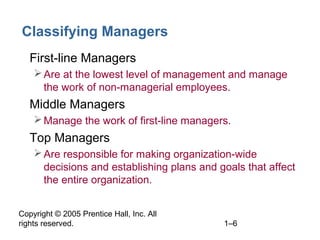
Classifying Managers
• First-line Managers
Are at the lowest level of management and manage
the work of non-managerial employees.
• Middle Managers
Manage the work of first-line managers.
• Top Managers
Are responsible for making organization-wide
decisions and establishing plans and goals that affect
the entire organization.
Copyright © 2005 Prentice Hall, Inc. All
rights reserved. 1–7
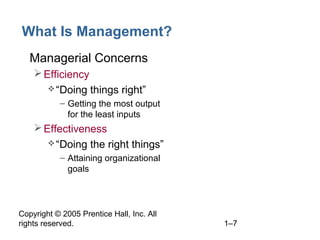
What Is Management?
• Managerial Concerns
Efficiency
“Doing things right”
– Getting the most output
for the least inputs
Effectiveness
“Doing the right things”
– Attaining organizational
goals
Copyright © 2005 Prentice Hall, Inc. All
rights reserved. 1–8
What Do Managers Do?
• Functional Approach
Planning
 Defining goals, establishing strategies to achieve goals,
developing plans to integrate and coordinate activities
Organizing
 Arranging work to accomplish organizational goals
Leading
 Working with and through people to accomplish goals.
Controlling
 Monitoring, comparing, and correcting the work
Copyright © 2005 Prentice Hall, Inc. All
rights reserved. 1–9
What Do Managers Do? (cont’d)
• Management Roles
Approach
Interpersonal roles
 Figurehead, leader, liaison
Informational roles
 Monitor, disseminator,
spokesperson
Decisional roles
 Disturbance handler,
resource allocator, negotiator
Copyright © 2005 Prentice Hall, Inc. All
rights reserved. 1–10
What Do Managers Do? (cont’d)
• Skills Approach
Technical skills
 Knowledge and proficiency in a specific field
Human skills
 The ability to work well with other people
Conceptual skills
 The ability to think and conceptualize about abstract
and complex situations concerning the organization
Copyright © 2005 Prentice Hall, Inc. All
rights reserved. 1–11
How The Manager’s Job Is Changing
• The Increasing Importance of Customers
Customers: the reason that organizations exist
 Managing customer relationships is the responsibility of
all managers and employees.
 Consistent high quality customer service is essential for
survival.
• Innovation
Doing things differently, exploring new territory, and
taking risks
 Managers should encourage employees to be aware of
and act on opportunities for innovation.
Copyright © 2005 Prentice Hall, Inc. All
rights reserved. 1–12
What Is An Organization?
• An Organization Defined
A deliberate arrangement of people to accomplish
some specific purpose
• Common Characteristics of Organizations
Have a distinct purpose (goal)
Composed of people
Have a deliberate structure
Copyright © 2005 Prentice Hall, Inc. All
rights reserved. 1–13
Why Study Management?
• The Value of Studying Management
The universality of management
 Good management is needed in all organizations.
The reality of work
 Employees either manage or are managed.
Rewards and challenges of being a manager
 Management offers challenging, exciting and creative
opportunities for meaningful and fulfilling work.
 Successful managers receive significant monetary
rewards for their efforts.

Introduction to management and organization

  • 1.
    PowerPoint Presentation byCharlie CookPowerPoint Presentation by Charlie Cook Copyright © 2005 Prentice Hall, Inc.Copyright © 2005 Prentice Hall, Inc. All rights reserved.All rights reserved. 8th edition Steven P. Robbins Mary Coulter
  • 2.
    Copyright © 2005Prentice Hall, Inc. All rights reserved. 1–2 L E A R N I N G O U T L I N E Follow this Learning Outline as you read and study this chapter. Who Are Managers? • Describe who is doing managerial work in today’s organizations. • Define who managers are. • Explain how manager differ from non-managerial employees. • Discuss how to classify managers in organizations. What Is Management? • Define management. • Contrast efficiency and effectiveness. • Explain why efficiency and effectiveness are important to management.
  • 3.
    Copyright © 2005Prentice Hall, Inc. All rights reserved. 1–3 L E A R N I N G O U T L I N E (cont’d) Follow this Learning Outline as you read and study this chapter. What Do Managers Do? • Describe the four functions of management. • Explain Mintzberg’s managerial roles. • Tell how a manager’s include reflection and action. • Describe Katz’s three essential managerial skills and how the importance of these skills changes depending on managerial level. • List other important managerial skills and competencies. • Discuss the change that are impacting managers’ jobs. • Explain why customer service and innovation are important to the manager’s job.
  • 4.
    Copyright © 2005Prentice Hall, Inc. All rights reserved. 1–4 L E A R N I N G O U T L I N E (cont’d) Follow this Learning Outline as you read and study this chapter. What Is An Organization? • Describe the characteristics of an organization. • Explain how the concept of an organization is changing. Why Study Management? • Explain the universality of management concept. • Discuss why an understanding of management is important even if you don’t plan to be a manager. • Describe the rewards and challenges of being a manager.
  • 5.
    Copyright © 2005Prentice Hall, Inc. All rights reserved. 1–5 Who Are Managers? • Manager Someone who works with and through other people by coordinating and integrating their work activities in order to accomplish organizational goals.
  • 6.
    Copyright © 2005Prentice Hall, Inc. All rights reserved. 1–6 Classifying Managers • First-line Managers Are at the lowest level of management and manage the work of non-managerial employees. • Middle Managers Manage the work of first-line managers. • Top Managers Are responsible for making organization-wide decisions and establishing plans and goals that affect the entire organization.
  • 7.
    Copyright © 2005Prentice Hall, Inc. All rights reserved. 1–7 What Is Management? • Managerial Concerns Efficiency “Doing things right” – Getting the most output for the least inputs Effectiveness “Doing the right things” – Attaining organizational goals
  • 8.
    Copyright © 2005Prentice Hall, Inc. All rights reserved. 1–8 What Do Managers Do? • Functional Approach Planning  Defining goals, establishing strategies to achieve goals, developing plans to integrate and coordinate activities Organizing  Arranging work to accomplish organizational goals Leading  Working with and through people to accomplish goals. Controlling  Monitoring, comparing, and correcting the work
  • 9.
    Copyright © 2005Prentice Hall, Inc. All rights reserved. 1–9 What Do Managers Do? (cont’d) • Management Roles Approach Interpersonal roles  Figurehead, leader, liaison Informational roles  Monitor, disseminator, spokesperson Decisional roles  Disturbance handler, resource allocator, negotiator
  • 10.
    Copyright © 2005Prentice Hall, Inc. All rights reserved. 1–10 What Do Managers Do? (cont’d) • Skills Approach Technical skills  Knowledge and proficiency in a specific field Human skills  The ability to work well with other people Conceptual skills  The ability to think and conceptualize about abstract and complex situations concerning the organization
  • 11.
    Copyright © 2005Prentice Hall, Inc. All rights reserved. 1–11 How The Manager’s Job Is Changing • The Increasing Importance of Customers Customers: the reason that organizations exist  Managing customer relationships is the responsibility of all managers and employees.  Consistent high quality customer service is essential for survival. • Innovation Doing things differently, exploring new territory, and taking risks  Managers should encourage employees to be aware of and act on opportunities for innovation.
  • 12.
    Copyright © 2005Prentice Hall, Inc. All rights reserved. 1–12 What Is An Organization? • An Organization Defined A deliberate arrangement of people to accomplish some specific purpose • Common Characteristics of Organizations Have a distinct purpose (goal) Composed of people Have a deliberate structure
  • 13.
    Copyright © 2005Prentice Hall, Inc. All rights reserved. 1–13 Why Study Management? • The Value of Studying Management The universality of management  Good management is needed in all organizations. The reality of work  Employees either manage or are managed. Rewards and challenges of being a manager  Management offers challenging, exciting and creative opportunities for meaningful and fulfilling work.  Successful managers receive significant monetary rewards for their efforts.