Copyright-Think Talent Services : not for reuse without permission 1
LEADERSHIP ASSESSMENT
Our Approach
Our Approach
Our Leadership Assessment of Senior Leaders is based on 4 Key
Elements
Copyright-Think Talent Services : not for reuse without permission 2
Judgment
Resilience
Balance
Trust
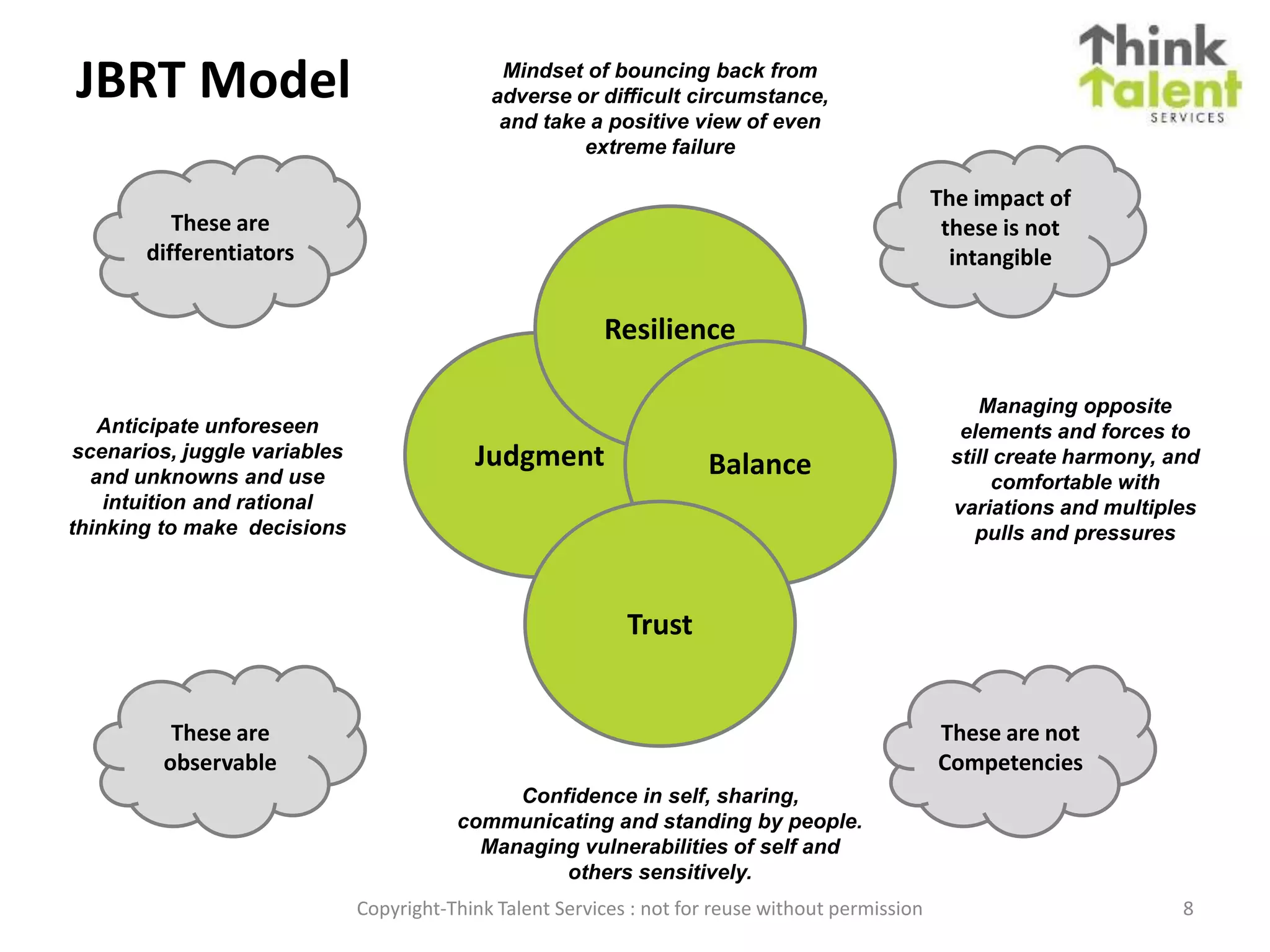
JBRT Model
3
Judgment
Resilience
Balance
Trust
Anticipate unforeseen
scenarios, juggle variables
and unknowns and use
intuition and rational
thinking to make decisions
Mindset of bouncing back from
adverse or difficult circumstance,
and take a positive view of even
extreme failure
Managing opposite
elements and forces to
still create harmony, and
comfortable with
variations and multiples
pulls and pressures
Confidence in self, sharing,
communicating and standing by people.
Managing vulnerabilities of self and
others sensitively.
These are not
Competencies
These are
observable
These are
differentiators
The impact of
these is not
intangible
Copyright-Think Talent Services : not for reuse without permission
How do we test JBRT
JBRT
Hogan Personality
Assessment
Hogan Judgement
Report
Extended Situation
Judgement Test
Behavioural Event
Interview
Copyright-Think Talent Services : not for reuse without permission 4
Our Background Research
Copyright-Think Talent Services : not for reuse without permission 5
The beginning
• The JBRT model is based on interactions (conversations) with over 3000 senior and
middle level leaders over the last ten years trying to decode:
– what elements beyond competencies make leaders successful ?
– what seem to be the underlying elements (in making great leaders who they
are) whose effect is seen and felt but the factor itself is difficult to describe,
measure and is very nebulous ?
• It is observed that these elements are not new and several past studies are
available which speak to these factors in isolation and in many different contexts.
However, this model suggests that the elements together make a significant
difference to leadership success rather than in isolation.
• We started by using a initial hypothesis - great leaders will necessarily display
futuristic skills more often and in more diverse situations - which others are
grappling with to understand and display. These appeared to be largely ‘intangible’
set of skills, and leaders seemed to have almost mastered these.
6Copyright-Think Talent Services : not for reuse without permission
The conversations
7
How leaders made decisions in a challenging and or turbulent situation?
How leaders kept their composure during an unforeseen scenario?
How leaders bounced back when they faced a set back or a tough period?
How leaders took their teams or people along, even when under stress
and/or in likely non-consensus situations ?
Copyright-Think Talent Services : not for reuse without permission
The free wheeling conversations centered around experiences of managers and
leaders about leaders they had found effective and admirable. Each respondent was
asked to discuss leader/s who they had a personal experience of. Examples and
incidents were discussed to illustrate why certain leaders were or would be more
successful. Most leaders discussed were ‘senior corporate leaders’- CEOs, MDs and
CXOs, although there was representation from the political, educational and social
spheres. Each of the respondents had worked with or engaged with (as supplier,
customer, coach etc) such leaders.
Each respondent was also asked what they saw as being ‘different’ in such leaders.
Examples that came up were often about:
Key findings
• There were of course a broad range of findings and insights –some illustrated in
later slides.
• Overall, four elements seemed to stand out (based on our understanding) and
more important, it appeared that all of them were
– A) not mutually exclusive,
– B) fed of each other, and
– C) were not really competencies in the way competencies are usually defined
but something beyond.
• The four elements are : Trust, Judgment, Balance and Resilience.
• We built our leadership model based on three insights and the four elements
• We have outlined for each of the four elements:
– observable behaviours – what people saw the leaders demonstrate and
– input competencies – what people thought the leader did to be able to demonstrate the
behaviour.
Copyright-Think Talent Services : not for reuse without permission 8
Why are some leaders significantly different?
9
89% - Leading people
86% - Strategic planning
86% - Inspiring commitment
82% - Managing change
82% - Resourcefulness
81% - Participative management
79% - Being a quick learner
79% - Employee development
77% - Doing whatever it takes
76% - Balancing personal life and work
Leadership skills required for next 5 years (a CCL study):
Copyright-Think Talent Services : not for reuse without permission
One key finding from our
conversations was that while
competency frameworks
helped in understanding some
of the intangible skills and
help improve performance in
these areas to a degree,
leaders who were really good
at these intangibles were
difficult to measure except by
way of results. The source of
the impact was not really
clear in the competency and
was difficult to define.
Why are some leaders significantly different?
10
89% - Leading people
86% - Strategic planning
86% - Inspiring commitment
82% - Managing change
82% - Resourcefulness
81% - Participative management
79% - Being a quick learner
79% - Employee development
77% - Doing whatever it takes
76% - Balancing personal life and work
Leadership skills required for next 5 years (a CCL study):
Copyright-Think Talent Services : not for reuse without permission
Our second key finding:
While competencies made
sense at early stages of
managerial and leadership
development, senior leaders
appeared to develop by virtue
of ‘sense making’ of
themselves and of their
environment; and using this
understanding to deliver
results consistently under
different conditions.
Why are some leaders significantly different?
11
89% - Leading people
86% - Strategic planning
86% - Inspiring commitment
82% - Managing change
82% - Resourcefulness
81% - Participative management
79% - Being a quick learner
79% - Employee development
77% - Doing whatever it takes
76% - Balancing personal life and work
Leadership skills required for next 5 years (a CCL study):
Copyright-Think Talent Services : not for reuse without permission
Our third key finding:
Learning and performance
went hand in hand for great
leaders. Competencies per se
were not about performance
only. The key way leadership
was evaluated to be effective
was by impact and not by
displaying a particular
competency. Stories of success
and failure were about
outcomes, and rarely were
specific characteristics the
sticking point—they came
afterwards.
12
Mumbai
1006, Atrium II,
Courtyard Marriot Hotel Compound,
Andheri Kurla Road, Mumbai
Ph: +91-9866568620
Bangalore
1568, 1st Sector, Outer Ring Road,
HSR Layout, Bangalore – 560 102
Phone: +91 80 64006888
Hyderabad
301, 2nd Floor, Vaishno Kuteer,
Puppalguda, Manikonda
Hyderabad
Phone: +91 90400 84006
Pune
704, Ruby, Niyati Empire, Kharadi, Pune
Phone: +91 7774009961
Our Coordinates
Our Website : www.thinktalentindia.com
E-mail : info@thinktalentindia.com
Corporate Office
Think Talent Services Private Limited
501, 5th Floor, Tower A
Spaze I-Tech Park, Sohna Road, Sector 49
Gurgaon,
Haryana 122018
Phone: +91-124-4201824
Copyright-Think Talent Services : not for reuse without permission

Leadership Assessment

  • 1.
    Copyright-Think Talent Services: not for reuse without permission 1 LEADERSHIP ASSESSMENT Our Approach
  • 2.
    Our Approach Our LeadershipAssessment of Senior Leaders is based on 4 Key Elements Copyright-Think Talent Services : not for reuse without permission 2 Judgment Resilience Balance Trust
  • 3.
    JBRT Model 3 Judgment Resilience Balance Trust Anticipate unforeseen scenarios,juggle variables and unknowns and use intuition and rational thinking to make decisions Mindset of bouncing back from adverse or difficult circumstance, and take a positive view of even extreme failure Managing opposite elements and forces to still create harmony, and comfortable with variations and multiples pulls and pressures Confidence in self, sharing, communicating and standing by people. Managing vulnerabilities of self and others sensitively. These are not Competencies These are observable These are differentiators The impact of these is not intangible Copyright-Think Talent Services : not for reuse without permission
  • 4.
    How do wetest JBRT JBRT Hogan Personality Assessment Hogan Judgement Report Extended Situation Judgement Test Behavioural Event Interview Copyright-Think Talent Services : not for reuse without permission 4
  • 5.
    Our Background Research Copyright-ThinkTalent Services : not for reuse without permission 5
  • 6.
    The beginning • TheJBRT model is based on interactions (conversations) with over 3000 senior and middle level leaders over the last ten years trying to decode: – what elements beyond competencies make leaders successful ? – what seem to be the underlying elements (in making great leaders who they are) whose effect is seen and felt but the factor itself is difficult to describe, measure and is very nebulous ? • It is observed that these elements are not new and several past studies are available which speak to these factors in isolation and in many different contexts. However, this model suggests that the elements together make a significant difference to leadership success rather than in isolation. • We started by using a initial hypothesis - great leaders will necessarily display futuristic skills more often and in more diverse situations - which others are grappling with to understand and display. These appeared to be largely ‘intangible’ set of skills, and leaders seemed to have almost mastered these. 6Copyright-Think Talent Services : not for reuse without permission
  • 7.
    The conversations 7 How leadersmade decisions in a challenging and or turbulent situation? How leaders kept their composure during an unforeseen scenario? How leaders bounced back when they faced a set back or a tough period? How leaders took their teams or people along, even when under stress and/or in likely non-consensus situations ? Copyright-Think Talent Services : not for reuse without permission The free wheeling conversations centered around experiences of managers and leaders about leaders they had found effective and admirable. Each respondent was asked to discuss leader/s who they had a personal experience of. Examples and incidents were discussed to illustrate why certain leaders were or would be more successful. Most leaders discussed were ‘senior corporate leaders’- CEOs, MDs and CXOs, although there was representation from the political, educational and social spheres. Each of the respondents had worked with or engaged with (as supplier, customer, coach etc) such leaders. Each respondent was also asked what they saw as being ‘different’ in such leaders. Examples that came up were often about:
  • 8.
    Key findings • Therewere of course a broad range of findings and insights –some illustrated in later slides. • Overall, four elements seemed to stand out (based on our understanding) and more important, it appeared that all of them were – A) not mutually exclusive, – B) fed of each other, and – C) were not really competencies in the way competencies are usually defined but something beyond. • The four elements are : Trust, Judgment, Balance and Resilience. • We built our leadership model based on three insights and the four elements • We have outlined for each of the four elements: – observable behaviours – what people saw the leaders demonstrate and – input competencies – what people thought the leader did to be able to demonstrate the behaviour. Copyright-Think Talent Services : not for reuse without permission 8
  • 9.
    Why are someleaders significantly different? 9 89% - Leading people 86% - Strategic planning 86% - Inspiring commitment 82% - Managing change 82% - Resourcefulness 81% - Participative management 79% - Being a quick learner 79% - Employee development 77% - Doing whatever it takes 76% - Balancing personal life and work Leadership skills required for next 5 years (a CCL study): Copyright-Think Talent Services : not for reuse without permission One key finding from our conversations was that while competency frameworks helped in understanding some of the intangible skills and help improve performance in these areas to a degree, leaders who were really good at these intangibles were difficult to measure except by way of results. The source of the impact was not really clear in the competency and was difficult to define.
  • 10.
    Why are someleaders significantly different? 10 89% - Leading people 86% - Strategic planning 86% - Inspiring commitment 82% - Managing change 82% - Resourcefulness 81% - Participative management 79% - Being a quick learner 79% - Employee development 77% - Doing whatever it takes 76% - Balancing personal life and work Leadership skills required for next 5 years (a CCL study): Copyright-Think Talent Services : not for reuse without permission Our second key finding: While competencies made sense at early stages of managerial and leadership development, senior leaders appeared to develop by virtue of ‘sense making’ of themselves and of their environment; and using this understanding to deliver results consistently under different conditions.
  • 11.
    Why are someleaders significantly different? 11 89% - Leading people 86% - Strategic planning 86% - Inspiring commitment 82% - Managing change 82% - Resourcefulness 81% - Participative management 79% - Being a quick learner 79% - Employee development 77% - Doing whatever it takes 76% - Balancing personal life and work Leadership skills required for next 5 years (a CCL study): Copyright-Think Talent Services : not for reuse without permission Our third key finding: Learning and performance went hand in hand for great leaders. Competencies per se were not about performance only. The key way leadership was evaluated to be effective was by impact and not by displaying a particular competency. Stories of success and failure were about outcomes, and rarely were specific characteristics the sticking point—they came afterwards.
  • 12.
    12 Mumbai 1006, Atrium II, CourtyardMarriot Hotel Compound, Andheri Kurla Road, Mumbai Ph: +91-9866568620 Bangalore 1568, 1st Sector, Outer Ring Road, HSR Layout, Bangalore – 560 102 Phone: +91 80 64006888 Hyderabad 301, 2nd Floor, Vaishno Kuteer, Puppalguda, Manikonda Hyderabad Phone: +91 90400 84006 Pune 704, Ruby, Niyati Empire, Kharadi, Pune Phone: +91 7774009961 Our Coordinates Our Website : www.thinktalentindia.com E-mail : info@thinktalentindia.com Corporate Office Think Talent Services Private Limited 501, 5th Floor, Tower A Spaze I-Tech Park, Sohna Road, Sector 49 Gurgaon, Haryana 122018 Phone: +91-124-4201824 Copyright-Think Talent Services : not for reuse without permission