HR SCORECARD
Contents
▧ What is HR Scorecard
▧ Structure of HR Scorecard
▧ Approach to HR Scorecard
▧ Constituents of Scorecard
▧ Benefits of HR Scorecard
▧ Practical Applications of HR Scorecard
2
1. What is
Human Resource Scorecard
▧ It illustrates most important actions performed by
HR dept. including its achievements, productivity,
etc.
▧ Crucial tool to be ready and prepared to face
future changes in organization.
3
2.
Structure of HR Scorecard
4
5
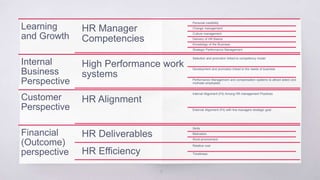
Learning
and Growth
HR Manager
Competencies
Personal credibility
Change management
Culture management
Delivery of HR Basics
Knowledge of the Business
Strategic Performance Management
Internal
Business
Perspective
High Performance work
systems
Selection and promotion linked to competency model
Development and promotion linked to the needs of business
Performance Management and compensation systems to attract select and
motivate employees
Customer
Perspective
HR Alignment
Internal Alignment (Fit) Among HR management Practices
External Alignment (Fit) with line managers strategic goal
Financial
(Outcome)
perspective
HR Deliverables
Skills
Motivation
Work environment
HR Efficiency
Relative cost
Timeliness
3.
How to HR Approach HR
Scorecard
Process of building an HR Scorecard
6
Process of building an HR Scorecard
▧ Step 1: Discover the chief performance drivers of the R&D
unit. productivity improvement and revenue growth.
▧ Step 2: Understand the role played by the HR in the
discovered drivers those can be the deliverables needed to
aid the drivers.
▧ Step 3: Categorise elements that need to be gathered to
create the defined deliverables.
▧ Step 4: Chose metrics to access the development towards
presenting the deliverables that have been categorised.
▧ Step 5: Plan visual cues and icons that show how
performance has been assessed on every metrics.
7
“
An HR Scorecard is a mechanism for
describing and measuring how people and
people managemnet systems create value in
organizations, as well as communicating key
organizational objectives to the workforce.
8
4.
Constituents of HR Scorecard
Process of building an HR Scorecard
9
The constituents of HR Scorecards are:
▧ Workforce Success
▧ Right HR Costs
▧ Right Types of HR Alignment
▧ Right HR Practices
▧ Right HR Professionals
10
5.
Benefits of HR Scorecard
11
Below mentioned are the different benefits of HR
Scorecard
1)It emphasises on the difference between the HR Deliverables
and HR Doables
2)Creates value and control cost
3)Measure top indictors
4)Evaluation of the contribution of HR in “Bottom line” and
strategy implementation
5)Allows HR Managers to manage their strategic responsibilities
effectively
6)Encourages change and flexibility
12
PRACTICAL APPLICATIONS
13
Below mentioned are the practical applications of HR
Scorecard:
1.Hiring effectiveness
2.Turnover
3.Outcomes of training
4.Benefit cost
14
Thanks!
Any questions?
@SushmaPPetkar @HarishMN
15

HR Scorecard

  • 1.
  • 2.
    Contents ▧ What isHR Scorecard ▧ Structure of HR Scorecard ▧ Approach to HR Scorecard ▧ Constituents of Scorecard ▧ Benefits of HR Scorecard ▧ Practical Applications of HR Scorecard 2
  • 3.
    1. What is HumanResource Scorecard ▧ It illustrates most important actions performed by HR dept. including its achievements, productivity, etc. ▧ Crucial tool to be ready and prepared to face future changes in organization. 3
  • 4.
    2. Structure of HRScorecard 4
  • 5.
    5 Learning and Growth HR Manager Competencies Personalcredibility Change management Culture management Delivery of HR Basics Knowledge of the Business Strategic Performance Management Internal Business Perspective High Performance work systems Selection and promotion linked to competency model Development and promotion linked to the needs of business Performance Management and compensation systems to attract select and motivate employees Customer Perspective HR Alignment Internal Alignment (Fit) Among HR management Practices External Alignment (Fit) with line managers strategic goal Financial (Outcome) perspective HR Deliverables Skills Motivation Work environment HR Efficiency Relative cost Timeliness
  • 6.
    3. How to HRApproach HR Scorecard Process of building an HR Scorecard 6
  • 7.
    Process of buildingan HR Scorecard ▧ Step 1: Discover the chief performance drivers of the R&D unit. productivity improvement and revenue growth. ▧ Step 2: Understand the role played by the HR in the discovered drivers those can be the deliverables needed to aid the drivers. ▧ Step 3: Categorise elements that need to be gathered to create the defined deliverables. ▧ Step 4: Chose metrics to access the development towards presenting the deliverables that have been categorised. ▧ Step 5: Plan visual cues and icons that show how performance has been assessed on every metrics. 7
  • 8.
    “ An HR Scorecardis a mechanism for describing and measuring how people and people managemnet systems create value in organizations, as well as communicating key organizational objectives to the workforce. 8
  • 9.
    4. Constituents of HRScorecard Process of building an HR Scorecard 9
  • 10.
    The constituents ofHR Scorecards are: ▧ Workforce Success ▧ Right HR Costs ▧ Right Types of HR Alignment ▧ Right HR Practices ▧ Right HR Professionals 10
  • 11.
    5. Benefits of HRScorecard 11
  • 12.
    Below mentioned arethe different benefits of HR Scorecard 1)It emphasises on the difference between the HR Deliverables and HR Doables 2)Creates value and control cost 3)Measure top indictors 4)Evaluation of the contribution of HR in “Bottom line” and strategy implementation 5)Allows HR Managers to manage their strategic responsibilities effectively 6)Encourages change and flexibility 12
  • 13.
  • 14.
    Below mentioned arethe practical applications of HR Scorecard: 1.Hiring effectiveness 2.Turnover 3.Outcomes of training 4.Benefit cost 14
  • 15.

Editor's Notes

  • #4 HR Scorecard illustrates the most important actions performed by the human resource department including its achievements, productivity, etc. HR Scorecard can also be stated as a procedure by which the non-financial, as well as the financial targets or metrics, are assigned to the HRM related activities group which are needed to accomplish organizational strategic goals and monitor results. For organization, HR Scorecard development is continuous process. It is crucial for the HR professionals to keep themselves ready and prepared in order to face changes within organization.
  • #6 Financial (Outcome) perspective HR Deliverables Skills motivation work environment HR Efficiency Relative cost timeliness Customer Perspective HR Alignment Internal Alignment (Fit) Among HR management Practices External Alignment (Fit) with line managers strategic goals Internal Business Perspective High Performance work systems Selection and promotion linked to competency model Development and promotion linked to the needs of business Performance Management and compensation systems to attract select and motivate employees Learning and Growth HR Manager Competencies Personal credibility Change management Culture management Delivery of HR Basics Knowledge of the Business Strategic Performance Management
  • #8 While building an HR Scorecard, the below mentioned process needs to be followed by every unit of the organization Step 1: Discover the chief performance drivers of the R&D unit. They might be productivity improvement and revenue growth. Step 2: Understand the role played by the HR in the discovered drivers those can be the deliverables needed to aid the drivers. Example: When HR reduces requirement cycle time, it supports a high talent and stable staff. This subsequently support delivery schedules that are reliable, and thus growth in revenue. Step 3: Categorise elements that need to be gathered to create the defined deliverables. Thus, elements can be validated competency models, retains policies that result in an experienced R&D unit and performance appraisals on a regular basis. Step 4: Chose metrics to access the development towards presenting the deliverables that have been categorised. Also, identify each metrics target performance. Step 5: Plan visual cues and icons that show how performance has been assessed on every metrics. Example: A red circle depicts “Unsatisfactory”, a yellow on depicts “cause for concern” and green indicating “Satisfactory”. These signs make it easier for managers to find the performances that have fallen below the target performance of the metric. Such visual icons also help people to identify when the target performance will be meet or will exceed the actual performance.
  • #11 The constituents of HR Scorecards are: The first element is what we call workforce success. It asks: has the workforce accomplished their key strategic objectives for the business? The second element is we called Right HR costs. It asks: is our total investment in the workforce (not just the HR Function) appropriate (not just minimized)? The third element we describe as right types of HR alignment. It asks: are our HR Practices aligned with the business strategy and differentiated across positions, where appropriate? The fourth element is right HR practices. Its asks: have we designed and implemented world class HR management policies and practices throughout the business? The fifth element is right HR professionals. Its asks: do our HR professionals have the skills they need to design and implement world class HR management system?
  • #13 Below mentioned are the different benefits of HR Scorecard It emphasises on the difference between the HR Deliverables and HR Doables: The HR measurement system should be such that it differentiates between deliverables that impact the implementation of the strategy and doables that do not. Example: Policy implementation becomes a deliverable only when it develops a employee behaviour that coerces implementation of strategy. An effective HR measurement system is one that pushes HR professionals to constantly think operationally as well as strategically. Creates value and controls cost: The management expects HR to control the firms cost. In addition to this, the HR also serves in a strategic role and so they are expected to create value too. With help of HR Scorecard, HR managers can balance both the objectives effectively. Along with encouraging the practitioners to do away with the cost where possible, it also helps them in defending investment by demarking the possible benefits effectively. Measure top indictors: this model of the strategic contribution of HRs links their HR Systems and decisions to HR deliverables. This will also impact the top performance drivers in implementing the firms strategy. Evaluation of the contribution of HR in “Bottom line” and strategy implementation. Allows HR Managers to manage their strategic responsibilities effectively. Encourages change and flexibility
  • #15 Below mentioned are the practical applications of HR Scorecard: Hiring effectiveness Turnover Outcomes of training Benefit cost