
The Extraordinary Leader Turning  Good Managers  into Great Leaders Presented by Jack Zenger and Joe Folkman
The Extraordinary Leader Research  The last two years were spent researching the impact of leadership performance and the key behaviors that make great leadership possible The source of our insight – hundreds of thousands of 360 assessments done over the past 10 years Our approach – lead with the data The result – New insights that fundamentally change our philosophy and approach
Insight 1 Great Leaders Make a Great Difference.
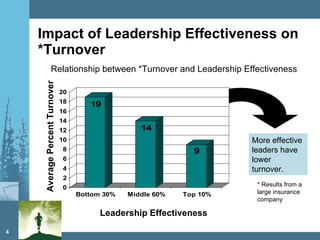
Impact of Leadership Effectiveness on *Turnover More effective leaders have lower turnover. Relationship between *Turnover and Leadership Effectiveness Average Percent Turnover Leadership Effectiveness * Results from a large insurance company
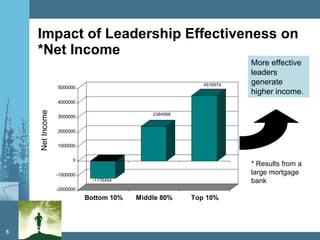
Impact of Leadership Effectiveness on  *Net Income Net Income More effective leaders generate higher income.  * Results from a large mortgage bank
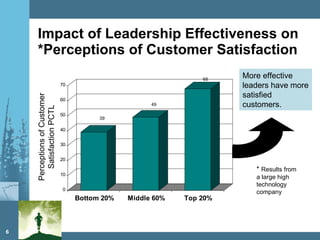
Impact of Leadership Effectiveness on *Perceptions of Customer Satisfaction Perceptions of Customer Satisfaction PCTL More effective leaders have more satisfied customers. *  Results from a large high technology company
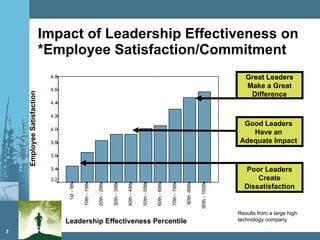
Impact of Leadership Effectiveness on *Employee Satisfaction/Commitment Results from a large high technology company Leadership Effectiveness Percentile Employee Satisfaction 90th - 100th 80th -89th 70th - 79th 60th - 69th 50th - 59th 40th - 49th 30th - 39th 20th - 29th 10th - 19th 1st - 9th 4.8 4.6 4.4 4.2 4.0 3.8 3.6 3.4 3.2 Poor Leaders Create Dissatisfaction Good Leaders  Have an  Adequate Impact  Great Leaders Make a Great Difference
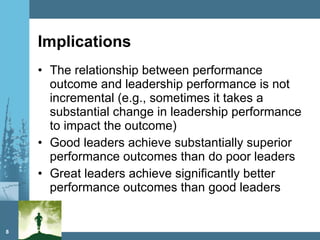
Implications The relationship between performance outcome and leadership performance is not incremental (e.g., sometimes it takes a substantial change in leadership performance to impact the outcome) Good leaders achieve substantially superior performance outcomes than do poor leaders Great leaders achieve significantly better performance outcomes than good leaders
Insight 2 Current approaches to development primarily focus on fixing weaknesses
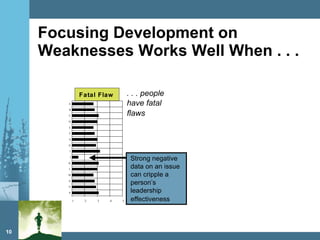
Focusing Development on Weaknesses Works Well When . . . Fatal Flaw  1 2 3 4 5 P O N M L K J I H G F E D C B A . . . people  have fatal  flaws Strong negative  data on an issue  can cripple a  person’s  leadership  effectiveness
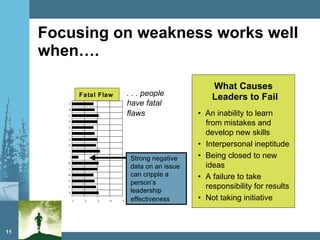
Focusing on weakness works well when…. Fatal Flaw  . . . people  have fatal  flaws Strong negative  data on an issue  can cripple a  person’s  leadership  effectiveness 1 2 3 4 5 P O N M L K J I H G F E D C B A What Causes  Leaders to Fail • An inability to learn  from mistakes and  develop new skills  • Interpersonal ineptitude • Being closed to new  ideas • A failure to take  responsibility for results • Not taking initiative
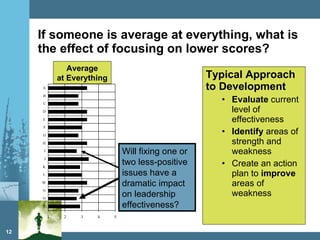
If someone is average at everything, what is the effect of focusing on lower scores? Typical Approach to Development Evaluate  current level of effectiveness Identify  areas of strength and weakness Create an action plan to  improve  areas of weakness Average at Everything Will fixing one or two less-positive issues have a dramatic impact on leadership effectiveness?
What Does Performance Improvement Mean to Most People? This philosophy for improvement is reinforced by: Educational experience Performance management approaches Culture Fixing Weaknesses
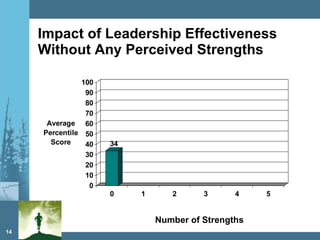
Impact of Leadership Effectiveness Without Any Perceived Strengths  Number of Strengths
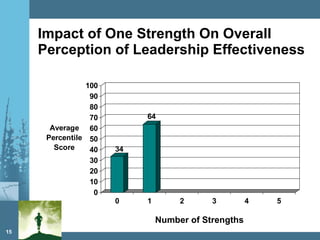
Impact of One Strength On Overall Perception of Leadership Effectiveness  Number of Strengths
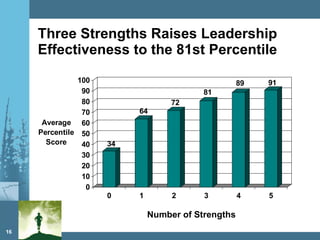
Three Strengths Raises Leadership Effectiveness to the 81st Percentile  Number of Strengths
Insight 3 Powerful Combinations
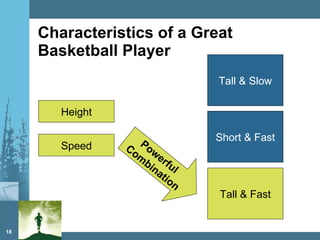
Characteristics of a Great Basketball Player Height Speed Tall & Slow Tall & Fast Short & Fast Powerful  Combination
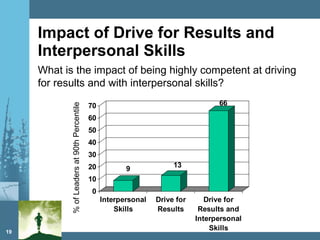
Impact of Drive for Results and Interpersonal Skills % of Leaders at 90th Percentile What is the impact of being highly competent at driving for results and with interpersonal skills?
Insight 4 Not all behaviors are created equal – some are more noticeable and leverage more improvement than others
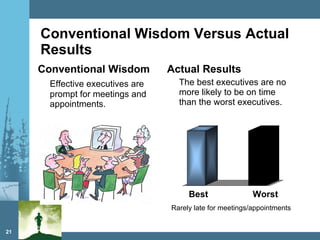
Conventional Wisdom Versus Actual Results Conventional Wisdom Effective executives are prompt for meetings and appointments. Actual Results The best executives are no more likely to be on time than the worst executives. Rarely late for meetings/appointments Best Worst
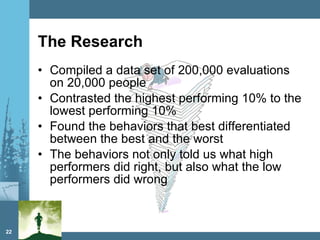
The Research Compiled a data set of 200,000 evaluations on 20,000 people Contrasted the highest performing 10% to the lowest performing 10% Found the behaviors that best differentiated between the best and the worst The behaviors not only told us what high performers did right, but also what the low performers did wrong
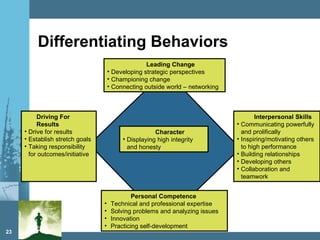
Differentiating Behaviors Leading Change Developing strategic perspectives  Championing change  Connecting outside world  –  networking Character Displaying high integrity and honesty Interpersonal Skills Communicating powerfully and prolifically Inspiring/motivating others to high performance  Building relationships Developing others Collaboration and teamwork  Driving For Results Drive for results  Establish stretch goals Taking responsibility for outcomes/initiative Personal Competence  Technical and professional expertise Solving problems and analyzing issues Innovation Practicing self-development
Insight 5 The non-linear approach to development may be the most helpful way to develop strengths
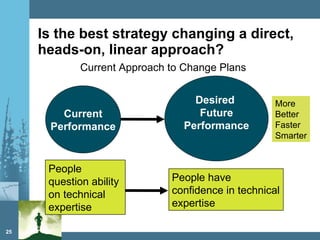
Is the best strategy changing a direct, heads-on, linear approach? Current Approach to Change Plans  Current Performance People question ability on technical expertise Desired  Future Performance People have confidence in technical expertise More Better Faster Smarter
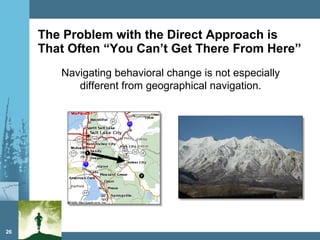
The Problem with the Direct Approach is That Often “You Can’t Get There From Here”  Navigating behavioral change is not especially different from geographical navigation.
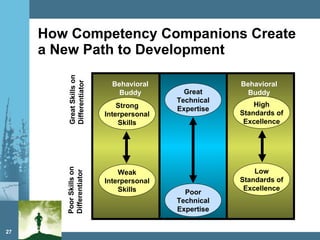
How Competency Companions Create a New Path to Development Great Skills on Differentiator Poor Skills on Differentiator Differentiator Great Technical Expertise Poor Technical Expertise Strong Interpersonal Skills Weak Interpersonal Skills Behavioral Buddy High Standards of Excellence Low Standards of Excellence Behavioral Buddy
How Do You Build Trust? Competency Companions Considerate of others Open, friendly style Non-competitive internally Listen Use candor
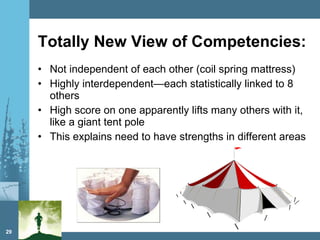
Totally New View of Competencies: Not independent of each other (coil spring mattress) Highly interdependent—each statistically linked to 8 others High score on one apparently lifts many others with it, like a giant tent pole This explains need to have strengths in different areas
Insight 6 Change Requires Practice
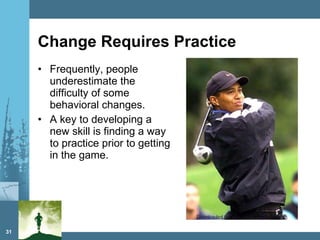
Change Requires Practice Frequently, people underestimate the difficulty of some behavioral changes. A key to developing a new skill is finding a way to practice prior to getting in the game.
Summary Effective leadership can impact bottom line results Good leaders achieve more than poor leaders but great leaders can produce a 2X impact on many outcomes If you have a fatal flaw, fix it Building leadership strengths will substantially influence the perception of leadership effectiveness Not all behaviors are created equal – some are more noticeable than others Non-linear development is a new approach to change that provides a unique path to developing strengths To become extraordinary, leaders must practice leadership

Extraordinary leadership

  • 1.
    The Extraordinary LeaderTurning Good Managers into Great Leaders Presented by Jack Zenger and Joe Folkman
  • 2.
    The Extraordinary LeaderResearch The last two years were spent researching the impact of leadership performance and the key behaviors that make great leadership possible The source of our insight – hundreds of thousands of 360 assessments done over the past 10 years Our approach – lead with the data The result – New insights that fundamentally change our philosophy and approach
  • 3.
    Insight 1 GreatLeaders Make a Great Difference.
  • 4.
    Impact of LeadershipEffectiveness on *Turnover More effective leaders have lower turnover. Relationship between *Turnover and Leadership Effectiveness Average Percent Turnover Leadership Effectiveness * Results from a large insurance company
  • 5.
    Impact of LeadershipEffectiveness on *Net Income Net Income More effective leaders generate higher income. * Results from a large mortgage bank
  • 6.
    Impact of LeadershipEffectiveness on *Perceptions of Customer Satisfaction Perceptions of Customer Satisfaction PCTL More effective leaders have more satisfied customers. * Results from a large high technology company
  • 7.
    Impact of LeadershipEffectiveness on *Employee Satisfaction/Commitment Results from a large high technology company Leadership Effectiveness Percentile Employee Satisfaction 90th - 100th 80th -89th 70th - 79th 60th - 69th 50th - 59th 40th - 49th 30th - 39th 20th - 29th 10th - 19th 1st - 9th 4.8 4.6 4.4 4.2 4.0 3.8 3.6 3.4 3.2 Poor Leaders Create Dissatisfaction Good Leaders Have an Adequate Impact Great Leaders Make a Great Difference
  • 8.
    Implications The relationshipbetween performance outcome and leadership performance is not incremental (e.g., sometimes it takes a substantial change in leadership performance to impact the outcome) Good leaders achieve substantially superior performance outcomes than do poor leaders Great leaders achieve significantly better performance outcomes than good leaders
  • 9.
    Insight 2 Currentapproaches to development primarily focus on fixing weaknesses
  • 10.
    Focusing Development onWeaknesses Works Well When . . . Fatal Flaw 1 2 3 4 5 P O N M L K J I H G F E D C B A . . . people have fatal flaws Strong negative data on an issue can cripple a person’s leadership effectiveness
  • 11.
    Focusing on weaknessworks well when…. Fatal Flaw . . . people have fatal flaws Strong negative data on an issue can cripple a person’s leadership effectiveness 1 2 3 4 5 P O N M L K J I H G F E D C B A What Causes Leaders to Fail • An inability to learn from mistakes and develop new skills • Interpersonal ineptitude • Being closed to new ideas • A failure to take responsibility for results • Not taking initiative
  • 12.
    If someone isaverage at everything, what is the effect of focusing on lower scores? Typical Approach to Development Evaluate current level of effectiveness Identify areas of strength and weakness Create an action plan to improve areas of weakness Average at Everything Will fixing one or two less-positive issues have a dramatic impact on leadership effectiveness?
  • 13.
    What Does PerformanceImprovement Mean to Most People? This philosophy for improvement is reinforced by: Educational experience Performance management approaches Culture Fixing Weaknesses
  • 14.
    Impact of LeadershipEffectiveness Without Any Perceived Strengths Number of Strengths
  • 15.
    Impact of OneStrength On Overall Perception of Leadership Effectiveness Number of Strengths
  • 16.
    Three Strengths RaisesLeadership Effectiveness to the 81st Percentile Number of Strengths
  • 17.
    Insight 3 PowerfulCombinations
  • 18.
    Characteristics of aGreat Basketball Player Height Speed Tall & Slow Tall & Fast Short & Fast Powerful Combination
  • 19.
    Impact of Drivefor Results and Interpersonal Skills % of Leaders at 90th Percentile What is the impact of being highly competent at driving for results and with interpersonal skills?
  • 20.
    Insight 4 Notall behaviors are created equal – some are more noticeable and leverage more improvement than others
  • 21.
    Conventional Wisdom VersusActual Results Conventional Wisdom Effective executives are prompt for meetings and appointments. Actual Results The best executives are no more likely to be on time than the worst executives. Rarely late for meetings/appointments Best Worst
  • 22.
    The Research Compileda data set of 200,000 evaluations on 20,000 people Contrasted the highest performing 10% to the lowest performing 10% Found the behaviors that best differentiated between the best and the worst The behaviors not only told us what high performers did right, but also what the low performers did wrong
  • 23.
    Differentiating Behaviors LeadingChange Developing strategic perspectives Championing change Connecting outside world – networking Character Displaying high integrity and honesty Interpersonal Skills Communicating powerfully and prolifically Inspiring/motivating others to high performance Building relationships Developing others Collaboration and teamwork Driving For Results Drive for results Establish stretch goals Taking responsibility for outcomes/initiative Personal Competence Technical and professional expertise Solving problems and analyzing issues Innovation Practicing self-development
  • 24.
    Insight 5 Thenon-linear approach to development may be the most helpful way to develop strengths
  • 25.
    Is the beststrategy changing a direct, heads-on, linear approach? Current Approach to Change Plans Current Performance People question ability on technical expertise Desired Future Performance People have confidence in technical expertise More Better Faster Smarter
  • 26.
    The Problem withthe Direct Approach is That Often “You Can’t Get There From Here” Navigating behavioral change is not especially different from geographical navigation.
  • 27.
    How Competency CompanionsCreate a New Path to Development Great Skills on Differentiator Poor Skills on Differentiator Differentiator Great Technical Expertise Poor Technical Expertise Strong Interpersonal Skills Weak Interpersonal Skills Behavioral Buddy High Standards of Excellence Low Standards of Excellence Behavioral Buddy
  • 28.
    How Do YouBuild Trust? Competency Companions Considerate of others Open, friendly style Non-competitive internally Listen Use candor
  • 29.
    Totally New Viewof Competencies: Not independent of each other (coil spring mattress) Highly interdependent—each statistically linked to 8 others High score on one apparently lifts many others with it, like a giant tent pole This explains need to have strengths in different areas
  • 30.
    Insight 6 ChangeRequires Practice
  • 31.
    Change Requires PracticeFrequently, people underestimate the difficulty of some behavioral changes. A key to developing a new skill is finding a way to practice prior to getting in the game.
  • 32.
    Summary Effective leadershipcan impact bottom line results Good leaders achieve more than poor leaders but great leaders can produce a 2X impact on many outcomes If you have a fatal flaw, fix it Building leadership strengths will substantially influence the perception of leadership effectiveness Not all behaviors are created equal – some are more noticeable than others Non-linear development is a new approach to change that provides a unique path to developing strengths To become extraordinary, leaders must practice leadership