Managing Leadership Talent Tim Coburn Flourish Ltd Visiting Fellow at Nottingham Business School International Centre for Talent Management and Development February 2009
What to expect Responsible for talent? This is for you Practical tools and things that work Use it to check what you’re doing
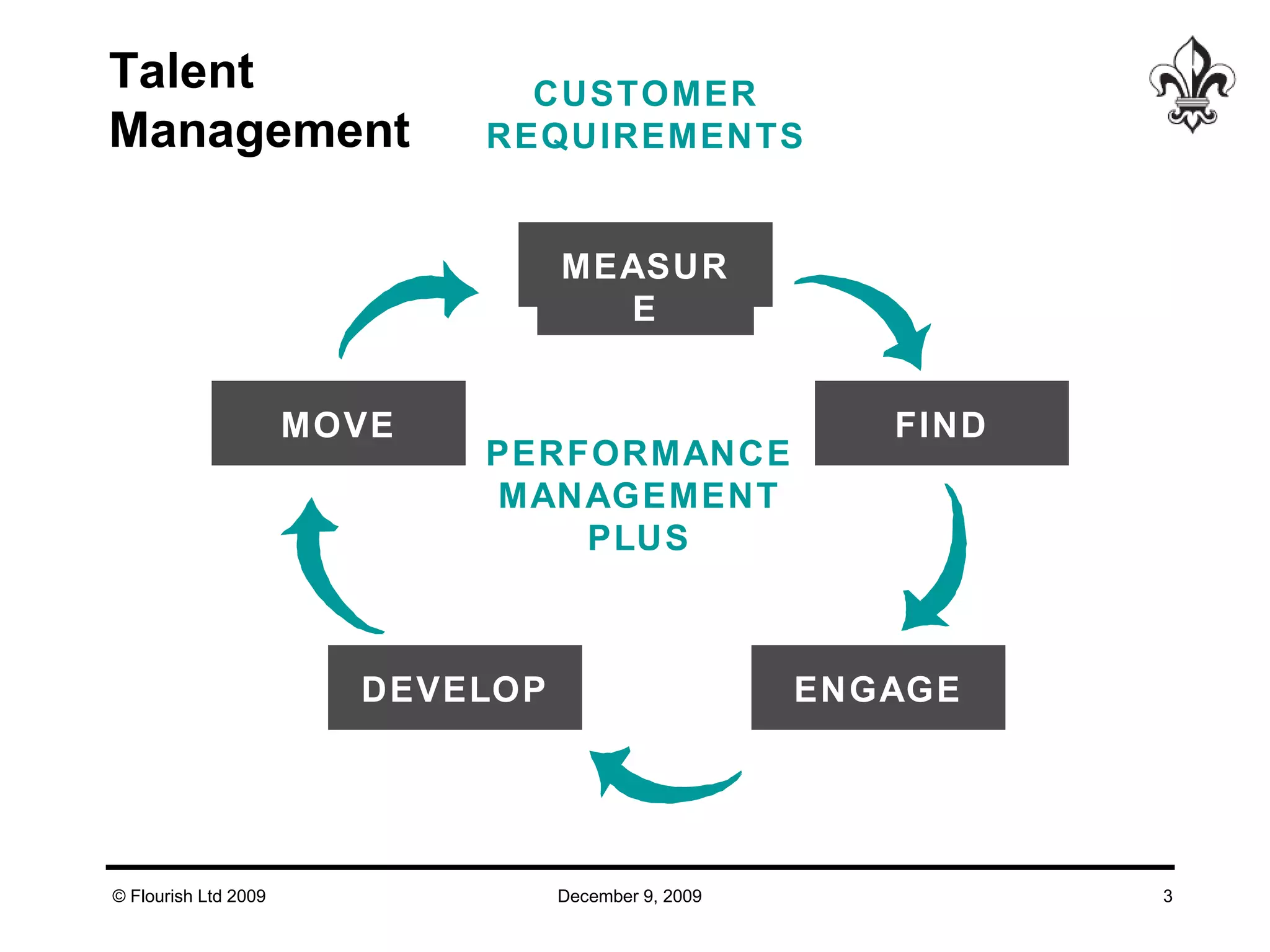
STRATEGIC DECISIONS FIND CUSTOMER REQUIREMENTS PERFORMANCE MANAGEMENT PLUS ENGAGE DEVELOP MOVE MEASURE Talent Management
Start here Who is your customer? What is on their mind? What do they need from you? How will they measure your success?
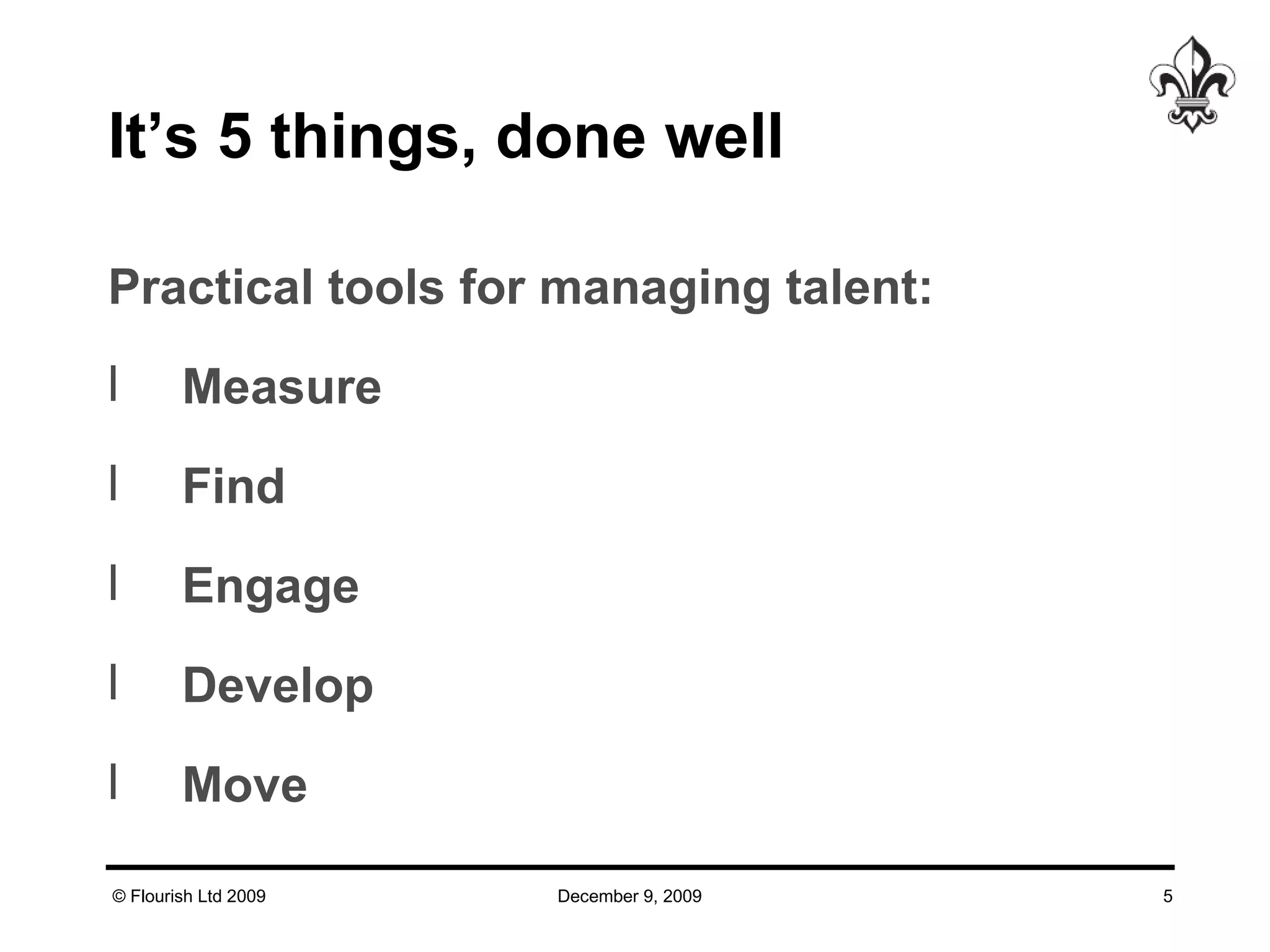
It’s 5 things, done well Practical tools for managing talent: Measure  Find Engage  Develop Move
Measure
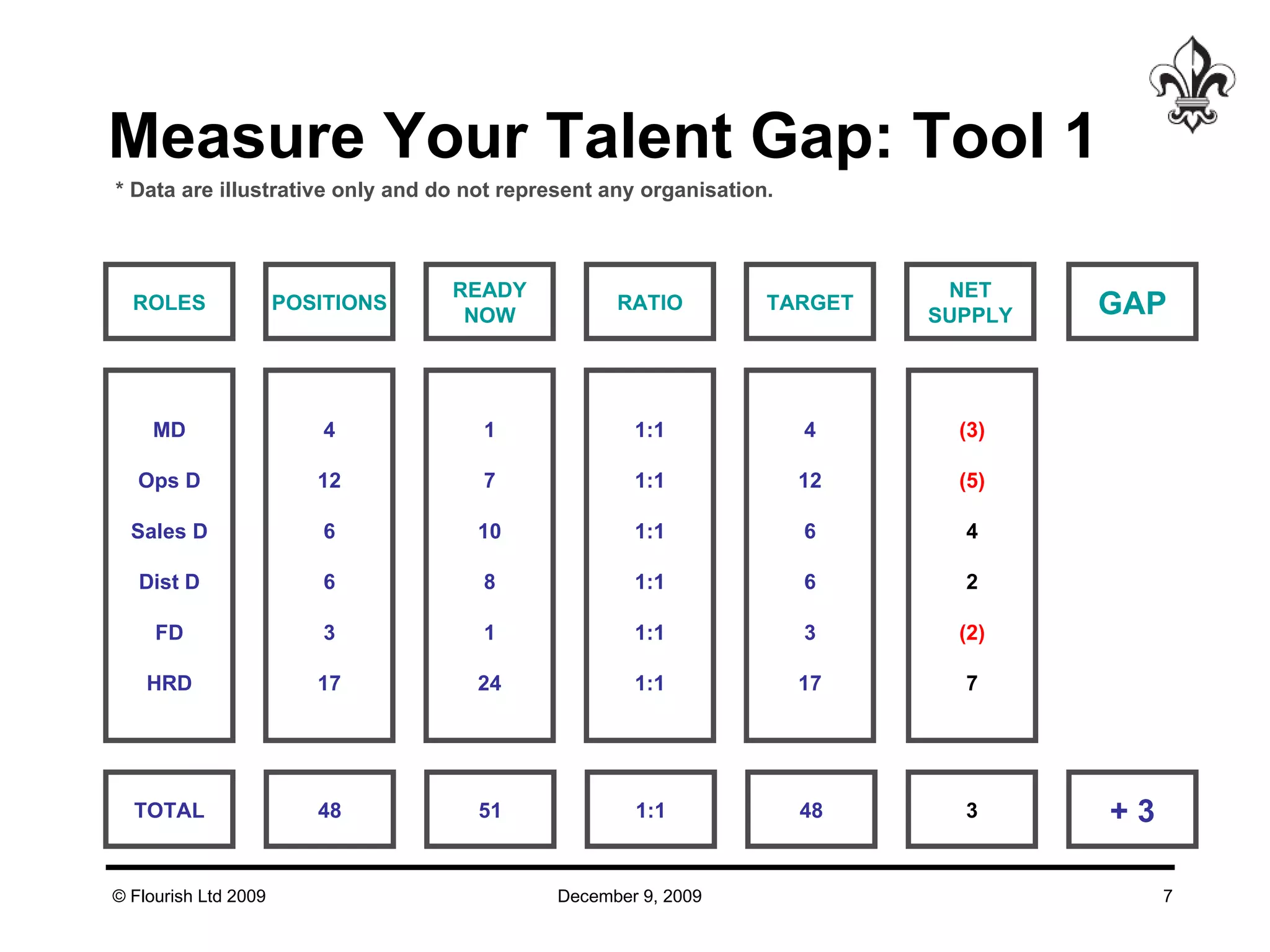
Measure Your Talent Gap: Tool 1 * Data are illustrative only and do not represent any organisation. ROLES MD Ops D Sales D Dist D FD HRD POSITIONS 4 12 6 6 3 17 READY NOW 1 7 10 8 1 24 RATIO 1:1 1:1 1:1 1:1 1:1 1:1 TARGET 4 12 6 6 3 17 NET SUPPLY (3) (5) 4 2 (2) 7 TOTAL 48 51 1:1 48 3 GAP + 3
Review Advantages? Limitations?
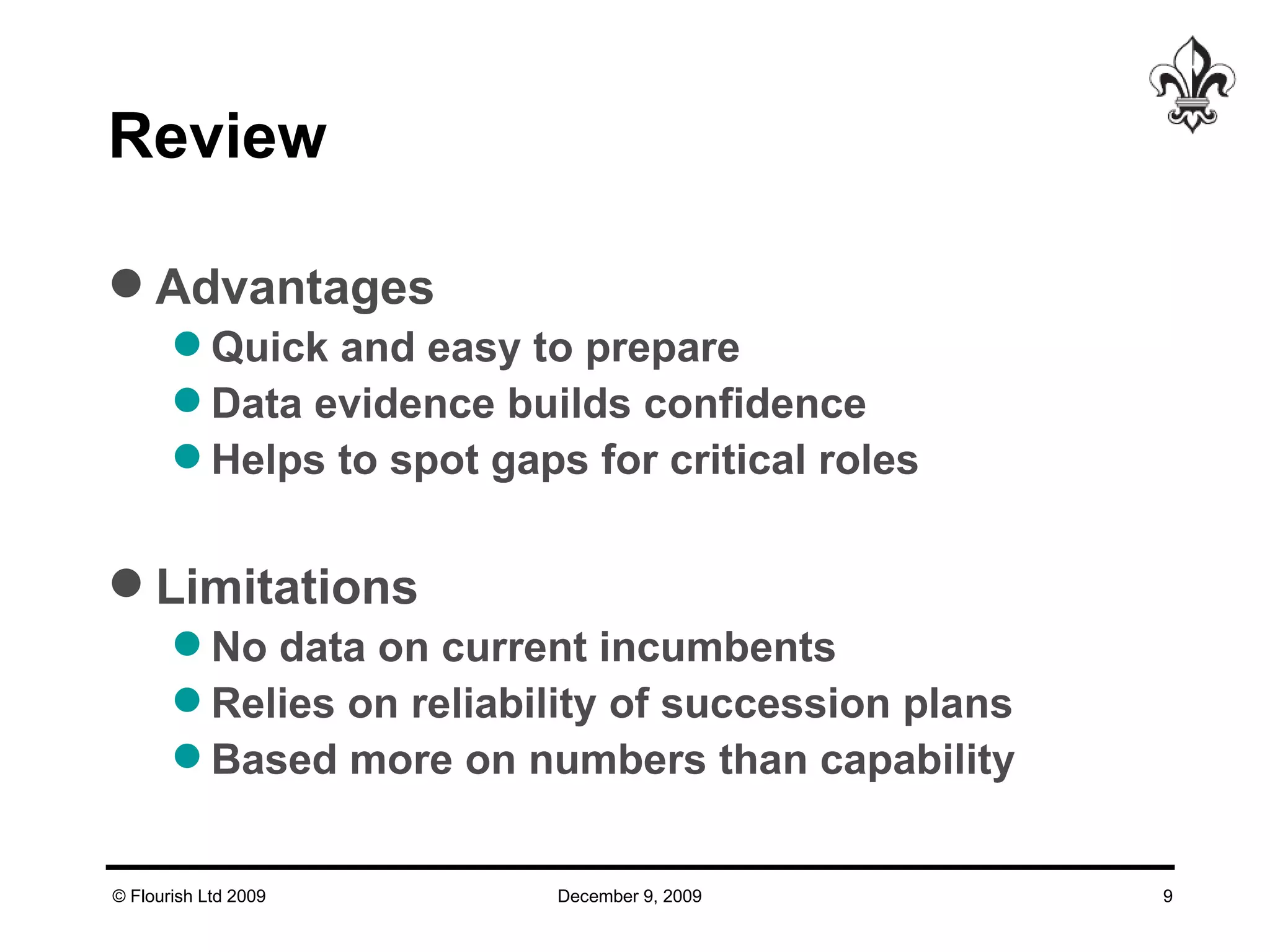
Review Advantages Quick and easy to prepare  Data evidence builds confidence Helps to spot gaps for critical roles Limitations No data on current incumbents Relies on reliability of succession plans Based more on numbers than capability
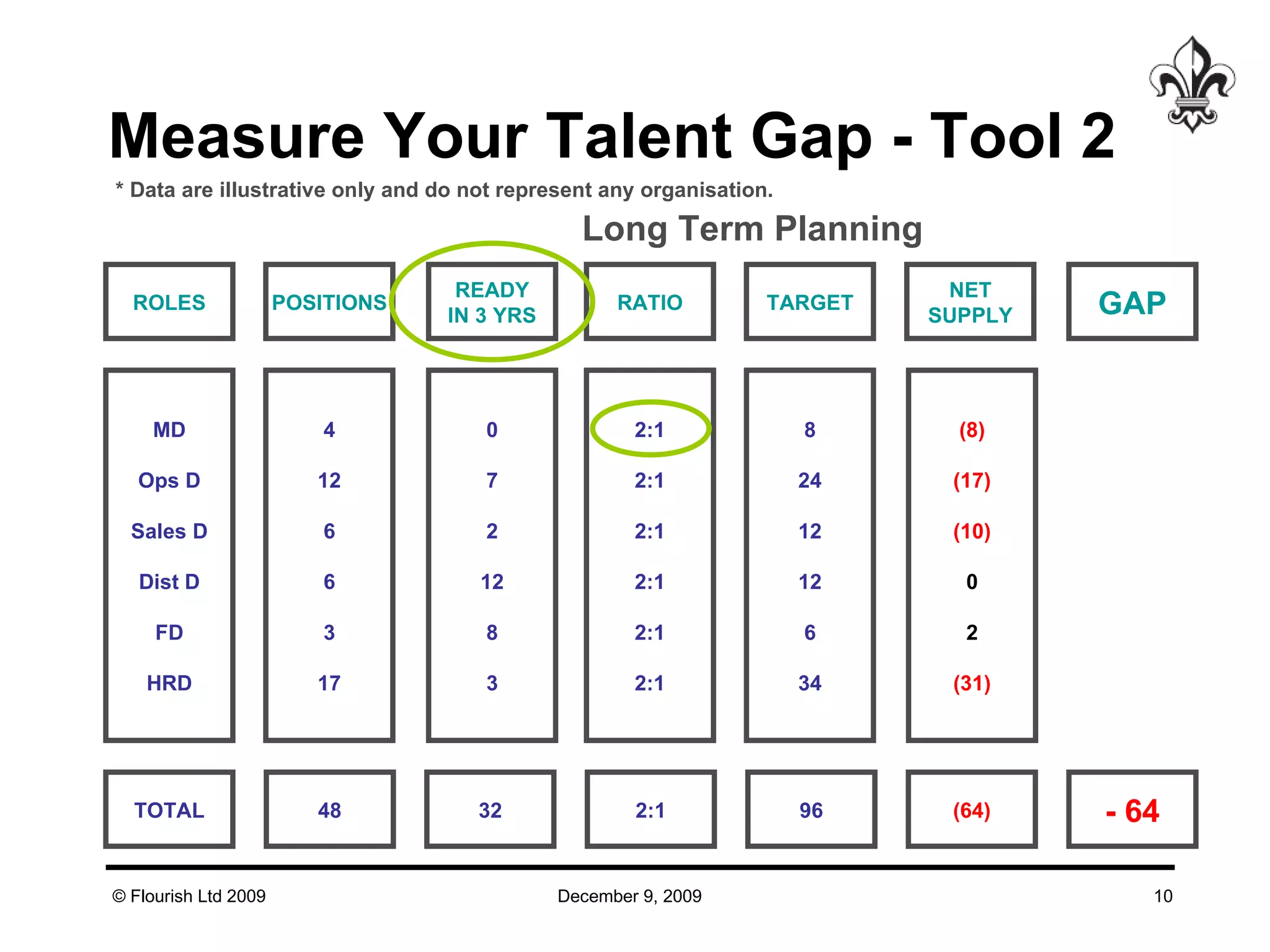
Measure Your Talent Gap - Tool 2 * Data are illustrative only and do not represent any organisation. ROLES MD Ops D Sales D Dist D FD HRD POSITIONS 4 12 6 6 3 17 READY IN 3 YRS 0 7 2 12 8 3 RATIO 2:1 2:1 2:1 2:1 2:1 2:1 TARGET 8 24 12 12 6 34 NET SUPPLY (8) (17) (10) 0 2 (31) TOTAL 48 32 2:1 96 (64) GAP - 64 Long Term Planning
Review Additional Advantages? Additional Limitations?
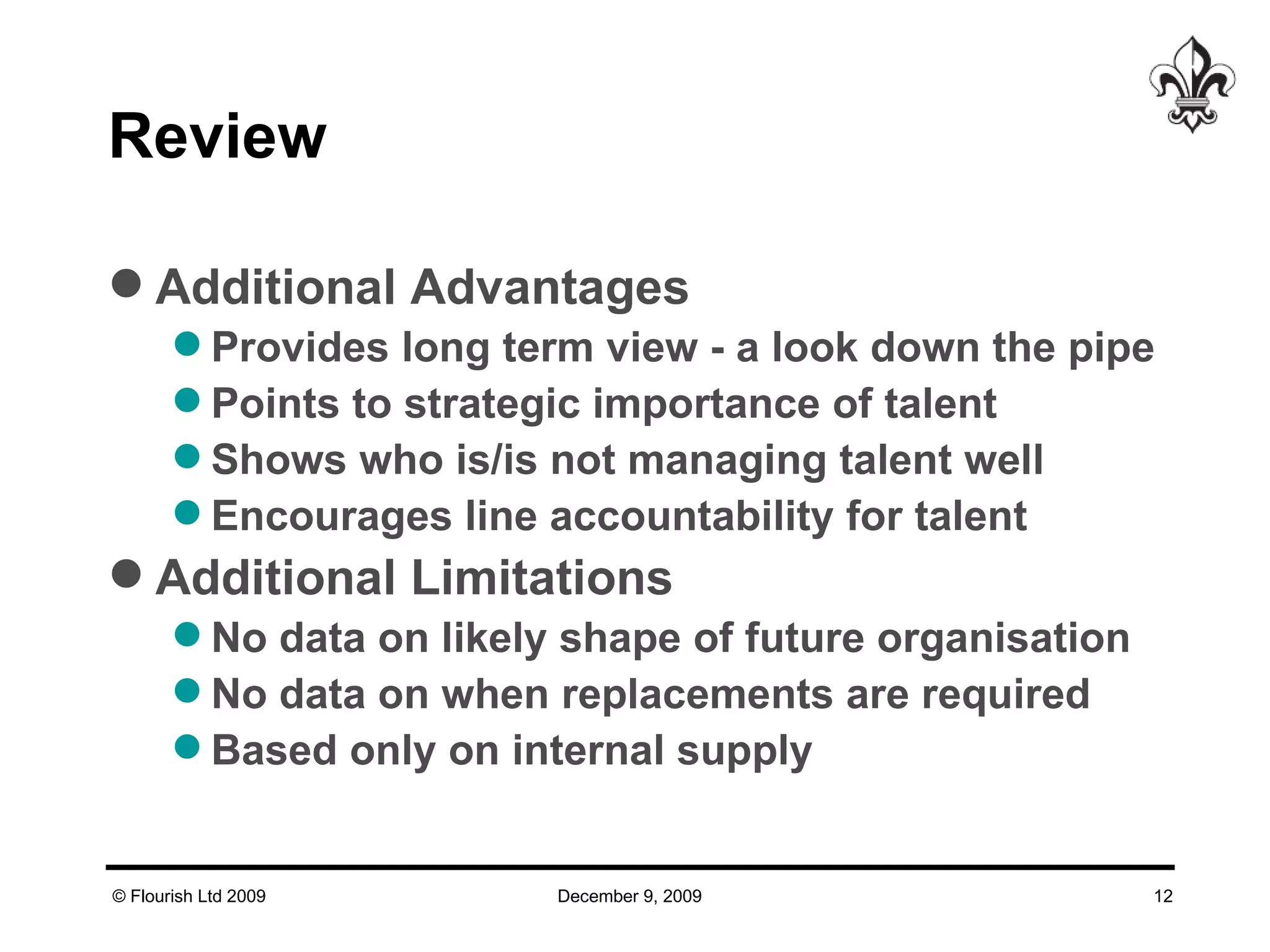
Review  Additional Advantages Provides long term view - a look down the pipe Points to strategic importance of talent Shows who is/is not managing talent well Encourages line accountability for talent Additional Limitations No data on likely shape of future organisation No data on when replacements are required Based only on internal supply
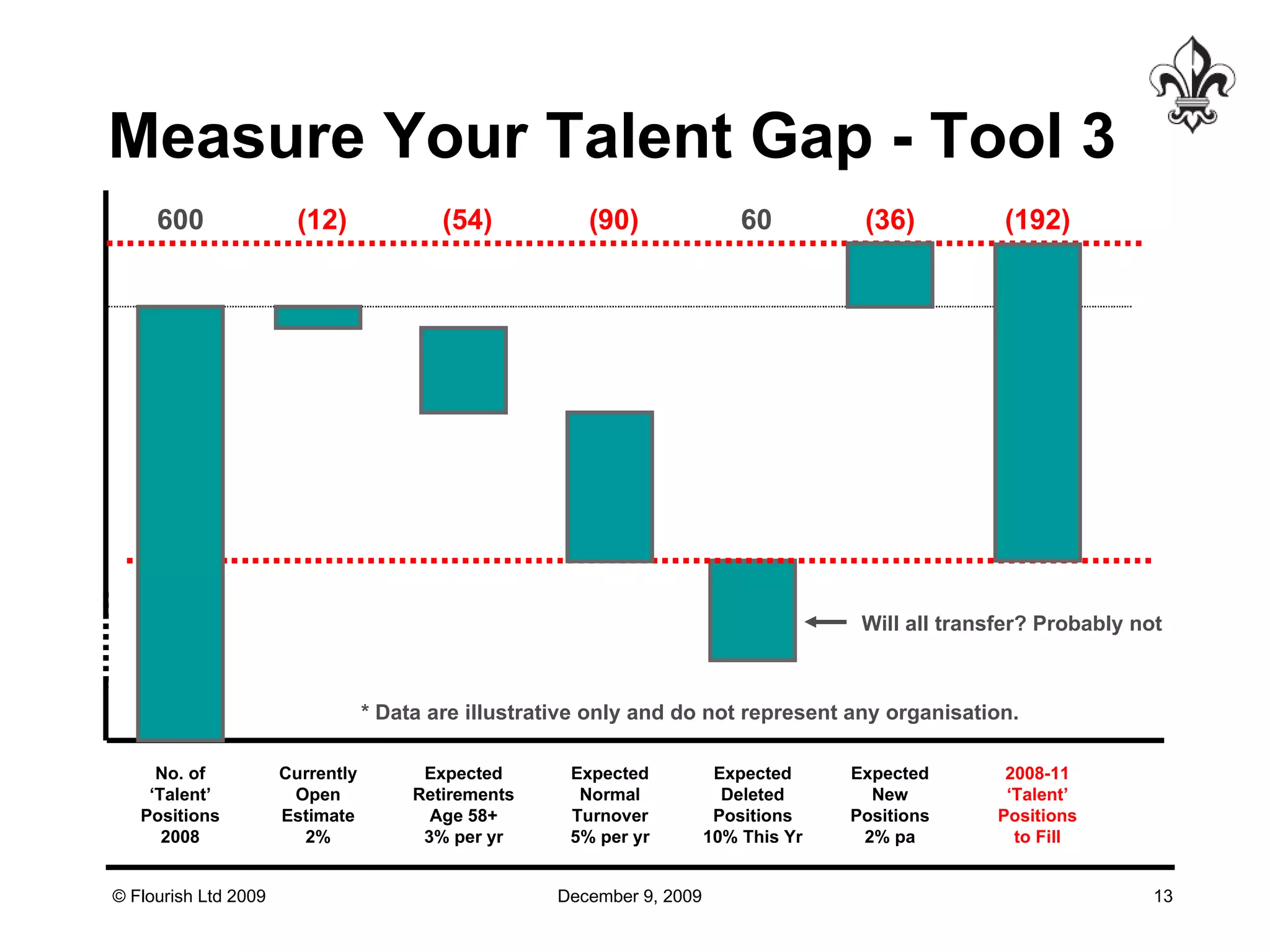
Measure Your Talent Gap - Tool 3 * Data are illustrative only and do not represent any organisation. Will all transfer? Probably not Currently Open Estimate 2% (12) Expected Retirements Age 58+ 3% per yr (54) Expected Deleted Positions 10% This Yr 60 Expected New Positions 2% pa (36)  2008-11 ‘ Talent’ Positions to Fill (192)  Expected Normal Turnover 5% per yr (90) No. of ‘ Talent’ Positions 2008 600
Review Additional Advantages? Additional Limitations?
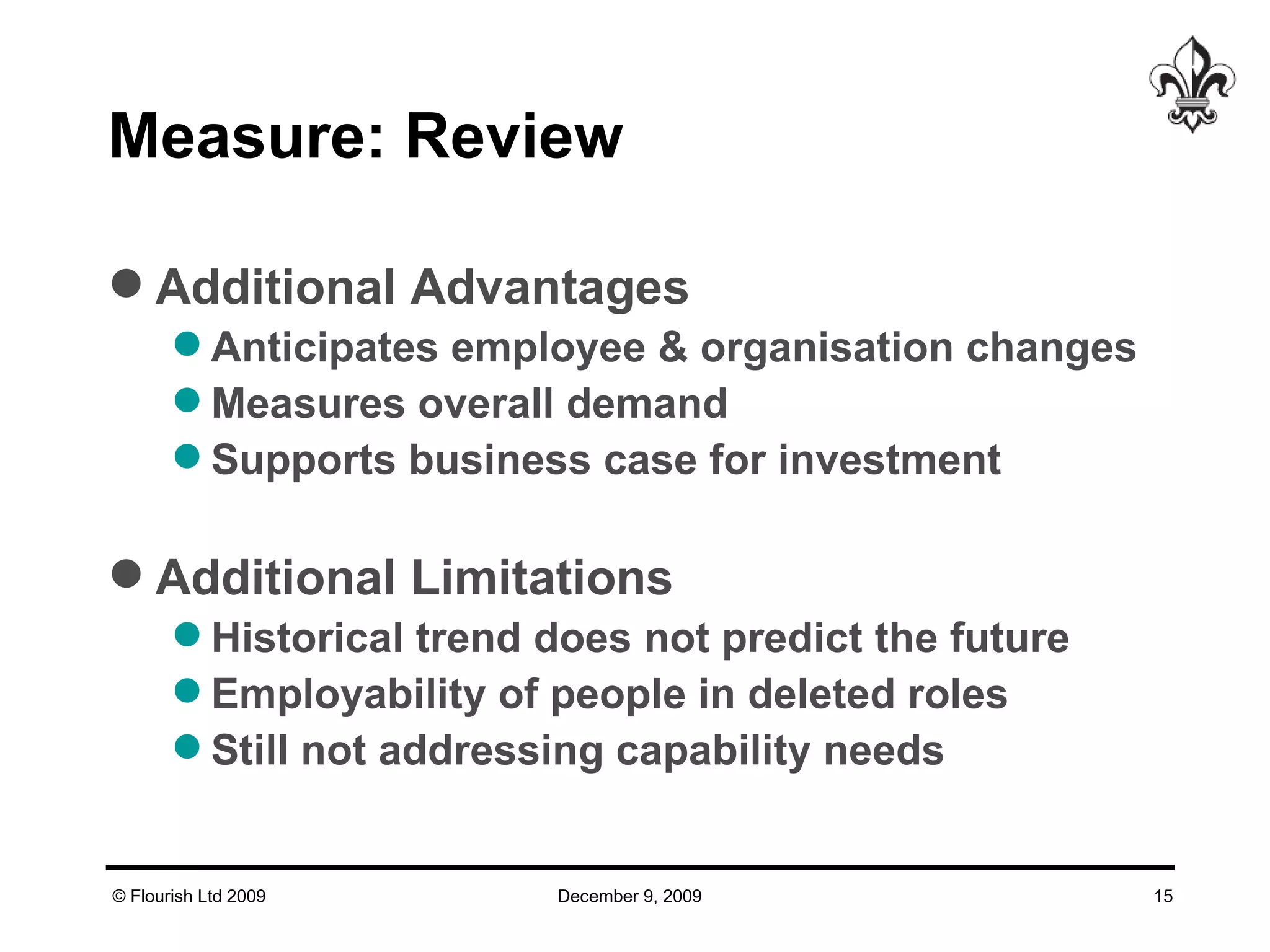
Measure: Review  Additional Advantages Anticipates employee & organisation changes Measures overall demand Supports business case for investment Additional Limitations Historical trend does not predict the future Employability of people in deleted roles Still not addressing capability needs
Find
Big question Leadership talent? What exactly, are you looking for? Let’s try an experiment…
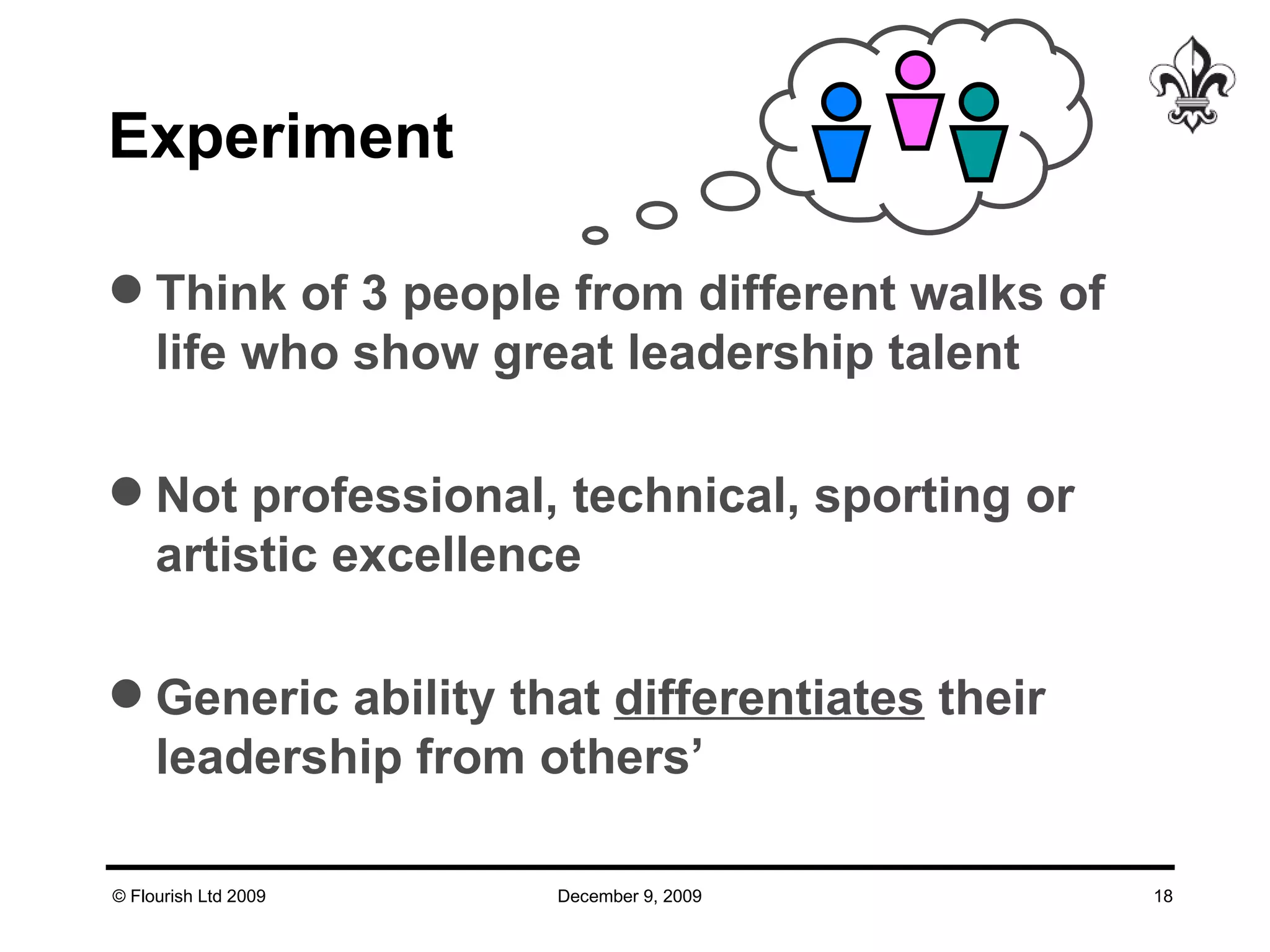
Experiment Think of 3 people from different walks of life who show great leadership talent Not professional, technical, sporting or artistic excellence Generic ability that  differentiates  their leadership from others’
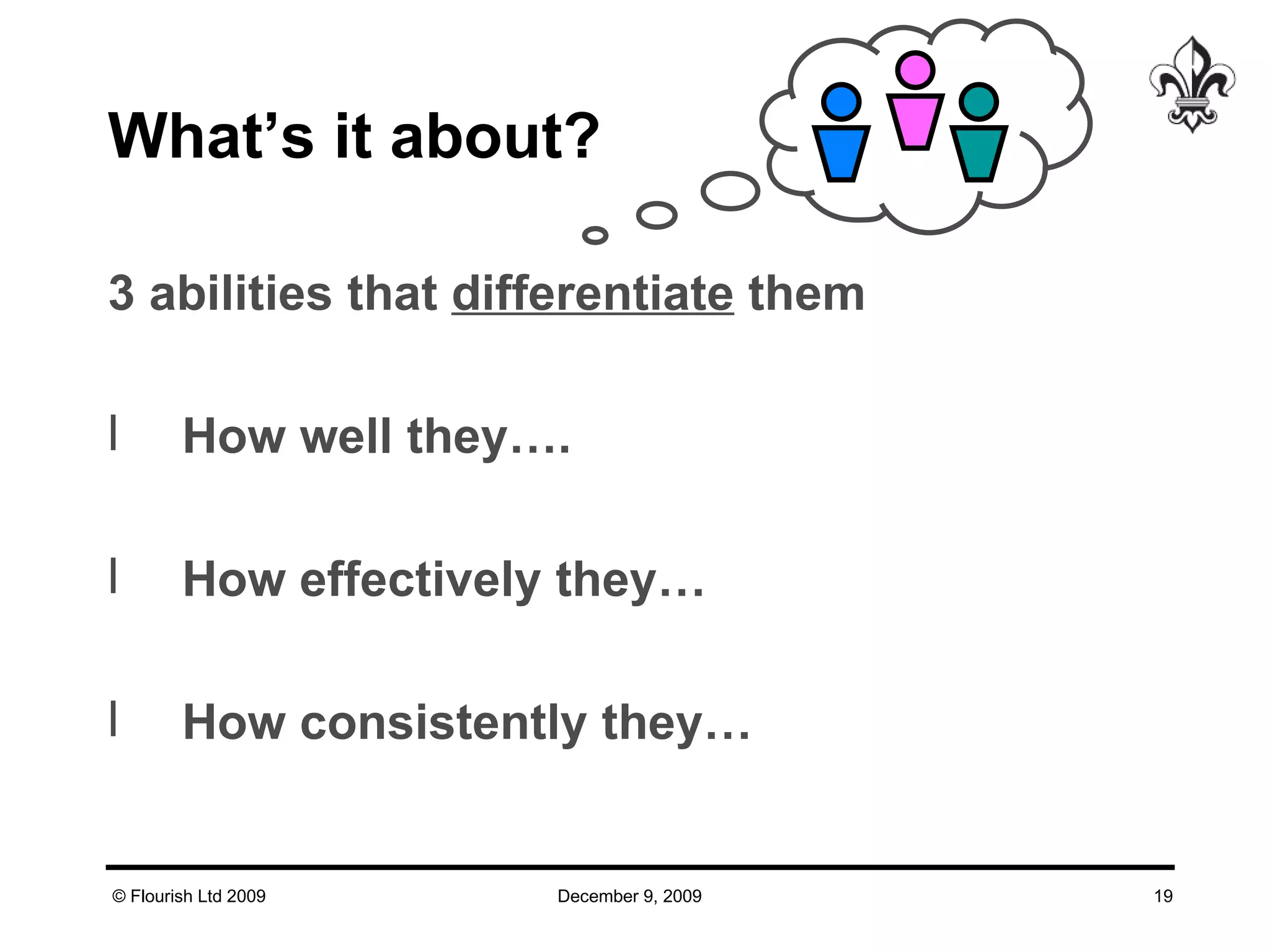
What’s it about? 3 abilities that  differentiate  them How well they…. How effectively they… How consistently they…
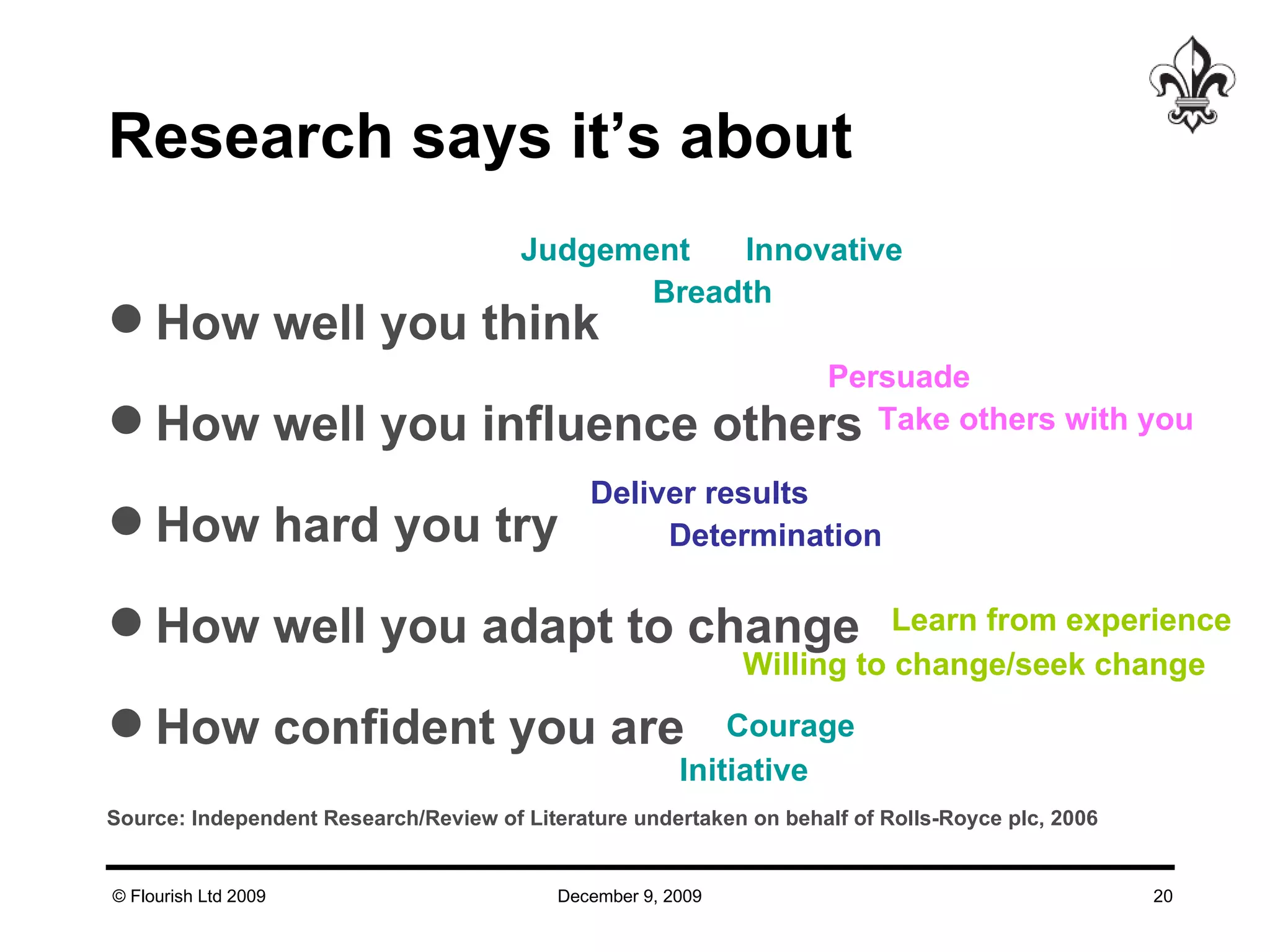
Research says it’s about  How well you think How well you influence others How hard you try How well you adapt to change How confident you are Source: Independent Research/Review of Literature undertaken on behalf of Rolls-Royce plc, 2006 Judgement Breadth Persuade Take others with you Deliver results Determination Innovative Willing to change/seek change Learn from experience Initiative Courage
Out of interest How do you define leadership talent in your organisation?
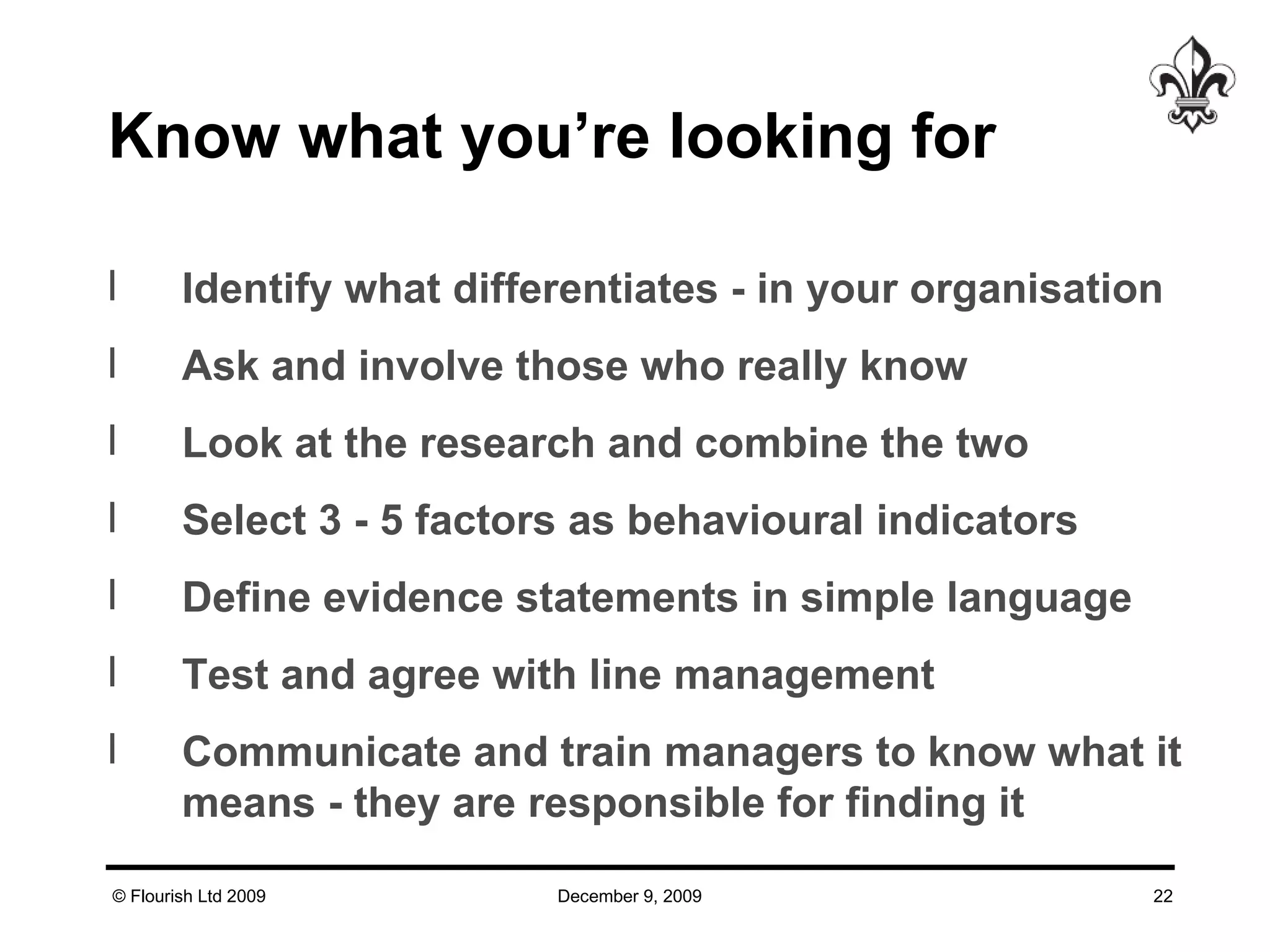
Know what you’re looking for  Identify what differentiates - in your organisation Ask and involve those who really know Look at the research and combine the two Select 3 - 5 factors as behavioural indicators Define evidence statements in simple language Test and agree with line management Communicate and train managers to know what it means - they are responsible for finding it
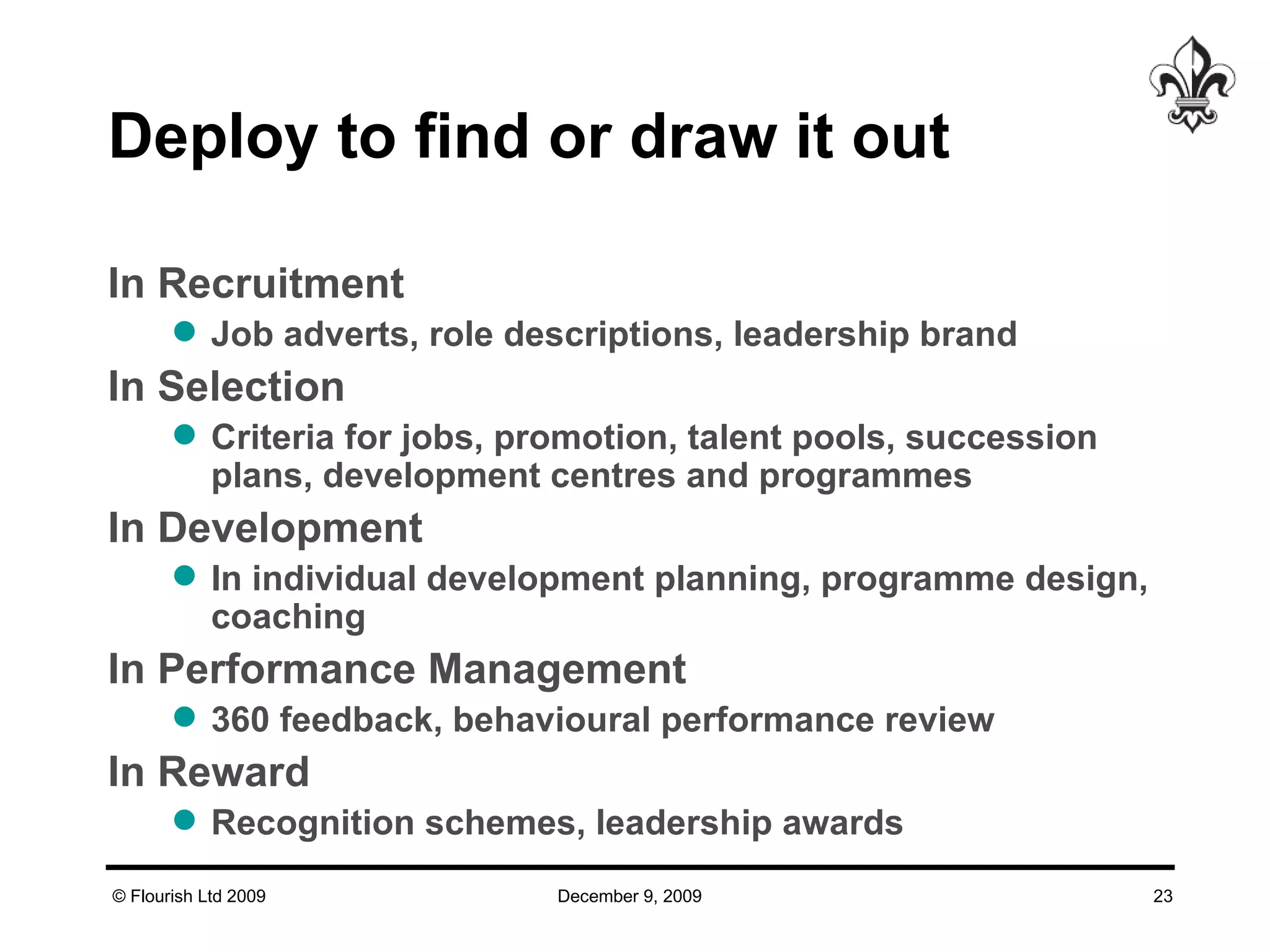
Deploy to find or draw it out  In Recruitment Job adverts, role descriptions, leadership brand In Selection Criteria for jobs, promotion, talent pools, succession plans, development centres and programmes In Development In individual development planning, programme design, coaching In Performance Management 360 feedback, behavioural performance review In Reward Recognition schemes, leadership awards
Find: Review How does your current approach align to the research? What improvements could you make?
Engage
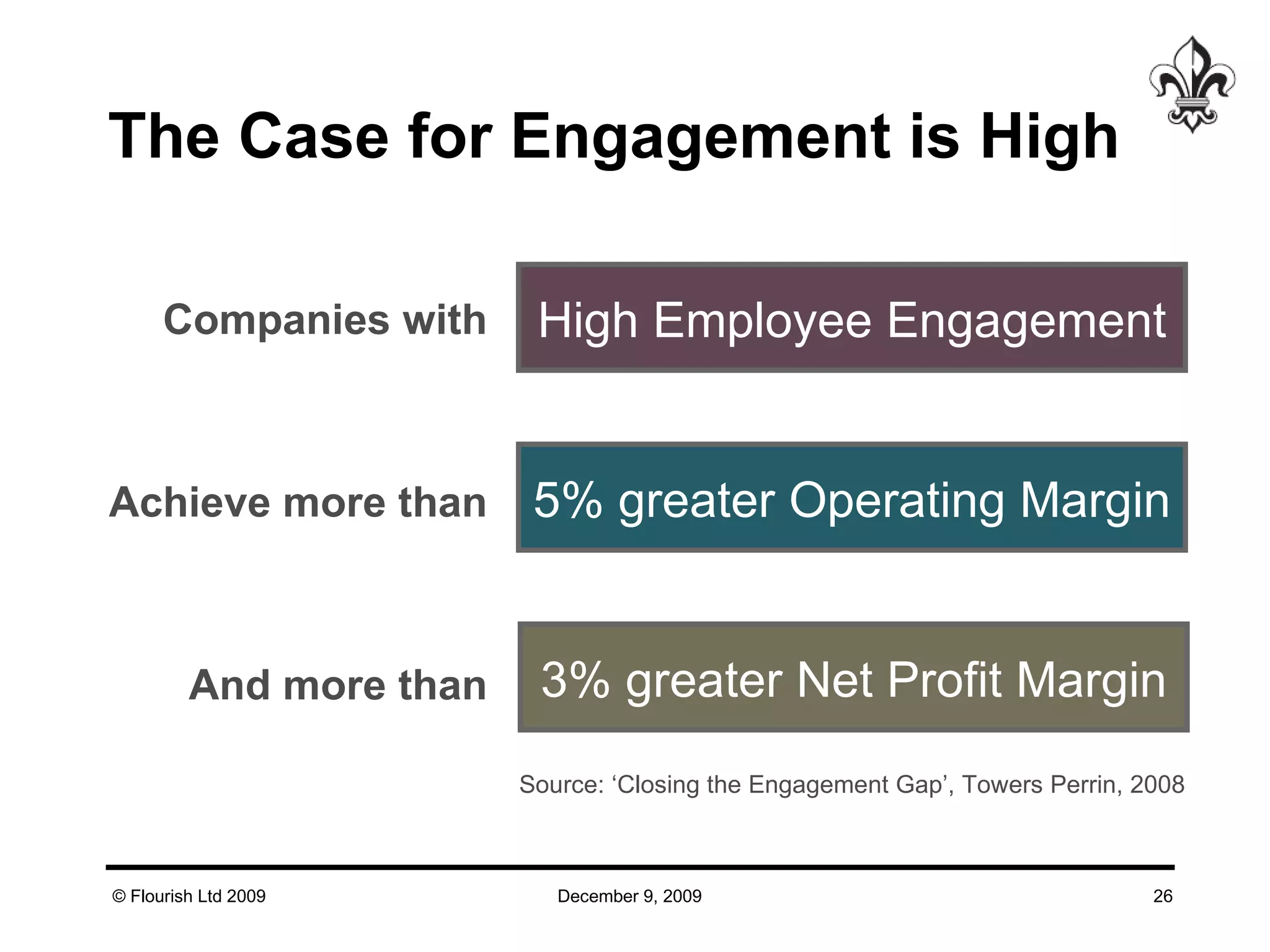
The Case for  Engagement is High Companies with Achieve more than And more than High Employee Engagement 5% greater Operating Margin 3% greater Net Profit Margin Source: ‘Closing the Engagement Gap’, Towers Perrin, 2008
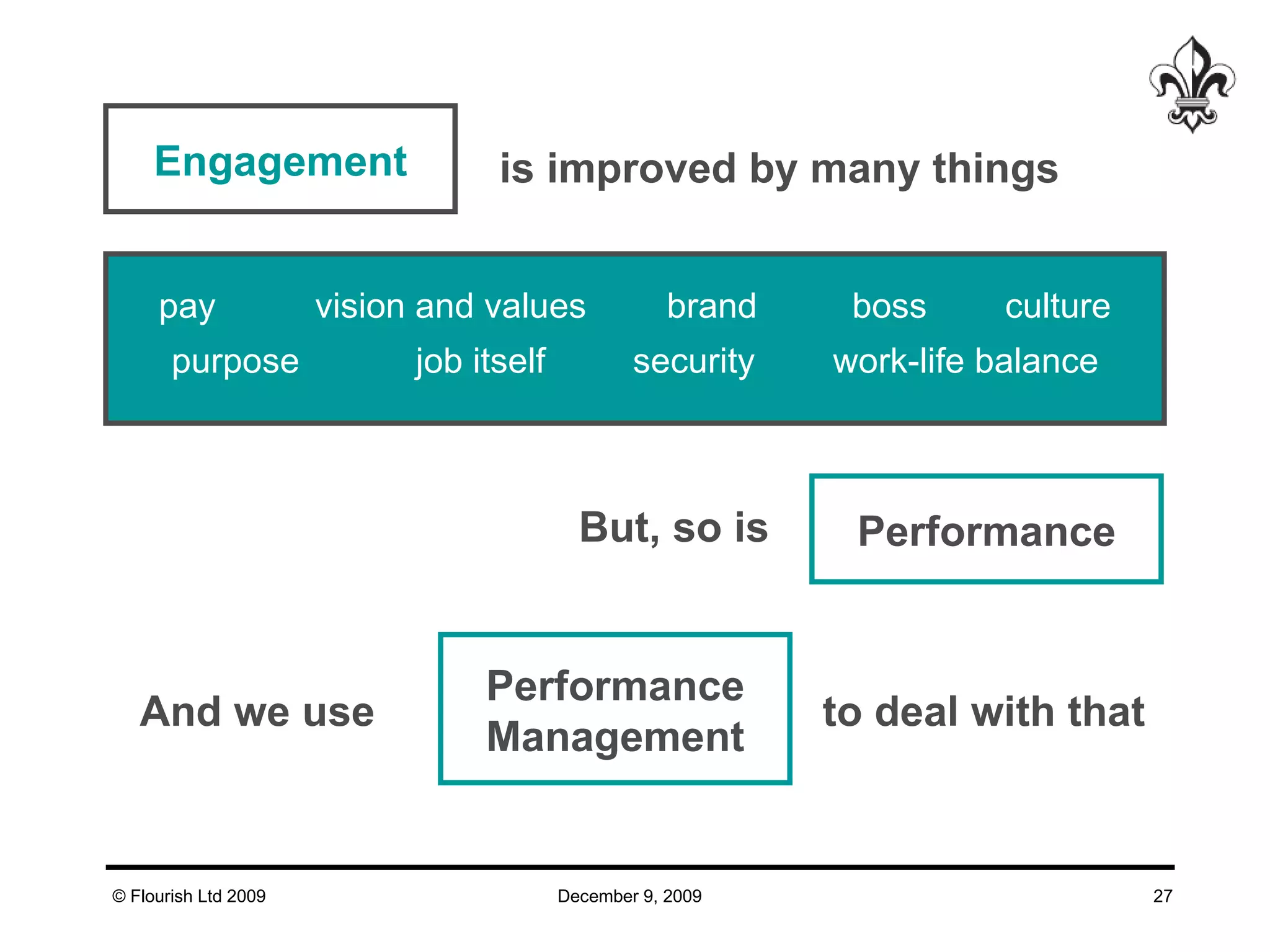
But, so is  Engagement is improved by many things pay   vision and values brand   boss  culture purpose job itself  security  work-life balance  Performance And we use Performance Management to deal with that
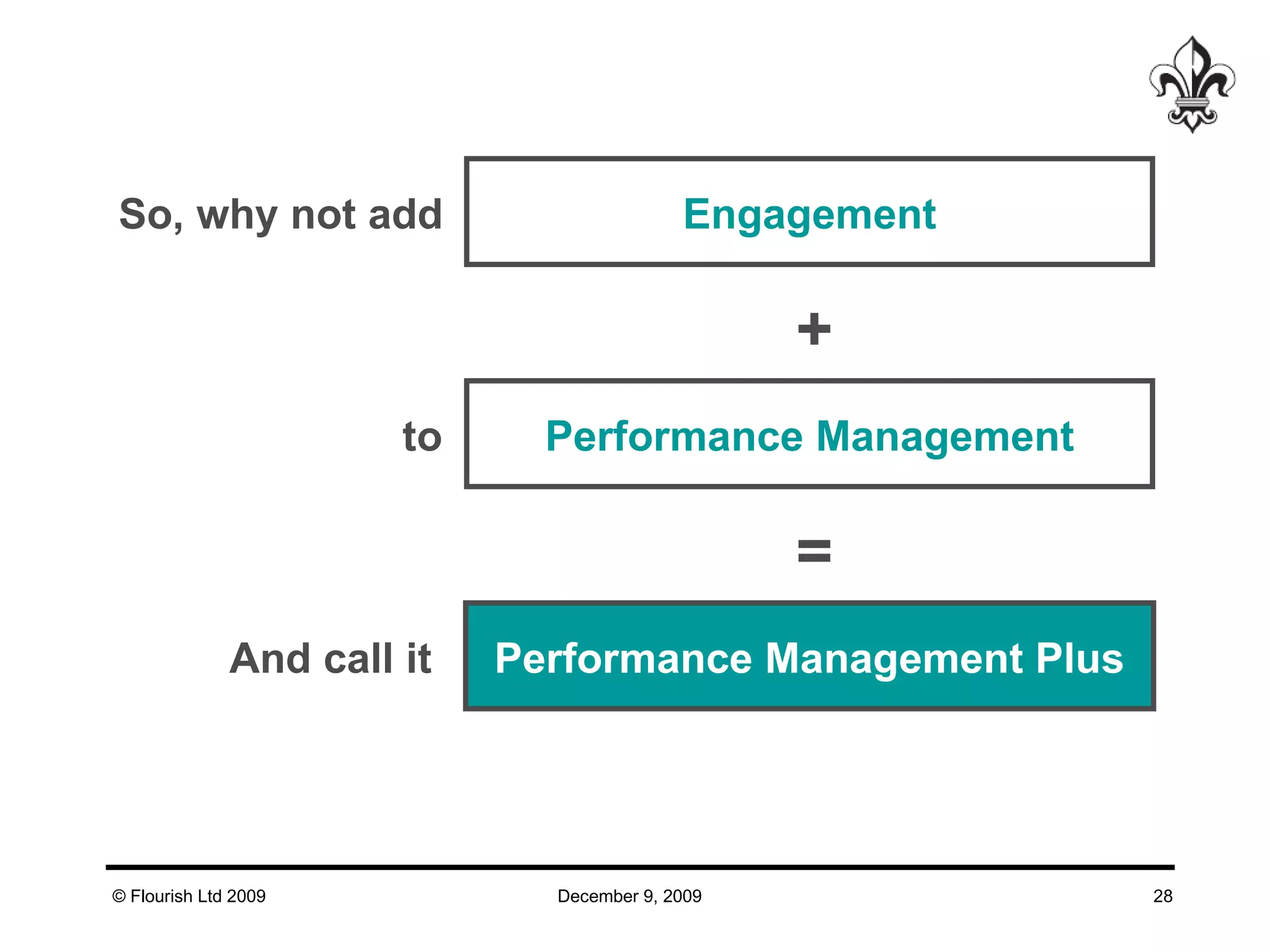
So, why not add And call it Engagement Performance Management Performance Management Plus to + =
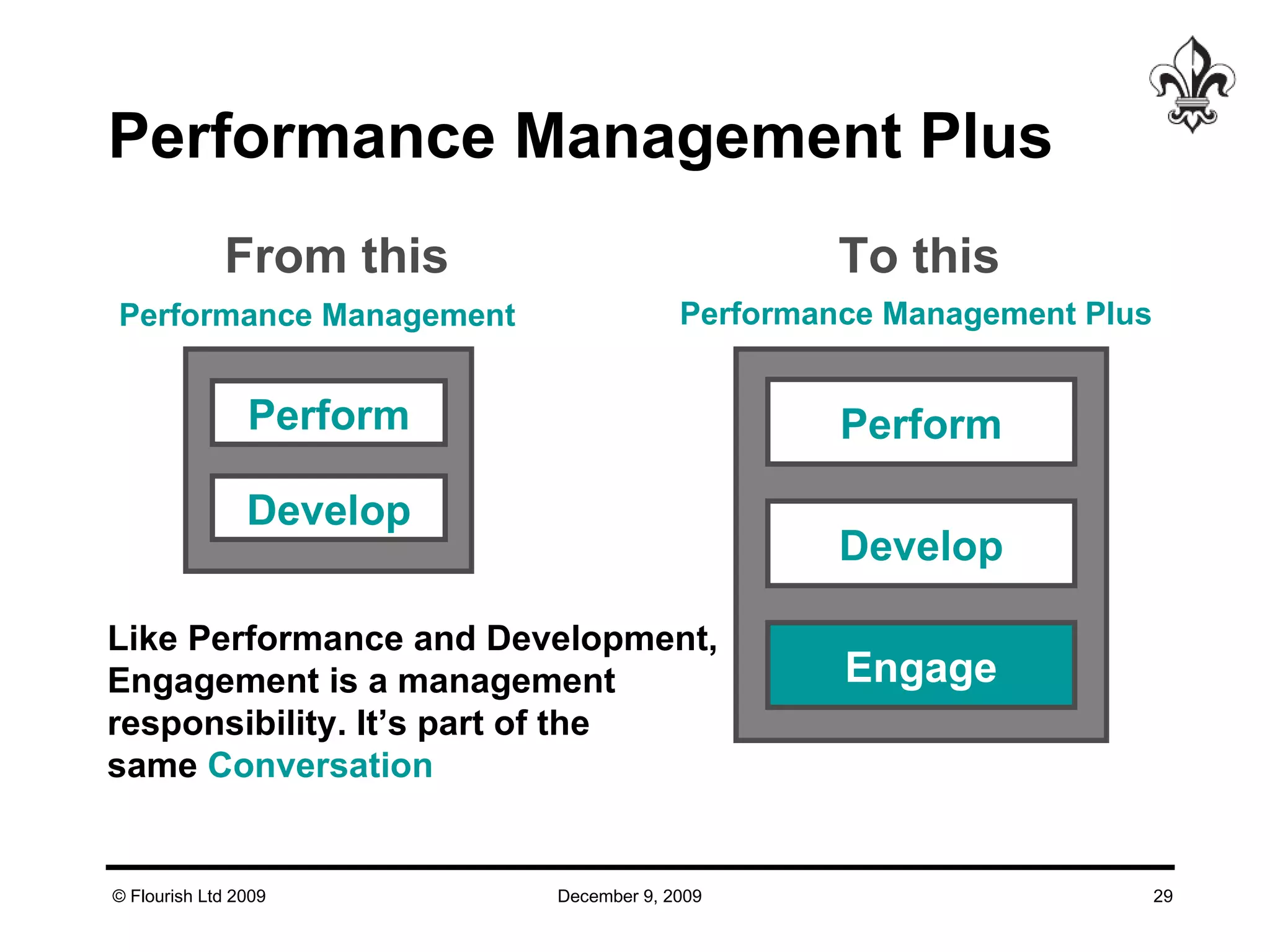
Performance Management Plus  Perform Develop Perform Develop Engage From this To this Performance Management Performance Management Plus Like Performance and Development, Engagement is a management responsibility. It’s part of the same  Conversation
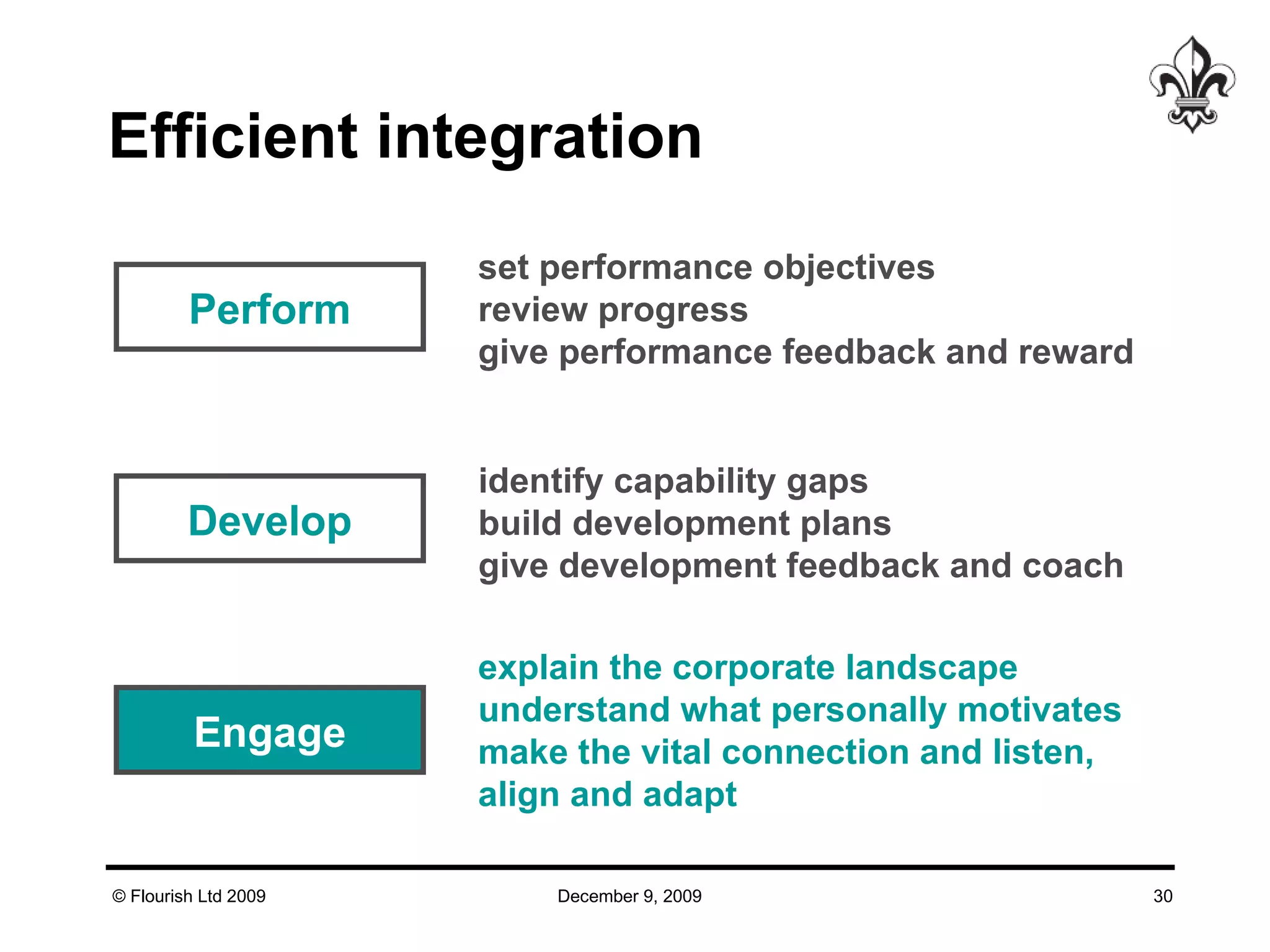
Efficient integration Perform Develop Engage explain the corporate landscape understand what personally motivates make the vital connection and listen, align and adapt  set performance objectives review progress give performance feedback and reward identify capability gaps build development plans give development feedback and coach
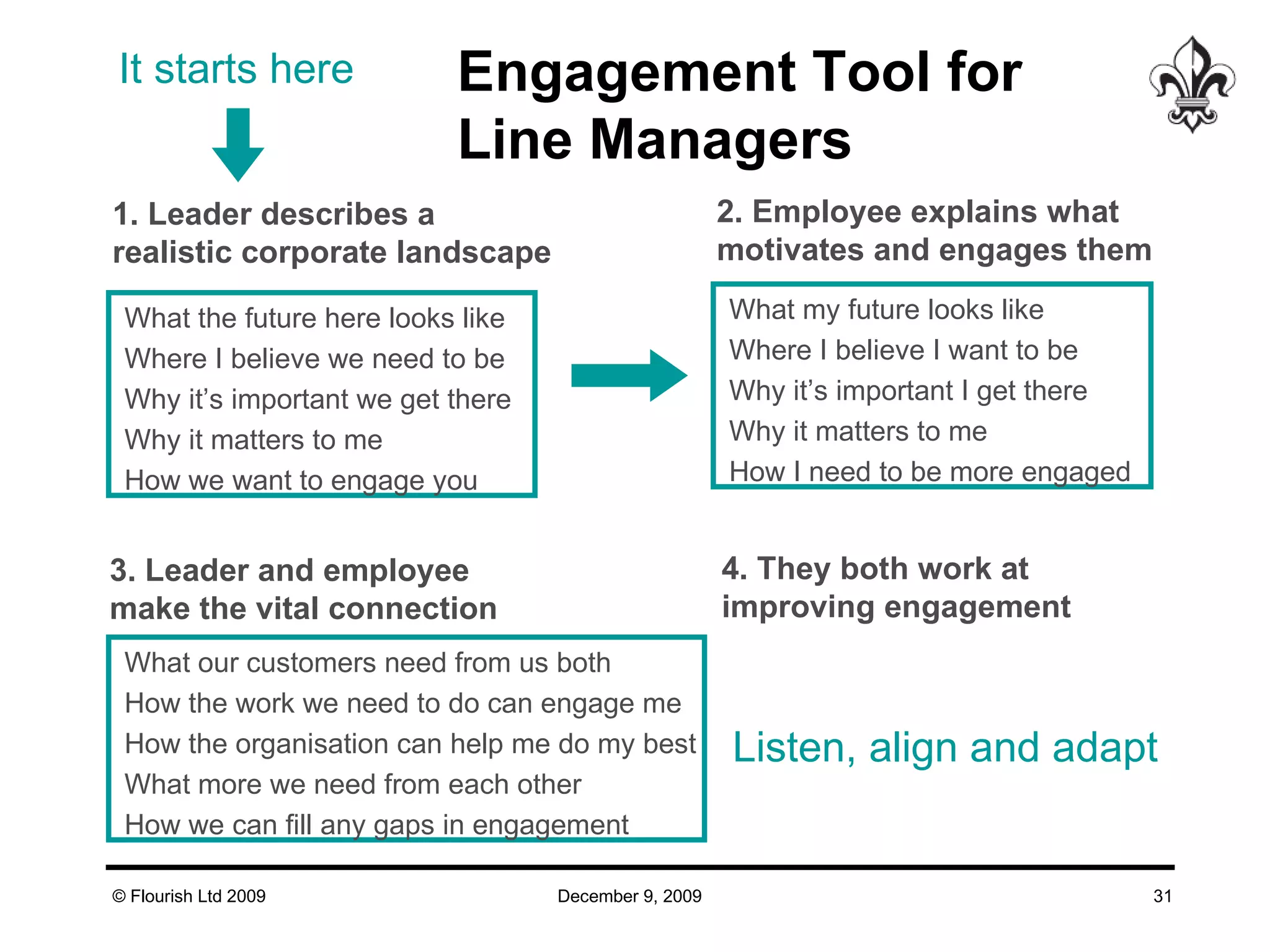
Engagement Tool for  Line Managers What the future here looks like Where I believe we need to be  Why it’s important we get there  Why it matters to me How we want to engage you 1. Leader describes a  realistic corporate landscape What my future looks like Where I believe I want to be  Why it’s important I get there  Why it matters to me How I need to be more engaged 2. Employee explains what motivates and engages them What our customers need from us both  How the work we need to do can engage me  How the organisation can help me do my best  What more we need from each other How we can fill any gaps in engagement  3. Leader and employee make the vital connection Listen, align and adapt It starts here 4. They both work at improving engagement
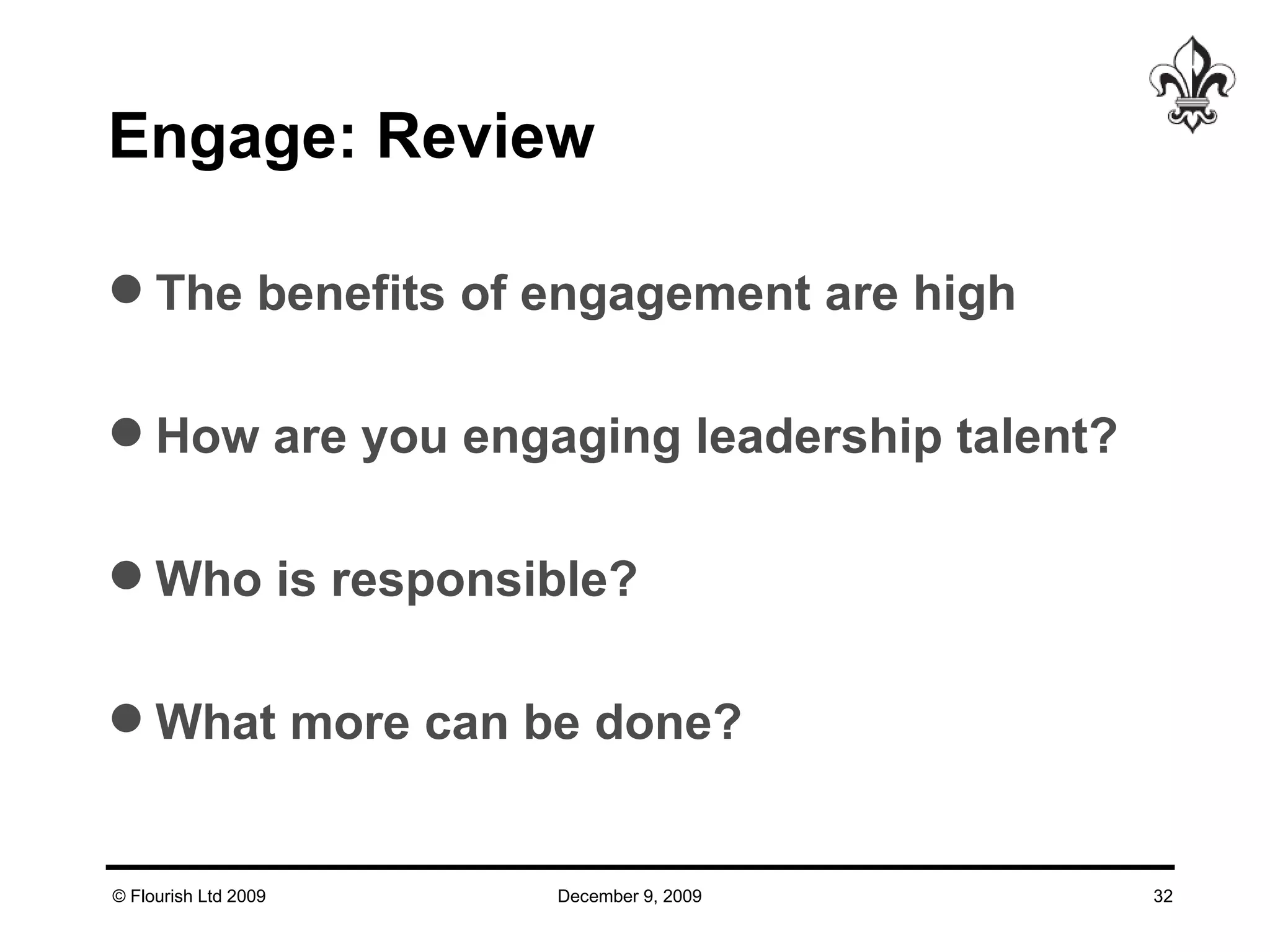
Engage: Review The benefits of engagement are high How are you engaging leadership talent? Who is responsible? What more can be done?
Develop
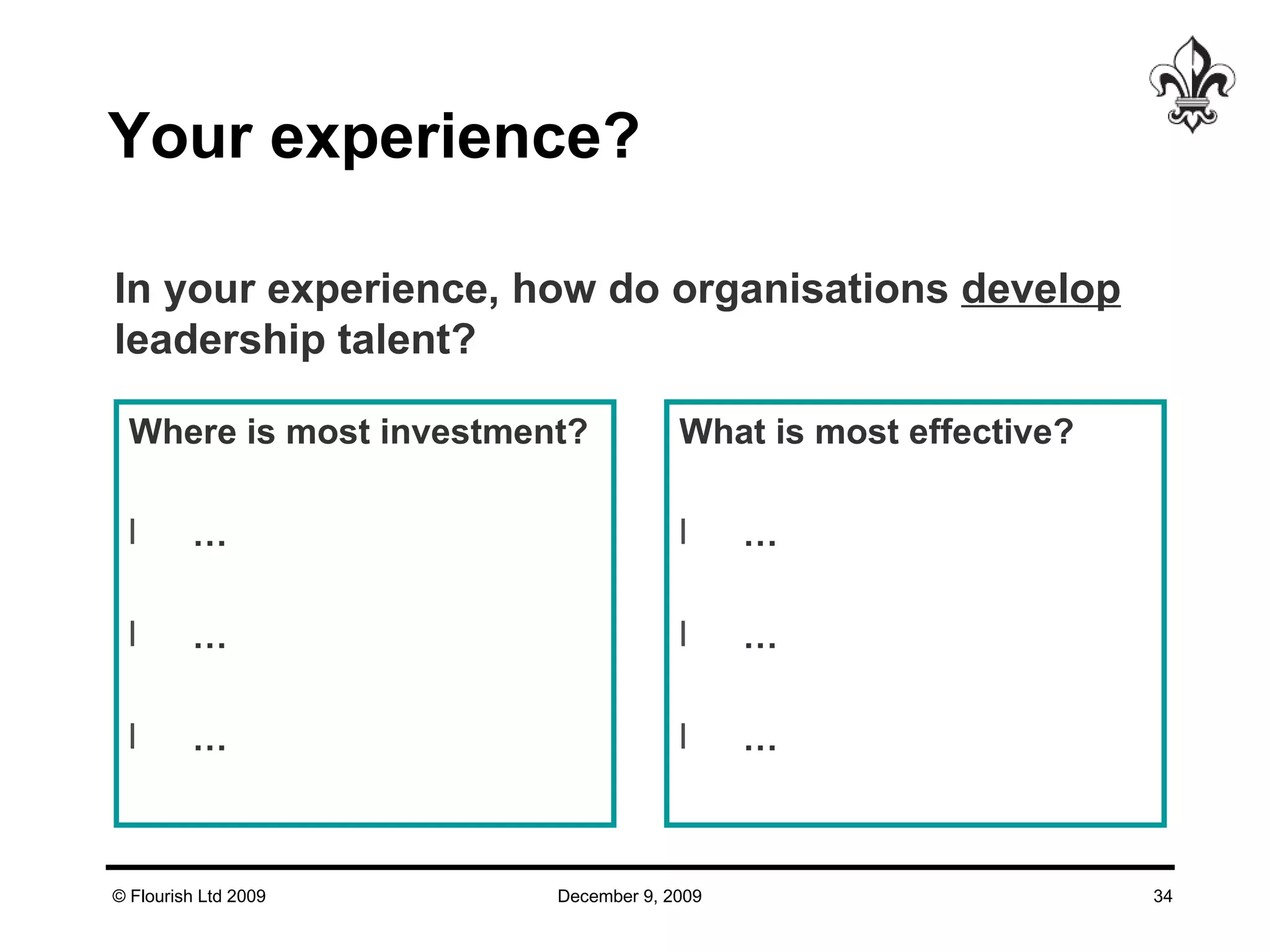
Your experience? Where is most investment? … … … What is most effective? … … … In your experience, how do organisations  develop leadership talent?
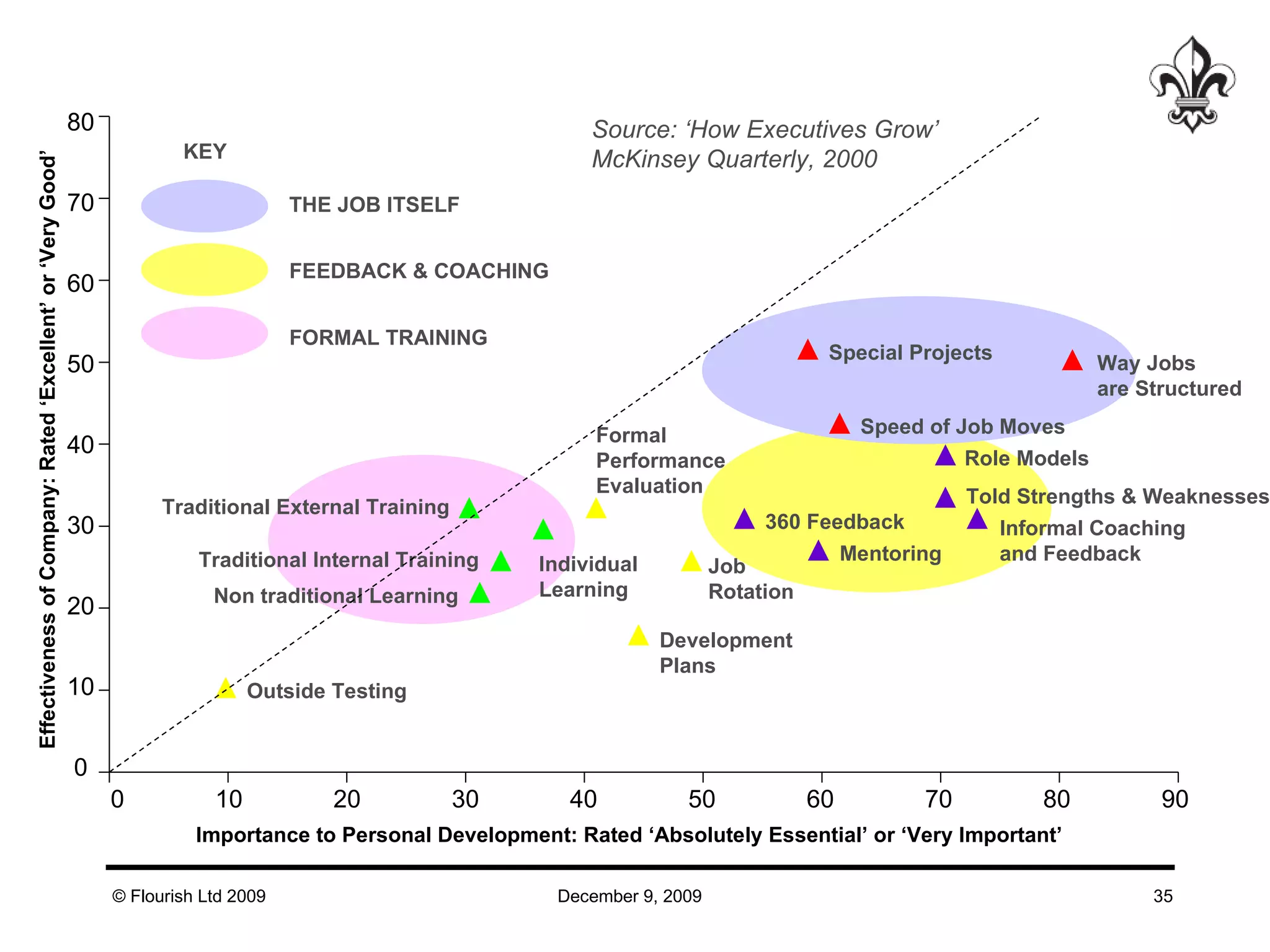
Source: ‘How Executives Grow’ McKinsey Quarterly, 2000 Importance to Personal Development: Rated ‘Absolutely Essential’ or ‘Very Important’ Effectiveness of Company: Rated ‘Excellent’ or ‘Very Good’ 0 10 20 30 40 50 60 70 80 90 0 10 20 30 40 50 60 70 80 Way Jobs are Structured Special Projects Speed of Job Moves Role Models Told Strengths & Weaknesses Informal Coaching  and Feedback 360 Feedback Mentoring Traditional External Training Traditional Internal Training Non traditional Learning Individual Learning Formal Performance Evaluation Job Rotation Development Plans Outside Testing THE JOB ITSELF FEEDBACK & COACHING FORMAL TRAINING KEY
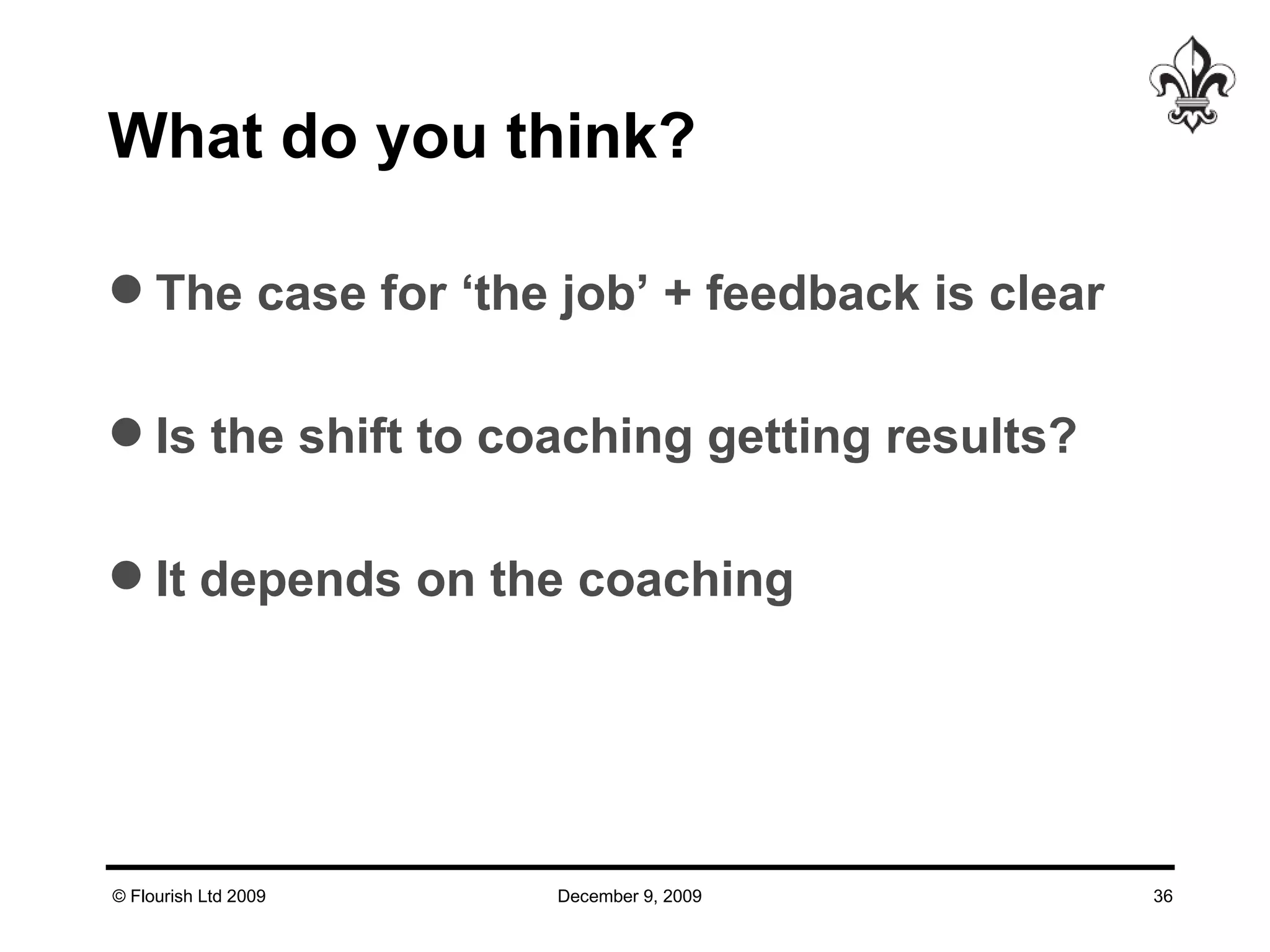
What do you think? The case for ‘the job’ + feedback is clear Is the shift to coaching getting results? It depends on the coaching
Coaching and Feedback What have you learned from experience? What is emerging as ‘good practice’?
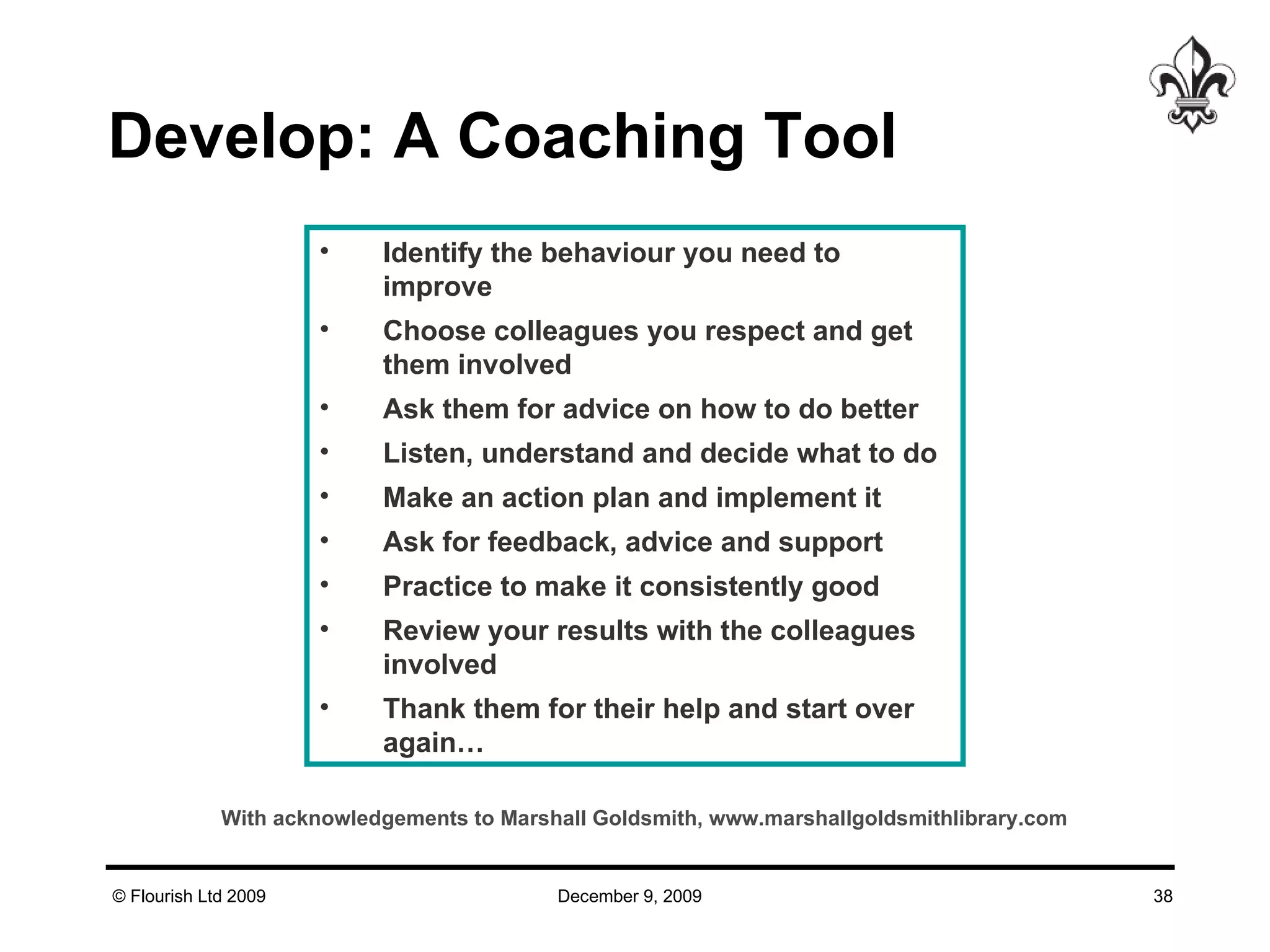
Develop: A Coaching Tool Identify the behaviour you need to improve Choose colleagues you respect and get them involved Ask them for advice on how to do better Listen, understand and decide what to do Make an action plan and implement it Ask for feedback, advice and support Practice to make it consistently good Review your results with the colleagues involved Thank them for their help and start over again… With acknowledgements to Marshall Goldsmith, www.marshallgoldsmithlibrary.com
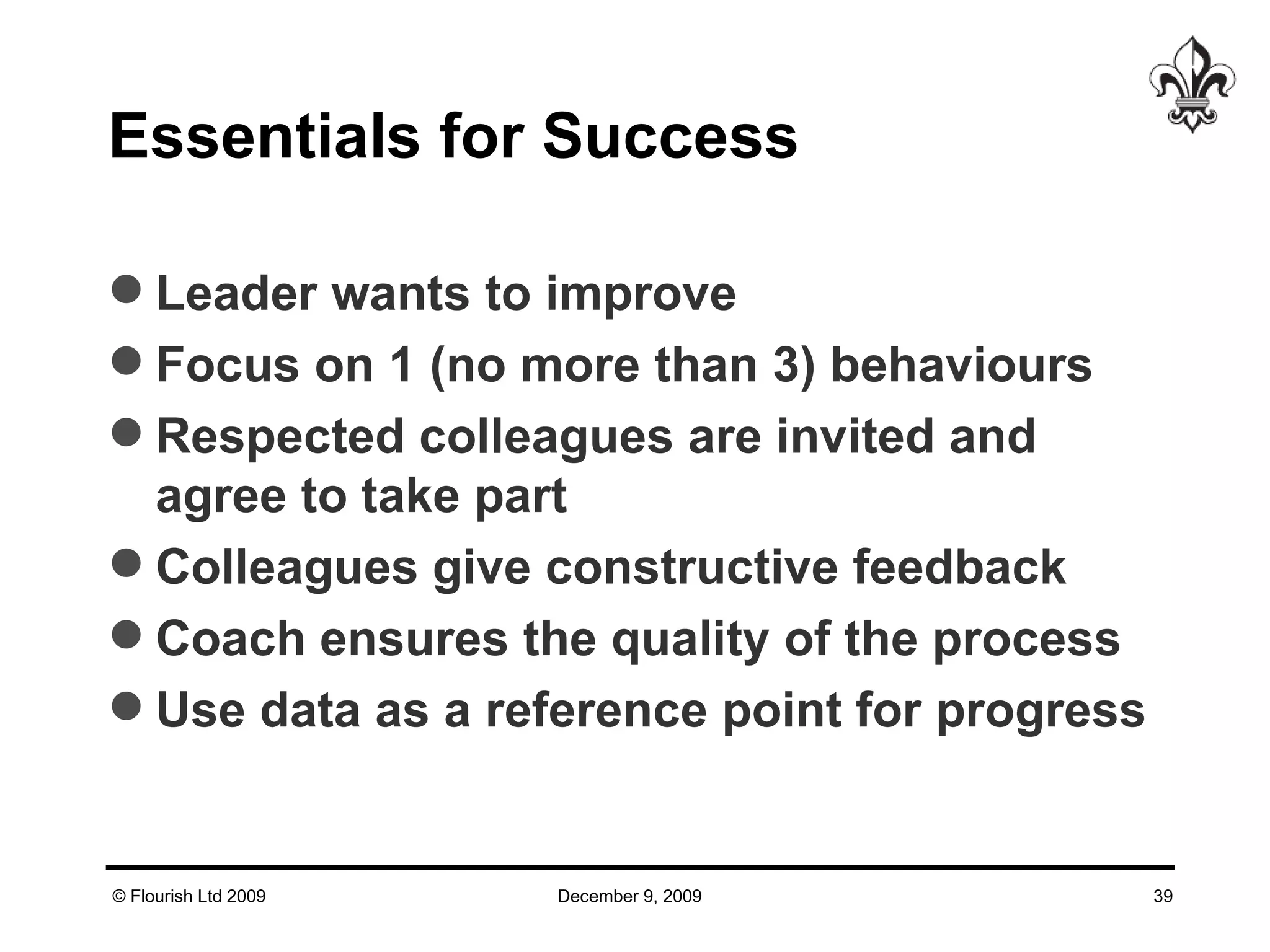
Essentials for Success  Leader wants to improve Focus on 1 (no more than 3) behaviours  Respected colleagues are invited and agree to take part Colleagues give constructive feedback  Coach ensures the quality of the process  Use data as a reference point for progress
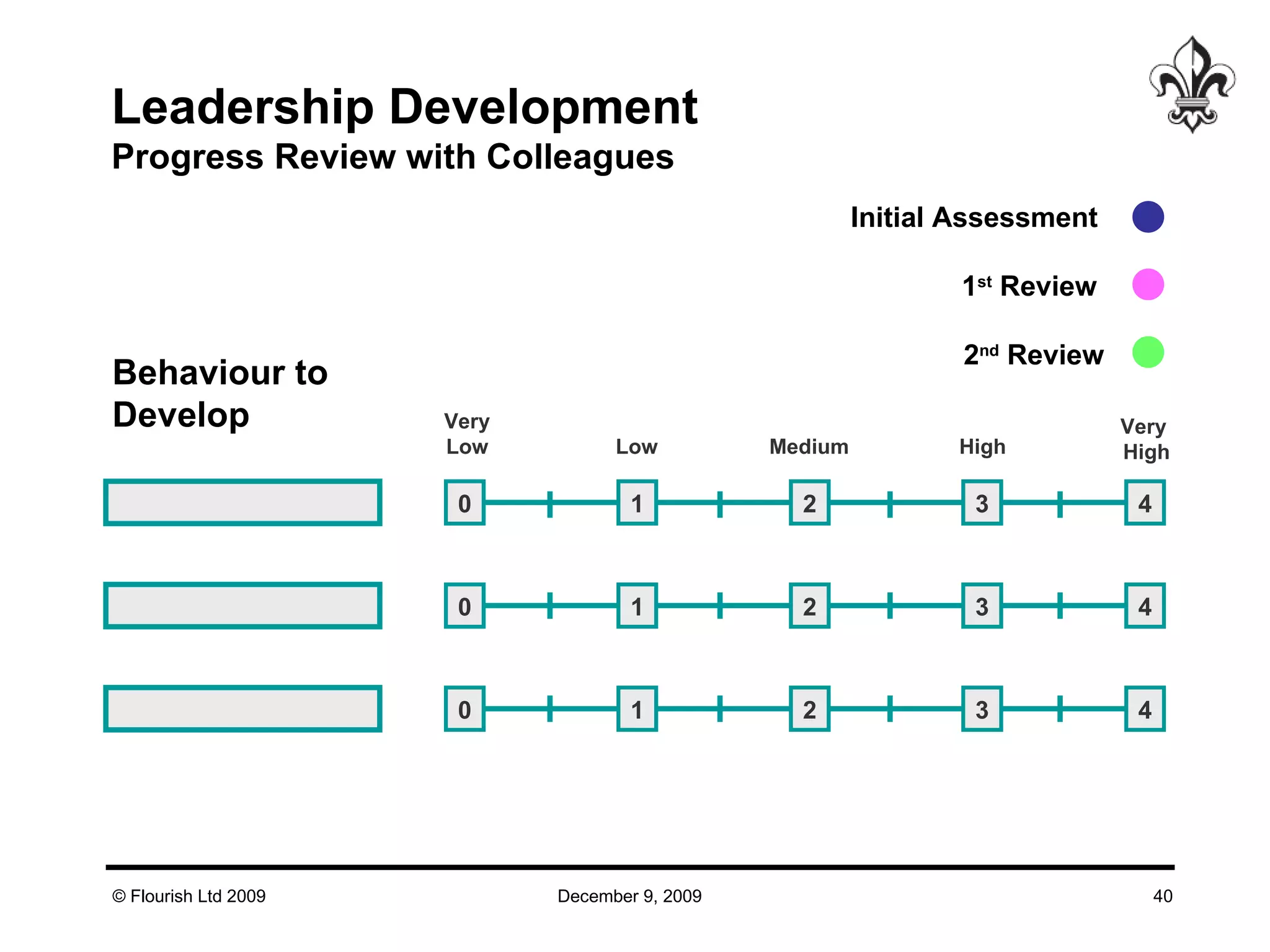
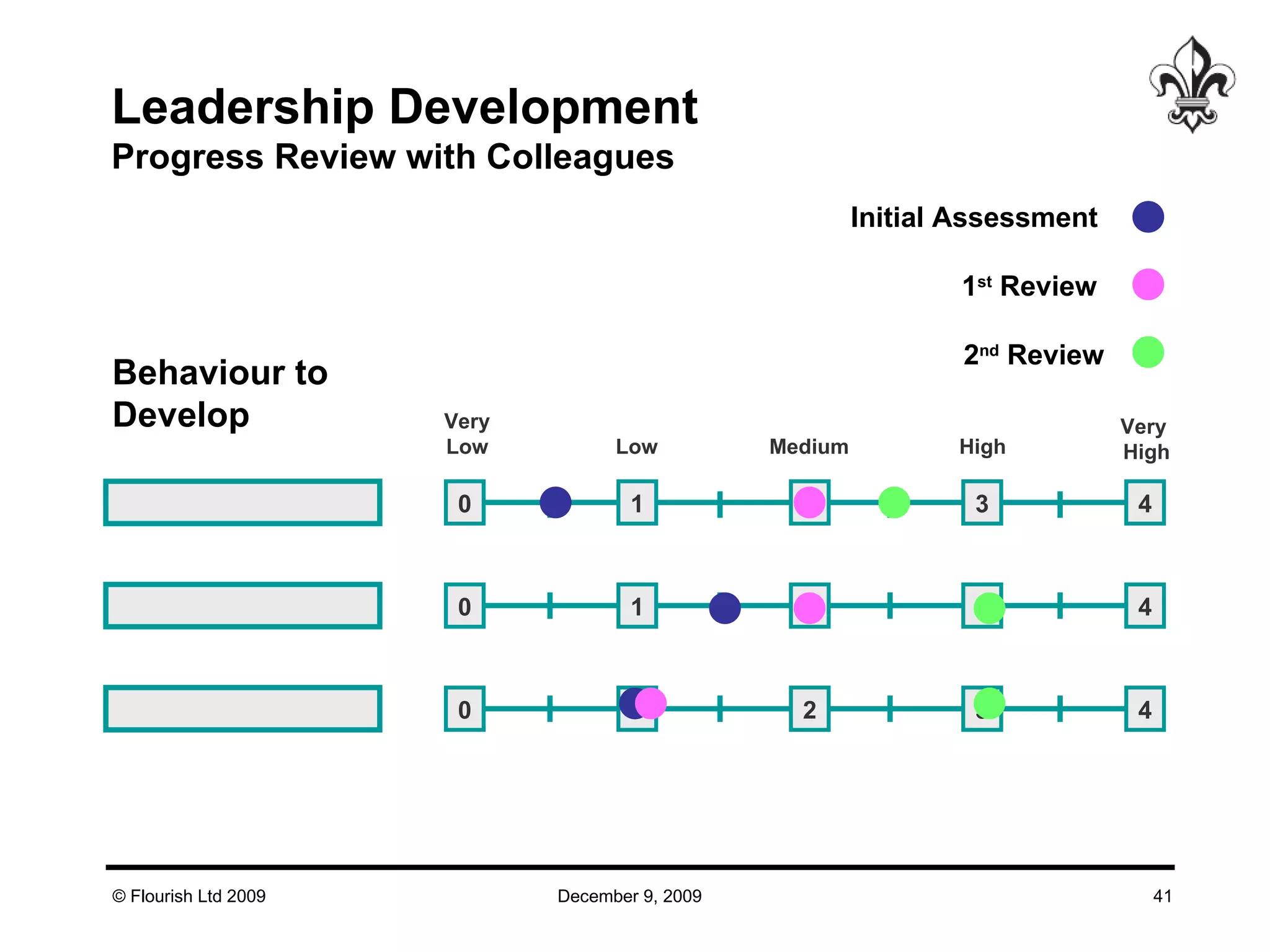
Initial Assessment  1 st  Review  2 nd  Review Leadership Development Progress Review with Colleagues Behaviour to Develop Medium High Low Very Low Very  High 0 1 2 3 4 0 1 2 3 4 0 1 2 3 4
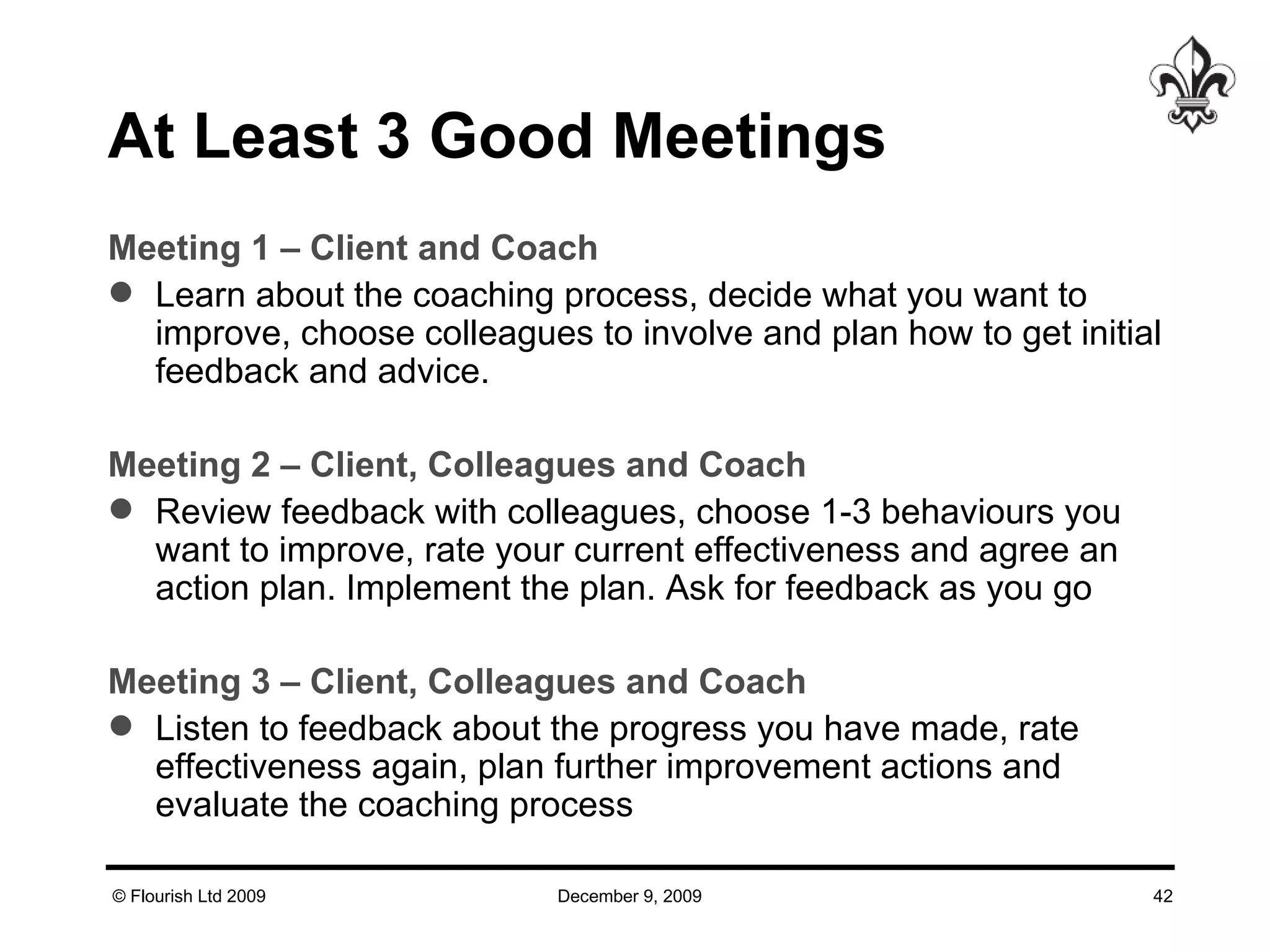
At Least 3 Good Meetings Meeting 1 – Client and Coach Learn about the coaching process, decide what you want to improve, choose colleagues to involve and plan how to get initial feedback and advice. Meeting 2 – Client, Colleagues and Coach Review feedback with colleagues, choose 1-3 behaviours you want to improve, rate your current effectiveness and agree an action plan. Implement the plan. Ask for feedback as you go Meeting 3 – Client, Colleagues and Coach Listen to feedback about the progress you have made, rate effectiveness again, plan further improvement actions and evaluate the coaching process
Coaching Tool: Review Advantages? Limitations?
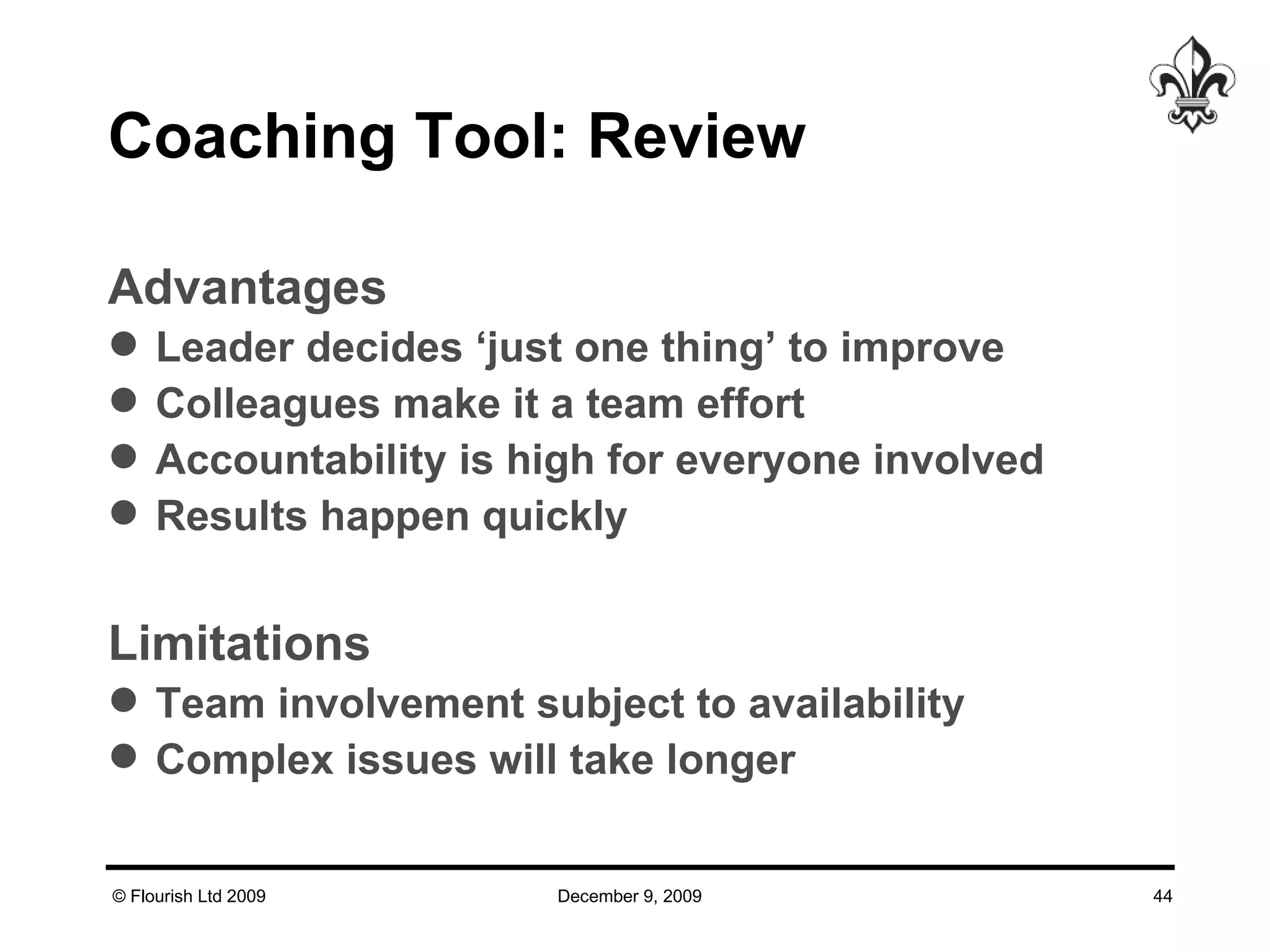
Coaching Tool: Review Advantages Leader decides ‘just one thing’ to improve Colleagues make it a team effort Accountability is high for everyone involved Results happen quickly Limitations Team involvement subject to availability Complex issues will take longer
Move
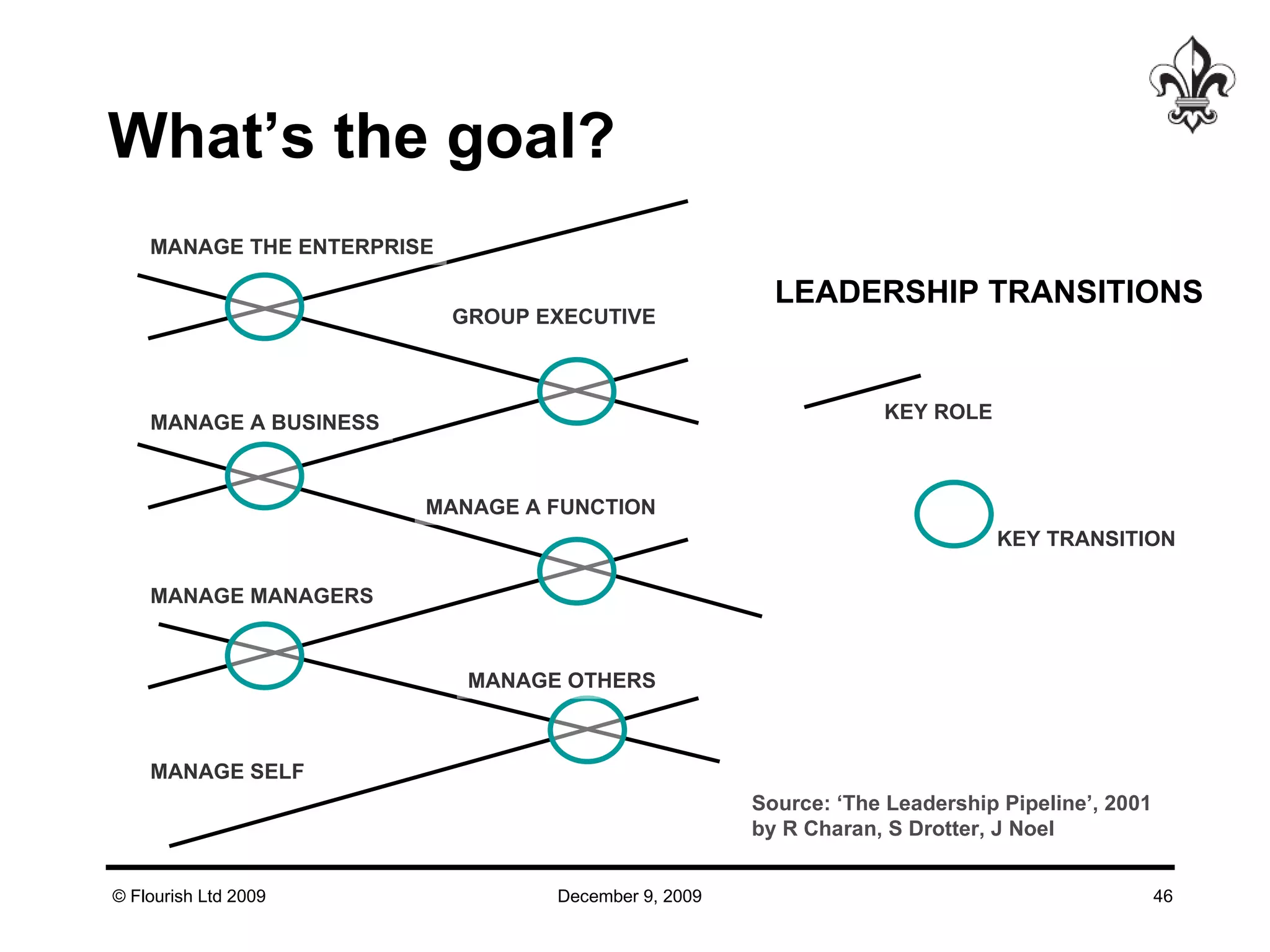
What’s the goal? KEY ROLE KEY TRANSITION MANAGE SELF MANAGE OTHERS MANAGE MANAGERS MANAGE A FUNCTION MANAGE A BUSINESS GROUP EXECUTIVE MANAGE THE ENTERPRISE LEADERSHIP TRANSITIONS Source: ‘The Leadership Pipeline’, 2001 by R Charan, S Drotter, J Noel
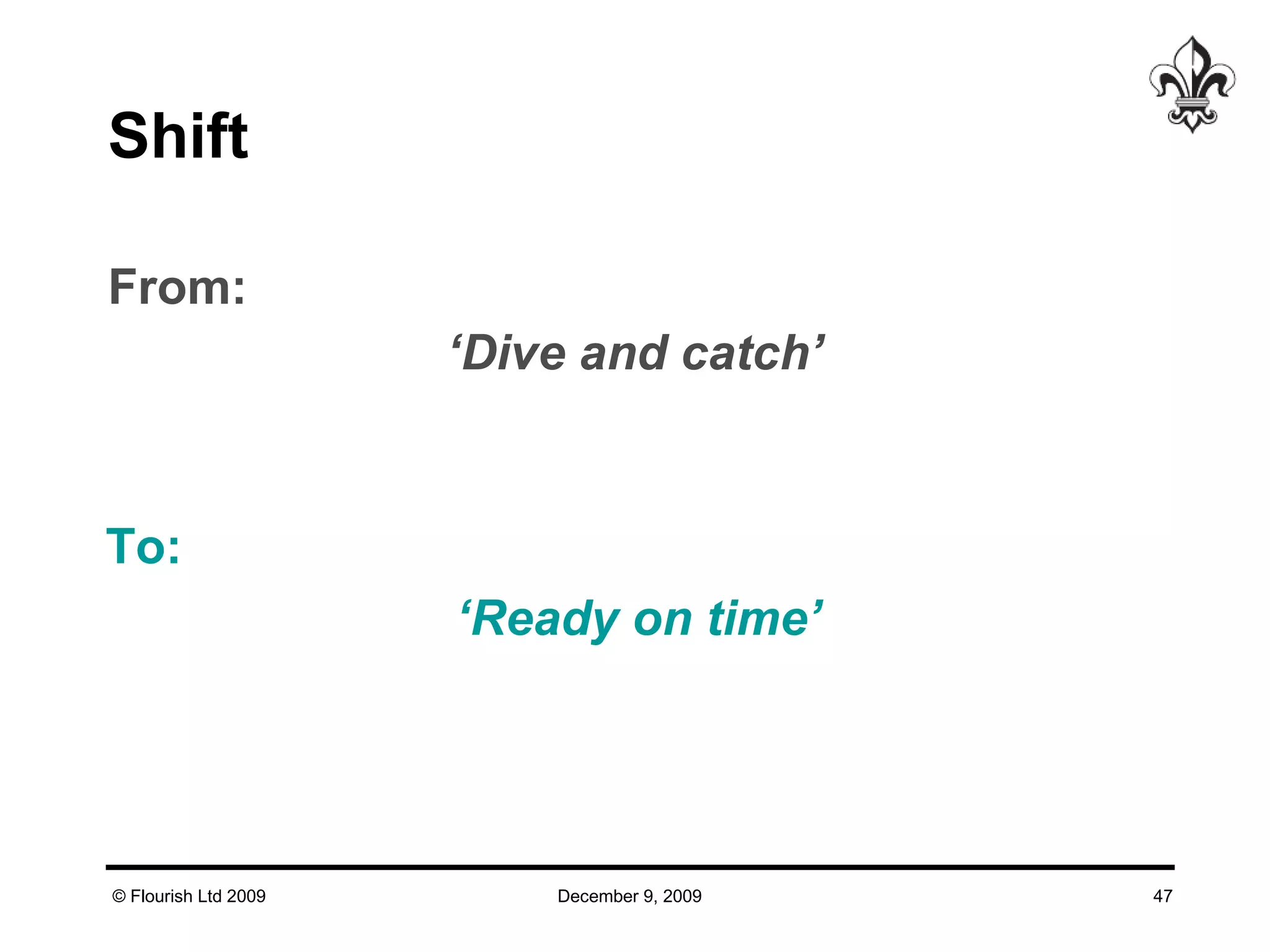
Shift From: ‘ Dive and catch’ To: ‘ Ready on time’
Move: Goal A good supply of capable leaders Right people into the right roles Owned by line management Reward for the ‘generators of talent’
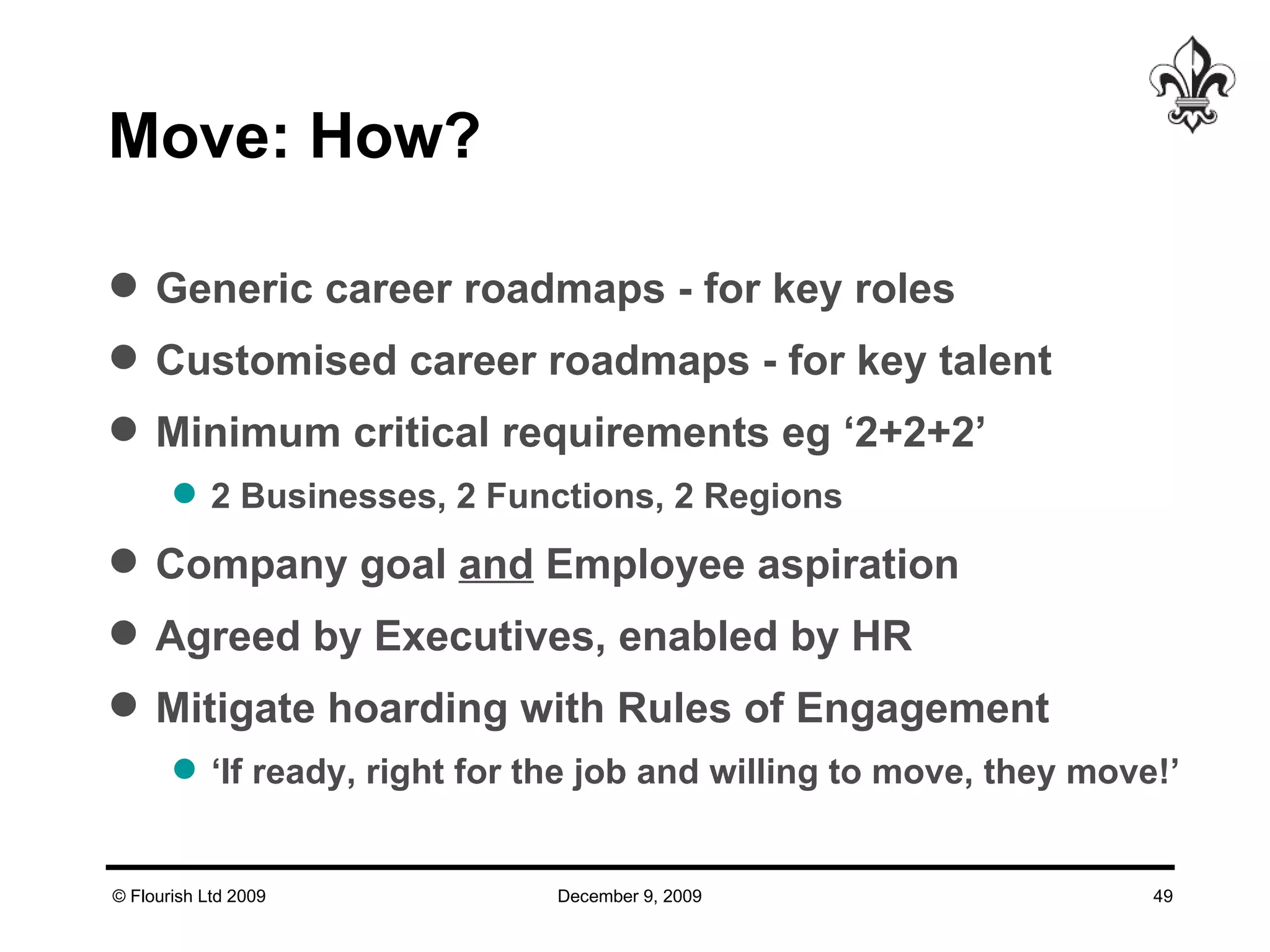
Move: How? Generic career roadmaps - for key roles Customised career roadmaps - for key talent Minimum critical requirements eg ‘2+2+2’ 2 Businesses, 2 Functions, 2 Regions Company goal  and  Employee aspiration Agreed by Executives, enabled by HR Mitigate hoarding with Rules of Engagement ‘ If ready, right for the job and willing to move, they move!’
Move: Review How to get line management doing it? How do you reward talent management?
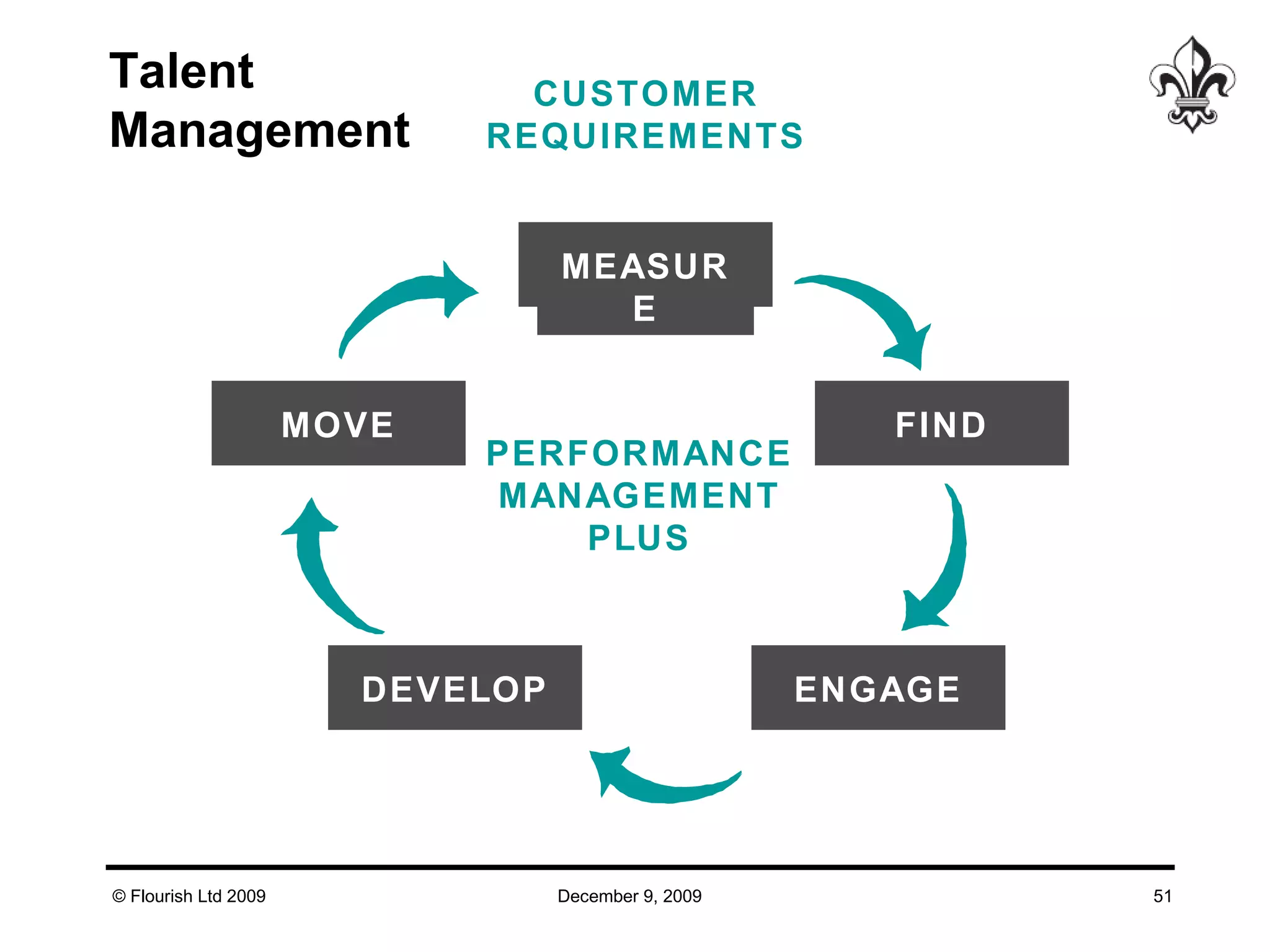
STRATEGIC DECISIONS FIND CUSTOMER REQUIREMENTS PERFORMANCE MANAGEMENT PLUS ENGAGE DEVELOP MOVE MEASURE Talent Management
How are you doing?
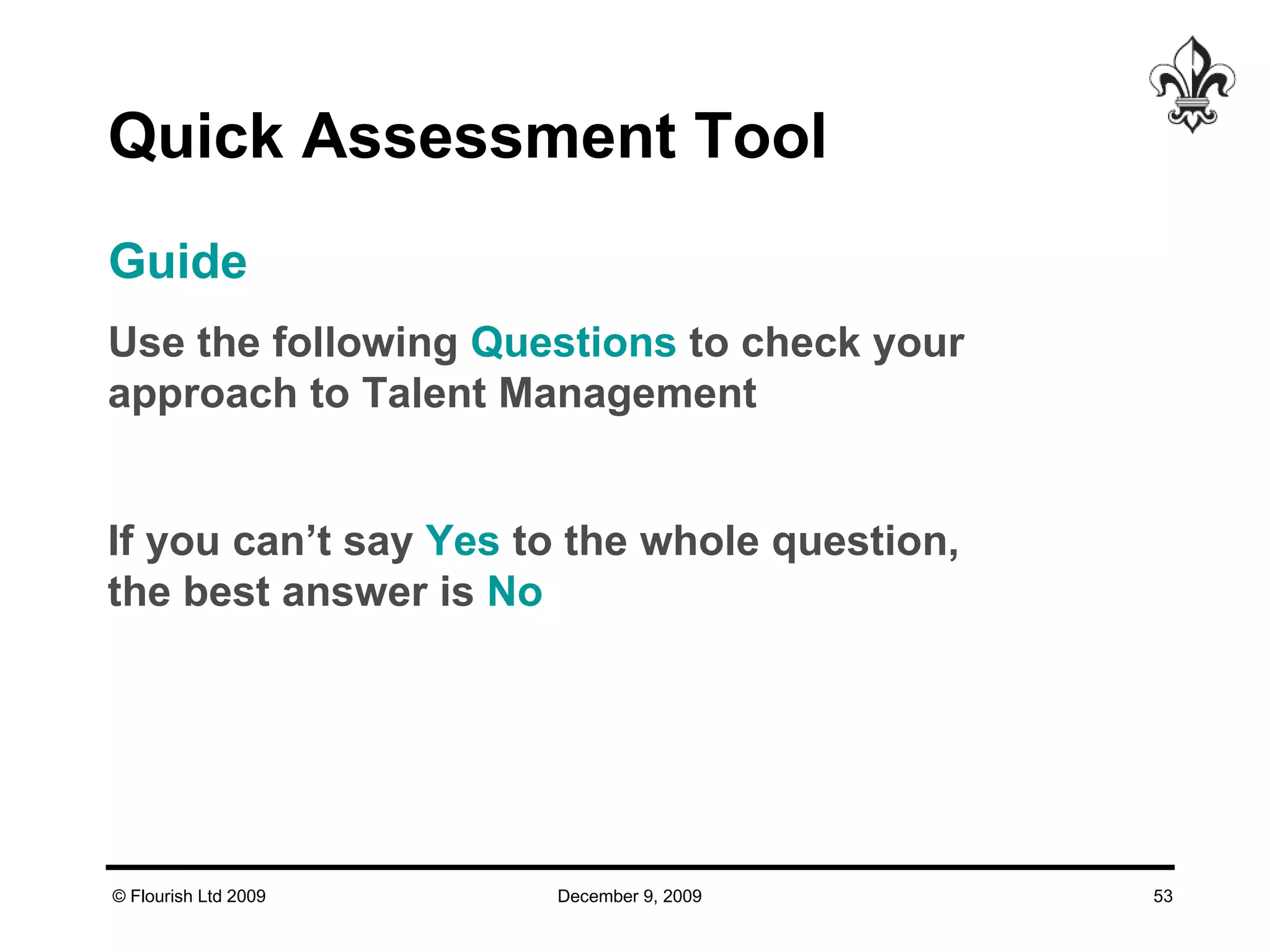
Quick Assessment Tool Use the following  Questions  to check your approach to Talent Management If you can’t say  Yes  to the whole question, the best answer is  No Guide
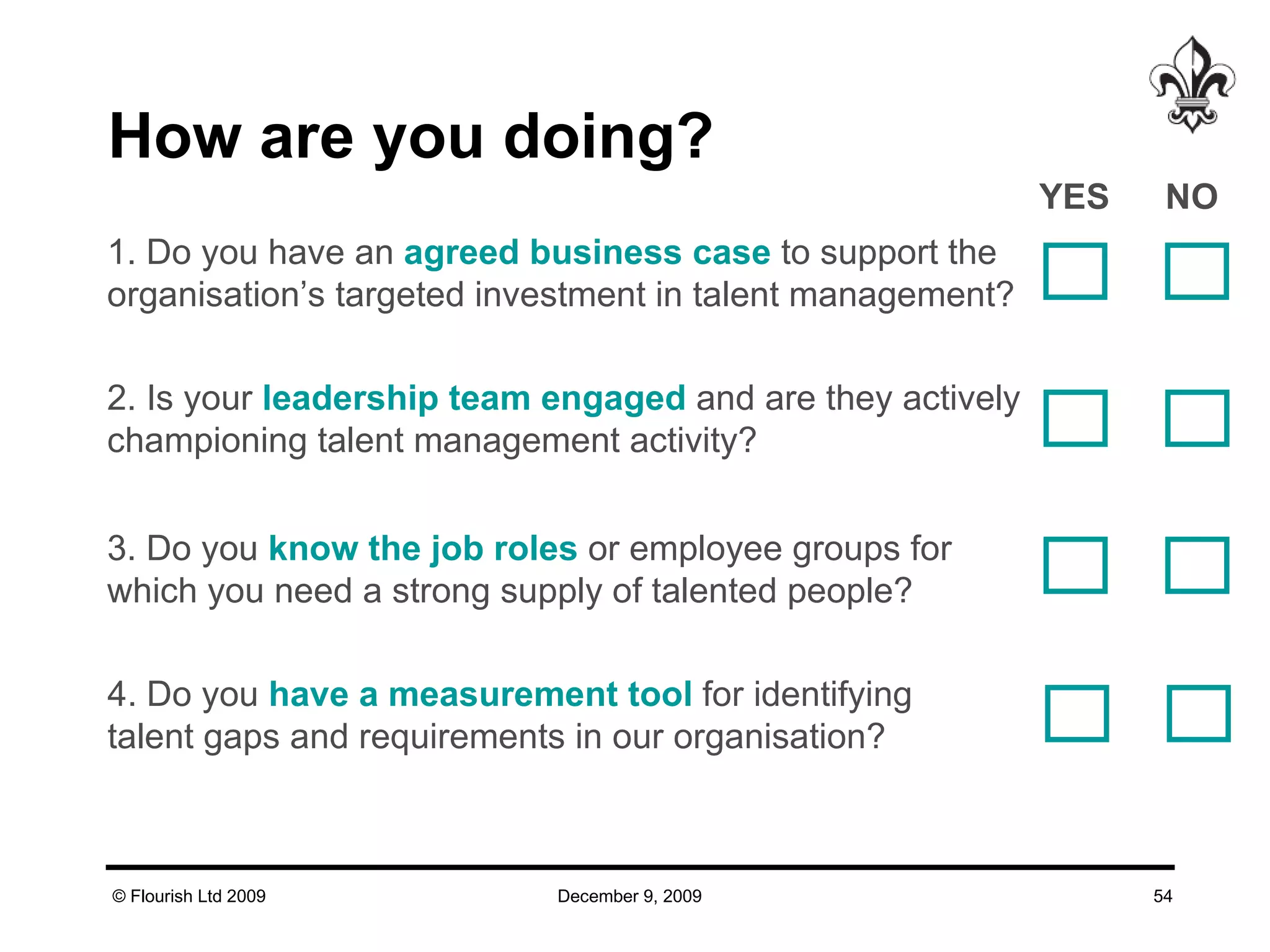
How are you doing? 1. Do you have an  agreed   business case  to support the organisation’s targeted investment in talent management?  2. Is your  leadership team engaged  and are they actively  championing talent management activity?  3. Do you  know the job roles  or employee groups for which you need a strong supply of talented people?  4. Do you  have a   measurement tool  for identifying talent gaps and requirements in our organisation?  YES NO
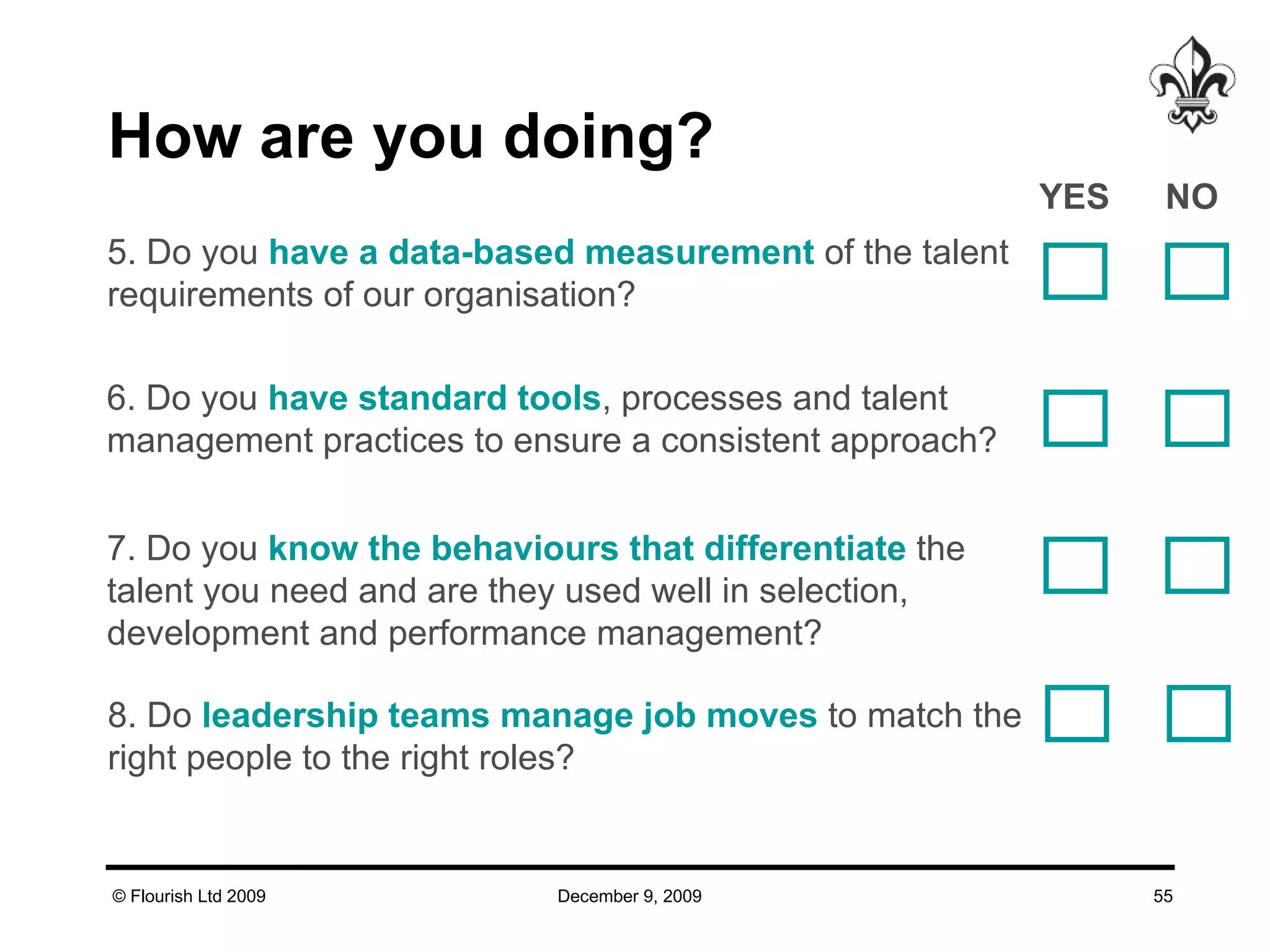
How are you doing? 5. Do you  have a data-based measurement  of the talent requirements of our organisation?  6. Do you  have standard tools , processes and talent management practices to ensure a consistent approach?  7. Do you  know the behaviours that differentiate  the talent you need and are they used well in selection, development and performance management?  8. Do  leadership teams   manage job moves  to match the right people to the right roles?  YES NO
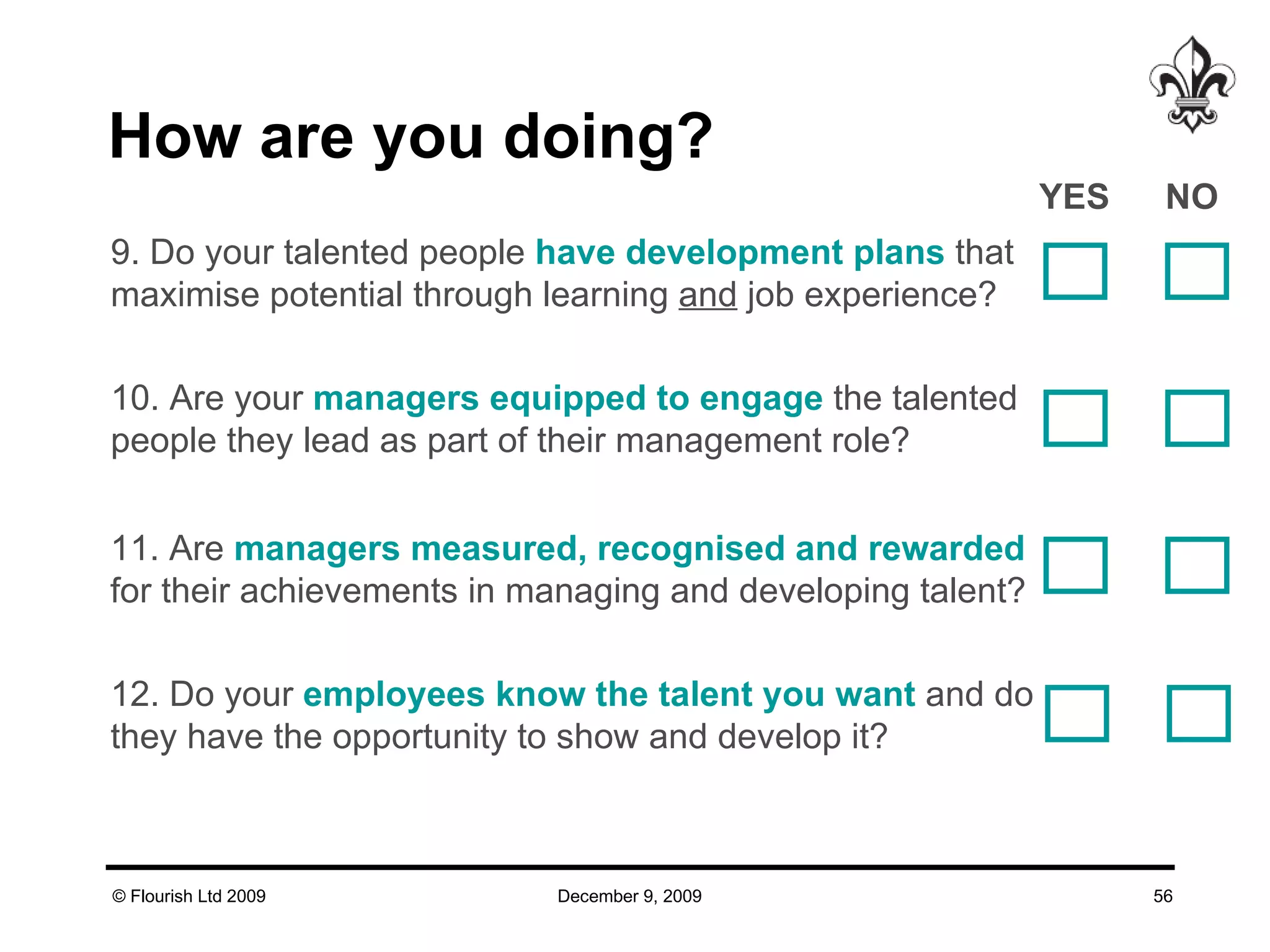
How are you doing? 9. Do your talented people  have development plans  that maximise potential through learning  and  job experience?  10. Are your  managers equipped to engage  the talented people they lead as part of their management role?  11. Are  managers measured, recognised and rewarded for their achievements in managing and developing talent?  12. Do your  employees know the talent you want  and do they have the opportunity to show and develop it?  YES NO
How are you doing? What are your priorities? How will you work on them?
For more information: www. flourishltd .com tim . [email_address] .com Flourish  provides solutions for: Executives  Leaders HR business partners Consultants, coaches and facilitators  We have expertise in: Leadership Development  Talent Management Employee Engagement Organisation Development Tim Coburn  has more than 20 years experience in senior positions at the BBC, Motorola and Rolls-Royce in talent management, leadership development, OD and learning and development. He is Managing Director of Flourish, a specialist provider of high value performance and development solutions. He is a Visiting Fellow at the International Centre for Talent Management and Development at Nottingham Business School, England.

Managing Leadership Talent

  • 1.
    Managing Leadership TalentTim Coburn Flourish Ltd Visiting Fellow at Nottingham Business School International Centre for Talent Management and Development February 2009
  • 2.
    What to expectResponsible for talent? This is for you Practical tools and things that work Use it to check what you’re doing
  • 3.
    STRATEGIC DECISIONS FINDCUSTOMER REQUIREMENTS PERFORMANCE MANAGEMENT PLUS ENGAGE DEVELOP MOVE MEASURE Talent Management
  • 4.
    Start here Whois your customer? What is on their mind? What do they need from you? How will they measure your success?
  • 5.
    It’s 5 things,done well Practical tools for managing talent: Measure Find Engage Develop Move
  • 6.
  • 7.
    Measure Your TalentGap: Tool 1 * Data are illustrative only and do not represent any organisation. ROLES MD Ops D Sales D Dist D FD HRD POSITIONS 4 12 6 6 3 17 READY NOW 1 7 10 8 1 24 RATIO 1:1 1:1 1:1 1:1 1:1 1:1 TARGET 4 12 6 6 3 17 NET SUPPLY (3) (5) 4 2 (2) 7 TOTAL 48 51 1:1 48 3 GAP + 3
  • 8.
  • 9.
    Review Advantages Quickand easy to prepare Data evidence builds confidence Helps to spot gaps for critical roles Limitations No data on current incumbents Relies on reliability of succession plans Based more on numbers than capability
  • 10.
    Measure Your TalentGap - Tool 2 * Data are illustrative only and do not represent any organisation. ROLES MD Ops D Sales D Dist D FD HRD POSITIONS 4 12 6 6 3 17 READY IN 3 YRS 0 7 2 12 8 3 RATIO 2:1 2:1 2:1 2:1 2:1 2:1 TARGET 8 24 12 12 6 34 NET SUPPLY (8) (17) (10) 0 2 (31) TOTAL 48 32 2:1 96 (64) GAP - 64 Long Term Planning
  • 11.
    Review Additional Advantages?Additional Limitations?
  • 12.
    Review AdditionalAdvantages Provides long term view - a look down the pipe Points to strategic importance of talent Shows who is/is not managing talent well Encourages line accountability for talent Additional Limitations No data on likely shape of future organisation No data on when replacements are required Based only on internal supply
  • 13.
    Measure Your TalentGap - Tool 3 * Data are illustrative only and do not represent any organisation. Will all transfer? Probably not Currently Open Estimate 2% (12) Expected Retirements Age 58+ 3% per yr (54) Expected Deleted Positions 10% This Yr 60 Expected New Positions 2% pa (36) 2008-11 ‘ Talent’ Positions to Fill (192) Expected Normal Turnover 5% per yr (90) No. of ‘ Talent’ Positions 2008 600
  • 14.
    Review Additional Advantages?Additional Limitations?
  • 15.
    Measure: Review Additional Advantages Anticipates employee & organisation changes Measures overall demand Supports business case for investment Additional Limitations Historical trend does not predict the future Employability of people in deleted roles Still not addressing capability needs
  • 16.
  • 17.
    Big question Leadershiptalent? What exactly, are you looking for? Let’s try an experiment…
  • 18.
    Experiment Think of3 people from different walks of life who show great leadership talent Not professional, technical, sporting or artistic excellence Generic ability that differentiates their leadership from others’
  • 19.
    What’s it about?3 abilities that differentiate them How well they…. How effectively they… How consistently they…
  • 20.
    Research says it’sabout How well you think How well you influence others How hard you try How well you adapt to change How confident you are Source: Independent Research/Review of Literature undertaken on behalf of Rolls-Royce plc, 2006 Judgement Breadth Persuade Take others with you Deliver results Determination Innovative Willing to change/seek change Learn from experience Initiative Courage
  • 21.
    Out of interestHow do you define leadership talent in your organisation?
  • 22.
    Know what you’relooking for Identify what differentiates - in your organisation Ask and involve those who really know Look at the research and combine the two Select 3 - 5 factors as behavioural indicators Define evidence statements in simple language Test and agree with line management Communicate and train managers to know what it means - they are responsible for finding it
  • 23.
    Deploy to findor draw it out In Recruitment Job adverts, role descriptions, leadership brand In Selection Criteria for jobs, promotion, talent pools, succession plans, development centres and programmes In Development In individual development planning, programme design, coaching In Performance Management 360 feedback, behavioural performance review In Reward Recognition schemes, leadership awards
  • 24.
    Find: Review Howdoes your current approach align to the research? What improvements could you make?
  • 25.
  • 26.
    The Case for Engagement is High Companies with Achieve more than And more than High Employee Engagement 5% greater Operating Margin 3% greater Net Profit Margin Source: ‘Closing the Engagement Gap’, Towers Perrin, 2008
  • 27.
    But, so is Engagement is improved by many things pay vision and values brand boss culture purpose job itself security work-life balance Performance And we use Performance Management to deal with that
  • 28.
    So, why notadd And call it Engagement Performance Management Performance Management Plus to + =
  • 29.
    Performance Management Plus Perform Develop Perform Develop Engage From this To this Performance Management Performance Management Plus Like Performance and Development, Engagement is a management responsibility. It’s part of the same Conversation
  • 30.
    Efficient integration PerformDevelop Engage explain the corporate landscape understand what personally motivates make the vital connection and listen, align and adapt set performance objectives review progress give performance feedback and reward identify capability gaps build development plans give development feedback and coach
  • 31.
    Engagement Tool for Line Managers What the future here looks like Where I believe we need to be Why it’s important we get there Why it matters to me How we want to engage you 1. Leader describes a realistic corporate landscape What my future looks like Where I believe I want to be Why it’s important I get there Why it matters to me How I need to be more engaged 2. Employee explains what motivates and engages them What our customers need from us both How the work we need to do can engage me How the organisation can help me do my best What more we need from each other How we can fill any gaps in engagement 3. Leader and employee make the vital connection Listen, align and adapt It starts here 4. They both work at improving engagement
  • 32.
    Engage: Review Thebenefits of engagement are high How are you engaging leadership talent? Who is responsible? What more can be done?
  • 33.
  • 34.
    Your experience? Whereis most investment? … … … What is most effective? … … … In your experience, how do organisations develop leadership talent?
  • 35.
    Source: ‘How ExecutivesGrow’ McKinsey Quarterly, 2000 Importance to Personal Development: Rated ‘Absolutely Essential’ or ‘Very Important’ Effectiveness of Company: Rated ‘Excellent’ or ‘Very Good’ 0 10 20 30 40 50 60 70 80 90 0 10 20 30 40 50 60 70 80 Way Jobs are Structured Special Projects Speed of Job Moves Role Models Told Strengths & Weaknesses Informal Coaching and Feedback 360 Feedback Mentoring Traditional External Training Traditional Internal Training Non traditional Learning Individual Learning Formal Performance Evaluation Job Rotation Development Plans Outside Testing THE JOB ITSELF FEEDBACK & COACHING FORMAL TRAINING KEY
  • 36.
    What do youthink? The case for ‘the job’ + feedback is clear Is the shift to coaching getting results? It depends on the coaching
  • 37.
    Coaching and FeedbackWhat have you learned from experience? What is emerging as ‘good practice’?
  • 38.
    Develop: A CoachingTool Identify the behaviour you need to improve Choose colleagues you respect and get them involved Ask them for advice on how to do better Listen, understand and decide what to do Make an action plan and implement it Ask for feedback, advice and support Practice to make it consistently good Review your results with the colleagues involved Thank them for their help and start over again… With acknowledgements to Marshall Goldsmith, www.marshallgoldsmithlibrary.com
  • 39.
    Essentials for Success Leader wants to improve Focus on 1 (no more than 3) behaviours Respected colleagues are invited and agree to take part Colleagues give constructive feedback Coach ensures the quality of the process Use data as a reference point for progress
  • 40.
    Initial Assessment 1 st Review 2 nd Review Leadership Development Progress Review with Colleagues Behaviour to Develop Medium High Low Very Low Very High 0 1 2 3 4 0 1 2 3 4 0 1 2 3 4
  • 41.
    Initial Assessment 1 st Review 2 nd Review Leadership Development Progress Review with Colleagues Behaviour to Develop Medium High Low Very Low Very High 0 1 2 3 4 0 1 2 3 4 0 1 2 3 4
  • 42.
    At Least 3Good Meetings Meeting 1 – Client and Coach Learn about the coaching process, decide what you want to improve, choose colleagues to involve and plan how to get initial feedback and advice. Meeting 2 – Client, Colleagues and Coach Review feedback with colleagues, choose 1-3 behaviours you want to improve, rate your current effectiveness and agree an action plan. Implement the plan. Ask for feedback as you go Meeting 3 – Client, Colleagues and Coach Listen to feedback about the progress you have made, rate effectiveness again, plan further improvement actions and evaluate the coaching process
  • 43.
    Coaching Tool: ReviewAdvantages? Limitations?
  • 44.
    Coaching Tool: ReviewAdvantages Leader decides ‘just one thing’ to improve Colleagues make it a team effort Accountability is high for everyone involved Results happen quickly Limitations Team involvement subject to availability Complex issues will take longer
  • 45.
  • 46.
    What’s the goal?KEY ROLE KEY TRANSITION MANAGE SELF MANAGE OTHERS MANAGE MANAGERS MANAGE A FUNCTION MANAGE A BUSINESS GROUP EXECUTIVE MANAGE THE ENTERPRISE LEADERSHIP TRANSITIONS Source: ‘The Leadership Pipeline’, 2001 by R Charan, S Drotter, J Noel
  • 47.
    Shift From: ‘Dive and catch’ To: ‘ Ready on time’
  • 48.
    Move: Goal Agood supply of capable leaders Right people into the right roles Owned by line management Reward for the ‘generators of talent’
  • 49.
    Move: How? Genericcareer roadmaps - for key roles Customised career roadmaps - for key talent Minimum critical requirements eg ‘2+2+2’ 2 Businesses, 2 Functions, 2 Regions Company goal and Employee aspiration Agreed by Executives, enabled by HR Mitigate hoarding with Rules of Engagement ‘ If ready, right for the job and willing to move, they move!’
  • 50.
    Move: Review Howto get line management doing it? How do you reward talent management?
  • 51.
    STRATEGIC DECISIONS FINDCUSTOMER REQUIREMENTS PERFORMANCE MANAGEMENT PLUS ENGAGE DEVELOP MOVE MEASURE Talent Management
  • 52.
  • 53.
    Quick Assessment ToolUse the following Questions to check your approach to Talent Management If you can’t say Yes to the whole question, the best answer is No Guide
  • 54.
    How are youdoing? 1. Do you have an agreed business case to support the organisation’s targeted investment in talent management? 2. Is your leadership team engaged and are they actively championing talent management activity? 3. Do you know the job roles or employee groups for which you need a strong supply of talented people? 4. Do you have a measurement tool for identifying talent gaps and requirements in our organisation? YES NO
  • 55.
    How are youdoing? 5. Do you have a data-based measurement of the talent requirements of our organisation? 6. Do you have standard tools , processes and talent management practices to ensure a consistent approach? 7. Do you know the behaviours that differentiate the talent you need and are they used well in selection, development and performance management? 8. Do leadership teams manage job moves to match the right people to the right roles? YES NO
  • 56.
    How are youdoing? 9. Do your talented people have development plans that maximise potential through learning and job experience? 10. Are your managers equipped to engage the talented people they lead as part of their management role? 11. Are managers measured, recognised and rewarded for their achievements in managing and developing talent? 12. Do your employees know the talent you want and do they have the opportunity to show and develop it? YES NO
  • 57.
    How are youdoing? What are your priorities? How will you work on them?
  • 58.
    For more information:www. flourishltd .com tim . [email_address] .com Flourish provides solutions for: Executives Leaders HR business partners Consultants, coaches and facilitators We have expertise in: Leadership Development Talent Management Employee Engagement Organisation Development Tim Coburn has more than 20 years experience in senior positions at the BBC, Motorola and Rolls-Royce in talent management, leadership development, OD and learning and development. He is Managing Director of Flourish, a specialist provider of high value performance and development solutions. He is a Visiting Fellow at the International Centre for Talent Management and Development at Nottingham Business School, England.