The document outlines an approach to leadership development that emphasizes understanding the 'why' and 'how' behind initiatives, rather than just the 'what', to foster long-term change and alignment with strategic goals. It describes a structured intervention design that incorporates diagnosis, assessment, and development phases, utilizing various methodologies to enhance participant learning and reflection. The approach also recognizes the importance of mindset alongside skills, advocating for collaborative learning experiences to ensure sustainable transformation.
Introduction to Leadership Development Programs and the organization's approach towards them.
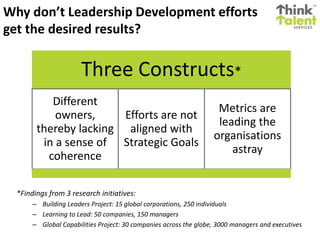
Identifies reasons for ineffective leadership development, based on three major research initiatives involving 15 global corporations and 3000 managers.
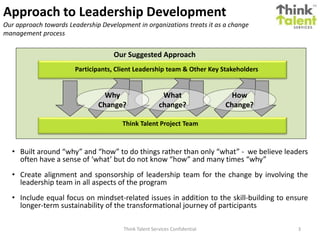
Proposes a change management approach focusing on understanding 'why', 'how', and aligning leadership teams for effective development.
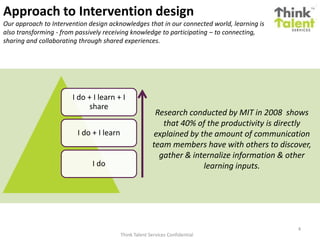
Discusses intervention design emphasizing interactive learning and collaboration, supported by MIT research showing the impact of communication on productivity.
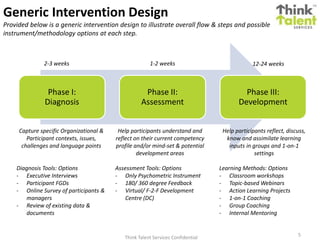
Outlines a generic intervention design consisting of diagnosis, assessment, and development phases with tools and timelines for each.
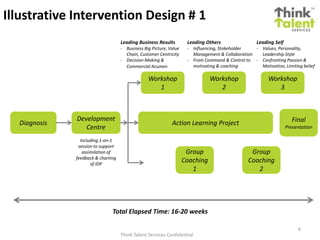
Details the first illustrative intervention design over 16-20 weeks focusing on business results and personal leadership competencies.
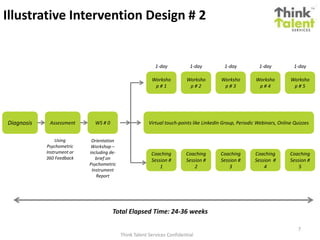
Describes a second illustrative intervention design lasting 24-36 weeks with multiple workshops and coaching sessions for participant development.
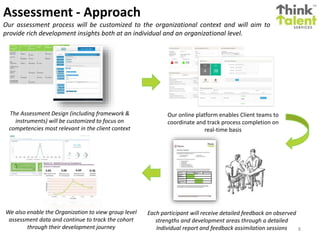
Outlines a tailored assessment process providing detailed feedback to individuals and organizational insights to track development.
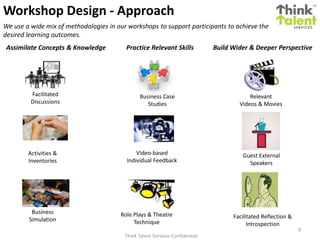
Explores diverse methodologies used in workshops, including role plays and simulations to support learning outcomes.
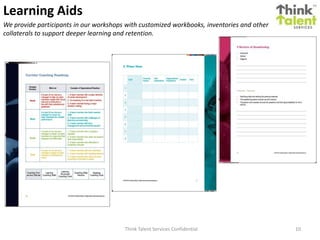
Highlights customized materials provided to workshop participants to enhance learning retention.
Provides corporate contact details for Think Talent Services across various locations in India.
Why don’t LeadershipDevelopment efforts
get the desired results?
*Findings from 3 research initiatives:
– Building Leaders Project: 15 global corporations, 250 individuals
– Learning to Lead: 50 companies, 150 managers
– Global Capabilities Project: 30 companies across the globe, 3000 managers and executives
Three Constructs*
Different
owners,
thereby lacking
in a sense of
coherence
Efforts are not
aligned with
Strategic Goals
Metrics are
leading the
organisations
astray
3.
Think Talent ServicesConfidential 3
Participants, Client Leadership team & Other Key Stakeholders
Think Talent Project Team
What
change?
Our Suggested Approach
• Built around “why” and “how” to do things rather than only “what” - we believe leaders
often have a sense of ‘what’ but do not know “how” and many times “why”
• Create alignment and sponsorship of leadership team for the change by involving the
leadership team in all aspects of the program
• Include equal focus on mindset-related issues in addition to the skill-building to ensure
longer-term sustainability of the transformational journey of participants
Why
Change?
How
Change?
Approach to Leadership Development
Our approach towards Leadership Development in organizations treats it as a change
management process
4.
Approach to Interventiondesign
Our approach to Intervention design acknowledges that in our connected world, learning is
also transforming - from passively receiving knowledge to participating – to connecting,
sharing and collaborating through shared experiences.
Think Talent Services Confidential
4
I do + I learn + I
share
I do + I learn
I do
Research conducted by MIT in 2008 shows
that 40% of the productivity is directly
explained by the amount of communication
team members have with others to discover,
gather & internalize information & other
learning inputs.
5.
Think Talent ServicesConfidential
5
Phase I:
Diagnosis
Phase II:
Assessment
Phase III:
Development
Capture specific Organizational &
Participant contexts, issues,
challenges and language points
Diagnosis Tools: Options
- Executive Interviews
- Participant FGDs
- Online Survey of participants &
managers
- Review of existing data &
documents
2-3 weeks 1-2 weeks 12-24 weeks
Generic Intervention Design
Provided below is a generic intervention design to illustrate overall flow & steps and possible
instrument/methodology options at each step.
Help participants understand and
reflect on their current competency
profile and/or mind-set & potential
development areas
Assessment Tools: Options
- Only Psychometric Instrument
- 180/ 360 degree Feedback
- Virtual/ F-2-F Development
Centre (DC)
Help participants reflect, discuss,
know and assimilate learning
inputs in groups and 1-on-1
settings
Learning Methods: Options
- Classroom workshops
- Topic-based Webinars
- Action Learning Projects
- 1-on-1 Coaching
- Group Coaching
- Internal Mentoring
6.
Think Talent ServicesConfidential
6
Diagnosis
Development
Centre
Workshop
1
Workshop
2
Workshop
3
Action Learning Project
Group
Coaching
1
Group
Coaching
2
Final
Presentation
Total Elapsed Time: 16-20 weeks
Including 1-on-1
session to support
assimilation of
feedback & charting
of IDP
Illustrative Intervention Design # 1
Leading Business Results
- Business Big Picture, Value
Chain, Customer Centricity
- Decision-Making &
Commercial Acumen
Leading Others
- Influencing, Stakeholder
Management & Collaboration
- From Command & Control to
motivating & coaching
Leading Self
- Values, Personality,
Leadership Style
- Confronting Passion &
Motivation, Limiting belief
7.
Illustrative Intervention Design# 2
Think Talent Services Confidential
7
Diagnosis Assessment
Worksho
p # 1
Total Elapsed Time: 24-36 weeks
Worksho
p # 2
Worksho
p # 3
Worksho
p # 4
Worksho
p # 5
Coaching
Session #
1
Coaching
Session #
2
Coaching
Session #
3
Coaching
Session #
4
Coaching
Session #
5
WS # 0 Virtual touch-points like LinkedIn Group, Periodic Webinars, Online Quizzes
Using
Psychometric
Instrument or
360 Feedback
Orientation
Workshop –
including de-
brief on
Psychometric
Instrument
Report
1-day 1-day 1-day 1-day 1-day
8.
Assessment - Approach
Ourassessment process will be customized to the organizational context and will aim to
provide rich development insights both at an individual and an organizational level.
8
Each participant will receive detailed feedback on observed
strengths and development areas through a detailed
Individual report and feedback assimilation sessions
We also enable the Organization to view group level
assessment data and continue to track the cohort
through their development journey
The Assessment Design (including framework &
instruments) will be customized to focus on
competencies most relevant in the client context
Our online platform enables Client teams to
coordinate and track process completion on
real-time basis
9.
Workshop Design -Approach
Think Talent Services Confidential
9
Video-based
Individual Feedback
Role Plays & Theatre
Technique
Activities &
Inventories
We use a wide mix of methodologies in our workshops to support participants to achieve the
desired learning outcomes.
Business
Simulation
Guest External
Speakers
Facilitated
Discussions
Business Case
Studies
Relevant
Videos & Movies
Assimilate Concepts & Knowledge Practice Relevant Skills Build Wider & Deeper Perspective
Facilitated Reflection &
Introspection
10.
Think Talent ServicesConfidential 10
Learning Aids
We provide participants in our workshops with customized workbooks, inventories and other
collaterals to support deeper learning and retention.