1
Prepared By: Zohra Rubab
Bill Gates once said,
“Take our twenty best people away from us and I
can tell you that
Microsoft would be an unimportant company.”
2
Prepared By: Zohra Rubab
3
Prepared By: Zohra Rubab
4
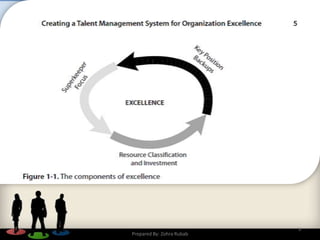
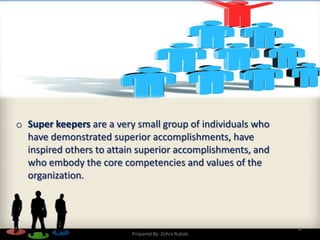
o Super keepers are a very small group of individuals who
have demonstrated superior accomplishments, have
inspired others to attain superior accomplishments, and
who embody the core competencies and values of the
organization.
Prepared By: Zohra Rubab
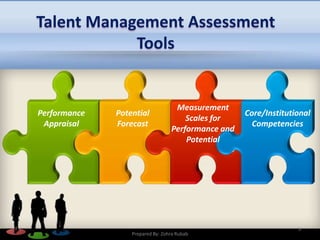
Talent Management Assessment
Tools
5
Performance
Appraisal
Potential
Forecast
Measurement
Scales for
Performance and
Potential
Core/Institutional
Competencies
Prepared By: Zohra Rubab
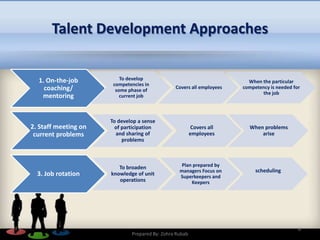
1. On-the-job
coaching/
mentoring
To develop
competencies in
some phase of
current job
Covers all employees
When the particular
competency is needed for
the job
2. Staff meeting on
current problems
To develop a sense
of participation
and sharing of
problems
Covers all
employees
When problems
arise
3. Job rotation
To broaden
knowledge of unit
operations
Plan prepared by
managers Focus on
Superkeepers and
Keepers
scheduling
Talent Development Approaches
6
Prepared By: Zohra Rubab
7
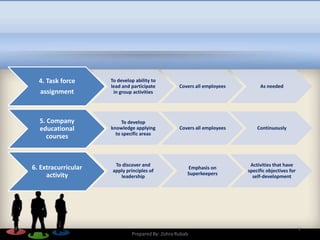
4. Task force
assignment
To develop ability to
lead and participate
in group activities
Covers all employees As needed
5. Company
educational
courses
To develop
knowledge applying
to specific areas
Covers all employees Continuously
6. Extracurricular
activity
To discover and
apply principles of
leadership
Emphasis on
Superkeepers
Activities that have
specific objectives for
self-development
Prepared By: Zohra Rubab
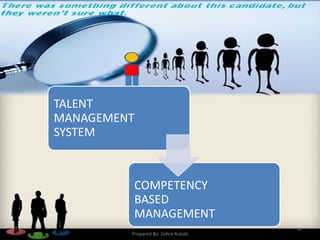
TALENT
MANAGEMENT
SYSTEM
COMPETENCY
BASED
MANAGEMENT
8
Prepared By: Zohra Rubab
What is competency?
• An underlying characteristic of a person/organization which enables to
deliver performance in a given job, role or a situation.
 Job related competencies
 Personal competencies
9
Prepared By: Zohra Rubab
10
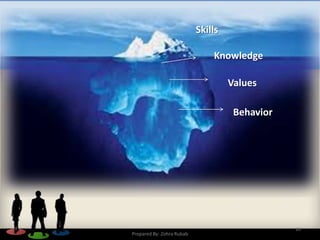
Skills
Knowledge
Values
Behavior
Prepared By: Zohra Rubab
DEVELOPING TALENT MANAGEMENT SYSTEM
Four Step Process
1. List of Organization’s Core competencies &
Assessment tools
2. Training & Development solution
3. Assessment of Employees’ Core competencies &
“Potential forecast”
4. Action Plans
11
Prepared By: Zohra Rubab
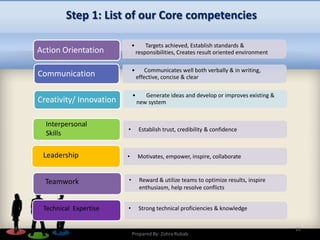
Step 1: List of our Core competencies
12
• Targets achieved, Establish standards &
responsibilities, Creates result oriented environmentAction Orientation
• Communicates well both verbally & in writing,
effective, concise & clearCommunication
• Generate ideas and develop or improves existing &
new systemCreativity/ Innovation
Interpersonal
Skills
• Establish trust, credibility & confidence
Leadership • Motivates, empower, inspire, collaborate
Teamwork • Reward & utilize teams to optimize results, inspire
enthusiasm, help resolve conflicts
Technical Expertise • Strong technical proficiencies & knowledge
Prepared By: Zohra Rubab
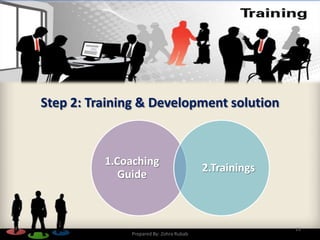
Step 2: Training & Development solution
1.Coaching
Guide
2.Trainings
13
Prepared By: Zohra Rubab
Step 3: Assessment of Employees’ Core competencies &
“Potential forecast”
o Substitute organization competencies & definition for the
sample competencies.
o (Refer to the step 1 worksheet)
14
Prepared By: Zohra Rubab
Step 4: Action Plans
Approaches to Action Plan
 Bench Strength Summary
 Individual Competency Assessment
15
Prepared By: Zohra Rubab
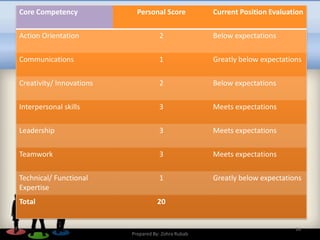
Core Competency Personal Score Current Position Evaluation
Action Orientation 2 Below expectations
Communications 1 Greatly below expectations
Creativity/ Innovations 2 Below expectations
Interpersonal skills 3 Meets expectations
Leadership 3 Meets expectations
Teamwork 3 Meets expectations
Technical/ Functional
Expertise
1 Greatly below expectations
Total 20
16
Prepared By: Zohra Rubab
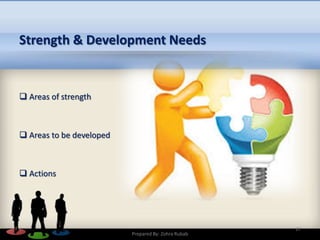
Strength & Development Needs
 Areas of strength
 Areas to be developed
 Actions
17
Prepared By: Zohra Rubab
18
Prepared By: Zohra Rubab
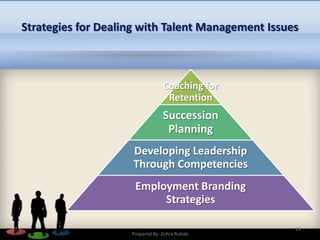
Coaching for
Retention
Succession
Planning
Developing Leadership
Through Competencies
Employment Branding
Strategies
Strategies for Dealing with Talent Management Issues
19
Prepared By: Zohra Rubab
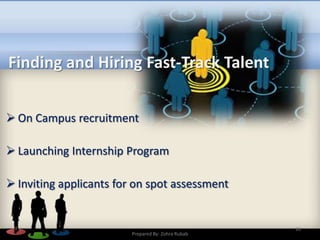
Finding and Hiring Fast-Track Talent
 On Campus recruitment
 Launching Internship Program
 Inviting applicants for on spot assessment
20
Prepared By: Zohra Rubab
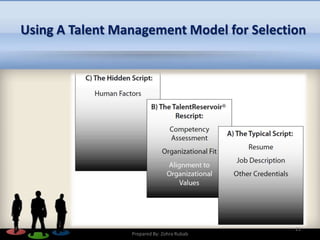
Using A Talent Management Model for Selection
21
Prepared By: Zohra Rubab
22
Prepared By: Zohra Rubab

Talent Management

  • 1.
  • 2.
    Bill Gates oncesaid, “Take our twenty best people away from us and I can tell you that Microsoft would be an unimportant company.” 2 Prepared By: Zohra Rubab
  • 3.
  • 4.
    4 o Super keepersare a very small group of individuals who have demonstrated superior accomplishments, have inspired others to attain superior accomplishments, and who embody the core competencies and values of the organization. Prepared By: Zohra Rubab
  • 5.
    Talent Management Assessment Tools 5 Performance Appraisal Potential Forecast Measurement Scalesfor Performance and Potential Core/Institutional Competencies Prepared By: Zohra Rubab
  • 6.
    1. On-the-job coaching/ mentoring To develop competenciesin some phase of current job Covers all employees When the particular competency is needed for the job 2. Staff meeting on current problems To develop a sense of participation and sharing of problems Covers all employees When problems arise 3. Job rotation To broaden knowledge of unit operations Plan prepared by managers Focus on Superkeepers and Keepers scheduling Talent Development Approaches 6 Prepared By: Zohra Rubab
  • 7.
    7 4. Task force assignment Todevelop ability to lead and participate in group activities Covers all employees As needed 5. Company educational courses To develop knowledge applying to specific areas Covers all employees Continuously 6. Extracurricular activity To discover and apply principles of leadership Emphasis on Superkeepers Activities that have specific objectives for self-development Prepared By: Zohra Rubab
  • 8.
  • 9.
    What is competency? •An underlying characteristic of a person/organization which enables to deliver performance in a given job, role or a situation.  Job related competencies  Personal competencies 9 Prepared By: Zohra Rubab
  • 10.
  • 11.
    DEVELOPING TALENT MANAGEMENTSYSTEM Four Step Process 1. List of Organization’s Core competencies & Assessment tools 2. Training & Development solution 3. Assessment of Employees’ Core competencies & “Potential forecast” 4. Action Plans 11 Prepared By: Zohra Rubab
  • 12.
    Step 1: Listof our Core competencies 12 • Targets achieved, Establish standards & responsibilities, Creates result oriented environmentAction Orientation • Communicates well both verbally & in writing, effective, concise & clearCommunication • Generate ideas and develop or improves existing & new systemCreativity/ Innovation Interpersonal Skills • Establish trust, credibility & confidence Leadership • Motivates, empower, inspire, collaborate Teamwork • Reward & utilize teams to optimize results, inspire enthusiasm, help resolve conflicts Technical Expertise • Strong technical proficiencies & knowledge Prepared By: Zohra Rubab
  • 13.
    Step 2: Training& Development solution 1.Coaching Guide 2.Trainings 13 Prepared By: Zohra Rubab
  • 14.
    Step 3: Assessmentof Employees’ Core competencies & “Potential forecast” o Substitute organization competencies & definition for the sample competencies. o (Refer to the step 1 worksheet) 14 Prepared By: Zohra Rubab
  • 15.
    Step 4: ActionPlans Approaches to Action Plan  Bench Strength Summary  Individual Competency Assessment 15 Prepared By: Zohra Rubab
  • 16.
    Core Competency PersonalScore Current Position Evaluation Action Orientation 2 Below expectations Communications 1 Greatly below expectations Creativity/ Innovations 2 Below expectations Interpersonal skills 3 Meets expectations Leadership 3 Meets expectations Teamwork 3 Meets expectations Technical/ Functional Expertise 1 Greatly below expectations Total 20 16 Prepared By: Zohra Rubab
  • 17.
    Strength & DevelopmentNeeds  Areas of strength  Areas to be developed  Actions 17 Prepared By: Zohra Rubab
  • 18.
  • 19.
    Coaching for Retention Succession Planning Developing Leadership ThroughCompetencies Employment Branding Strategies Strategies for Dealing with Talent Management Issues 19 Prepared By: Zohra Rubab
  • 20.
    Finding and HiringFast-Track Talent  On Campus recruitment  Launching Internship Program  Inviting applicants for on spot assessment 20 Prepared By: Zohra Rubab
  • 21.
    Using A TalentManagement Model for Selection 21 Prepared By: Zohra Rubab
  • 22.

Editor's Notes

  • #5 1.Superkeeper: They impact organizational growth
  • #6 *Measurement scales for performance and potential: The most common scale for performance measurement is:greatly exceeds expectations (5), exceeds expectations (4), meets expectations(3), below expectations (2), greatly below expectations (1). The most commonscale for potential assessment is: high potential (5), promotable (4), lateral (3),marginal (2), none (1).
  • #16 *Reason for not preferring Bench Strength Summary is limited career growth within department