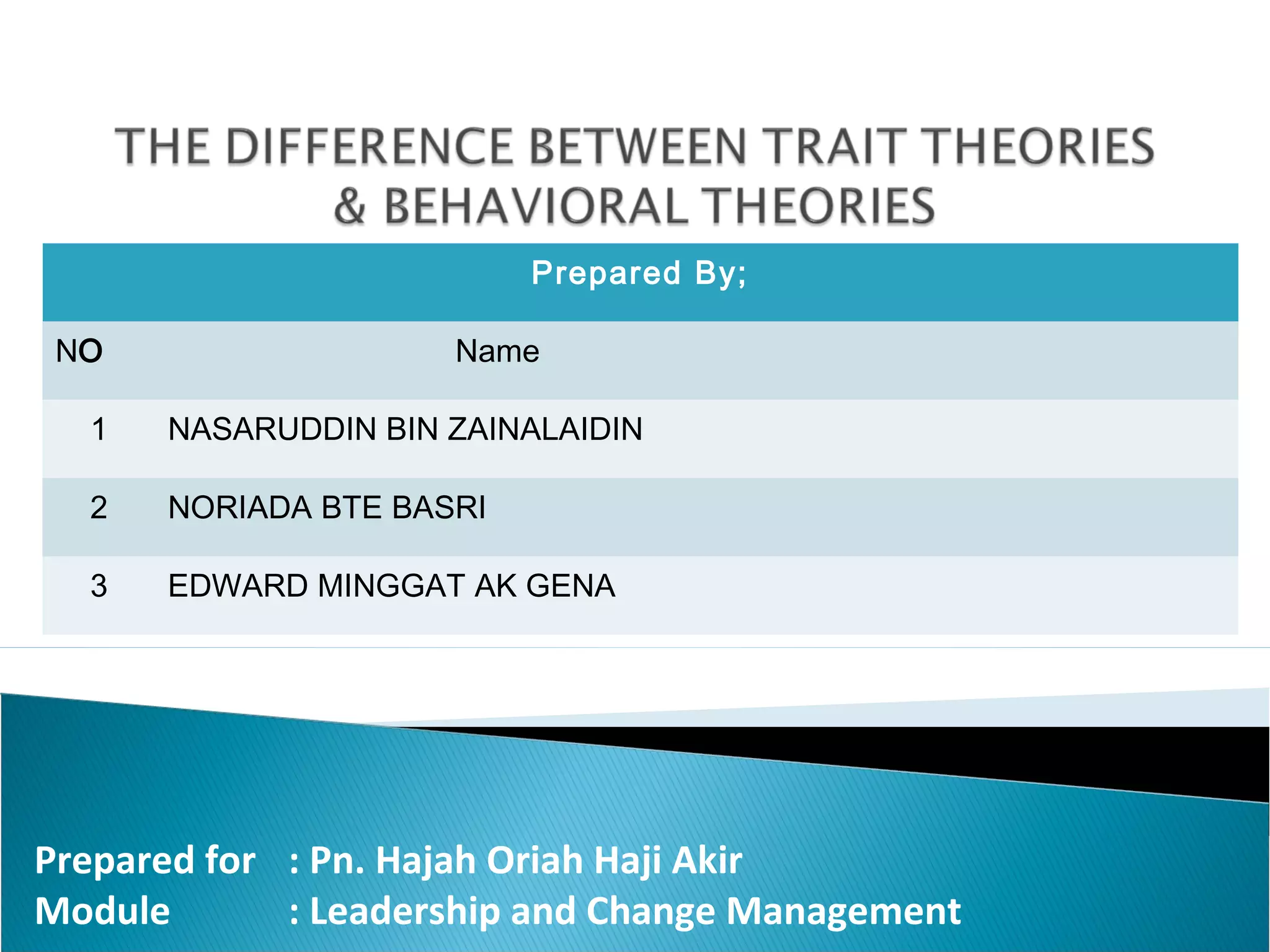
Prepared By;
NO Name
1 NASARUDDIN BIN ZAINALAIDIN
2 NORIADA BTE BASRI
3 EDWARD MINGGAT AK GENA
Prepared for : Pn. Hajah Oriah Haji Akir
Module : Leadership and Change Management
The purpose of the presentation is to
discuss the differences between traits
theories and behavioral theories of
leadership
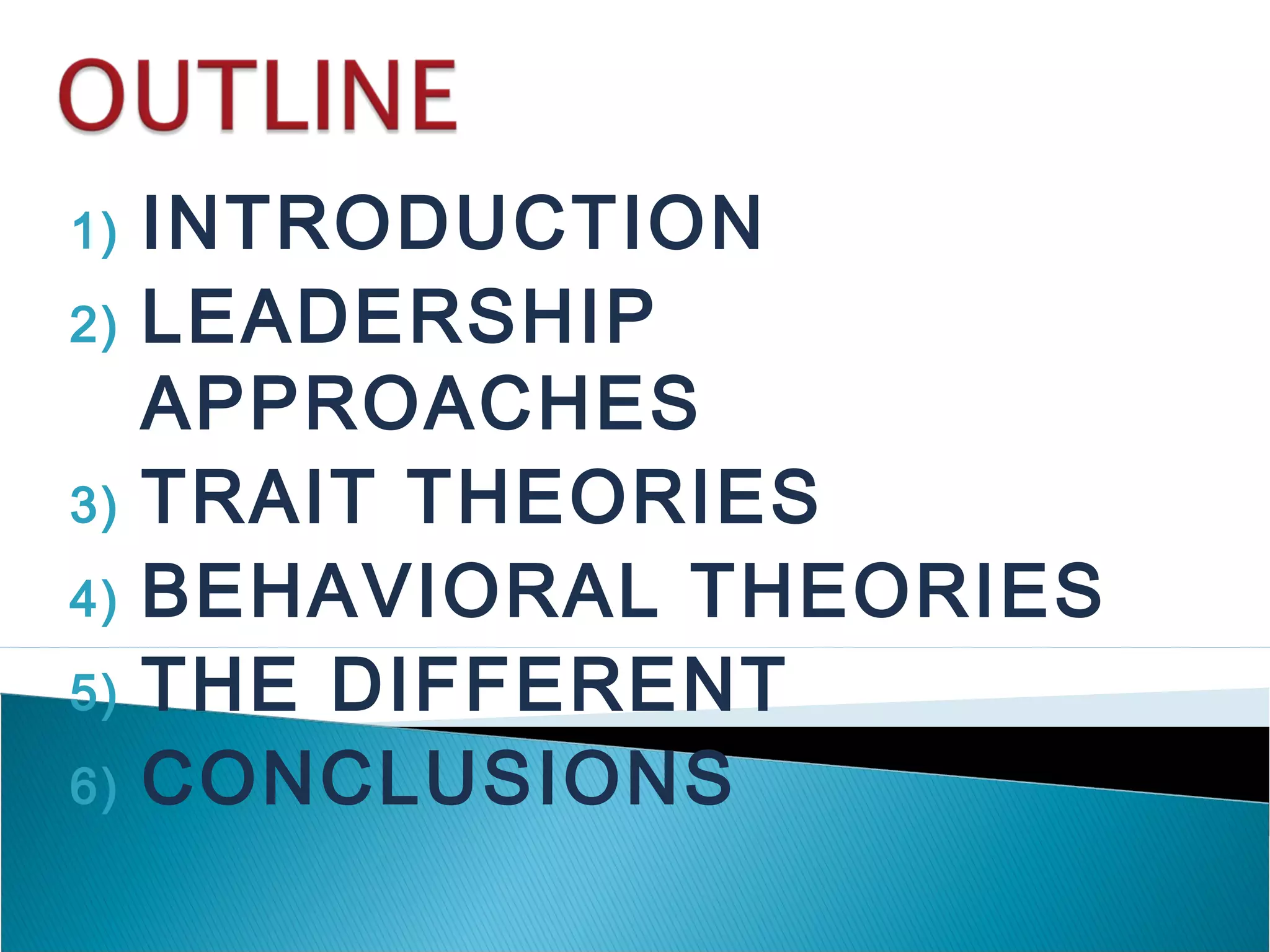
1) INTRODUCTION
2) LEADERSHIP
APPROACHES
3) TRAIT THEORIES
4) BEHAVIORAL THEORIES
5) THE DIFFERENT
6) CONCLUSIONS
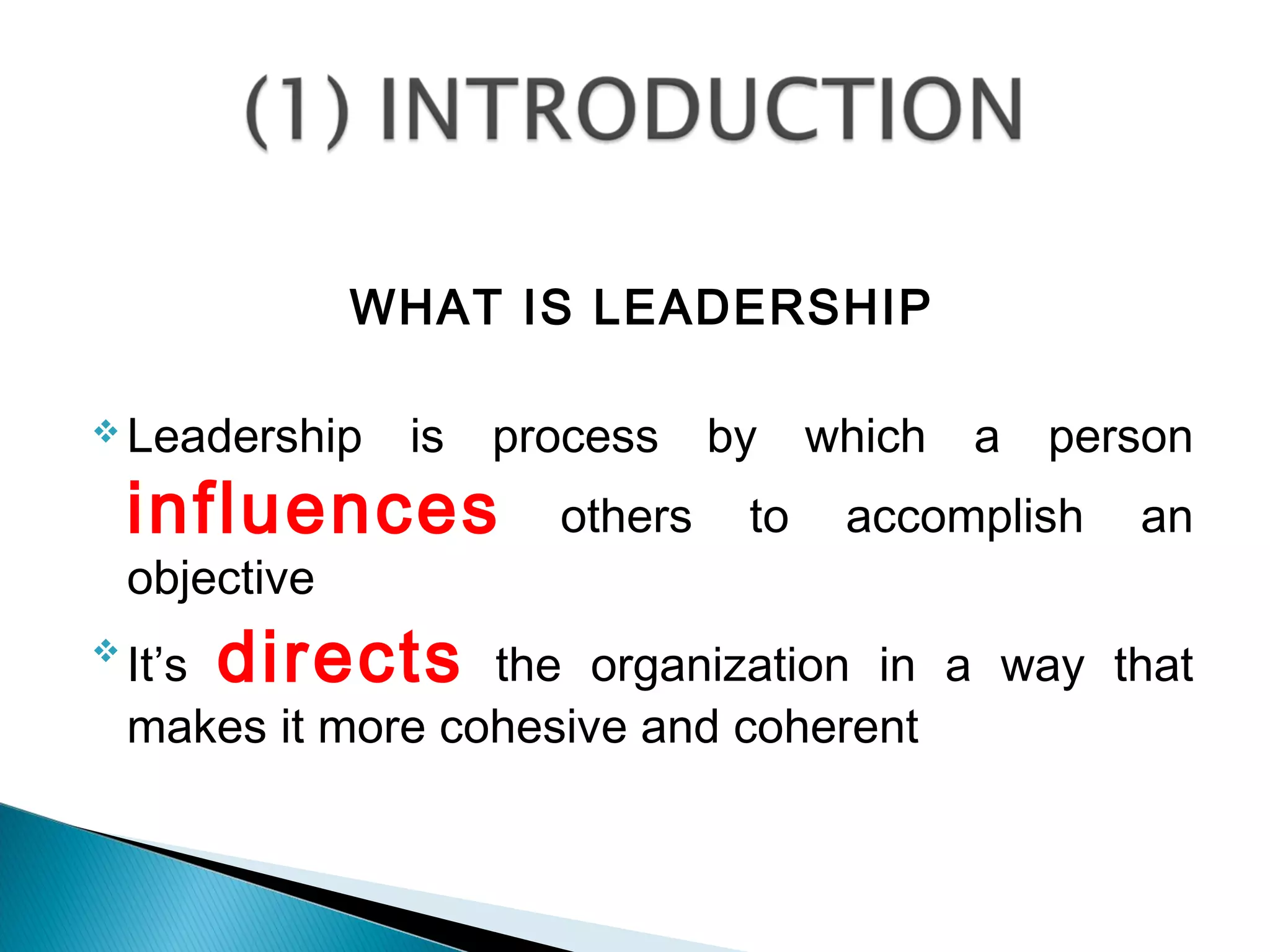
WHAT IS LEADERSHIP
 Leadership is process by which a person
influences others to accomplish an
objective

It’s directs the organization in a way that
makes it more cohesive and coherent
WHY DO WE NEED LEADERS
 Group need to stay orderly and focused
 To accomplish tasks
 To make sense of the world
 Romantic ideal
LEADERSHIP EFFECTIVENESS
Characteristics of leaders
Characteristics of followers
Characteristics of the situation
 Approaches to understand leadership.
 5 approaches to leadership:-
1. Trait Approaches
2. Behavioral Theories of Leadership
3. Power-Influence Approaches
4. Situational Approaches
5. Integrative Approaches
 Theories that consider personality, social, physical or
intellectual to differentiate leaders from non leaders.
 A “virtue theory” of leadership.
 Trait theory stresses that there is a certain set of
basic personality markers that set leaders apart from
followers.
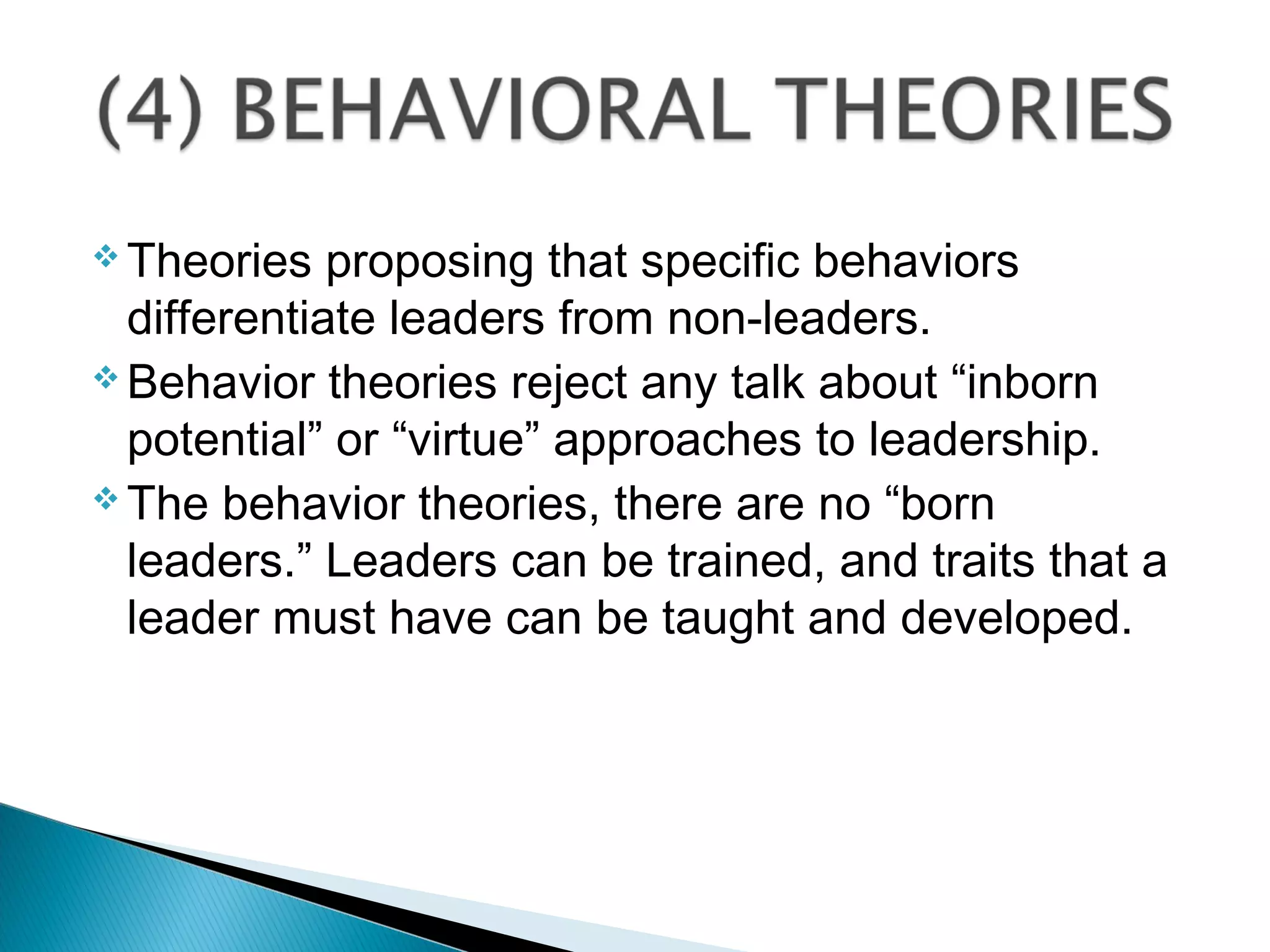
 Theories proposing that specific behaviors
differentiate leaders from non-leaders.
 Behavior theories reject any talk about “inborn
potential” or “virtue” approaches to leadership.
 The behavior theories, there are no “born
leaders.” Leaders can be trained, and traits that a
leader must have can be taught and developed.
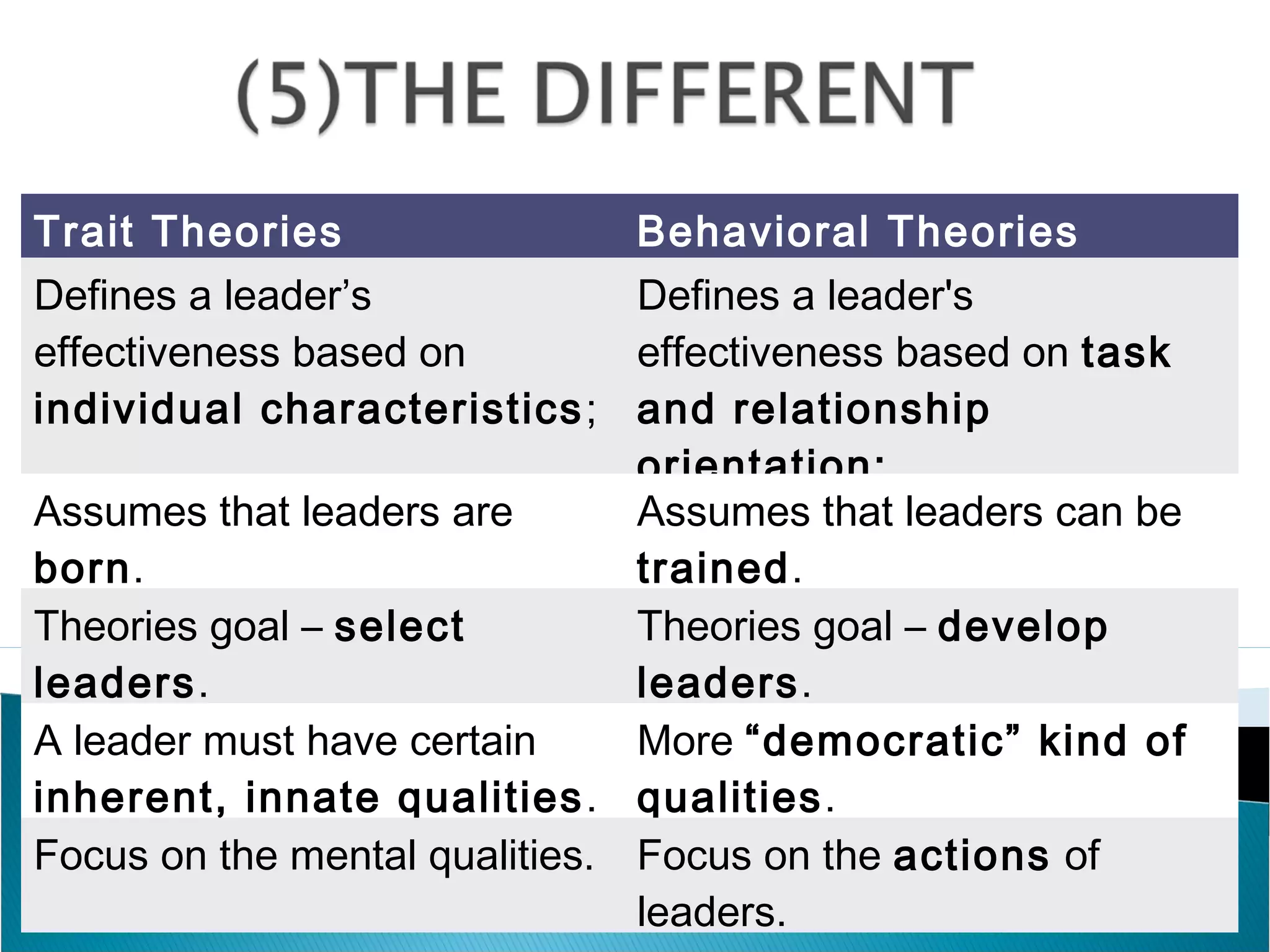
Trait Theories Behavioral Theories
Defines a leader’s
effectiveness based on
individual characteristics;
Defines a leader's
effectiveness based on task
and relationship
orientation;
Assumes that leaders are
born.
Assumes that leaders can be
trained.
Theories goal – select
leaders.
Theories goal – develop
leaders.
A leader must have certain
inherent, innate qualities.
More “democratic” kind of
qualities.
Focus on the mental qualities. Focus on the actions of
leaders.
 Both trait and behavioral theories contained significant
limitations.
 Both trait and behavioral theories are the basis for the
leaders “made/born” debate.
 Both approaches to leadership can teach current and
future managers valuable lessons about leading.
 Difference people / organization have difference
approaches to understand leadership.
The differences between traits theories and behavioral theories of leadership

The differences between traits theories and behavioral theories of leadership

  • 1.
    Prepared By; NO Name 1NASARUDDIN BIN ZAINALAIDIN 2 NORIADA BTE BASRI 3 EDWARD MINGGAT AK GENA Prepared for : Pn. Hajah Oriah Haji Akir Module : Leadership and Change Management
  • 2.
    The purpose ofthe presentation is to discuss the differences between traits theories and behavioral theories of leadership
  • 3.
    1) INTRODUCTION 2) LEADERSHIP APPROACHES 3)TRAIT THEORIES 4) BEHAVIORAL THEORIES 5) THE DIFFERENT 6) CONCLUSIONS
  • 4.
    WHAT IS LEADERSHIP Leadership is process by which a person influences others to accomplish an objective  It’s directs the organization in a way that makes it more cohesive and coherent
  • 5.
    WHY DO WENEED LEADERS  Group need to stay orderly and focused  To accomplish tasks  To make sense of the world  Romantic ideal
  • 6.
    LEADERSHIP EFFECTIVENESS Characteristics ofleaders Characteristics of followers Characteristics of the situation
  • 7.
     Approaches tounderstand leadership.  5 approaches to leadership:- 1. Trait Approaches 2. Behavioral Theories of Leadership 3. Power-Influence Approaches 4. Situational Approaches 5. Integrative Approaches
  • 8.
     Theories thatconsider personality, social, physical or intellectual to differentiate leaders from non leaders.  A “virtue theory” of leadership.  Trait theory stresses that there is a certain set of basic personality markers that set leaders apart from followers.
  • 10.
     Theories proposingthat specific behaviors differentiate leaders from non-leaders.  Behavior theories reject any talk about “inborn potential” or “virtue” approaches to leadership.  The behavior theories, there are no “born leaders.” Leaders can be trained, and traits that a leader must have can be taught and developed.
  • 12.
    Trait Theories BehavioralTheories Defines a leader’s effectiveness based on individual characteristics; Defines a leader's effectiveness based on task and relationship orientation; Assumes that leaders are born. Assumes that leaders can be trained. Theories goal – select leaders. Theories goal – develop leaders. A leader must have certain inherent, innate qualities. More “democratic” kind of qualities. Focus on the mental qualities. Focus on the actions of leaders.
  • 13.
     Both traitand behavioral theories contained significant limitations.  Both trait and behavioral theories are the basis for the leaders “made/born” debate.  Both approaches to leadership can teach current and future managers valuable lessons about leading.  Difference people / organization have difference approaches to understand leadership.

Editor's Notes

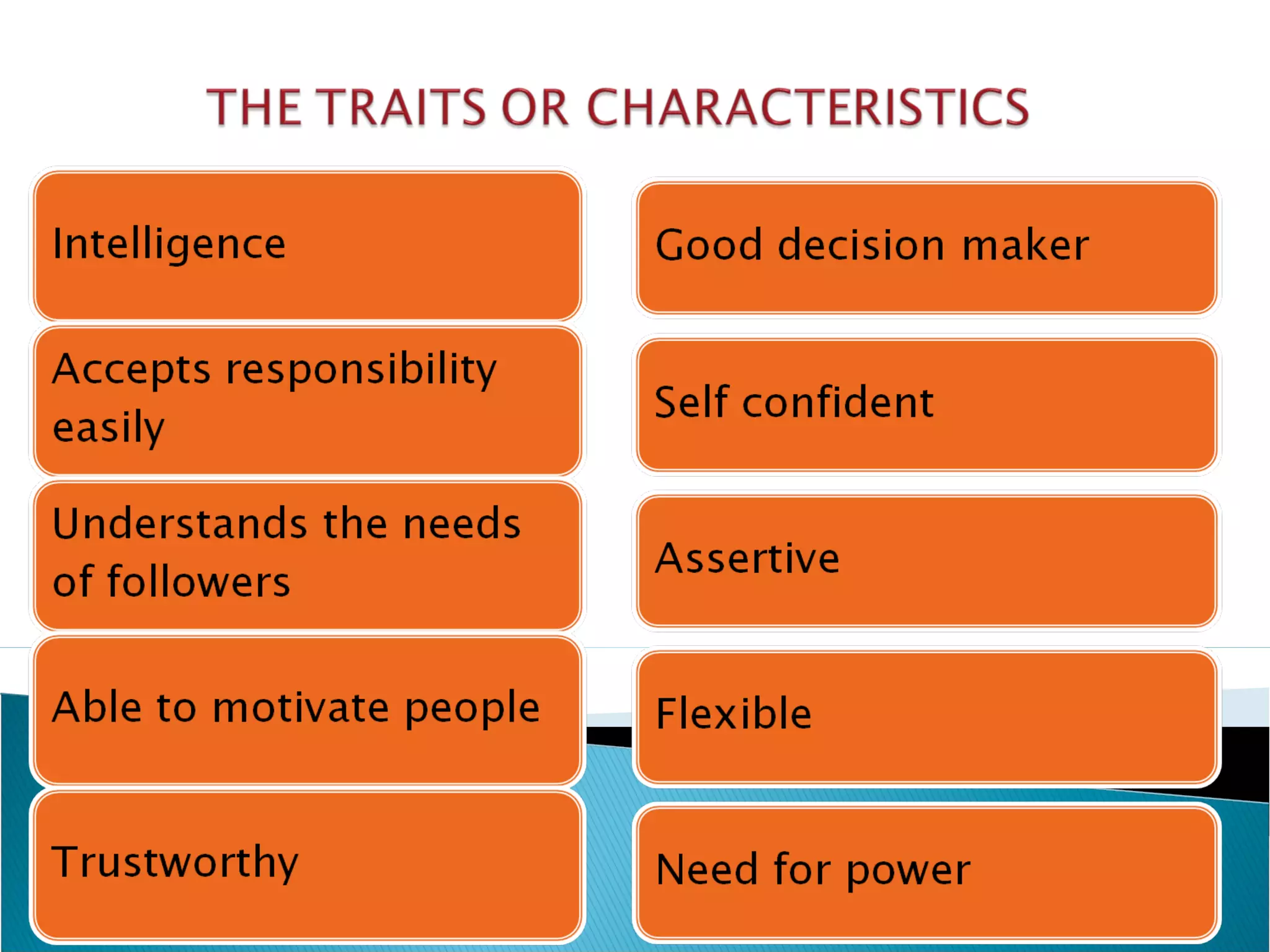
  • #10 One of the earliest approaches to studying leadership Trait theories are based on qualities of an individual person. It is believed that people are born with certain traits or characteristics that will allow them to lead. There have been studies of what people think are the best leadership traits that an individual needs to lead.  Some of the traits or characteristics are: Intelligence Accepts responsibility easily Understands the needs of followers Able to motivate people Trustworthy Good decision maker Self confident Assertive Flexible Need for power The trait leadership theories assumes there are certain traits that all leaders need to have whether in a war, a company or in a classroom. One situation might require a leader to have a group of traits that might differ from another situation. 
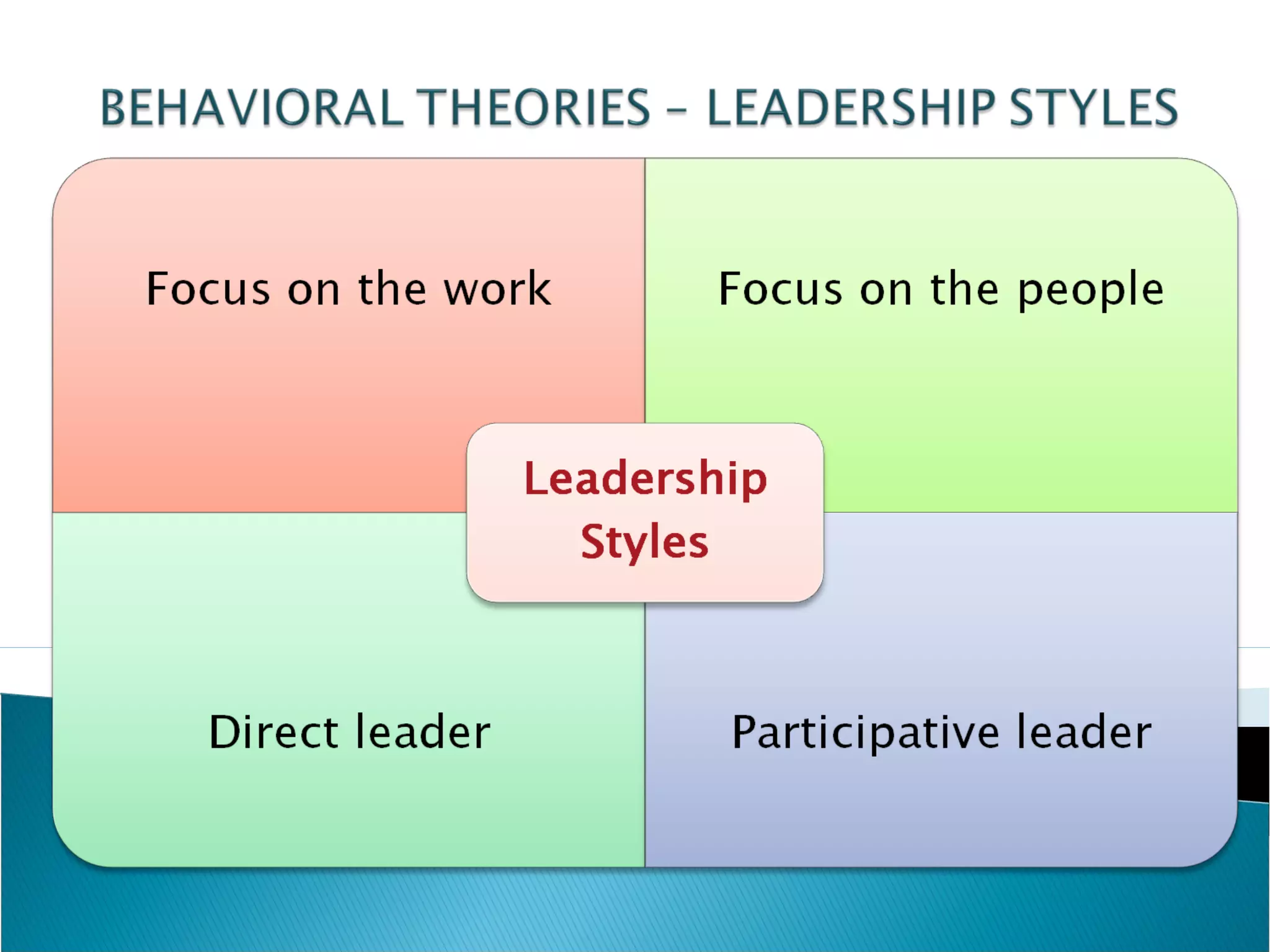
  • #12 Behavioral theories looked at how leaders behaved which developed into different leadership styles. They define leadership as learned, not something you're born with.   There are four styles: Focus on the work - where leaders organize people to get the job done in the most efficient manner. Focus on the people - where leaders make sure the workers needs are met, they are happier and will put more effort into getting the work done. Direct leader - where the leader makes all the decisions for others and expects them to follow. Participative leader - where the leader gets the input from others to make a decision to benefit everyone as a whole. With behavioral theories, a leader can't just choose one style and use it.  The type of work, environment and the people all determine which style can be used.  Not every leader can move from one style to another based upon circumstances.
  • #13 Trait research failed to predict leadership success consistently. As a result, some researchers began to examine what effective leaders do rather than what effective leaders are. We term this the behavioral approach to leadership. The researchers examined two independent patterns of behaviors or styles that are used by effective leaders. The behavioral approach assumed that what the leader does is the primary variable that determines effectiveness. Behavioral models defined a leader's effectiveness based on task orientation, such as setting goals, giving directions, setting standards, supervising worker performance, and applauding new ideas. The other behavior found in effective leaders was relationship orientation, such as showing empathy for needs and feelings, being supportive of group needs, establishing trusting relationships, and allowing workers to participate in decision making. Numerous studies have examined these behaviors, often with differing terms attached to the concepts of task orientation and relationship orientation.13 The general consensus is that effective leaders use a combination of behaviors. However, it is still not obvious which behaviors are most effective, because numerous other factors can influence performance and success. Most important, the behavioral studies focused our attention on leadership training. Take, for example, Jack Welch, hailed today as one of America's most successful CEOs. In his earlier years, he was nicknamed "Neutron Jack" and was labeled in 1984 as "the undisputed premier" among Americas toughest bosses. He demonstrated all the task-oriented behaviors such as demanding high performance standards, establishing rigid rules and procedures, autocratic decision making, and high levels of control, but few if any of the relationship-oriented behaviors.14 However, as we read about Jack Welch today and analyze his reign of success at General Electric, we realize what most of the behavioral leadership theorists learned: (1) effective leaders use a range of behaviors, (2) these behaviors can be learned, and (3) an important characteristic of effective leaders is their ability to change and adapt to the organizational settings in which they manage.