Theories that consider personality, social, physical, or
intellectual traits to differentiate leaders from nonleaders.
Leadership Traits:•Intelligence and action-oriented judgement
•Eagerness to accept responsibility
•Task competence
•Understanding of followers and their needs
•Skill in dealing with people
•Need for achievement
•Capacity to motivate people
•Decisiveness
•Self-confidence
•Adaptability/flexibility
Theories proposing that specific behaviors differentiate
leaders from nonleaders.
Behavior Style:•Concern for task: they look for high levels of productivity, and
ways to organize people and activities in order to meet those
objectives.
•Concern for people: leaders look upon their followers as people
– their needs, interests, problems, development.
•Directive leadership: leaders taking decisions for others – and
expecting followers to follow instructions.
•Participative leadership: leaders try to share decision-making
with others.
Concern for Relationships

9

9.1
Human relations
Style

5.5
Compromise
Style

5

1

9.9
Maximum concern
for both relationship
and task

1.9
Psychologically
distant, task
specialist

1.1
Low - profile

1

5

Concern for production

9
Theories assumes that there is no one best way to lead,
effective leadership depends on leader’s and follower’s
characteristics as well as other factors in the leadership
situation.

The Fiedler Model:
Proposes that effective group performance depends upon the proper
match between the leader’s style of interacting with followers and
the degree to which the situation allows the leader to control and
influence.
Path-Goal Model:
States that the leader’s job is to assist his or her followers in
attaining their goals and to provide direction or support to ensure
their goals are compatible with organizational goals.

Situational Leadership Model:
Argues that successful leadership is achieved by selecting the right
leadership style which is contingent on the level of the followers’
readiness
Situational Leadership Model:
•
•
•
•
•
•
•

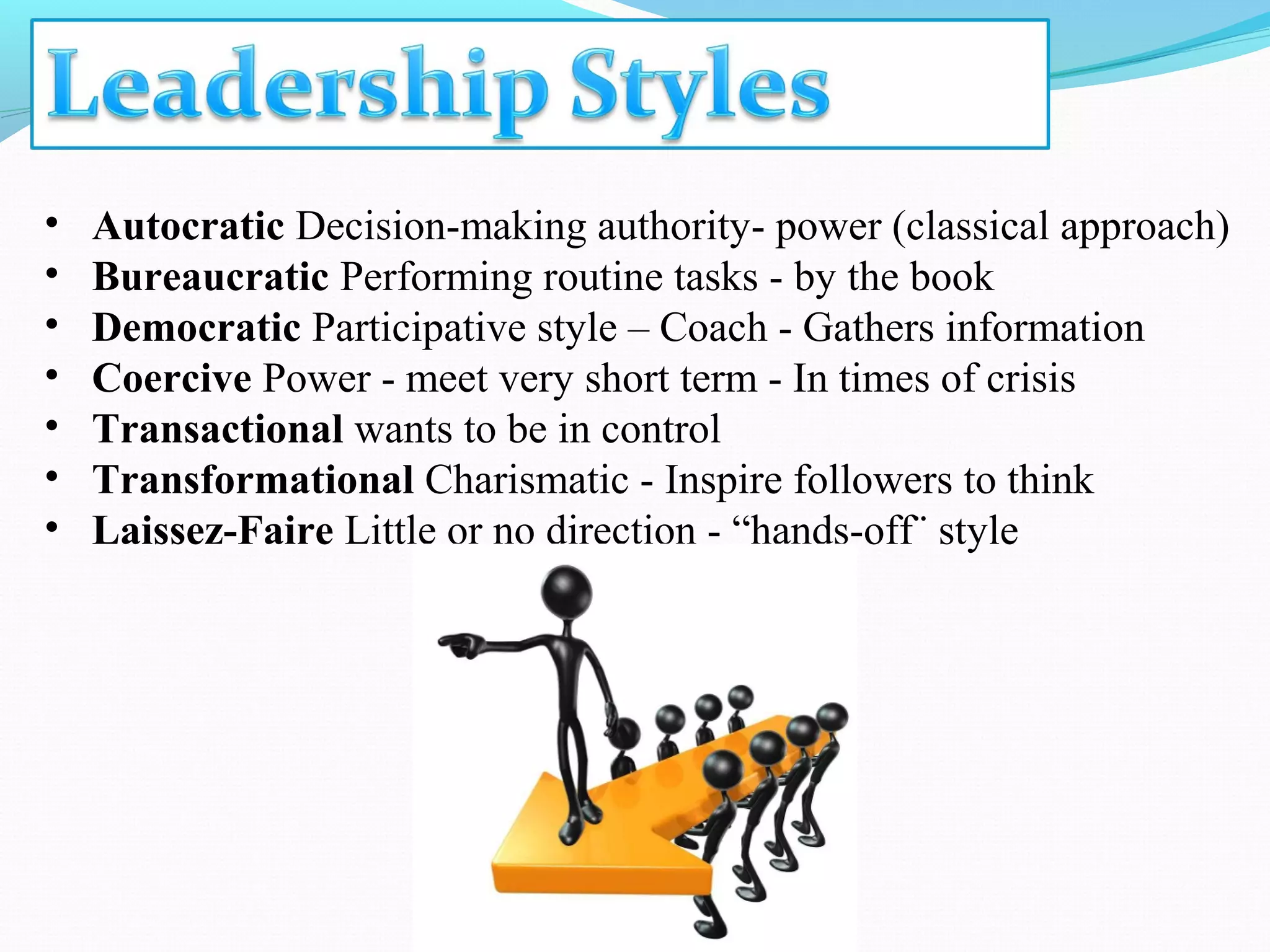
Autocratic Decision-making authority- power (classical approach)
Bureaucratic Performing routine tasks - by the book
Democratic Participative style – Coach - Gathers information
Coercive Power - meet very short term - In times of crisis
Transactional wants to be in control
Transformational Charismatic - Inspire followers to think
Laissez-Faire Little or no direction - “hands-off¨ style
Managers are people who do things right and leaders are people
who do the right things.

Leadership produces
change and movement
While
Management produces
order an consistency
Leaders:
More Personal in their orientation to group members
More global in their thinking
Focus on values and expectations
Value cooperation not just coordination
Foster ideas of unity – equality – justice - fairness
Managers:
Focus on control and results
Give clear direction
Make solitary assignments
Work hard for cooperation
The most effective leaders:
•
•
•
•
•
•
•
•
•

Are always investing in strengths
Work with a “team”, not individual
Understand their followers needs
Be alert to their personal, social problems
Motivate team members
Work on their attitudes, try do make them healthy
Provide them with the right information
Evaluate your team members, performance in an objective
Reward good performance
•
•
•
•

Acquire broad experience
Model effective leaders
Self-develop leadership traits
Help your leader lead
Leadership

Leadership

  • 3.
    Theories that considerpersonality, social, physical, or intellectual traits to differentiate leaders from nonleaders. Leadership Traits:•Intelligence and action-oriented judgement •Eagerness to accept responsibility •Task competence •Understanding of followers and their needs •Skill in dealing with people •Need for achievement •Capacity to motivate people •Decisiveness •Self-confidence •Adaptability/flexibility
  • 4.
    Theories proposing thatspecific behaviors differentiate leaders from nonleaders. Behavior Style:•Concern for task: they look for high levels of productivity, and ways to organize people and activities in order to meet those objectives. •Concern for people: leaders look upon their followers as people – their needs, interests, problems, development. •Directive leadership: leaders taking decisions for others – and expecting followers to follow instructions. •Participative leadership: leaders try to share decision-making with others.
  • 5.
    Concern for Relationships 9 9.1 Humanrelations Style 5.5 Compromise Style 5 1 9.9 Maximum concern for both relationship and task 1.9 Psychologically distant, task specialist 1.1 Low - profile 1 5 Concern for production 9
  • 6.
    Theories assumes thatthere is no one best way to lead, effective leadership depends on leader’s and follower’s characteristics as well as other factors in the leadership situation. The Fiedler Model: Proposes that effective group performance depends upon the proper match between the leader’s style of interacting with followers and the degree to which the situation allows the leader to control and influence.
  • 7.
    Path-Goal Model: States thatthe leader’s job is to assist his or her followers in attaining their goals and to provide direction or support to ensure their goals are compatible with organizational goals. Situational Leadership Model: Argues that successful leadership is achieved by selecting the right leadership style which is contingent on the level of the followers’ readiness
  • 8.
  • 9.
    • • • • • • • Autocratic Decision-making authority-power (classical approach) Bureaucratic Performing routine tasks - by the book Democratic Participative style – Coach - Gathers information Coercive Power - meet very short term - In times of crisis Transactional wants to be in control Transformational Charismatic - Inspire followers to think Laissez-Faire Little or no direction - “hands-off¨ style
  • 10.
    Managers are peoplewho do things right and leaders are people who do the right things. Leadership produces change and movement While Management produces order an consistency
  • 11.
    Leaders: More Personal intheir orientation to group members More global in their thinking Focus on values and expectations Value cooperation not just coordination Foster ideas of unity – equality – justice - fairness Managers: Focus on control and results Give clear direction Make solitary assignments Work hard for cooperation
  • 12.
    The most effectiveleaders: • • • • • • • • • Are always investing in strengths Work with a “team”, not individual Understand their followers needs Be alert to their personal, social problems Motivate team members Work on their attitudes, try do make them healthy Provide them with the right information Evaluate your team members, performance in an objective Reward good performance
  • 13.
    • • • • Acquire broad experience Modeleffective leaders Self-develop leadership traits Help your leader lead