Leadership
DEFINITION
• It is the process of encouraging & helping
others to work enthusiastically towards
objectives.
• It can also be defined as the relationship in
which one person (the leader) influences
others to work together willingly on related
tasks to attain goals desired by the leader
and/or group.
Difference between leaders &
managers
Leaders
• Innovate
• Develop
• Inspire
• Long term view
• Ask what & why
• Originate
• Do the right things
Managers
• Administer
• Maintain
• Control
• Short term view
• Ask how & when
• Initiate
• Do things right
IMPORTANCE OF LEADERSHIP
FORMAL & INFORMAL LEADERSHIP
• Formal leadership occurs when a manager
leads by exercising formal authority.
• Any employee who is assigned a managerial
position has the opportunity & responsibility
to exercise formal leadership in relation to
subordinates.
• Informal leadership arises when a person
without formal authority is influential in
directing the behaviour of others.
• Although not formally appointed or elected,
he becomes a leader through his actions or
personal attractions.
LEADERSHIP STYLES
• The behaviour the leader exhibits during supervision
of subordinates is known as leadership style.
• It is divided into 4 types –
a) Styles based on the amount of authority retained by
the leader.
b) Styles based on the relative emphasis placed on the
task to be performed versus that placed on people.
c) Styles based on the assumptions about people made
by the leader.
Likert’s 4 styles
Entrepreneurial Leadership Style
Styles based on authority retained
Autocratic(Authoritarian)
• Manager retains power
• Manager is decision-making authority
• Manager does not consult employees for inputs
• Subordinates expected to obey orders without
explanations
When to use Autocratic
• New, untrained employees
• Employees do not respond to any other
leadership style
• High-volume production required
• Limited time for decision making
• Manager’s power is challenged by an
employee
PARTICIPATIVE STYLE
a) Consultative leaders - Solicit opinions from
group before making a decision. These leaders
make it clear that they alone have final authority
to make final decisions.
b) Consensual leaders – Encourage group
discussion on an issue & then make a decision
that reflects the general agreement (consensus)
of group members. Leads to considerable delay
in decision making because every member has
to give his/her consent.
C ) Democratic leaders They function as
collectors of opinion & take a vote before
making a decision.
Free rein style
• Also called Laissez – faire, free rein leader
chooses not to adopt a leadership role.
• It works when the group is composed of
highly committed members.
STYLES BASED ON TASK VERSUS
PEOPLE EMPHASIS
Styles based on assumptions
about people
LIKERT’S 4 STYLES
• Exploitative authoritarian - Leader uses
sanctions, communication is downward,
superiors & subordinates are psychologically
distant, & the decisions are generally made at the
top of the organisation.
• Benevolent authoritarian – Leader uses rewards
to encourage performance, upward
communication is permitted but to the extent the
boss wants. Major decisions are made by the
people at the top of the hierarchy.
• Consultative – Leader uses reward, subordinates
are involved in decision making in a limited way.
• Participative – Subordinates & superiors are
psychologically close, group decision making is
widespread in the organisation. There is a
tendency among a number of individuals to
belong to more than one work group in order to
promote inter- group links & understanding.
Entrepreneurship leadership
style
• Impatience towards employees because the
entrepreneur is always busy.
• A charismatic personality that inspires others
to want to do business with him or her despite
the impatience.
• A much stronger interest in dealing with
customers than employees.
THEORIES OF LEADERSHIP
• Trait theory
• Leader Behaviour Theory
• Managerial Grid
• Contingency Theory
• Theory X & Theory Y of McGregor
TRAIT APPROACH
• Trait theories of leadership focus on the
individual characteristics of successful leaders.
• According to the theories, leaders possess a
set of traits which make them distinct from
followers.
Ralph Stogdill, surveyed more than 5,000
leadership studies & concluded that successful
leaders tend to have the following qualities –
• A strong desire for accomplishment
• Persistent pursuit of goals
• Creativity & Intelligence used to solve problems.
• Initiative applied to social situations
• Willingness to accept behavioural consequences.
• Low susceptibility to interpersonal stress
• Ability to influence other people
BEHAVIOURAL THEORIES
• Ohio State University Studies
• University of Michigan Studies
Ohio State University Studies
• Main objective was to identify the major
dimensions of leadership & to investigate the
effect of leader behaviour on employee
performance & satisfaction.
• 2 leadership dimensions were identified –
a) Initiating structure which refers to leader
behaviour that defines & organises the group
tasks, assigns the tasks to employees &
supervises their activities.
b) Consideration refers to leader behaviour
that can be characterised by friendliness,
respect, supportiveness, openness, trust, &
concern for the welfare of the employees.
UNIVERSITY OF MICHIGAN STUDIES
• 2 dimensions of leadership
• Production centered – leaders set rigid work
standards, organised tasks down to the last
detail, prescribe the work methods to be
followed & closely supervised subordinates
performance.
• Employee centered leaders – encouraged
employee participation in goal setting & in other
work related decisions & helped ensure high
performance by inspiring. Respect & trust.
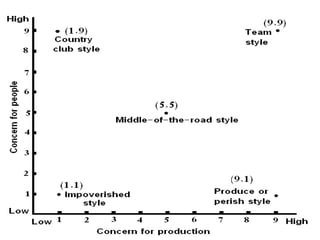
MANAGERIAL GRID
• The managerial grid model (1964) is
a situational leadership model developed
by Robert R. Blake and Jane Mouton.
• This model originally identified five different
leadership styles based on the concern for
people and the concern for production
CONTINGENCY THEORIES OF
LEADERSHIP
• It became increasingly clear for people
studying the leadership phenomenon that
predicting leadership effectiveness was more
complex than identifying a few traits or
preferable behaviours.
• The failure to obtain consistent results led to
a focus on situational or contingency theories
of leadership.
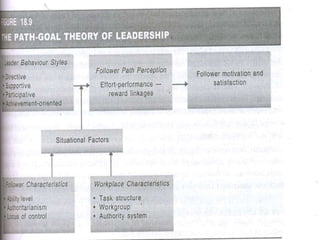
PATH GOAL THEORY OF LEADERSHIP
• Developed by Robert House
• Essence of the theory is that the leader’s job is to
use structure, support & rewards to create a work
environment that helps employees reach the
organisation’s goals.
• According to the theory, the leader must clarify
goals for the subrodinates & clear the path for
realising the goals.
• The theory is called path goal because its
major concern is how the leader influences
the subordinates’ perceptions of their work
goals, personal goals & paths to goal
attainment.
• Locus of control - extent to which individuals
believe that they can control events that affect
them.
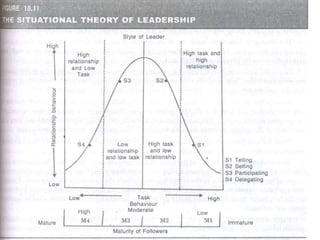
Situational theory of leadership
• By Paul Hersey & Kenneth Blanchard
• Maturity – Desire for achievement,
willingness to accept responsibility, task
related ability & experience.
Mcgregor’s theory x & theory y
• Theory X by McGregor had the following
assumptions –
1. Employees are inherently lazy & will avoid work
unless forced to do it.
2. Employees have no ambition or desire for
responsibility, instead they prefer to be directed
& controlled.
3. Employees have no motivation to achieve
organisational objectives.
4. Employees are only motivated by physiological
& safety needs.
• Theory Y by McGregor had the following
assumptions –
1. Employees find work as natural as play if
organisational conditions are appropriate.
People appear averse to work only because their
past work experiences have been unsatisfactory.
2. Employees can be motivated by higher order
needs such as ego, autonomy & self
actualisation.
3. Employees seek responsibility since it allows
them to satisfy higher order needs.

Leadership

  • 1.
  • 2.
    DEFINITION • It isthe process of encouraging & helping others to work enthusiastically towards objectives. • It can also be defined as the relationship in which one person (the leader) influences others to work together willingly on related tasks to attain goals desired by the leader and/or group.
  • 3.
    Difference between leaders& managers Leaders • Innovate • Develop • Inspire • Long term view • Ask what & why • Originate • Do the right things Managers • Administer • Maintain • Control • Short term view • Ask how & when • Initiate • Do things right
  • 4.
  • 5.
    FORMAL & INFORMALLEADERSHIP • Formal leadership occurs when a manager leads by exercising formal authority. • Any employee who is assigned a managerial position has the opportunity & responsibility to exercise formal leadership in relation to subordinates.
  • 6.
    • Informal leadershiparises when a person without formal authority is influential in directing the behaviour of others. • Although not formally appointed or elected, he becomes a leader through his actions or personal attractions.
  • 7.
    LEADERSHIP STYLES • Thebehaviour the leader exhibits during supervision of subordinates is known as leadership style. • It is divided into 4 types – a) Styles based on the amount of authority retained by the leader. b) Styles based on the relative emphasis placed on the task to be performed versus that placed on people. c) Styles based on the assumptions about people made by the leader. Likert’s 4 styles Entrepreneurial Leadership Style
  • 8.
    Styles based onauthority retained
  • 9.
    Autocratic(Authoritarian) • Manager retainspower • Manager is decision-making authority • Manager does not consult employees for inputs • Subordinates expected to obey orders without explanations
  • 10.
    When to useAutocratic • New, untrained employees • Employees do not respond to any other leadership style • High-volume production required • Limited time for decision making • Manager’s power is challenged by an employee
  • 11.
    PARTICIPATIVE STYLE a) Consultativeleaders - Solicit opinions from group before making a decision. These leaders make it clear that they alone have final authority to make final decisions. b) Consensual leaders – Encourage group discussion on an issue & then make a decision that reflects the general agreement (consensus) of group members. Leads to considerable delay in decision making because every member has to give his/her consent.
  • 12.
    C ) Democraticleaders They function as collectors of opinion & take a vote before making a decision.
  • 13.
    Free rein style •Also called Laissez – faire, free rein leader chooses not to adopt a leadership role. • It works when the group is composed of highly committed members.
  • 14.
    STYLES BASED ONTASK VERSUS PEOPLE EMPHASIS
  • 15.
    Styles based onassumptions about people
  • 16.
    LIKERT’S 4 STYLES •Exploitative authoritarian - Leader uses sanctions, communication is downward, superiors & subordinates are psychologically distant, & the decisions are generally made at the top of the organisation. • Benevolent authoritarian – Leader uses rewards to encourage performance, upward communication is permitted but to the extent the boss wants. Major decisions are made by the people at the top of the hierarchy.
  • 17.
    • Consultative –Leader uses reward, subordinates are involved in decision making in a limited way. • Participative – Subordinates & superiors are psychologically close, group decision making is widespread in the organisation. There is a tendency among a number of individuals to belong to more than one work group in order to promote inter- group links & understanding.
  • 18.
  • 19.
    • Impatience towardsemployees because the entrepreneur is always busy. • A charismatic personality that inspires others to want to do business with him or her despite the impatience. • A much stronger interest in dealing with customers than employees.
  • 20.
  • 21.
    • Trait theory •Leader Behaviour Theory • Managerial Grid • Contingency Theory • Theory X & Theory Y of McGregor
  • 22.
    TRAIT APPROACH • Traittheories of leadership focus on the individual characteristics of successful leaders. • According to the theories, leaders possess a set of traits which make them distinct from followers.
  • 23.
    Ralph Stogdill, surveyedmore than 5,000 leadership studies & concluded that successful leaders tend to have the following qualities – • A strong desire for accomplishment • Persistent pursuit of goals • Creativity & Intelligence used to solve problems. • Initiative applied to social situations • Willingness to accept behavioural consequences. • Low susceptibility to interpersonal stress • Ability to influence other people
  • 24.
    BEHAVIOURAL THEORIES • OhioState University Studies • University of Michigan Studies
  • 25.
    Ohio State UniversityStudies • Main objective was to identify the major dimensions of leadership & to investigate the effect of leader behaviour on employee performance & satisfaction. • 2 leadership dimensions were identified – a) Initiating structure which refers to leader behaviour that defines & organises the group tasks, assigns the tasks to employees & supervises their activities.
  • 26.
    b) Consideration refersto leader behaviour that can be characterised by friendliness, respect, supportiveness, openness, trust, & concern for the welfare of the employees.
  • 27.
    UNIVERSITY OF MICHIGANSTUDIES • 2 dimensions of leadership • Production centered – leaders set rigid work standards, organised tasks down to the last detail, prescribe the work methods to be followed & closely supervised subordinates performance. • Employee centered leaders – encouraged employee participation in goal setting & in other work related decisions & helped ensure high performance by inspiring. Respect & trust.
  • 28.
    MANAGERIAL GRID • Themanagerial grid model (1964) is a situational leadership model developed by Robert R. Blake and Jane Mouton. • This model originally identified five different leadership styles based on the concern for people and the concern for production
  • 30.
  • 31.
    • It becameincreasingly clear for people studying the leadership phenomenon that predicting leadership effectiveness was more complex than identifying a few traits or preferable behaviours. • The failure to obtain consistent results led to a focus on situational or contingency theories of leadership.
  • 32.
    PATH GOAL THEORYOF LEADERSHIP • Developed by Robert House • Essence of the theory is that the leader’s job is to use structure, support & rewards to create a work environment that helps employees reach the organisation’s goals. • According to the theory, the leader must clarify goals for the subrodinates & clear the path for realising the goals.
  • 33.
    • The theoryis called path goal because its major concern is how the leader influences the subordinates’ perceptions of their work goals, personal goals & paths to goal attainment.
  • 35.
    • Locus ofcontrol - extent to which individuals believe that they can control events that affect them.
  • 36.
    Situational theory ofleadership • By Paul Hersey & Kenneth Blanchard • Maturity – Desire for achievement, willingness to accept responsibility, task related ability & experience.
  • 38.
  • 39.
    • Theory Xby McGregor had the following assumptions – 1. Employees are inherently lazy & will avoid work unless forced to do it. 2. Employees have no ambition or desire for responsibility, instead they prefer to be directed & controlled. 3. Employees have no motivation to achieve organisational objectives. 4. Employees are only motivated by physiological & safety needs.
  • 40.
    • Theory Yby McGregor had the following assumptions – 1. Employees find work as natural as play if organisational conditions are appropriate. People appear averse to work only because their past work experiences have been unsatisfactory. 2. Employees can be motivated by higher order needs such as ego, autonomy & self actualisation. 3. Employees seek responsibility since it allows them to satisfy higher order needs.