LEAD DISCOVERY AND FORCES INVOLVED IN DRUG INTERACTIONS Presented by: SANCHIT KUMAR SRIVASTAV M.PHARM  (PHARMACEUTICAL CHEMISTRY)
CONTENTS LEAD DISCOVERY: INTRODUCTION CHOOSING DISEASE & DRUG TARGET IDENTIFYING A BIOASSAY FINDING A LEAD COMPOUND ISOLATION & PURIFICATION STRUCTURE DETERMINATION SAR IDENTIFICATION OF PHARMACOPHORE MISC. FACTORS FORCES INVOLVED IN DRUG-RECEPTOR INTERACTIONS:
INTRODUCTION: Various efforts were made to isolate and purify the active  principles of various remedies by using following  principles  involved in drug discovery & drug development as: Miscellaneous Principles: Improve pharmacokinetic properties Study drug metabolism Tests for toxicity Design a manufacturing process Clinical trials General Principles Involved Choose a disease Choose a drug target Identify a bioassay Find a lead compound Isolate & Purify the lead compound Determine the structure of the lead compound SARs Identify a pharmacophore Improve target interactions
DRUG TARGET Once a particular area of medical need has been determined, the next stage is to identify the suitable drug target and it involves following: Identification of Receptor, enzyme, or nucleic acid Identification of whether agonist or antagonist should be designed for a particular receptor For e.g. :  Agonist of serotonin receptors are useful for treatment of migraine, while antagonist of dopamine receptors are useful as antidepressants. Target specificity & selectivity (to reduce side effects) Targeting drugs to specific organs & tissues
Identifying a bioassay Choosing a right bioassay plays crucial role in Lead Discovery which involves following factors: Choice of bioassay:  The test implemented should be simple, quick, relevant. In vivo tests:  Tests on animals involve including a clinical conditions in an animal to produce observable symptoms. The animal is then treated to see whether the drug alleviates the problem by eliminating observable symptoms. For e.g. development of NSAIDS was carried out by inducing inflammation on test animals  and then testing to see whether the drugs relieved the inflammation.
In vitro tests:  It involves specific tissues, cells, or enzymes. Receptor agonists & antagonists can be tested on isolated tissues or cells which express the target receptor on their surface. This can also be performed to tests the drugs for physiological effects. Screening by NMR:  To detect whether a compound binds to a protein target , in this a compound is radiated with a short pulse of energy & its nuclei  are promoted to excited state giving off energy, this energy can be measured to produce an spectrum. Now the NMR spectrum of drug, then the protein is added. If the drug binds to a protein it essentially become a part of protein.
Finding a Lead compound Once a target & a testing system has been chosen, the next is to find a Lead Compound” which shows the desired pharmaceutical activity. There are many ways by which a lead compound might be discovered. Screening of natural materials (e.g. Artemisinin):  Plants & trees have always rich source of lead compounds like morphine, cocaine, digitalis, quinine, nicotine, & many others. For e.g.: Local anesthetics from  cocaine , Anticancer agent from  taxol. Various agents can also be determined from following: Microbiological world: bacteria, fungi for  Cephalosporin, Tetracycline. Marine world: coral, sponges for  Curacin A. Combinatorial synthesis:  It involves the production of chemical libraries or pools, one of which may prove to be a useful compound.
CADD:  To determine the structure of the protein & its binding site & to determine the molecule which will fit and bind. Computerized screening of structural databanks:  This is related to pharmacophore of the drug. Designing lead compounds by NMR technique:   To detect whether a compound binds to a protein target , in this a compound is radiated with a short pulse of energy & its nuclei  are promoted to excited state giving off energy, this energy can be measured to produce an spectrum. Now the NMR spectrum of drug, then the protein is added. If the drug binds to a protein it essentially become a part of protein.
Isolation & Purification  It is mainly related with chromatographic technique. Structure Activity Relationships By synthesizing compounds where one particular group of the molecule is removed or altered, it is possible to find out which groups are essential and which are not. This involves testing all the analogues for biological activity and comparing them with the original compound. If an analogue shows a significantly lowered activity, then the group which has been modified must have been important.
Drug Metabolism It involves the Phase-1 and Phase-2 metabolism. Identification of Pharmacophore Once it is established which groups are important for a drug’s activity, we move to the next step- the identification of the lead compound. The pharmacophore summarizes the important functional group which are important for the activity and their relative position in the space with respect to each other.
Toxicity Testing Before the drugs move for the clinical trials it is tested for its toxicity. Safety assessment starts with  in vitro  and  in vivo  testing on genetically engineered cell culture or transgenic mice to examine any effects on the cell reproduction and to identify potential carcinogens. Toxicity of a drug used to measured by its LD-50 value (the lethal dose required to kill the 50% of a group of animals). For e.g., UK-47265, an antifungal agent was an extremely promising one, but  in vivo  tests on mice, dogs, and rats showed that it had liver toxicity and was potentially teratogenic agent .
Clinical Trials There are four phases of clinical trials: Phase-1:  Healthy volunteers take the drug to test whether the drug  has the effect claimed including desired potency, its pharmacokinetics, side effects. Patients may also be used. Phase-2:  Testing of drugs on a small group of patients Phase-3:  Drug is to be tested on a much larger sample of patients and compared with other available treatments, i.e. they may be compared with  placebo  (a preparation which has no effect at all). There is random selection of the patients. Phase-4:  The drug is now placed on the market and can be prescribed. However, the drug is still monitored for its effectiveness & for any unexpected side-effects.
Forces Involved In Drug Receptor Interactions Following types of the Bonding or Forces involves in the Drug-Receptor interactions: Covalent Bonding:  The stability of this type of bond permits the formation of an easily reversible drug-receptor complex. When the receptor is activated by an irreversible antagonist is said to be formation of covalent bond. E.g. acetyl-cholinesterase. Hydrogen bonding:  H-bonds are a type of dipole-dipole interaction formed between the proton of a group X-H (X: electronegative atom).
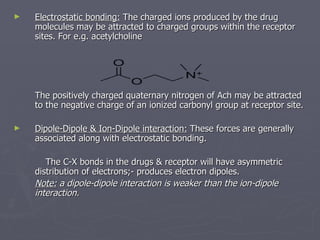
Electrostatic bonding:  The charged ions produced by the drug molecules may be attracted to charged groups within the receptor sites. For e.g. acetylcholine The positively charged quaternary nitrogen of Ach may be attracted to the negative charge of an ionized carbonyl group at receptor site.  Dipole-Dipole & Ion-Dipole interaction:  These forces are generally associated along with electrostatic bonding. The C-X bonds in the drugs & receptor will have asymmetric distribution of electrons;- produces electron dipoles. Note:  a dipole-dipole interaction is weaker than the ion-dipole interaction.
Hydrophobic Forces:  When 2 non-polar groups such as lipophillic group on a drug and a non-polar receptor group each surrounded by the ordered water molecules become disordered in an attempt to associate with each other, this increases the entropy- results in decrease in free energy that stabilizes the drug receptor complexes. This stabilization known as Hydrophobic interaction. Van der Waals or London Attractive forces:  Van der Waals bonds exists between all atoms- are based on induction of asymmetry in the electron cloud of an atom by a molecules of neighboring atom. Such forces operate within an effective distance of about 0.4 to 0.6 nm & exert an attractive forces of less than 2 kJ/mol.

Lead drug discovery

  • 1.
    LEAD DISCOVERY ANDFORCES INVOLVED IN DRUG INTERACTIONS Presented by: SANCHIT KUMAR SRIVASTAV M.PHARM (PHARMACEUTICAL CHEMISTRY)
  • 2.
    CONTENTS LEAD DISCOVERY:INTRODUCTION CHOOSING DISEASE & DRUG TARGET IDENTIFYING A BIOASSAY FINDING A LEAD COMPOUND ISOLATION & PURIFICATION STRUCTURE DETERMINATION SAR IDENTIFICATION OF PHARMACOPHORE MISC. FACTORS FORCES INVOLVED IN DRUG-RECEPTOR INTERACTIONS:
  • 3.
    INTRODUCTION: Various effortswere made to isolate and purify the active principles of various remedies by using following principles involved in drug discovery & drug development as: Miscellaneous Principles: Improve pharmacokinetic properties Study drug metabolism Tests for toxicity Design a manufacturing process Clinical trials General Principles Involved Choose a disease Choose a drug target Identify a bioassay Find a lead compound Isolate & Purify the lead compound Determine the structure of the lead compound SARs Identify a pharmacophore Improve target interactions
  • 4.
    DRUG TARGET Oncea particular area of medical need has been determined, the next stage is to identify the suitable drug target and it involves following: Identification of Receptor, enzyme, or nucleic acid Identification of whether agonist or antagonist should be designed for a particular receptor For e.g. : Agonist of serotonin receptors are useful for treatment of migraine, while antagonist of dopamine receptors are useful as antidepressants. Target specificity & selectivity (to reduce side effects) Targeting drugs to specific organs & tissues
  • 5.
    Identifying a bioassayChoosing a right bioassay plays crucial role in Lead Discovery which involves following factors: Choice of bioassay: The test implemented should be simple, quick, relevant. In vivo tests: Tests on animals involve including a clinical conditions in an animal to produce observable symptoms. The animal is then treated to see whether the drug alleviates the problem by eliminating observable symptoms. For e.g. development of NSAIDS was carried out by inducing inflammation on test animals and then testing to see whether the drugs relieved the inflammation.
  • 6.
    In vitro tests: It involves specific tissues, cells, or enzymes. Receptor agonists & antagonists can be tested on isolated tissues or cells which express the target receptor on their surface. This can also be performed to tests the drugs for physiological effects. Screening by NMR: To detect whether a compound binds to a protein target , in this a compound is radiated with a short pulse of energy & its nuclei are promoted to excited state giving off energy, this energy can be measured to produce an spectrum. Now the NMR spectrum of drug, then the protein is added. If the drug binds to a protein it essentially become a part of protein.
  • 7.
    Finding a Leadcompound Once a target & a testing system has been chosen, the next is to find a Lead Compound” which shows the desired pharmaceutical activity. There are many ways by which a lead compound might be discovered. Screening of natural materials (e.g. Artemisinin): Plants & trees have always rich source of lead compounds like morphine, cocaine, digitalis, quinine, nicotine, & many others. For e.g.: Local anesthetics from cocaine , Anticancer agent from taxol. Various agents can also be determined from following: Microbiological world: bacteria, fungi for Cephalosporin, Tetracycline. Marine world: coral, sponges for Curacin A. Combinatorial synthesis: It involves the production of chemical libraries or pools, one of which may prove to be a useful compound.
  • 8.
    CADD: Todetermine the structure of the protein & its binding site & to determine the molecule which will fit and bind. Computerized screening of structural databanks: This is related to pharmacophore of the drug. Designing lead compounds by NMR technique: To detect whether a compound binds to a protein target , in this a compound is radiated with a short pulse of energy & its nuclei are promoted to excited state giving off energy, this energy can be measured to produce an spectrum. Now the NMR spectrum of drug, then the protein is added. If the drug binds to a protein it essentially become a part of protein.
  • 9.
    Isolation & Purification It is mainly related with chromatographic technique. Structure Activity Relationships By synthesizing compounds where one particular group of the molecule is removed or altered, it is possible to find out which groups are essential and which are not. This involves testing all the analogues for biological activity and comparing them with the original compound. If an analogue shows a significantly lowered activity, then the group which has been modified must have been important.
  • 10.
    Drug Metabolism Itinvolves the Phase-1 and Phase-2 metabolism. Identification of Pharmacophore Once it is established which groups are important for a drug’s activity, we move to the next step- the identification of the lead compound. The pharmacophore summarizes the important functional group which are important for the activity and their relative position in the space with respect to each other.
  • 11.
    Toxicity Testing Beforethe drugs move for the clinical trials it is tested for its toxicity. Safety assessment starts with in vitro and in vivo testing on genetically engineered cell culture or transgenic mice to examine any effects on the cell reproduction and to identify potential carcinogens. Toxicity of a drug used to measured by its LD-50 value (the lethal dose required to kill the 50% of a group of animals). For e.g., UK-47265, an antifungal agent was an extremely promising one, but in vivo tests on mice, dogs, and rats showed that it had liver toxicity and was potentially teratogenic agent .
  • 12.
    Clinical Trials Thereare four phases of clinical trials: Phase-1: Healthy volunteers take the drug to test whether the drug has the effect claimed including desired potency, its pharmacokinetics, side effects. Patients may also be used. Phase-2: Testing of drugs on a small group of patients Phase-3: Drug is to be tested on a much larger sample of patients and compared with other available treatments, i.e. they may be compared with placebo (a preparation which has no effect at all). There is random selection of the patients. Phase-4: The drug is now placed on the market and can be prescribed. However, the drug is still monitored for its effectiveness & for any unexpected side-effects.
  • 13.
    Forces Involved InDrug Receptor Interactions Following types of the Bonding or Forces involves in the Drug-Receptor interactions: Covalent Bonding: The stability of this type of bond permits the formation of an easily reversible drug-receptor complex. When the receptor is activated by an irreversible antagonist is said to be formation of covalent bond. E.g. acetyl-cholinesterase. Hydrogen bonding: H-bonds are a type of dipole-dipole interaction formed between the proton of a group X-H (X: electronegative atom).
  • 14.
    Electrostatic bonding: The charged ions produced by the drug molecules may be attracted to charged groups within the receptor sites. For e.g. acetylcholine The positively charged quaternary nitrogen of Ach may be attracted to the negative charge of an ionized carbonyl group at receptor site. Dipole-Dipole & Ion-Dipole interaction: These forces are generally associated along with electrostatic bonding. The C-X bonds in the drugs & receptor will have asymmetric distribution of electrons;- produces electron dipoles. Note: a dipole-dipole interaction is weaker than the ion-dipole interaction.
  • 15.
    Hydrophobic Forces: When 2 non-polar groups such as lipophillic group on a drug and a non-polar receptor group each surrounded by the ordered water molecules become disordered in an attempt to associate with each other, this increases the entropy- results in decrease in free energy that stabilizes the drug receptor complexes. This stabilization known as Hydrophobic interaction. Van der Waals or London Attractive forces: Van der Waals bonds exists between all atoms- are based on induction of asymmetry in the electron cloud of an atom by a molecules of neighboring atom. Such forces operate within an effective distance of about 0.4 to 0.6 nm & exert an attractive forces of less than 2 kJ/mol.

Editor's Notes

  • #10 As asaASDASD ASDASD ASDASSSSSSSSSSSSS