TOPIC :DRUG DISCOVEY
Mr. Darshan N U
M pharmacy first semester
Dept. of Pharmaceutical Chemistry
1
content
• Introduction to drug discovery
• Drug discovery process
• Discovery of drug without a lead
 penicillin
 Librium
• Discovery of drug With lead
 Random and non random screening
 Drug metabolism studies
 Clinical observations
 Rational approaches to lead discovery
2
DRUG DISCOVERY
Drug discovery is defined as “ the process of designing and developing new
chemical moieties for the treatment of disease”. The association of chemistry
biology, and pharmacology has worked miracles in the field of medicines. The
discovery of new molecules hails back from olden times that include extraction
of medicinal components from natural sources. The discovery of the drug blooms
with pre-discovery phase, where scientist discovers the root of disease their study
involves understanding how the protein are altered, how altered protein affect the
cells and tissue and how these transformed proteins affect the patient’s health.
3
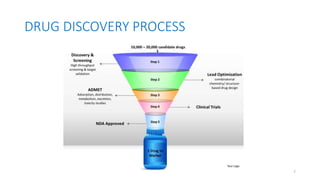
Drug discovery is a very time consuming and expensive process. The time period to bring a
drug to market is 12 -15 years at an average cost of $600-800 millions. For approximately
every 10,000 compounds that are evaluated in animal studies, 10 will make it to human
clinical trials in order to get one compound on the market. The clinical trial consist of three
phases prior to approval.
Phase –I (6 months)
Phase - 2
(about 1-3 years)
Phase - 3
(about 2-6 year)
Evaluates the safety, tolerability, pharmacokinetic properties and pharmacological
effects in 20 — 100 healthy volunteers.
Assess the effectiveness of the drug, determines the side effect and safety aspect
and clarifies the dosing regimen in a few hundred diseased patients.
It is a larger trial with several thousand in clinics and hospitals that establishes
the efficacy of the drug and monitors adverse reaction for long term use
4
Once the new drug application (NDA) is submitted to the Food and Drug
Administration (FDA) it will take several months to several years before it's
approved for commercial use.
 Phase - IV Studies are considered to be the result found with a drug that has
already been allowed onto the drug market and is in general use.
Drug candidates that fail late in this process result in huge, uncovered
financial loss for the company. That's why the cost to purchase of a drug is so
high.
5
In the past, most drugs have been discovered either by identifying the active
ingredients from traditional remedies. The leaves of Ocimum sanctum for the
cure of common cold can be attributed to the religious believes of the Hindus
and antimalarial plant Dichroafebrifuga, also known in China as chang shan
were discovered serendipitiously.(akasmika)
The process of drug discovery involves the identification of candidates,
synthesis, characterization, screening and assay of therapeutic efficacy. Once a
compound has shown its value in these tests, it will begin the process of drug
development prior to clinical trial.
6
DRUG DISCOVERY PROCESS
7
In recent years the methods used for drug development have undergone
various transformations.
In olden days drugs were discovered by trial and error method but now
they are developed by screening synthetic chemicals or extracts in a
sequential manner.
Later radiology and binding assays were developed which gave information
about the interaction of compounds with receptors and helped in selecting
the best suited compound.
8
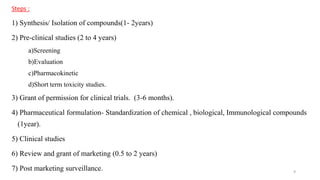
Steps :
1) Synthesis/ Isolation of compounds(1- 2years)
2) Pre-clinical studies (2 to 4 years)
a)Screening
b)Evaluation
c)Pharmacokinetic
d)Short term toxicity studies.
3) Grant of permission for clinical trials. (3-6 months).
4) Pharmaceutical formulation- Standardization of chemical , biological, Immunological compounds
(1year).
5) Clinical studies
6) Review and grant of marketing (0.5 to 2 years)
7) Post marketing surveillance. 9
LEAD MOIETY
In general drugs are not discovered, but lead compounds only discovered. The
lead is a prototype compound that has a number of attractive characteristics,
such as the desired biological or pharmacological activity, but may have other
undesirable characteristics. For example, high toxicity, other biological
activities, absorption difficulties, insolubility or metabolism problem. The
structure of the lead compound is modified by synthesis to amplify the desired
activity and to minimize or eliminate the unwanted properties with extensive
biological, pharmacological and animal studies.
10
Drug Discovery without lead
Penicillins and Librium are two important drugs that were discovered without a
lead [accidental discovery].
1. Penicillin
Penicillin G
11
 In 1928 Alexander Fleming noticed a green mold growing in a culture of
Staphylococcus aureus, and where the two had converged, the bacteria
were lysed. This led to the discovery of penicillin, which was produced by
the mold.
 Joseph Lister had treated a wounded patient with Penicillium, the organism
later found to be the producer of penicillin.
 The phenomenon was initially observed by Fleming.
 The culture dish inoculated by Fleming must have become accidentally and
simultaneously contaminated with the mold spore.
12
 Instead of placing the dish in the refrigerator or incubator when he went on
vacation as is normally done, Fleming inadvertently left it on his lab bench.
When he returned, he noticed the lysed bacteria.
 Fleming suggested that penicillin could be useful as a topical antiseptic, he was
not successful in producing penicillin in a form suitable to treat infections.
 Nothing more was done until Sir Howard Florey at Oxford University
reinvestigated the possibility of producing penicillin in a useful form.
 In 1940 he succeeded in producing penicillin that could be administered
topically and systemically, but the full extent of the value of penicillin was not
revealed until the late 1940. 13
 The original mold was Penicillium notatum , a strain that gave a relatively
low yield of Penicillin.
 It was replaced by Penicillium chrysogenum , which had been cultured
from a mold growing on a grapefruit in a market in Peoria, Illinois.
14
2. LIBRIUM
• The first benzodiazepine tranquilizer drug, chlordiazepoxide HCI [7-chloro-2-
(methylamino-5-phenyl-3 H-1,4-benzodiazepine 4-oxide] (Librium) was
discovered by Dr. Leo Sternbach at Roche was involved in a program to
synthesize a new class of tranquilizer drugs. He originally set out to prepare a
series of benzheptoxdiazines.
• Chlordiazepoxide HCl
15
 If this compound had not been found in the laboratory cleanup, all of the
negative pharmacological results would have been reported for the
quinazoline 3-oxide class of compounds, and benzodiazepine 4-oxides
may not have been discovered for many years to come.
 The examples of drug discovery without a lead are relatively few in
number. The typical occurrence is that a lead compound is identified, and
its structure is modified to give eventually, the compound that goes to
the clinic.
16
Thus Librium once identified as a lead then became exploited to develop future analogues to
Diazepam. The latter is 100 times more potent than the lead.
Paul Ehrlich had the idea of preparing dye stuff with selective affinity and toxicity for
bacteria. From this investigation, Prontosil Rubrum was discovered, a useful antibacterial
agent. However its activity was due to its metabolite sulfanilamide.
When a ship loaded with mustard gas was bombed in an Italian harbour, a military person who
came in contact with this gas showed an unusually low white blood cell count. This gave rise
to the development of alkylating agent, which was the first systemic approach to cancer
chemotherapy, especially in leukemia where leukocytes multiply in an uncontrolled fashion.
17
LEAD DISCOVERY
In general drugs are not discovered but discovery of lead compound is done
first. The lead is a prototype compound that has a number of attractive
characteristics, such that desired biological/ pharmacological activities on the
other hand they may have undesirable activity like toxicity ,
pharmacodynamic and pharmacokinetic problems.
Then the structure of lead compound is modified in such a way so that to
reduce the undesired activity of the compound and to improve the biological
activity.
18
19
At this stage of the compound is known as drug candidate.
Now this drug candidate is ready for the study of several biological and
pharmacological parameters.
If results are satisfactory then it becomes a clinical drug which is ready for
the clinical trials.
Several approaches made to discover a lead compound:
a)Random screening
b)Non- Random(Targeted/focussed) screening
c)Drug metabolism studies
d)Clinical observation
e)Rational approach to lead discovery.
20
A. Random screening :
In case the drug is not known and the compound with desired activity is not
known the random screening is done.
All compounds are tested in the bioassay without regard to their structures.
This is the choice of technique when nothing is known about receptor target.
The best example: War on cancer (Streptomycin and Tetracycline has to be
found out).These 2 antibiotics were found when random screening of several
soil sample were being done to get antibiotics. However this method is little
costly and time taking.
21
B. Non-random/Targeted/ focussed screening:
 It is a narrow approach in this technique the compound containing
functional groups than lead may be tested selectively. Now used for the
cancerous drugs.
 It is a modified form of random screening which was developed because of
budgetary and man power restrictions.
 In this method, only such compounds having similar structural skeletons to
that of lead are tested.
22
Drug metabolism studies :
During drug metabolism studies, metabolites that are isolated are screened to
determine if the activity observed is derived from the drug candidate or from
a metabolite.
Eg: The anti-inflammatory drug Sulindac[clinoril] is not the active agent.
The metabolic reduction product is responsible for the activity.
23
• Ex(2) :The nonsedating antihistamine terfenadine hydrochloride (Seldane)
was found to cause an abnormal heart rhythm in some users who also were
taking certain antifungal agents, which were found to block the enzyme that
metabolizes terfenadine.
• This caused a build-up of terfenadine, which led to the abnormal heart
rhythms. However, a metabolite of terfenadine, fexofenadine hydrochloride
(Allegra), was also found to be a non sedating antihistamine, but it can be
metabolized even in the presence of anti fungal agents. This, then, is a safer
drug. Metabolites can be screened for other activities as well.
24
25
Fexofenadine hydrochloride (Allegra)
Terfenadine hydrochloride (Seldane)
D. Clinical observations:
Many times the drug possesses more than one pharmacological activities the
main activity is called as therapeutic effect while rest of the actions is known
as side effects of the drug.
Such drugs may be used as lead compound for structural modification to
improve the potency of secondary effects.
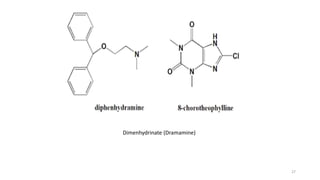
Ex: An antihistamine, dimenhydrinate (Dramamine) was found to be effective
in relieving a patient from car sickness also proved its effectiveness in the
treatment of seasickness and airsickness.
Then it is most widely used in the treatment of all forms of motion sickness.
26
27
Dimenhydrinate (Dramamine)
There are other popular examples of drugs derived from clinical observations.
Bupropion hydrochloride, an antidepressant drug , was found to help patients
stop smoking and is now the first drug marketed as a smoking cessation aid. The
impotence drug sildenafil citrate was designed for the treatment of angina and
hypertension by blocking the enzyme phosphodiesterase-5, which hydrolyzes
(cGMP), a vasodilator that allows increased blood flow. In 1991 sildenafil went to
phase 1 clinical trails for angina. In phase 2 clinical trails, it was not as effective
against angina as Pfizer had hoped, so it went back to the phase 1 clinical trails
to see how high of a dose could to tolerated. It was that during that clinical trail
28
It was during that clinical trail that the volunteers reported increased erectile
function. Given the weak activity against angina, it was an easy decision to try
to determine its effectiveness as the first treatment for erectile dysfunction.
Sildenafil works by the mechanism for which it was designed as an antianginal
drug, except it inhibits the phosphodiesterase in the penis instead of the heart.
Sexual stimulation causes release of nitric oxide in the penis.
Sildenafil structure bupropion
29
Rational Approaches to Lead Discovery:
• The lead is just found by screening techniques, as a by-product of drug
metabolism studies, or from clinical investigations.
• Rational approaches to drug design now have become the major routes to
lead discovery.
• The first step is to identify the cause for the disease state.
• Many diseases, or at least the symptoms of diseases, arise from an imbalance
(either excess or deficiency) of particular chemicals in the body, from the
invasion of a foreign organism, or from aberrant cell growth.
30
• The effects of the imbalance can be corrected by antagonism or agonism of a
receptor or by inhibition of a particular enzyme, foreign organism enzyme
inhibition or interference with DNA biosynthesis or function are important
approaches to treat diseases arising from microorganisms and aberrant cell
growth.
• Once the relevant biochemical system is identified, initial lead compounds
then become the natural receptor ligands or enzyme substrates.
• For example, lead compounds for the contraceptives (+)- norgestrel and 17α-
ethynylestradiol (Activella) were the steroidal hormones progesterone and 17
β-estradiol.
31
32
Norgestrel 17α- ethynylestradiol (Activella)
• Serotonin was used as a lead for anti-inflammatory agents and from this lead
the anti-inflammatory drug Indomethacin (Indocin) was developed.
33
Serotonin
Indomethacin (Indocin)
• The rational approaches are directed at lead discovery.
• It is not possible, with much accuracy, to foretell toxicity and side effects,
anticipate transport characteristics, or predict the metabolic fate of a drug.
• Once a lead is identified, its structure can be modified until an effective drug
is obtained.
34
REFERENCES
• The organic chemistry of the drug design and drug action by
Richard.B.Silverman
• Text book of Medicinal chemistry by k . Ilango & P. Valentina
35
THANK YOU
36

DRUG DISCOVERY.pptx

  • 1.
    TOPIC :DRUG DISCOVEY Mr.Darshan N U M pharmacy first semester Dept. of Pharmaceutical Chemistry 1
  • 2.
    content • Introduction todrug discovery • Drug discovery process • Discovery of drug without a lead  penicillin  Librium • Discovery of drug With lead  Random and non random screening  Drug metabolism studies  Clinical observations  Rational approaches to lead discovery 2
  • 3.
    DRUG DISCOVERY Drug discoveryis defined as “ the process of designing and developing new chemical moieties for the treatment of disease”. The association of chemistry biology, and pharmacology has worked miracles in the field of medicines. The discovery of new molecules hails back from olden times that include extraction of medicinal components from natural sources. The discovery of the drug blooms with pre-discovery phase, where scientist discovers the root of disease their study involves understanding how the protein are altered, how altered protein affect the cells and tissue and how these transformed proteins affect the patient’s health. 3
  • 4.
    Drug discovery isa very time consuming and expensive process. The time period to bring a drug to market is 12 -15 years at an average cost of $600-800 millions. For approximately every 10,000 compounds that are evaluated in animal studies, 10 will make it to human clinical trials in order to get one compound on the market. The clinical trial consist of three phases prior to approval. Phase –I (6 months) Phase - 2 (about 1-3 years) Phase - 3 (about 2-6 year) Evaluates the safety, tolerability, pharmacokinetic properties and pharmacological effects in 20 — 100 healthy volunteers. Assess the effectiveness of the drug, determines the side effect and safety aspect and clarifies the dosing regimen in a few hundred diseased patients. It is a larger trial with several thousand in clinics and hospitals that establishes the efficacy of the drug and monitors adverse reaction for long term use 4
  • 5.
    Once the newdrug application (NDA) is submitted to the Food and Drug Administration (FDA) it will take several months to several years before it's approved for commercial use.  Phase - IV Studies are considered to be the result found with a drug that has already been allowed onto the drug market and is in general use. Drug candidates that fail late in this process result in huge, uncovered financial loss for the company. That's why the cost to purchase of a drug is so high. 5
  • 6.
    In the past,most drugs have been discovered either by identifying the active ingredients from traditional remedies. The leaves of Ocimum sanctum for the cure of common cold can be attributed to the religious believes of the Hindus and antimalarial plant Dichroafebrifuga, also known in China as chang shan were discovered serendipitiously.(akasmika) The process of drug discovery involves the identification of candidates, synthesis, characterization, screening and assay of therapeutic efficacy. Once a compound has shown its value in these tests, it will begin the process of drug development prior to clinical trial. 6
  • 7.
  • 8.
    In recent yearsthe methods used for drug development have undergone various transformations. In olden days drugs were discovered by trial and error method but now they are developed by screening synthetic chemicals or extracts in a sequential manner. Later radiology and binding assays were developed which gave information about the interaction of compounds with receptors and helped in selecting the best suited compound. 8
  • 9.
    Steps : 1) Synthesis/Isolation of compounds(1- 2years) 2) Pre-clinical studies (2 to 4 years) a)Screening b)Evaluation c)Pharmacokinetic d)Short term toxicity studies. 3) Grant of permission for clinical trials. (3-6 months). 4) Pharmaceutical formulation- Standardization of chemical , biological, Immunological compounds (1year). 5) Clinical studies 6) Review and grant of marketing (0.5 to 2 years) 7) Post marketing surveillance. 9
  • 10.
    LEAD MOIETY In generaldrugs are not discovered, but lead compounds only discovered. The lead is a prototype compound that has a number of attractive characteristics, such as the desired biological or pharmacological activity, but may have other undesirable characteristics. For example, high toxicity, other biological activities, absorption difficulties, insolubility or metabolism problem. The structure of the lead compound is modified by synthesis to amplify the desired activity and to minimize or eliminate the unwanted properties with extensive biological, pharmacological and animal studies. 10
  • 11.
    Drug Discovery withoutlead Penicillins and Librium are two important drugs that were discovered without a lead [accidental discovery]. 1. Penicillin Penicillin G 11
  • 12.
     In 1928Alexander Fleming noticed a green mold growing in a culture of Staphylococcus aureus, and where the two had converged, the bacteria were lysed. This led to the discovery of penicillin, which was produced by the mold.  Joseph Lister had treated a wounded patient with Penicillium, the organism later found to be the producer of penicillin.  The phenomenon was initially observed by Fleming.  The culture dish inoculated by Fleming must have become accidentally and simultaneously contaminated with the mold spore. 12
  • 13.
     Instead ofplacing the dish in the refrigerator or incubator when he went on vacation as is normally done, Fleming inadvertently left it on his lab bench. When he returned, he noticed the lysed bacteria.  Fleming suggested that penicillin could be useful as a topical antiseptic, he was not successful in producing penicillin in a form suitable to treat infections.  Nothing more was done until Sir Howard Florey at Oxford University reinvestigated the possibility of producing penicillin in a useful form.  In 1940 he succeeded in producing penicillin that could be administered topically and systemically, but the full extent of the value of penicillin was not revealed until the late 1940. 13
  • 14.
     The originalmold was Penicillium notatum , a strain that gave a relatively low yield of Penicillin.  It was replaced by Penicillium chrysogenum , which had been cultured from a mold growing on a grapefruit in a market in Peoria, Illinois. 14
  • 15.
    2. LIBRIUM • Thefirst benzodiazepine tranquilizer drug, chlordiazepoxide HCI [7-chloro-2- (methylamino-5-phenyl-3 H-1,4-benzodiazepine 4-oxide] (Librium) was discovered by Dr. Leo Sternbach at Roche was involved in a program to synthesize a new class of tranquilizer drugs. He originally set out to prepare a series of benzheptoxdiazines. • Chlordiazepoxide HCl 15
  • 16.
     If thiscompound had not been found in the laboratory cleanup, all of the negative pharmacological results would have been reported for the quinazoline 3-oxide class of compounds, and benzodiazepine 4-oxides may not have been discovered for many years to come.  The examples of drug discovery without a lead are relatively few in number. The typical occurrence is that a lead compound is identified, and its structure is modified to give eventually, the compound that goes to the clinic. 16
  • 17.
    Thus Librium onceidentified as a lead then became exploited to develop future analogues to Diazepam. The latter is 100 times more potent than the lead. Paul Ehrlich had the idea of preparing dye stuff with selective affinity and toxicity for bacteria. From this investigation, Prontosil Rubrum was discovered, a useful antibacterial agent. However its activity was due to its metabolite sulfanilamide. When a ship loaded with mustard gas was bombed in an Italian harbour, a military person who came in contact with this gas showed an unusually low white blood cell count. This gave rise to the development of alkylating agent, which was the first systemic approach to cancer chemotherapy, especially in leukemia where leukocytes multiply in an uncontrolled fashion. 17
  • 18.
    LEAD DISCOVERY In generaldrugs are not discovered but discovery of lead compound is done first. The lead is a prototype compound that has a number of attractive characteristics, such that desired biological/ pharmacological activities on the other hand they may have undesirable activity like toxicity , pharmacodynamic and pharmacokinetic problems. Then the structure of lead compound is modified in such a way so that to reduce the undesired activity of the compound and to improve the biological activity. 18
  • 19.
    19 At this stageof the compound is known as drug candidate. Now this drug candidate is ready for the study of several biological and pharmacological parameters. If results are satisfactory then it becomes a clinical drug which is ready for the clinical trials.
  • 20.
    Several approaches madeto discover a lead compound: a)Random screening b)Non- Random(Targeted/focussed) screening c)Drug metabolism studies d)Clinical observation e)Rational approach to lead discovery. 20
  • 21.
    A. Random screening: In case the drug is not known and the compound with desired activity is not known the random screening is done. All compounds are tested in the bioassay without regard to their structures. This is the choice of technique when nothing is known about receptor target. The best example: War on cancer (Streptomycin and Tetracycline has to be found out).These 2 antibiotics were found when random screening of several soil sample were being done to get antibiotics. However this method is little costly and time taking. 21
  • 22.
    B. Non-random/Targeted/ focussedscreening:  It is a narrow approach in this technique the compound containing functional groups than lead may be tested selectively. Now used for the cancerous drugs.  It is a modified form of random screening which was developed because of budgetary and man power restrictions.  In this method, only such compounds having similar structural skeletons to that of lead are tested. 22
  • 23.
    Drug metabolism studies: During drug metabolism studies, metabolites that are isolated are screened to determine if the activity observed is derived from the drug candidate or from a metabolite. Eg: The anti-inflammatory drug Sulindac[clinoril] is not the active agent. The metabolic reduction product is responsible for the activity. 23
  • 24.
    • Ex(2) :Thenonsedating antihistamine terfenadine hydrochloride (Seldane) was found to cause an abnormal heart rhythm in some users who also were taking certain antifungal agents, which were found to block the enzyme that metabolizes terfenadine. • This caused a build-up of terfenadine, which led to the abnormal heart rhythms. However, a metabolite of terfenadine, fexofenadine hydrochloride (Allegra), was also found to be a non sedating antihistamine, but it can be metabolized even in the presence of anti fungal agents. This, then, is a safer drug. Metabolites can be screened for other activities as well. 24
  • 25.
  • 26.
    D. Clinical observations: Manytimes the drug possesses more than one pharmacological activities the main activity is called as therapeutic effect while rest of the actions is known as side effects of the drug. Such drugs may be used as lead compound for structural modification to improve the potency of secondary effects. Ex: An antihistamine, dimenhydrinate (Dramamine) was found to be effective in relieving a patient from car sickness also proved its effectiveness in the treatment of seasickness and airsickness. Then it is most widely used in the treatment of all forms of motion sickness. 26
  • 27.
  • 28.
    There are otherpopular examples of drugs derived from clinical observations. Bupropion hydrochloride, an antidepressant drug , was found to help patients stop smoking and is now the first drug marketed as a smoking cessation aid. The impotence drug sildenafil citrate was designed for the treatment of angina and hypertension by blocking the enzyme phosphodiesterase-5, which hydrolyzes (cGMP), a vasodilator that allows increased blood flow. In 1991 sildenafil went to phase 1 clinical trails for angina. In phase 2 clinical trails, it was not as effective against angina as Pfizer had hoped, so it went back to the phase 1 clinical trails to see how high of a dose could to tolerated. It was that during that clinical trail 28
  • 29.
    It was duringthat clinical trail that the volunteers reported increased erectile function. Given the weak activity against angina, it was an easy decision to try to determine its effectiveness as the first treatment for erectile dysfunction. Sildenafil works by the mechanism for which it was designed as an antianginal drug, except it inhibits the phosphodiesterase in the penis instead of the heart. Sexual stimulation causes release of nitric oxide in the penis. Sildenafil structure bupropion 29
  • 30.
    Rational Approaches toLead Discovery: • The lead is just found by screening techniques, as a by-product of drug metabolism studies, or from clinical investigations. • Rational approaches to drug design now have become the major routes to lead discovery. • The first step is to identify the cause for the disease state. • Many diseases, or at least the symptoms of diseases, arise from an imbalance (either excess or deficiency) of particular chemicals in the body, from the invasion of a foreign organism, or from aberrant cell growth. 30
  • 31.
    • The effectsof the imbalance can be corrected by antagonism or agonism of a receptor or by inhibition of a particular enzyme, foreign organism enzyme inhibition or interference with DNA biosynthesis or function are important approaches to treat diseases arising from microorganisms and aberrant cell growth. • Once the relevant biochemical system is identified, initial lead compounds then become the natural receptor ligands or enzyme substrates. • For example, lead compounds for the contraceptives (+)- norgestrel and 17α- ethynylestradiol (Activella) were the steroidal hormones progesterone and 17 β-estradiol. 31
  • 32.
  • 33.
    • Serotonin wasused as a lead for anti-inflammatory agents and from this lead the anti-inflammatory drug Indomethacin (Indocin) was developed. 33 Serotonin Indomethacin (Indocin)
  • 34.
    • The rationalapproaches are directed at lead discovery. • It is not possible, with much accuracy, to foretell toxicity and side effects, anticipate transport characteristics, or predict the metabolic fate of a drug. • Once a lead is identified, its structure can be modified until an effective drug is obtained. 34
  • 35.
    REFERENCES • The organicchemistry of the drug design and drug action by Richard.B.Silverman • Text book of Medicinal chemistry by k . Ilango & P. Valentina 35
  • 36.