i
Acknowledgement
I would like to thank my Physics teacher Mr. R.
Ghadai for his constant guidance, motivation, moral
encouragement and sympathetic attitude towards the
success of this project.
I also want to thank the principal and the institution for
providing the necessary materials.
I would also like to extend my gratitude towards the
lab attendant, my parents and everyone who has
helped me in completing the project successfully.
Chiranjeet Samantaray
Roll. No-
ii
Bonafide certificate
This is to certify that Chiranjeet Samantaray of class XII
has successfully completed the investigatory project on
“TO STUDY VARIATION OF CURRENT USING A
LDR" under the guidance of Mr. R. Ghadai.
This project is absolutely genuine and doesn't not
involve in any kind of plagiarism.
This is in partial fulfillment of Physics practical
examination AISSCE 2019-20.
Teacher in ChargeExternal Examiner
Principal School Stamp
iii
INDEX
ACKNOWLEDGEMENT i
BONAFIDE CERTIFICATE ii
INTRODUCTION 01
APPLICATIONS
02AIM & APPARATUS
03THEORY
08PROCEDURE
09OBSERVATIONS
11RESULT & CONCLUSION
12
SOURCES OF ERROR 13
BIBLIOGRAPHY 14
1
INTRODUCTION
The general purpose photoconductive cell is also
known as LDR – light dependent resistor. It is a type
of semiconductor and its conductivity changes with
proportional change in the intensity of light.
There are two common types of materials used to
manufacture the photoconductive cells. They
are Cadmium Sulphide (CdS) and Cadmium Selenide
(CdSe).
Extrinsic devices have impurities added, which have
a ground state energy closer to the conduction band -
since the electrons don't have as far to jump, lower
energy photons (i.e. longer wavelengths and lower
frequencies) are sufficient to trigger the device. Two
of its earliest applications were as part of smoke and
fire detection systems and camera light meters. The
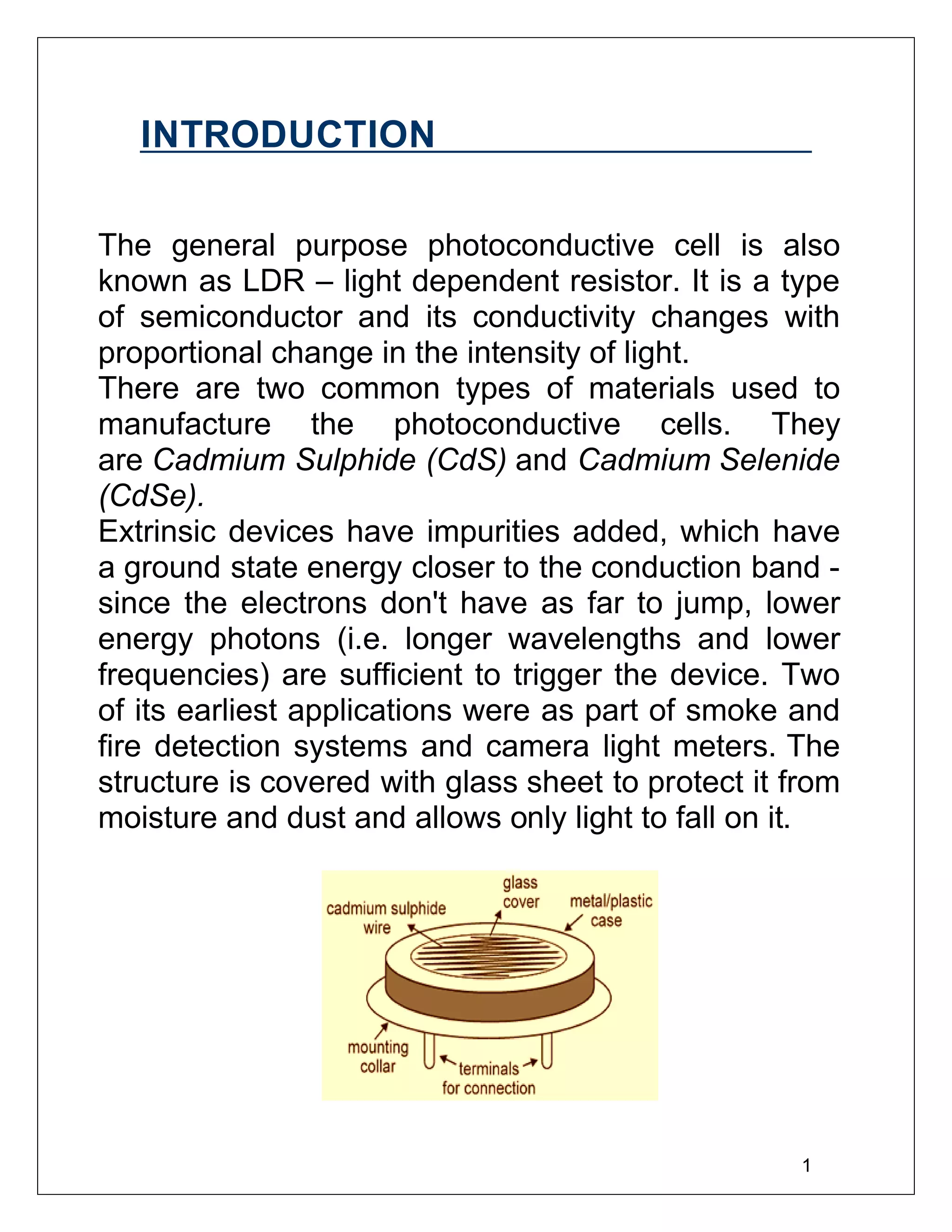
structure is covered with glass sheet to protect it from
moisture and dust and allows only light to fall on it.
12
Applications
Lead sulfide (PbS) and indium antimonide (InSb) LDRs
are used for the mid infrared spectral
region. GeCu photoconductors are among the best far-
infrared detectors available, and are used for infrared
astronomy and infrared spectroscopy.
Analog Applications
· Camera Exposure Control
· Auto Slide Focus - dual cell
· Photocopy Machines - density of toner
· Colorimetric Test Equipment
· Densitometer
· Electronic Scales - dual cell
· Automatic Gain Control – modulated light source
· Automated Rear View Mirror
Digital Applications
· Automatic Headlight Dimmer
· Night Light Control
· Oil Burner Flame Out
· Street Light Control
· Position Sensor
*LDR has a disadvantage that when its temperature changes, its
resistance changes drastically for a particular light intensity.
2
AIM & APPARATUS
AIM:
To study the variations, in current flowing in a circuit
containing a LDR, because of a variation:-
(a) In the power of the incandescent lamp, used to
‘illuminate’ the LDR. (Keeping all the lamps at a fixed
distance).
(b) In the distance of a incandescent lamp, (of fixed
power), used to ‘illuminate’ the LDR.
APPARATUS:
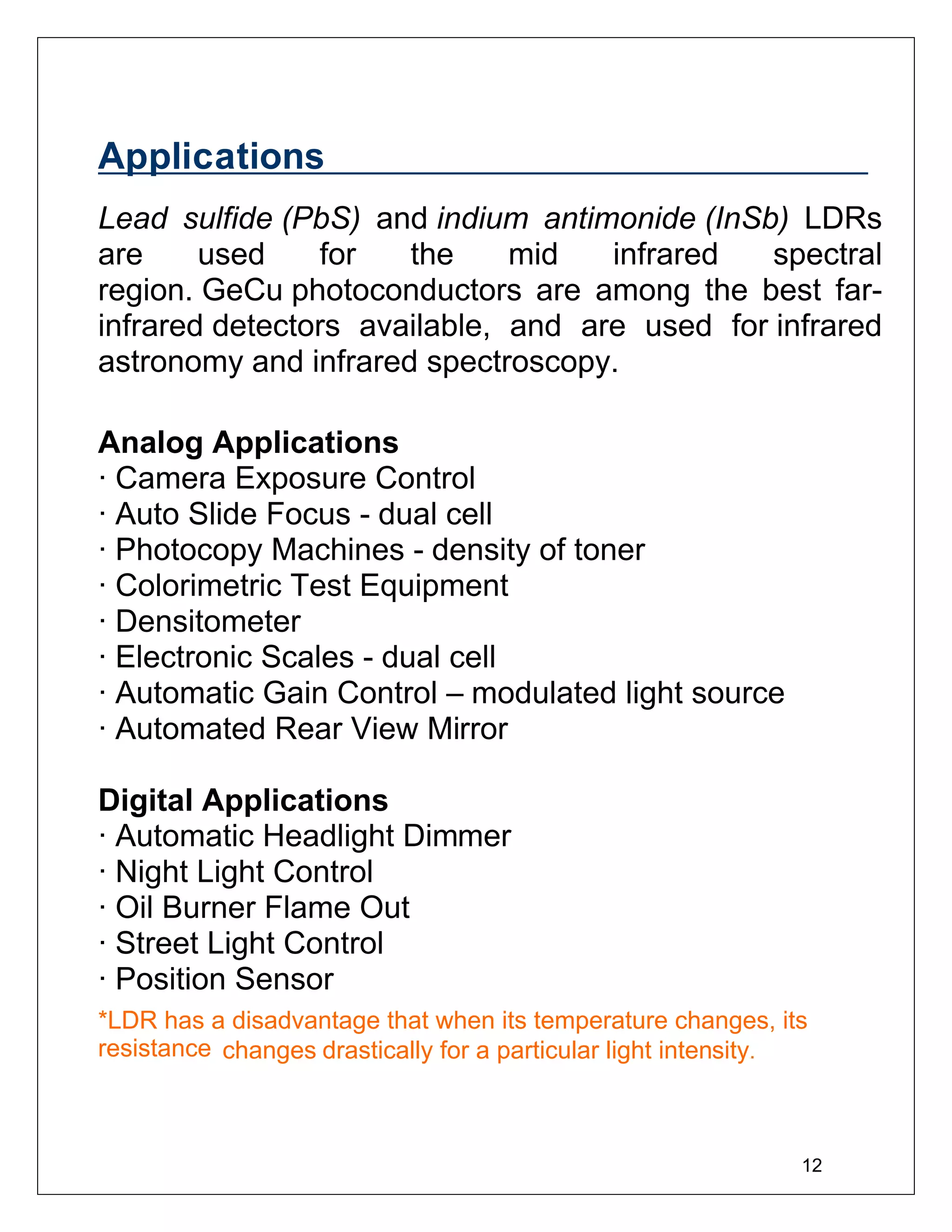
Light Dependent Resistor (LDR)
Connecting Wires
Source of different power rating (bulbs)
Bulb Holder
Metre scale
Multi Meter
Battery
3
THEORY
1.) LDR and its characteristics
When light is incident on it, a photon is absorbed and
thereby it excites an electron from valence band into
conduction band. Due to such new electrons coming up in
conduction band area, the electrical resistance of the
device decreases. Thus the LDR or photo-conductive
transducer has the resistance which is the inverse
function of radiation intensity.
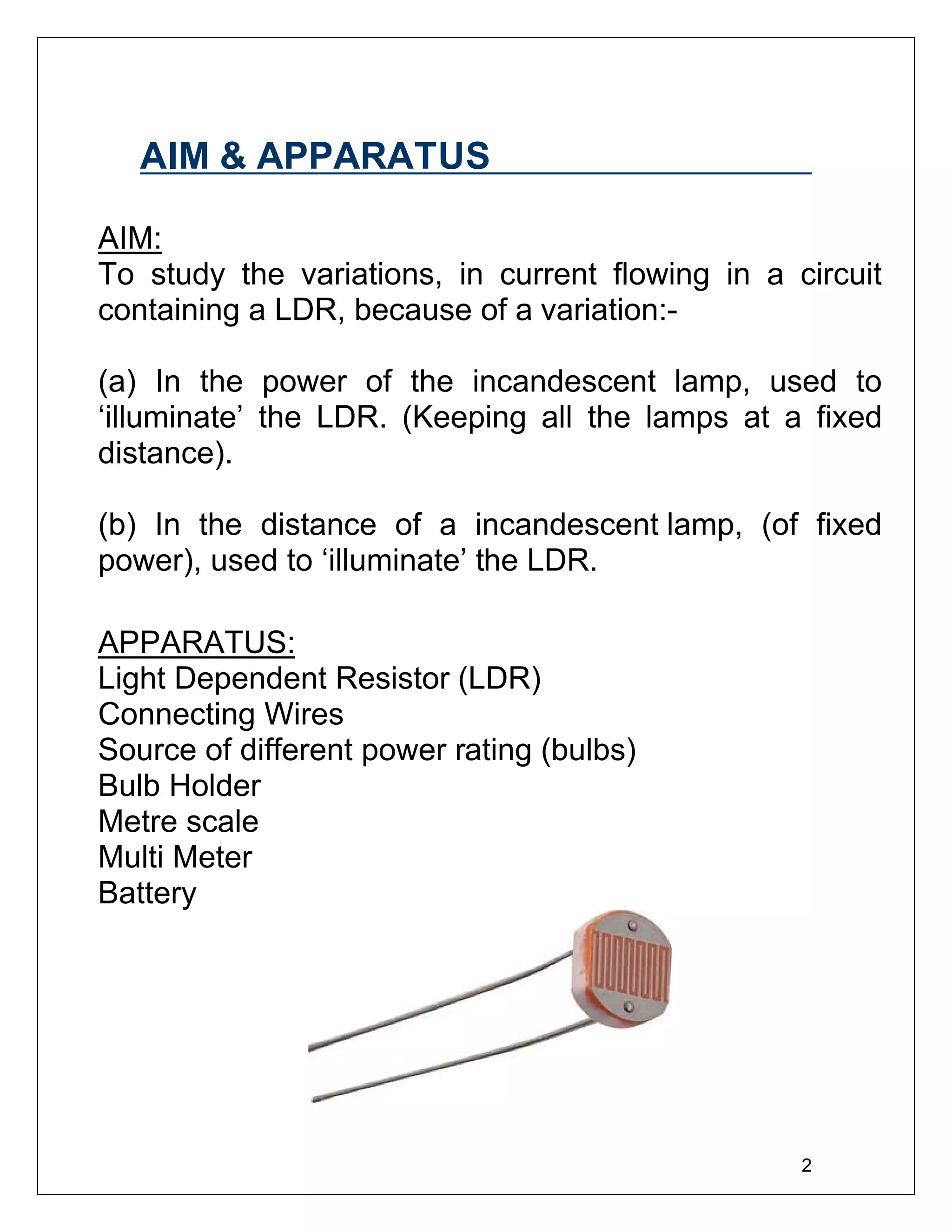
λ0 = threshold wavelength, in meters
e = charge on one electron, in Coulombs
Ew = work function of the metal used, in Ev
Here we must note that any radiation with wavelength
greater than the value obtained in above equation
CANNOT PRODUCE any change in the resistance of this
device.
The band gap energy of Cadmium Sulphide is
2.42eV and for Cadmium Selenide it is1.74eV. Due to
such large energy gaps, both the materials have
extremely high resistivity at room temperature.
4
Characteristics of photoconductive cells
Now when the device is kept in darkness, its resistance
is called as dark resistance. This resistance is typically
of the order of 1013
ohms. When light falls on it, its
resistance decreases up to several kilo ohms or even
hundreds of ohms, depending on the intensity of light,
falling on it.
The spectral response characteristics of two commercial
cells were compared in our laboratory. And we found
that there is almost no response to the radiation of a
wavelength which was shorter than 300nm. It was very
interesting to note that the Cadmium Sulphide cell has a
peak response nearer or within the green color of the
spectrum within a range of 520nm. Thus it can be used
nearer to the infra-red region up to 750nm. It was found
that the maximum response of Cadmium
Sulphoselenide is in the yellow-orange range at 615nm
and also it can be used in the infra-red region up to
about 970nm.
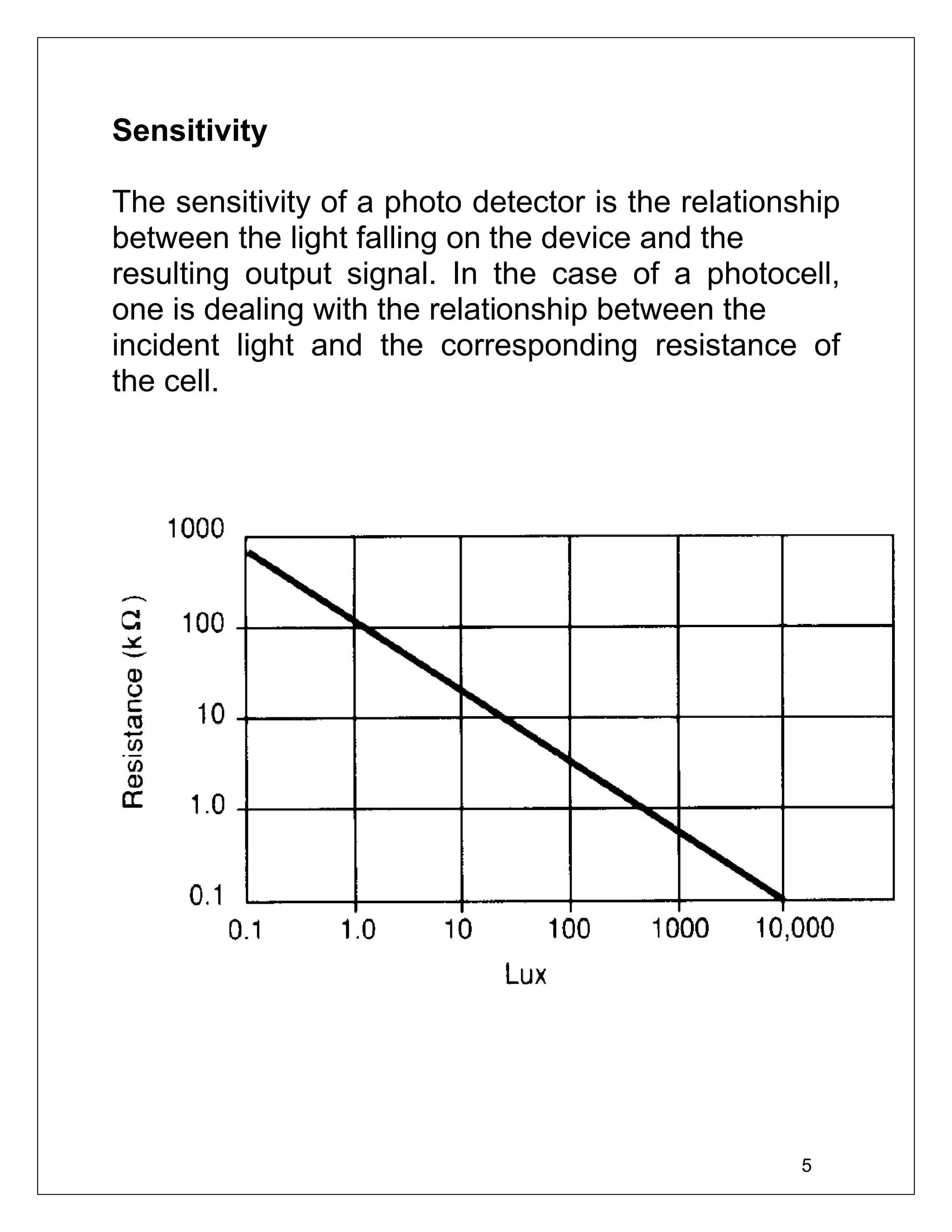
Sensitivity
The sensitivity of a photo detector is the relationship
between the light falling on the device and the
resulting output signal. In the case of a photocell,
one is dealing with the relationship between the
incident light and the corresponding resistance of
the cell.
5
Spectral Response
Like the human eye, the relative sensitivity of a
photoconductive cell is dependent on the
wavelength (color) of the incident light. Each
photoconductor material type has its own unique
spectral response curve or plot of the relative
response of the photocell versus wavelength of light.
6
2.) luminous flux variation:
Considering the source to be a point radiating in all
directions; consider a steradian (or even a simple
sphere), take a small element dA on the steradian at a
distance ‘r’ from the source. It comprises a small part
of the energy radiated (dEr).
Now, go further to a distance ‘R’ (R>r) from the
source, consider the same area element dA, it
comprises a much smaller part of energy radiated
(dER).
[dEr > dER].
It varies inversely as the square of the distance.
7
PROCEDURE
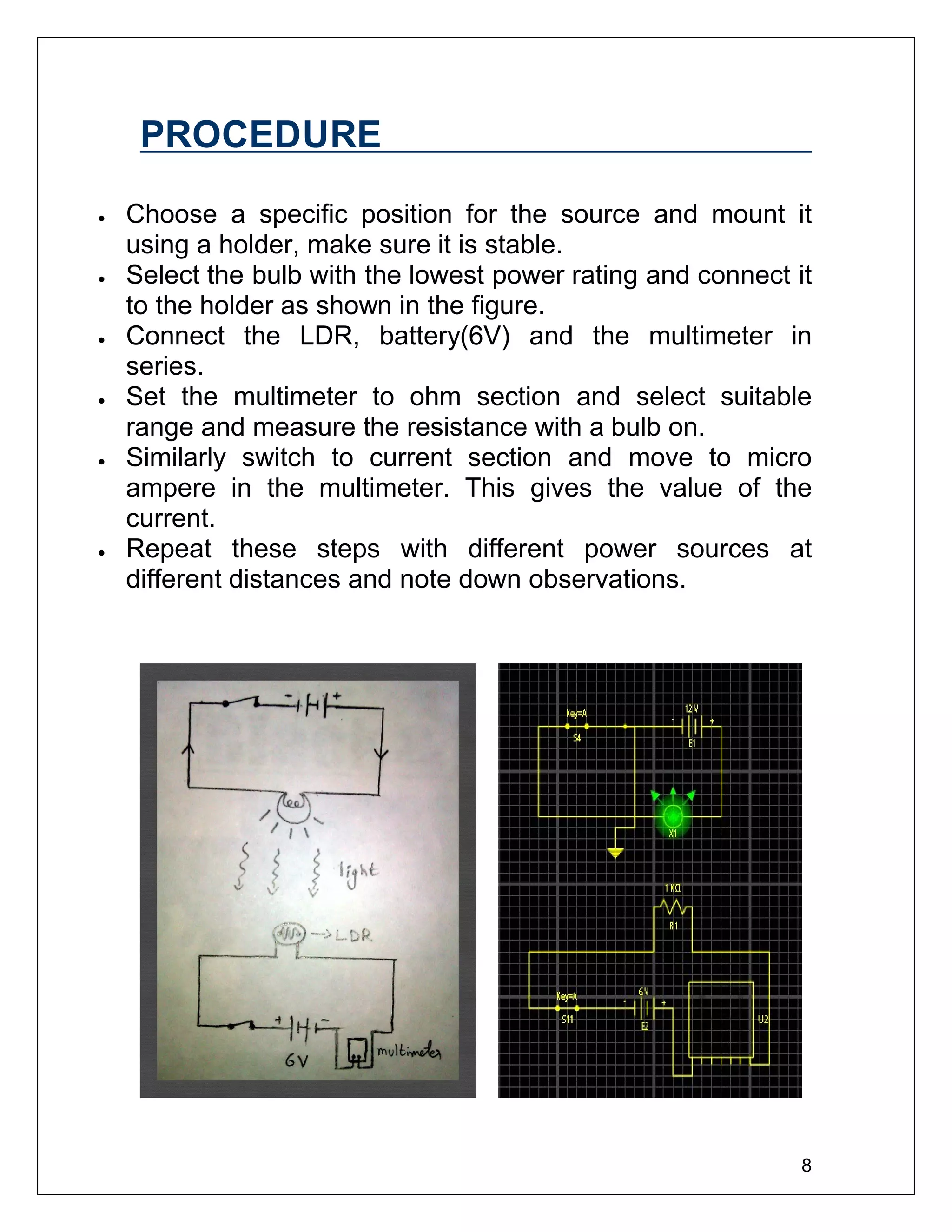
 Choose a specific position for the source and mount it
using a holder, make sure it is stable.
 Select the bulb with the lowest power rating and connect it
to the holder as shown in the figure.
 Connect the LDR, battery(6V) and the multimeter in
series.
 Set the multimeter to ohm section and select suitable
range and measure the resistance with a bulb on.
 Similarly switch to current section and move to micro
ampere in the multimeter. This gives the value of the
current.
 Repeat these steps with different power sources at
different distances and note down observations.
8
9
OBSERVATIONS
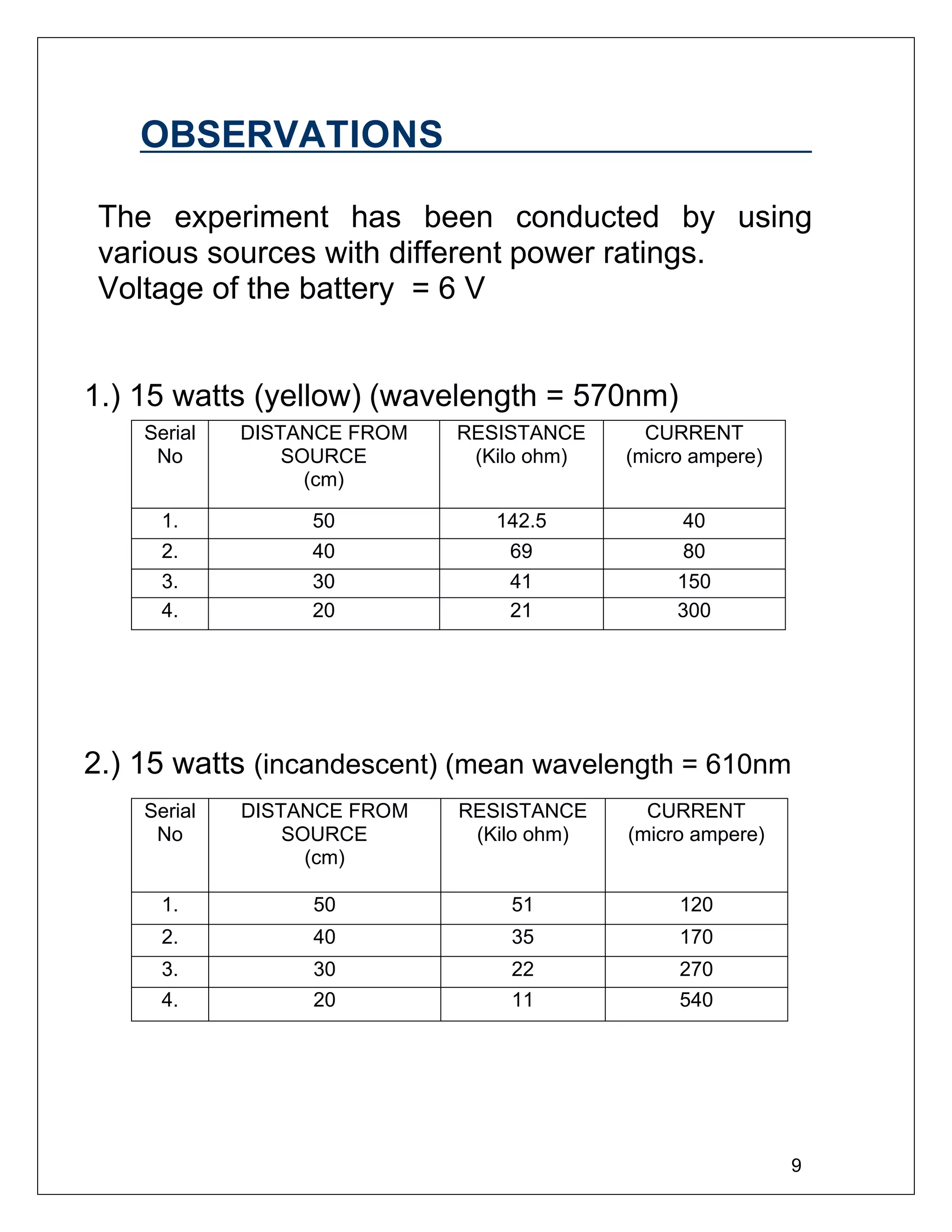
The experiment has been conducted by using
various sources with different power ratings.
Voltage of the battery = 6 V
1.) 15 watts (yellow) (wavelength = 570nm)
2.) 15 watts (incandescent) (mean wavelength = 610nm
Serial
No
DISTANCE FROM
SOURCE
(cm)
RESISTANCE
(Kilo ohm)
CURRENT
(micro ampere)
1. 50 142.5 40
2. 40 69 80
3. 30 41 150
4. 20 21 300
Serial
No
DISTANCE FROM
SOURCE
(cm)
RESISTANCE
(Kilo ohm)
CURRENT
(micro ampere)
1. 50 51 120
2. 40 35 170
3. 30 22 270
4. 20 11 540
10
3.) 40 watts (incandescent) (mean wavelength = 610nm)
4.) 20 watts (CFL) (white light)
Serial
No
DISTANCE FROM
SOURCE
(cm)
RESISTANCE
(Kilo ohm)
CURRENT
(micro ampere)
1. 50 20 300
2. 40 13 460
3. 30 8.5 700
4. 20 4.5 1330
Serial
No
DISTANCE FROM
SOURCE
(cm)
RESISTANCE
(Kilo ohm)
CURRENT
(micro ampere)
1. 50 15.5 380
2. 40 10 600
3. 30 6 1000
4. 20 3 2000
11
CONCLUSION & RESULT
 The LDR resistance decreases with increase in
intensity of light and hence there is an increase in
the flow of current.
 There is an increase in the current as the
distance from the source decreases.
 The intensity decreases as the distance from the
source increases
 The error lies within the experimental limit.
13
SOURCES OF ERROR
 The LDR may not be perpendicular to the source.
 Connections may be faulty.
 The experiment should be conducted in a dark
room.
 Measurements should be taken accurately.
14
BIBLIOGRAPHY
 NCERT physics class XII
 Art of Electronics by paul worowitz
 www.wikipedia.com/
 www.electronics2000.co.uk/links/education-hobby/
 www.ecelab.com/
 laboratory manual in physics
 Practical physics

203979153 investigatory-project-on-ldr (1)

  • 1.
    i Acknowledgement I would liketo thank my Physics teacher Mr. R. Ghadai for his constant guidance, motivation, moral encouragement and sympathetic attitude towards the success of this project. I also want to thank the principal and the institution for providing the necessary materials. I would also like to extend my gratitude towards the lab attendant, my parents and everyone who has helped me in completing the project successfully. Chiranjeet Samantaray Roll. No-
  • 2.
    ii Bonafide certificate This isto certify that Chiranjeet Samantaray of class XII has successfully completed the investigatory project on “TO STUDY VARIATION OF CURRENT USING A LDR" under the guidance of Mr. R. Ghadai. This project is absolutely genuine and doesn't not involve in any kind of plagiarism. This is in partial fulfillment of Physics practical examination AISSCE 2019-20. Teacher in ChargeExternal Examiner Principal School Stamp
  • 3.
    iii INDEX ACKNOWLEDGEMENT i BONAFIDE CERTIFICATEii INTRODUCTION 01 APPLICATIONS 02AIM & APPARATUS 03THEORY 08PROCEDURE 09OBSERVATIONS 11RESULT & CONCLUSION 12 SOURCES OF ERROR 13 BIBLIOGRAPHY 14
  • 4.
    1 INTRODUCTION The general purposephotoconductive cell is also known as LDR – light dependent resistor. It is a type of semiconductor and its conductivity changes with proportional change in the intensity of light. There are two common types of materials used to manufacture the photoconductive cells. They are Cadmium Sulphide (CdS) and Cadmium Selenide (CdSe). Extrinsic devices have impurities added, which have a ground state energy closer to the conduction band - since the electrons don't have as far to jump, lower energy photons (i.e. longer wavelengths and lower frequencies) are sufficient to trigger the device. Two of its earliest applications were as part of smoke and fire detection systems and camera light meters. The structure is covered with glass sheet to protect it from moisture and dust and allows only light to fall on it.
  • 5.
    12 Applications Lead sulfide (PbS)and indium antimonide (InSb) LDRs are used for the mid infrared spectral region. GeCu photoconductors are among the best far- infrared detectors available, and are used for infrared astronomy and infrared spectroscopy. Analog Applications · Camera Exposure Control · Auto Slide Focus - dual cell · Photocopy Machines - density of toner · Colorimetric Test Equipment · Densitometer · Electronic Scales - dual cell · Automatic Gain Control – modulated light source · Automated Rear View Mirror Digital Applications · Automatic Headlight Dimmer · Night Light Control · Oil Burner Flame Out · Street Light Control · Position Sensor *LDR has a disadvantage that when its temperature changes, its resistance changes drastically for a particular light intensity.
  • 6.
    2 AIM & APPARATUS AIM: Tostudy the variations, in current flowing in a circuit containing a LDR, because of a variation:- (a) In the power of the incandescent lamp, used to ‘illuminate’ the LDR. (Keeping all the lamps at a fixed distance). (b) In the distance of a incandescent lamp, (of fixed power), used to ‘illuminate’ the LDR. APPARATUS: Light Dependent Resistor (LDR) Connecting Wires Source of different power rating (bulbs) Bulb Holder Metre scale Multi Meter Battery
  • 7.
    3 THEORY 1.) LDR andits characteristics When light is incident on it, a photon is absorbed and thereby it excites an electron from valence band into conduction band. Due to such new electrons coming up in conduction band area, the electrical resistance of the device decreases. Thus the LDR or photo-conductive transducer has the resistance which is the inverse function of radiation intensity. λ0 = threshold wavelength, in meters e = charge on one electron, in Coulombs Ew = work function of the metal used, in Ev Here we must note that any radiation with wavelength greater than the value obtained in above equation CANNOT PRODUCE any change in the resistance of this device. The band gap energy of Cadmium Sulphide is 2.42eV and for Cadmium Selenide it is1.74eV. Due to such large energy gaps, both the materials have extremely high resistivity at room temperature.
  • 8.
    4 Characteristics of photoconductivecells Now when the device is kept in darkness, its resistance is called as dark resistance. This resistance is typically of the order of 1013 ohms. When light falls on it, its resistance decreases up to several kilo ohms or even hundreds of ohms, depending on the intensity of light, falling on it. The spectral response characteristics of two commercial cells were compared in our laboratory. And we found that there is almost no response to the radiation of a wavelength which was shorter than 300nm. It was very interesting to note that the Cadmium Sulphide cell has a peak response nearer or within the green color of the spectrum within a range of 520nm. Thus it can be used nearer to the infra-red region up to 750nm. It was found that the maximum response of Cadmium Sulphoselenide is in the yellow-orange range at 615nm and also it can be used in the infra-red region up to about 970nm.
  • 9.
    Sensitivity The sensitivity ofa photo detector is the relationship between the light falling on the device and the resulting output signal. In the case of a photocell, one is dealing with the relationship between the incident light and the corresponding resistance of the cell. 5
  • 10.
    Spectral Response Like thehuman eye, the relative sensitivity of a photoconductive cell is dependent on the wavelength (color) of the incident light. Each photoconductor material type has its own unique spectral response curve or plot of the relative response of the photocell versus wavelength of light. 6
  • 11.
    2.) luminous fluxvariation: Considering the source to be a point radiating in all directions; consider a steradian (or even a simple sphere), take a small element dA on the steradian at a distance ‘r’ from the source. It comprises a small part of the energy radiated (dEr). Now, go further to a distance ‘R’ (R>r) from the source, consider the same area element dA, it comprises a much smaller part of energy radiated (dER). [dEr > dER]. It varies inversely as the square of the distance. 7
  • 12.
    PROCEDURE  Choose aspecific position for the source and mount it using a holder, make sure it is stable.  Select the bulb with the lowest power rating and connect it to the holder as shown in the figure.  Connect the LDR, battery(6V) and the multimeter in series.  Set the multimeter to ohm section and select suitable range and measure the resistance with a bulb on.  Similarly switch to current section and move to micro ampere in the multimeter. This gives the value of the current.  Repeat these steps with different power sources at different distances and note down observations. 8
  • 13.
    9 OBSERVATIONS The experiment hasbeen conducted by using various sources with different power ratings. Voltage of the battery = 6 V 1.) 15 watts (yellow) (wavelength = 570nm) 2.) 15 watts (incandescent) (mean wavelength = 610nm Serial No DISTANCE FROM SOURCE (cm) RESISTANCE (Kilo ohm) CURRENT (micro ampere) 1. 50 142.5 40 2. 40 69 80 3. 30 41 150 4. 20 21 300 Serial No DISTANCE FROM SOURCE (cm) RESISTANCE (Kilo ohm) CURRENT (micro ampere) 1. 50 51 120 2. 40 35 170 3. 30 22 270 4. 20 11 540
  • 14.
    10 3.) 40 watts(incandescent) (mean wavelength = 610nm) 4.) 20 watts (CFL) (white light) Serial No DISTANCE FROM SOURCE (cm) RESISTANCE (Kilo ohm) CURRENT (micro ampere) 1. 50 20 300 2. 40 13 460 3. 30 8.5 700 4. 20 4.5 1330 Serial No DISTANCE FROM SOURCE (cm) RESISTANCE (Kilo ohm) CURRENT (micro ampere) 1. 50 15.5 380 2. 40 10 600 3. 30 6 1000 4. 20 3 2000
  • 15.
    11 CONCLUSION & RESULT The LDR resistance decreases with increase in intensity of light and hence there is an increase in the flow of current.  There is an increase in the current as the distance from the source decreases.  The intensity decreases as the distance from the source increases  The error lies within the experimental limit.
  • 16.
    13 SOURCES OF ERROR The LDR may not be perpendicular to the source.  Connections may be faulty.  The experiment should be conducted in a dark room.  Measurements should be taken accurately.
  • 17.
    14 BIBLIOGRAPHY  NCERT physicsclass XII  Art of Electronics by paul worowitz  www.wikipedia.com/  www.electronics2000.co.uk/links/education-hobby/  www.ecelab.com/  laboratory manual in physics  Practical physics