Ā© Dr. Lynn Fuller, Motorola Professor
Rochester Institute of Technology
Microelectronic Engineering
GaAs Device Technology
Page 1
ROCHESTER INSTITUTE OF TECHNOLOGY
MICROELECTRONIC ENGINEERING
Gallium Arsenide Devices, Technologies
& Integrated Circuits
Dr. Lynn Fuller
Motorola Professor
Microelectronic Engineering
Rochester Institute of Technology
82 Lomb Memorial Drive
Rochester, NY 14623-5604
Tel (585) 475-2035
Fax (585) 475-5041
LFFEEE@rit.edu
11-4-2001 gaas.ppt
Ā© Dr. Lynn Fuller, Motorola Professor
Rochester Institute of Technology
Microelectronic Engineering
GaAs Device Technology
Page 2
OUTLINE
Comparison of Silicon and GaAs
MBE
GaAs MESFET
MESFET Test Results
IC Process Technology
References
Ā© Dr. Lynn Fuller, Motorola Professor
Rochester Institute of Technology
Microelectronic Engineering
GaAs Device Technology
Page 3
COMPARISON OF SILICON AND GaAs
Silicon GaAs
Minority Carrier Lifetime 0.003 1E-8
Electron Mobility 1500 8000
Hole Mobility (cm2/Vs) 600 400
Energy Gap (eV) 1.12 (indirect) 1.43 (direct)
Vapor Pressure 1E-8@930C 1@1050C
The higher electron mobility for GaAs shows promise for high
speed devices and circuits. The direct gap allows for emission of
photons in LEDs and LASER devices.
Ī» = hc/E = (6.625E-34*3E8)/(1.6E-19*1.43)
= 869 nm (infrared)
Ā© Dr. Lynn Fuller, Motorola Professor
Rochester Institute of Technology
Microelectronic Engineering
GaAs Device Technology
Page 4
CRYSTAL GROWTH and OXIDES OF GaAs
The vapor pressure of As in GaAs is quite low. A GaAs substrate
heated to about 500 C begins to lose As from the surface. The wafer
can be capped with SiO2 or Si3N4 or the heat treating can be carried
out in an Arsenic over pressure. GaAs crystals are often grown in the
horizontal Bridgeman technique and the wafers are ā€œDā€ shaped.
Czochralski GaAs wafers are also available up to ~4ā€ in diameter.
GaAs wafers are more brittle than Silicon wafers. 4ā€ GaAs wafers
cost about $300 each.
GaAs does not grow a native oxide that is equivalent to SiO2.
Ga2O3 and As2O3 and As2O5 oxides that grow on GaAs present
more problems than uses.
Ā© Dr. Lynn Fuller, Motorola Professor
Rochester Institute of Technology
Microelectronic Engineering
GaAs Device Technology
Page 5
GAAS ON SILICON WAFERS
Ā© Dr. Lynn Fuller, Motorola Professor
Rochester Institute of Technology
Microelectronic Engineering
GaAs Device Technology
Page 6
CRYSTAL STRUCTURE
x
y
z
2
1
1
1
2
2
Diamond
Lattice
(Silicon)
Miller Indices
(1/x,1,y,1/z)
smallest integer set
(100) plane
(111) plane
Zincblende
Lattice
(GaAs)
As
Ga
Si
Ā© Dr. Lynn Fuller, Motorola Professor
Rochester Institute of Technology
Microelectronic Engineering
GaAs Device Technology
Page 7
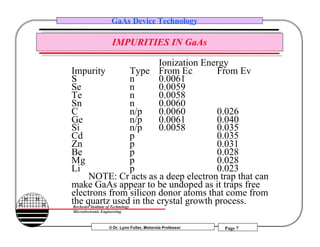
IMPURITIES IN GaAs
Ionization Energy
Impurity Type From Ec From Ev
S n 0.0061
Se n 0.0059
Te n 0.0058
Sn n 0.0060
C n/p 0.0060 0.026
Ge n/p 0.0061 0.040
Si n/p 0.0058 0.035
Cd p 0.035
Zn p 0.031
Be p 0.028
Mg p 0.028
Li p 0.023
NOTE: Cr acts as a deep electron trap that can
make GaAs appear to be undoped as it traps free
electrons from silicon donor atoms that come from
the quartz used in the crystal growth process.
Ā© Dr. Lynn Fuller, Motorola Professor
Rochester Institute of Technology
Microelectronic Engineering
GaAs Device Technology
Page 8
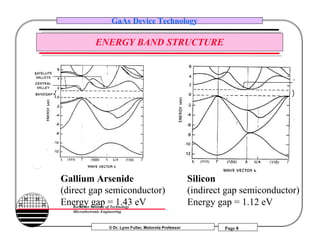
ENERGY BAND STRUCTURE
Gallium Arsenide
(direct gap semiconductor)
Energy gap = 1.43 eV
Silicon
(indirect gap semiconductor)
Energy gap = 1.12 eV
Ā© Dr. Lynn Fuller, Motorola Professor
Rochester Institute of Technology
Microelectronic Engineering
GaAs Device Technology
Page 9
ELECTRON AND HOLE MOBILITY
300 °K77 °K
8000
1015 1019
10161013
200,000
Electron Mobility in GaAs
at 77 K and 300 K
Hole Mobility in GaAs
at 77 K and 300 K
1000
400
1015
1020
Ā© Dr. Lynn Fuller, Motorola Professor
Rochester Institute of Technology
Microelectronic Engineering
GaAs Device Technology
Page 10
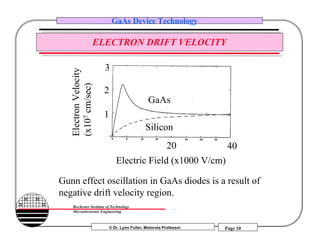
ELECTRON DRIFT VELOCITY
GaAs
Silicon
Electric Field (x1000 V/cm)
ElectronVelocity
(x107cm/sec)
3
2
1
20 40
Gunn effect oscillation in GaAs diodes is a result of
negative drift velocity region.
Ā© Dr. Lynn Fuller, Motorola Professor
Rochester Institute of Technology
Microelectronic Engineering
GaAs Device Technology
Page 11
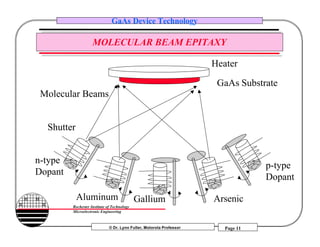
MOLECULAR BEAM EPITAXY
GalliumAluminum
Shutter
n-type
Dopant
Arsenic
p-type
Dopant
GaAs Substrate
Heater
Molecular Beams
Ā© Dr. Lynn Fuller, Motorola Professor
Rochester Institute of Technology
Microelectronic Engineering
GaAs Device Technology
Page 12
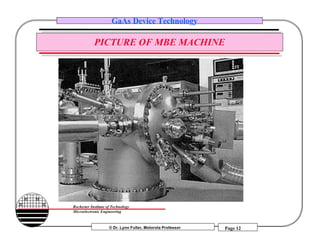
PICTURE OF MBE MACHINE
Ā© Dr. Lynn Fuller, Motorola Professor
Rochester Institute of Technology
Microelectronic Engineering
GaAs Device Technology
Page 13
EXAMPLES OF MBE LAYERS FOR BJT DEVICE
1015
1019
1018
1017
1016
Collector
n-GaAs
Base
p-GaAs
Emitter
n-AlGaAs
1.0 µm
Depth from Surface
NetDopantConcentration(cm-3)
Ā© Dr. Lynn Fuller, Motorola Professor
Rochester Institute of Technology
Microelectronic Engineering
GaAs Device Technology
Page 14
METAL CONTACTS TO GaAs
Aluminum makes a schottky barrier contact (rectifying) to n-type
GaAs.
Ohmic contacts are usually made using and alloyed (heated above the
eutectic temperature) contact of Gold (Au) and Germanium (Ge)
followed by a layer of Nickel (Ni) and alloyed at a temperature above
the AuGe eutectic temperature of 356 C. During alloying the Ge
dopes the surface of the GaAs n+
Ā© Dr. Lynn Fuller, Motorola Professor
Rochester Institute of Technology
Microelectronic Engineering
GaAs Device Technology
Page 15
GaAs DEPLETION MODE MESFET
GaAs
n+n+
Gate
Drain
Source
n-
Depletion Region
n- is about
2 µm thick
doped at 1E17
Si02
As the gate voltage is made more negative the depletion region
increases in size and the channel decreases until pinch-off.
Ā© Dr. Lynn Fuller, Motorola Professor
Rochester Institute of Technology
Microelectronic Engineering
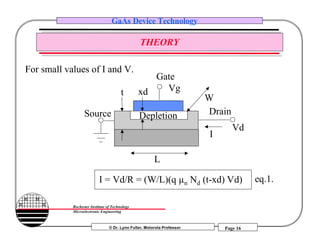
GaAs Device Technology
Page 16
THEORY
Gate
Source Drain
L
I
W
t
I = Vd/R = (W/L)(q µn Nd (t-xd) Vd)
xd
Vd
For small values of I and V.
eq.1.
Depletion
Vg
Ā© Dr. Lynn Fuller, Motorola Professor
Rochester Institute of Technology
Microelectronic Engineering
GaAs Device Technology
Page 17
THEORY
Where
xd = (2 εoεr/q)(Ψo-V)/Nd)^0.5
xd = width of space charge layer
q = 1.6E-19
εo= 8.85e-14 F/cm
εr = 13.1 for GaAs
Nd = n-type dopant concentration
ĪØo = built in voltage = KT/q ln (Nd/ni) + Eg/2
Eg is the energy gap for GaAs ~ 1.43 eV
V = Applied Voltage
Go = 1/R
Go = (W/L) (q µn Nd (t))
Ā© Dr. Lynn Fuller, Motorola Professor
Rochester Institute of Technology
Microelectronic Engineering
GaAs Device Technology
Page 18
THEORY
Gate
Source Drain
L
Id
W
t xd
Vd
For larger values of I and V.
Depletion
Id = Go { V -2/3(2εs/qNdt2)0.5 [(Ψo-Vg+Vd)1.5 - (Ψo-Vg )1.5]}
Vg
eq. 2.
Ā© Dr. Lynn Fuller, Motorola Professor
Rochester Institute of Technology
Microelectronic Engineering
GaAs Device Technology
Page 19
THEORY
Gate
Source Drain
L
Isat
W
t
Vd
For Pinch Off
Channel Pinched Off
Isat = Go [ qNd t2 - (Ψo-Vg ){1- 2/3[2εs (Ψo-Vg ) ]0.5}]
Depletion
Vg
qNdt26εs
eq. 3.
Ā© Dr. Lynn Fuller, Motorola Professor
Rochester Institute of Technology
Microelectronic Engineering
GaAs Device Technology
Page 20
THEORY
Vd
Id
Vg = 0.0
Vg = -2.0
Vg = -1.5
Vg = -0.5
Vg = -1.0
Saturation Region
eq.3.
Non Saturation
Region eq. 2.
Linear Region
eq.1.
Isat
Ā© Dr. Lynn Fuller, Motorola Professor
Rochester Institute of Technology
Microelectronic Engineering
GaAs Device Technology
Page 21
DEPLETION TRANSISTOR CHARACTERISTICS
Vgs=0
Vgs= -0.6
Vgs= -0.3
Vgs= -0.9
Vgs= -1.2
Vgs= -1.5
Pinch-off
Ā© Dr. Lynn Fuller, Motorola Professor
Rochester Institute of Technology
Microelectronic Engineering
GaAs Device Technology
Page 22
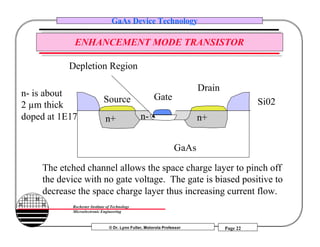
ENHANCEMENT MODE TRANSISTOR
GaAs
n+n+
Gate
Drain
Source
n-
Depletion Region
Si02
n- is about
2 µm thick
doped at 1E17
The etched channel allows the space charge layer to pinch off
the device with no gate voltage. The gate is biased positive to
decrease the space charge layer thus increasing current flow.
Ā© Dr. Lynn Fuller, Motorola Professor
Rochester Institute of Technology
Microelectronic Engineering
GaAs Device Technology
Page 23
INVERTER
Vout
+V
Vin
D-MESFET
E-MESFET
Vout
Vin
Ā© Dr. Lynn Fuller, Motorola Professor
Rochester Institute of Technology
Microelectronic Engineering
GaAs Device Technology
Page 24
GaAs IC PROCESS
Semi insulating starting wafer
5 Levels Photo
2 Levels Ion Implant
2 Levels LPCVD SiO2
Ā© Dr. Lynn Fuller, Motorola Professor
Rochester Institute of Technology
Microelectronic Engineering
GaAs Device Technology
Page 25
STARTING WAFER
GaAs semi insulating with n- epitaxial layer
n-
Ā© Dr. Lynn Fuller, Motorola Professor
Rochester Institute of Technology
Microelectronic Engineering
GaAs Device Technology
Page 26
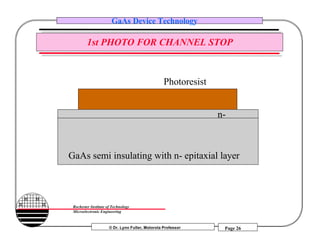
1st PHOTO FOR CHANNEL STOP
Photoresist
GaAs semi insulating with n- epitaxial layer
n-
Ā© Dr. Lynn Fuller, Motorola Professor
Rochester Institute of Technology
Microelectronic Engineering
GaAs Device Technology
Page 27
ALIGNMENT ETCH AND CHANNEL STOP IMPLANT
GaAs semi insulating with n- epitaxial layer
n-
Note: etch alignment marks with separate
mask step
Ā© Dr. Lynn Fuller, Motorola Professor
Rochester Institute of Technology
Microelectronic Engineering
GaAs Device Technology
Page 28
1ST ENCAPSULATION
LTO SiO2 5000 ƅ
GaAs semi insulating with n- epitaxial layer
n-
Ā© Dr. Lynn Fuller, Motorola Professor
Rochester Institute of Technology
Microelectronic Engineering
GaAs Device Technology
Page 29
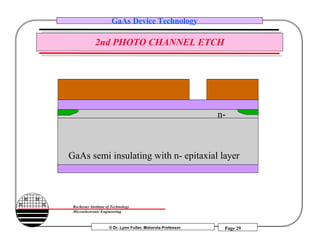
2nd PHOTO CHANNEL ETCH
GaAs semi insulating with n- epitaxial layer
n-
Ā© Dr. Lynn Fuller, Motorola Professor
Rochester Institute of Technology
Microelectronic Engineering
GaAs Device Technology
Page 30
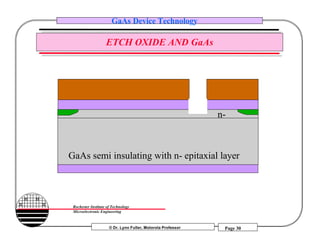
ETCH OXIDE AND GaAs
GaAs semi insulating with n- epitaxial layer
n-
Ā© Dr. Lynn Fuller, Motorola Professor
Rochester Institute of Technology
Microelectronic Engineering
GaAs Device Technology
Page 31
STRIP RESIST
GaAs semi insulating with n- epitaxial layer
n-
Ā© Dr. Lynn Fuller, Motorola Professor
Rochester Institute of Technology
Microelectronic Engineering
GaAs Device Technology
Page 32
3rd PHOTO FOR GATE LIFT-OFF
GaAs semi insulating with n- epitaxial layer
n-
Ā© Dr. Lynn Fuller, Motorola Professor
Rochester Institute of Technology
Microelectronic Engineering
GaAs Device Technology
Page 33
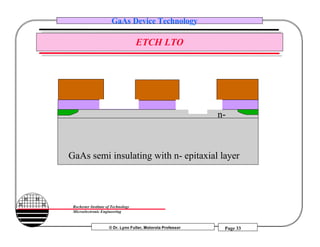
ETCH LTO
GaAs semi insulating with n- epitaxial layer
n-
Ā© Dr. Lynn Fuller, Motorola Professor
Rochester Institute of Technology
Microelectronic Engineering
GaAs Device Technology
Page 34
EVAPORATE GATE METAL
GaAs semi insulating with n- epitaxial layer
n-
Deposit 3000 ƅ Tungsten
Ā© Dr. Lynn Fuller, Motorola Professor
Rochester Institute of Technology
Microelectronic Engineering
GaAs Device Technology
Page 35
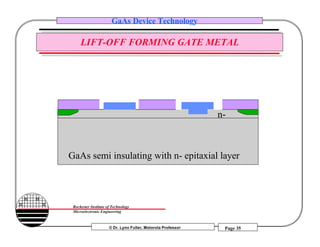
LIFT-OFF FORMING GATE METAL
GaAs semi insulating with n- epitaxial layer
n-
Ā© Dr. Lynn Fuller, Motorola Professor
Rochester Institute of Technology
Microelectronic Engineering
GaAs Device Technology
Page 36
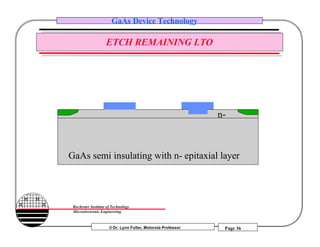
ETCH REMAINING LTO
GaAs semi insulating with n- epitaxial layer
n-
Ā© Dr. Lynn Fuller, Motorola Professor
Rochester Institute of Technology
Microelectronic Engineering
GaAs Device Technology
Page 37
4th PHOTO FOR D/S IMPLANT
GaAs semi insulating with n- epitaxial layer
n-
Ā© Dr. Lynn Fuller, Motorola Professor
Rochester Institute of Technology
Microelectronic Engineering
GaAs Device Technology
Page 38
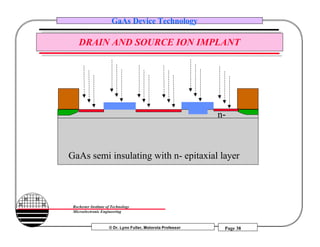
DRAIN AND SOURCE ION IMPLANT
GaAs semi insulating with n- epitaxial layer
n-
Ā© Dr. Lynn Fuller, Motorola Professor
Rochester Institute of Technology
Microelectronic Engineering
GaAs Device Technology
Page 39
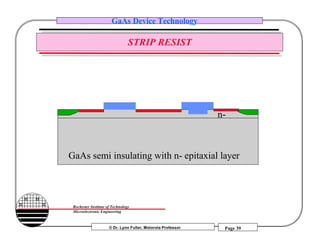
STRIP RESIST
GaAs semi insulating with n- epitaxial layer
n-
Ā© Dr. Lynn Fuller, Motorola Professor
Rochester Institute of Technology
Microelectronic Engineering
GaAs Device Technology
Page 40
2nd LPCVD SIO2 ENCAPSULATION
GaAs semi insulating with n- epitaxial layer
n-
Ā© Dr. Lynn Fuller, Motorola Professor
Rochester Institute of Technology
Microelectronic Engineering
GaAs Device Technology
Page 41
ANNEAL
GaAs semi insulating with n- epitaxial layer
Ā© Dr. Lynn Fuller, Motorola Professor
Rochester Institute of Technology
Microelectronic Engineering
GaAs Device Technology
Page 42
5th PHOTO D/S METAL LIFT OFF
GaAs semi insulating with n- epitaxial layer
Ā© Dr. Lynn Fuller, Motorola Professor
Rochester Institute of Technology
Microelectronic Engineering
GaAs Device Technology
Page 43
LTO ETCH
GaAs semi insulating with n- epitaxial layer
Ā© Dr. Lynn Fuller, Motorola Professor
Rochester Institute of Technology
Microelectronic Engineering
GaAs Device Technology
Page 44
EVAPORATE D/S METAL
GaAs semi insulating with n- epitaxial layer
Ā© Dr. Lynn Fuller, Motorola Professor
Rochester Institute of Technology
Microelectronic Engineering
GaAs Device Technology
Page 45
LIFT OFF
GaAs semi insulating with n- epitaxial layer
Ā© Dr. Lynn Fuller, Motorola Professor
Rochester Institute of Technology
Microelectronic Engineering
GaAs Device Technology
Page 46
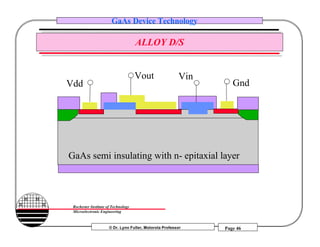
ALLOY D/S
GaAs semi insulating with n- epitaxial layer
Vdd
Vout Vin
Gnd
Ā© Dr. Lynn Fuller, Motorola Professor
Rochester Institute of Technology
Microelectronic Engineering
GaAs Device Technology
Page 47
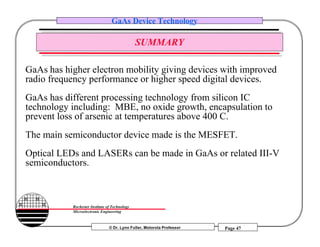
SUMMARY
GaAs has higher electron mobility giving devices with improved
radio frequency performance or higher speed digital devices.
GaAs has different processing technology from silicon IC
technology including: MBE, no oxide growth, encapsulation to
prevent loss of arsenic at temperatures above 400 C.
The main semiconductor device made is the MESFET.
Optical LEDs and LASERs can be made in GaAs or related III-V
semiconductors.
Ā© Dr. Lynn Fuller, Motorola Professor
Rochester Institute of Technology
Microelectronic Engineering
GaAs Device Technology
Page 48
REFERENCES
1. ā€œA Comparison of GaAs and Si Processing Technologyā€, C.E.
Weitzel, J.M. Frary, Motorola Semiconductor Research and
Development Labs, Semiconductor International, June 1982
2. ā€œGaAs Ics Bid for Commercial Successā€, Larry Waller,
Electronics June 14, 1984.3.
3. GaAs no longer next year’s technology as digital circuits come to
marketā€, W. Twaddell, EDN May 17, 1984.
4. ā€œAre MMICs a Fad or Factā€, D.R. Decker, MSN, July 1983.
5. ā€œGallium Arsenideā€, Inside Technology Today - a Texas
Instruments Videotape Series, 18 min.
Ā© Dr. Lynn Fuller, Motorola Professor
Rochester Institute of Technology
Microelectronic Engineering
GaAs Device Technology
Page 49
HOMEWORK - GaAs
1. Sketch the layout of a GaAs inverter built using the fabrication
process described.
2. Why are direct gap semiconductor materials necessary for
light emitting devices.
3. What energy gap corresponds to 600 nm (red) and 400 nm
(blue).

Gaas

  • 1.
    Ā© Dr. LynnFuller, Motorola Professor Rochester Institute of Technology Microelectronic Engineering GaAs Device Technology Page 1 ROCHESTER INSTITUTE OF TECHNOLOGY MICROELECTRONIC ENGINEERING Gallium Arsenide Devices, Technologies & Integrated Circuits Dr. Lynn Fuller Motorola Professor Microelectronic Engineering Rochester Institute of Technology 82 Lomb Memorial Drive Rochester, NY 14623-5604 Tel (585) 475-2035 Fax (585) 475-5041 LFFEEE@rit.edu 11-4-2001 gaas.ppt
  • 2.
    Ā© Dr. LynnFuller, Motorola Professor Rochester Institute of Technology Microelectronic Engineering GaAs Device Technology Page 2 OUTLINE Comparison of Silicon and GaAs MBE GaAs MESFET MESFET Test Results IC Process Technology References
  • 3.
    Ā© Dr. LynnFuller, Motorola Professor Rochester Institute of Technology Microelectronic Engineering GaAs Device Technology Page 3 COMPARISON OF SILICON AND GaAs Silicon GaAs Minority Carrier Lifetime 0.003 1E-8 Electron Mobility 1500 8000 Hole Mobility (cm2/Vs) 600 400 Energy Gap (eV) 1.12 (indirect) 1.43 (direct) Vapor Pressure 1E-8@930C 1@1050C The higher electron mobility for GaAs shows promise for high speed devices and circuits. The direct gap allows for emission of photons in LEDs and LASER devices. Ī» = hc/E = (6.625E-34*3E8)/(1.6E-19*1.43) = 869 nm (infrared)
  • 4.
    Ā© Dr. LynnFuller, Motorola Professor Rochester Institute of Technology Microelectronic Engineering GaAs Device Technology Page 4 CRYSTAL GROWTH and OXIDES OF GaAs The vapor pressure of As in GaAs is quite low. A GaAs substrate heated to about 500 C begins to lose As from the surface. The wafer can be capped with SiO2 or Si3N4 or the heat treating can be carried out in an Arsenic over pressure. GaAs crystals are often grown in the horizontal Bridgeman technique and the wafers are ā€œDā€ shaped. Czochralski GaAs wafers are also available up to ~4ā€ in diameter. GaAs wafers are more brittle than Silicon wafers. 4ā€ GaAs wafers cost about $300 each. GaAs does not grow a native oxide that is equivalent to SiO2. Ga2O3 and As2O3 and As2O5 oxides that grow on GaAs present more problems than uses.
  • 5.
    Ā© Dr. LynnFuller, Motorola Professor Rochester Institute of Technology Microelectronic Engineering GaAs Device Technology Page 5 GAAS ON SILICON WAFERS
  • 6.
    Ā© Dr. LynnFuller, Motorola Professor Rochester Institute of Technology Microelectronic Engineering GaAs Device Technology Page 6 CRYSTAL STRUCTURE x y z 2 1 1 1 2 2 Diamond Lattice (Silicon) Miller Indices (1/x,1,y,1/z) smallest integer set (100) plane (111) plane Zincblende Lattice (GaAs) As Ga Si
  • 7.
    Ā© Dr. LynnFuller, Motorola Professor Rochester Institute of Technology Microelectronic Engineering GaAs Device Technology Page 7 IMPURITIES IN GaAs Ionization Energy Impurity Type From Ec From Ev S n 0.0061 Se n 0.0059 Te n 0.0058 Sn n 0.0060 C n/p 0.0060 0.026 Ge n/p 0.0061 0.040 Si n/p 0.0058 0.035 Cd p 0.035 Zn p 0.031 Be p 0.028 Mg p 0.028 Li p 0.023 NOTE: Cr acts as a deep electron trap that can make GaAs appear to be undoped as it traps free electrons from silicon donor atoms that come from the quartz used in the crystal growth process.
  • 8.
    Ā© Dr. LynnFuller, Motorola Professor Rochester Institute of Technology Microelectronic Engineering GaAs Device Technology Page 8 ENERGY BAND STRUCTURE Gallium Arsenide (direct gap semiconductor) Energy gap = 1.43 eV Silicon (indirect gap semiconductor) Energy gap = 1.12 eV
  • 9.
    © Dr. LynnFuller, Motorola Professor Rochester Institute of Technology Microelectronic Engineering GaAs Device Technology Page 9 ELECTRON AND HOLE MOBILITY 300 °K77 °K 8000 1015 1019 10161013 200,000 Electron Mobility in GaAs at 77 K and 300 K Hole Mobility in GaAs at 77 K and 300 K 1000 400 1015 1020
  • 10.
    Ā© Dr. LynnFuller, Motorola Professor Rochester Institute of Technology Microelectronic Engineering GaAs Device Technology Page 10 ELECTRON DRIFT VELOCITY GaAs Silicon Electric Field (x1000 V/cm) ElectronVelocity (x107cm/sec) 3 2 1 20 40 Gunn effect oscillation in GaAs diodes is a result of negative drift velocity region.
  • 11.
    Ā© Dr. LynnFuller, Motorola Professor Rochester Institute of Technology Microelectronic Engineering GaAs Device Technology Page 11 MOLECULAR BEAM EPITAXY GalliumAluminum Shutter n-type Dopant Arsenic p-type Dopant GaAs Substrate Heater Molecular Beams
  • 12.
    Ā© Dr. LynnFuller, Motorola Professor Rochester Institute of Technology Microelectronic Engineering GaAs Device Technology Page 12 PICTURE OF MBE MACHINE
  • 13.
    © Dr. LynnFuller, Motorola Professor Rochester Institute of Technology Microelectronic Engineering GaAs Device Technology Page 13 EXAMPLES OF MBE LAYERS FOR BJT DEVICE 1015 1019 1018 1017 1016 Collector n-GaAs Base p-GaAs Emitter n-AlGaAs 1.0 µm Depth from Surface NetDopantConcentration(cm-3)
  • 14.
    Ā© Dr. LynnFuller, Motorola Professor Rochester Institute of Technology Microelectronic Engineering GaAs Device Technology Page 14 METAL CONTACTS TO GaAs Aluminum makes a schottky barrier contact (rectifying) to n-type GaAs. Ohmic contacts are usually made using and alloyed (heated above the eutectic temperature) contact of Gold (Au) and Germanium (Ge) followed by a layer of Nickel (Ni) and alloyed at a temperature above the AuGe eutectic temperature of 356 C. During alloying the Ge dopes the surface of the GaAs n+
  • 15.
    © Dr. LynnFuller, Motorola Professor Rochester Institute of Technology Microelectronic Engineering GaAs Device Technology Page 15 GaAs DEPLETION MODE MESFET GaAs n+n+ Gate Drain Source n- Depletion Region n- is about 2 µm thick doped at 1E17 Si02 As the gate voltage is made more negative the depletion region increases in size and the channel decreases until pinch-off.
  • 16.
    © Dr. LynnFuller, Motorola Professor Rochester Institute of Technology Microelectronic Engineering GaAs Device Technology Page 16 THEORY Gate Source Drain L I W t I = Vd/R = (W/L)(q µn Nd (t-xd) Vd) xd Vd For small values of I and V. eq.1. Depletion Vg
  • 17.
    © Dr. LynnFuller, Motorola Professor Rochester Institute of Technology Microelectronic Engineering GaAs Device Technology Page 17 THEORY Where xd = (2 εoεr/q)(Ψo-V)/Nd)^0.5 xd = width of space charge layer q = 1.6E-19 εo= 8.85e-14 F/cm εr = 13.1 for GaAs Nd = n-type dopant concentration Ψo = built in voltage = KT/q ln (Nd/ni) + Eg/2 Eg is the energy gap for GaAs ~ 1.43 eV V = Applied Voltage Go = 1/R Go = (W/L) (q µn Nd (t))
  • 18.
    © Dr. LynnFuller, Motorola Professor Rochester Institute of Technology Microelectronic Engineering GaAs Device Technology Page 18 THEORY Gate Source Drain L Id W t xd Vd For larger values of I and V. Depletion Id = Go { V -2/3(2εs/qNdt2)0.5 [(Ψo-Vg+Vd)1.5 - (Ψo-Vg )1.5]} Vg eq. 2.
  • 19.
    © Dr. LynnFuller, Motorola Professor Rochester Institute of Technology Microelectronic Engineering GaAs Device Technology Page 19 THEORY Gate Source Drain L Isat W t Vd For Pinch Off Channel Pinched Off Isat = Go [ qNd t2 - (Ψo-Vg ){1- 2/3[2εs (Ψo-Vg ) ]0.5}] Depletion Vg qNdt26εs eq. 3.
  • 20.
    Ā© Dr. LynnFuller, Motorola Professor Rochester Institute of Technology Microelectronic Engineering GaAs Device Technology Page 20 THEORY Vd Id Vg = 0.0 Vg = -2.0 Vg = -1.5 Vg = -0.5 Vg = -1.0 Saturation Region eq.3. Non Saturation Region eq. 2. Linear Region eq.1. Isat
  • 21.
    Ā© Dr. LynnFuller, Motorola Professor Rochester Institute of Technology Microelectronic Engineering GaAs Device Technology Page 21 DEPLETION TRANSISTOR CHARACTERISTICS Vgs=0 Vgs= -0.6 Vgs= -0.3 Vgs= -0.9 Vgs= -1.2 Vgs= -1.5 Pinch-off
  • 22.
    © Dr. LynnFuller, Motorola Professor Rochester Institute of Technology Microelectronic Engineering GaAs Device Technology Page 22 ENHANCEMENT MODE TRANSISTOR GaAs n+n+ Gate Drain Source n- Depletion Region Si02 n- is about 2 µm thick doped at 1E17 The etched channel allows the space charge layer to pinch off the device with no gate voltage. The gate is biased positive to decrease the space charge layer thus increasing current flow.
  • 23.
    Ā© Dr. LynnFuller, Motorola Professor Rochester Institute of Technology Microelectronic Engineering GaAs Device Technology Page 23 INVERTER Vout +V Vin D-MESFET E-MESFET Vout Vin
  • 24.
    Ā© Dr. LynnFuller, Motorola Professor Rochester Institute of Technology Microelectronic Engineering GaAs Device Technology Page 24 GaAs IC PROCESS Semi insulating starting wafer 5 Levels Photo 2 Levels Ion Implant 2 Levels LPCVD SiO2
  • 25.
    Ā© Dr. LynnFuller, Motorola Professor Rochester Institute of Technology Microelectronic Engineering GaAs Device Technology Page 25 STARTING WAFER GaAs semi insulating with n- epitaxial layer n-
  • 26.
    Ā© Dr. LynnFuller, Motorola Professor Rochester Institute of Technology Microelectronic Engineering GaAs Device Technology Page 26 1st PHOTO FOR CHANNEL STOP Photoresist GaAs semi insulating with n- epitaxial layer n-
  • 27.
    Ā© Dr. LynnFuller, Motorola Professor Rochester Institute of Technology Microelectronic Engineering GaAs Device Technology Page 27 ALIGNMENT ETCH AND CHANNEL STOP IMPLANT GaAs semi insulating with n- epitaxial layer n- Note: etch alignment marks with separate mask step
  • 28.
    Ā© Dr. LynnFuller, Motorola Professor Rochester Institute of Technology Microelectronic Engineering GaAs Device Technology Page 28 1ST ENCAPSULATION LTO SiO2 5000 ƅ GaAs semi insulating with n- epitaxial layer n-
  • 29.
    Ā© Dr. LynnFuller, Motorola Professor Rochester Institute of Technology Microelectronic Engineering GaAs Device Technology Page 29 2nd PHOTO CHANNEL ETCH GaAs semi insulating with n- epitaxial layer n-
  • 30.
    Ā© Dr. LynnFuller, Motorola Professor Rochester Institute of Technology Microelectronic Engineering GaAs Device Technology Page 30 ETCH OXIDE AND GaAs GaAs semi insulating with n- epitaxial layer n-
  • 31.
    Ā© Dr. LynnFuller, Motorola Professor Rochester Institute of Technology Microelectronic Engineering GaAs Device Technology Page 31 STRIP RESIST GaAs semi insulating with n- epitaxial layer n-
  • 32.
    Ā© Dr. LynnFuller, Motorola Professor Rochester Institute of Technology Microelectronic Engineering GaAs Device Technology Page 32 3rd PHOTO FOR GATE LIFT-OFF GaAs semi insulating with n- epitaxial layer n-
  • 33.
    Ā© Dr. LynnFuller, Motorola Professor Rochester Institute of Technology Microelectronic Engineering GaAs Device Technology Page 33 ETCH LTO GaAs semi insulating with n- epitaxial layer n-
  • 34.
    Ā© Dr. LynnFuller, Motorola Professor Rochester Institute of Technology Microelectronic Engineering GaAs Device Technology Page 34 EVAPORATE GATE METAL GaAs semi insulating with n- epitaxial layer n- Deposit 3000 ƅ Tungsten
  • 35.
    Ā© Dr. LynnFuller, Motorola Professor Rochester Institute of Technology Microelectronic Engineering GaAs Device Technology Page 35 LIFT-OFF FORMING GATE METAL GaAs semi insulating with n- epitaxial layer n-
  • 36.
    Ā© Dr. LynnFuller, Motorola Professor Rochester Institute of Technology Microelectronic Engineering GaAs Device Technology Page 36 ETCH REMAINING LTO GaAs semi insulating with n- epitaxial layer n-
  • 37.
    Ā© Dr. LynnFuller, Motorola Professor Rochester Institute of Technology Microelectronic Engineering GaAs Device Technology Page 37 4th PHOTO FOR D/S IMPLANT GaAs semi insulating with n- epitaxial layer n-
  • 38.
    Ā© Dr. LynnFuller, Motorola Professor Rochester Institute of Technology Microelectronic Engineering GaAs Device Technology Page 38 DRAIN AND SOURCE ION IMPLANT GaAs semi insulating with n- epitaxial layer n-
  • 39.
    Ā© Dr. LynnFuller, Motorola Professor Rochester Institute of Technology Microelectronic Engineering GaAs Device Technology Page 39 STRIP RESIST GaAs semi insulating with n- epitaxial layer n-
  • 40.
    Ā© Dr. LynnFuller, Motorola Professor Rochester Institute of Technology Microelectronic Engineering GaAs Device Technology Page 40 2nd LPCVD SIO2 ENCAPSULATION GaAs semi insulating with n- epitaxial layer n-
  • 41.
    Ā© Dr. LynnFuller, Motorola Professor Rochester Institute of Technology Microelectronic Engineering GaAs Device Technology Page 41 ANNEAL GaAs semi insulating with n- epitaxial layer
  • 42.
    Ā© Dr. LynnFuller, Motorola Professor Rochester Institute of Technology Microelectronic Engineering GaAs Device Technology Page 42 5th PHOTO D/S METAL LIFT OFF GaAs semi insulating with n- epitaxial layer
  • 43.
    Ā© Dr. LynnFuller, Motorola Professor Rochester Institute of Technology Microelectronic Engineering GaAs Device Technology Page 43 LTO ETCH GaAs semi insulating with n- epitaxial layer
  • 44.
    Ā© Dr. LynnFuller, Motorola Professor Rochester Institute of Technology Microelectronic Engineering GaAs Device Technology Page 44 EVAPORATE D/S METAL GaAs semi insulating with n- epitaxial layer
  • 45.
    Ā© Dr. LynnFuller, Motorola Professor Rochester Institute of Technology Microelectronic Engineering GaAs Device Technology Page 45 LIFT OFF GaAs semi insulating with n- epitaxial layer
  • 46.
    Ā© Dr. LynnFuller, Motorola Professor Rochester Institute of Technology Microelectronic Engineering GaAs Device Technology Page 46 ALLOY D/S GaAs semi insulating with n- epitaxial layer Vdd Vout Vin Gnd
  • 47.
    Ā© Dr. LynnFuller, Motorola Professor Rochester Institute of Technology Microelectronic Engineering GaAs Device Technology Page 47 SUMMARY GaAs has higher electron mobility giving devices with improved radio frequency performance or higher speed digital devices. GaAs has different processing technology from silicon IC technology including: MBE, no oxide growth, encapsulation to prevent loss of arsenic at temperatures above 400 C. The main semiconductor device made is the MESFET. Optical LEDs and LASERs can be made in GaAs or related III-V semiconductors.
  • 48.
    Ā© Dr. LynnFuller, Motorola Professor Rochester Institute of Technology Microelectronic Engineering GaAs Device Technology Page 48 REFERENCES 1. ā€œA Comparison of GaAs and Si Processing Technologyā€, C.E. Weitzel, J.M. Frary, Motorola Semiconductor Research and Development Labs, Semiconductor International, June 1982 2. ā€œGaAs Ics Bid for Commercial Successā€, Larry Waller, Electronics June 14, 1984.3. 3. GaAs no longer next year’s technology as digital circuits come to marketā€, W. Twaddell, EDN May 17, 1984. 4. ā€œAre MMICs a Fad or Factā€, D.R. Decker, MSN, July 1983. 5. ā€œGallium Arsenideā€, Inside Technology Today - a Texas Instruments Videotape Series, 18 min.
  • 49.
    Ā© Dr. LynnFuller, Motorola Professor Rochester Institute of Technology Microelectronic Engineering GaAs Device Technology Page 49 HOMEWORK - GaAs 1. Sketch the layout of a GaAs inverter built using the fabrication process described. 2. Why are direct gap semiconductor materials necessary for light emitting devices. 3. What energy gap corresponds to 600 nm (red) and 400 nm (blue).