LDAPCon 2009


                  20/09/2009


                 Jonathan Clarke
             jonathan@phillipoux.net


20/09/2009        http://lsc-project.org           Page 1
LDAPCon 2009


Introduction
●   LDAP directories are commonly used to store
    identity information
●   Provisioning for identity management is easy …
        –    Just put all employee information in a directory!
●   Simple, right? … well, yes, but …
        –    « HR already has software that only stores identity 
               information in a database »
        –    « We use Active Directory for our desktops and we 
               need users' identities there too »
        –    « XYZ software already uses a different directory »
20/09/2009                   http://lsc-project.org              Page 2
LDAPCon 2009


Introduction
●   Several different identity repositories
        –    How to make sure the same changes apply?
              ●   New employees
              ●   Name changes (marriage), transfers...
              ●   Employees leaving

●   Manual synchronization?
        –    Leads to a mess, leaving old accounts active …

●   Automatic synchronization?

20/09/2009                     http://lsc-project.org             Page 3
LDAPCon 2009


Introduction
●   Automatic synchronization
        –    It already exists, and works great
               ●   Directory- / database-specific replication
               ●   Application-specific connectors (AD, SAP, etc)

        –    What about the rest?
               ●   Between different databases, directories, files?
               ●   Different data models?
               ●   Using standards: LDAP, SQL, etc...?


20/09/2009                       http://lsc-project.org                Page 4
LDAPCon 2009


About LSC Project
●   What is LSC?
        –    LDAP Synchronization Connector
        –    Open Source project
        –    BSD licence
        –    Written in Java
        –    4 years in the making
        –    1 year ago LSC-project.org created
        –    6 regular contributors

●   Website: http://lsc-project.org

20/09/2009                      http://lsc-project.org           Page 5
LDAPCon 2009


Goals – functionality
●   Read/write to any database or LDAP directory
        –    Standard LDAPv3 operations
        –    JDBC connectors for databases


●   Transform data on-the-fly
        –    Adapt to a different data model
        –    JavaScript based engine to manipulate data


●   Adjustable updates: default, keep, force or merge
20/09/2009                   http://lsc-project.org           Page 6
LDAPCon 2009


Goals – usability
●   Quickly implement a new synchronization
●   Highly configurable
        –    What exactly do we read?
        –    Powerful transformations (correctness is important)
        –    What exactly do we write?
●   Run fast (performance is important)
●   Easy to setup


20/09/2009                  http://lsc-project.org           Page 7
LDAPCon 2009


Philosophy
●   Make it possible, now!
●   Make it more stable and safer
        –    Open Source benefits over home-grown scripts
        –    More secure and better tested
        –    Don't reinvent a buggy wheel!
●   Make it faster and simpler
        –    Faster than writing home-grown scripts
        –    Provide methods for IAM and directory-specific tasks
●   This is not the ultimate solution …
20/09/2009                   http://lsc-project.org           Page 8
LDAPCon 2009


LSC synchronization principles
●   Two levels of information per identity
        1. Existence – equivalent to an account (LDAP entry)
        2. Identity specific details – names, phone numbers
            (LDAP attributes and values)
●   A unique ID: the pivot attribute(s)
●   Synchronization operations
        ●    Create: Add entries from source to destination
        ●    Delete: Delete entries from destination not in source
        ●    Update: Compare and set specific details

20/09/2009                   http://lsc-project.org             Page 9
LDAPCon 2009


LSC synchronization principles
●   First step: sync
        –    Get a list of all pivots from the source
        –    For each pivot
               ●   Read the source object
               ●   Search for the destination object with pivot
               ●   Build up desired destination object by applying
                       transformations to source object
               ●   If the destination object exists, calculate modifications
               ●   Apply: create or modify


20/09/2009                       http://lsc-project.org                  Page 10
LDAPCon 2009


LSC synchronization principles
●   Second step: clean (optional)
        –    Get a list of all pivots from the destination
        –    For each pivot
               ●   Search for the source object with pivot
               ●   If the source object doesn't exists, delete from
                      destination
               ●   Apply: delete


20/09/2009                       http://lsc-project.org                Page 11
LDAPCon 2009


Defining a synchronization
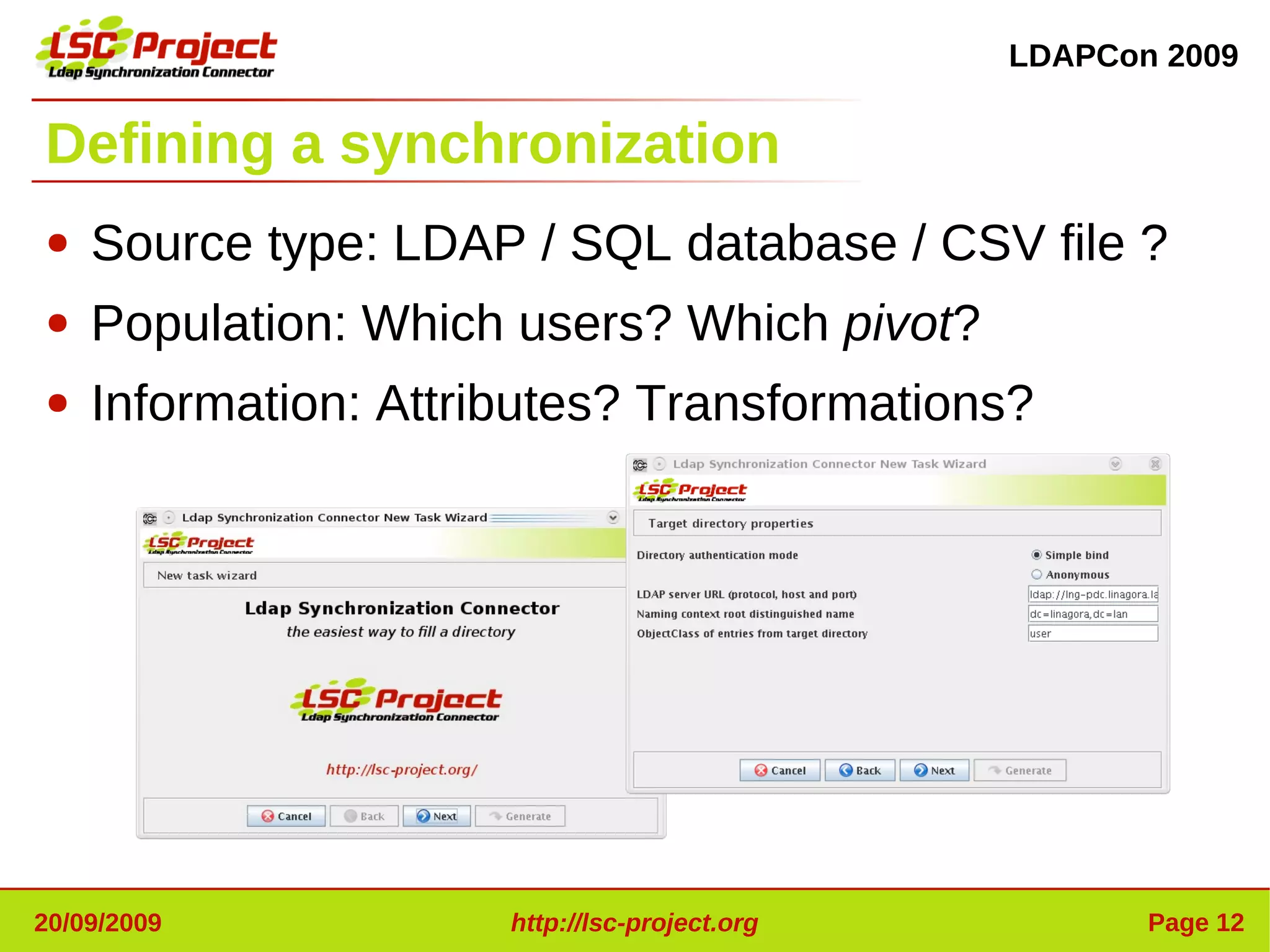
●   Source type: LDAP / SQL database / CSV file ?
●   Population: Which users? Which pivot?
●   Information: Attributes? Transformations?


20/09/2009            http://lsc-project.org          Page 12
LDAPCon 2009


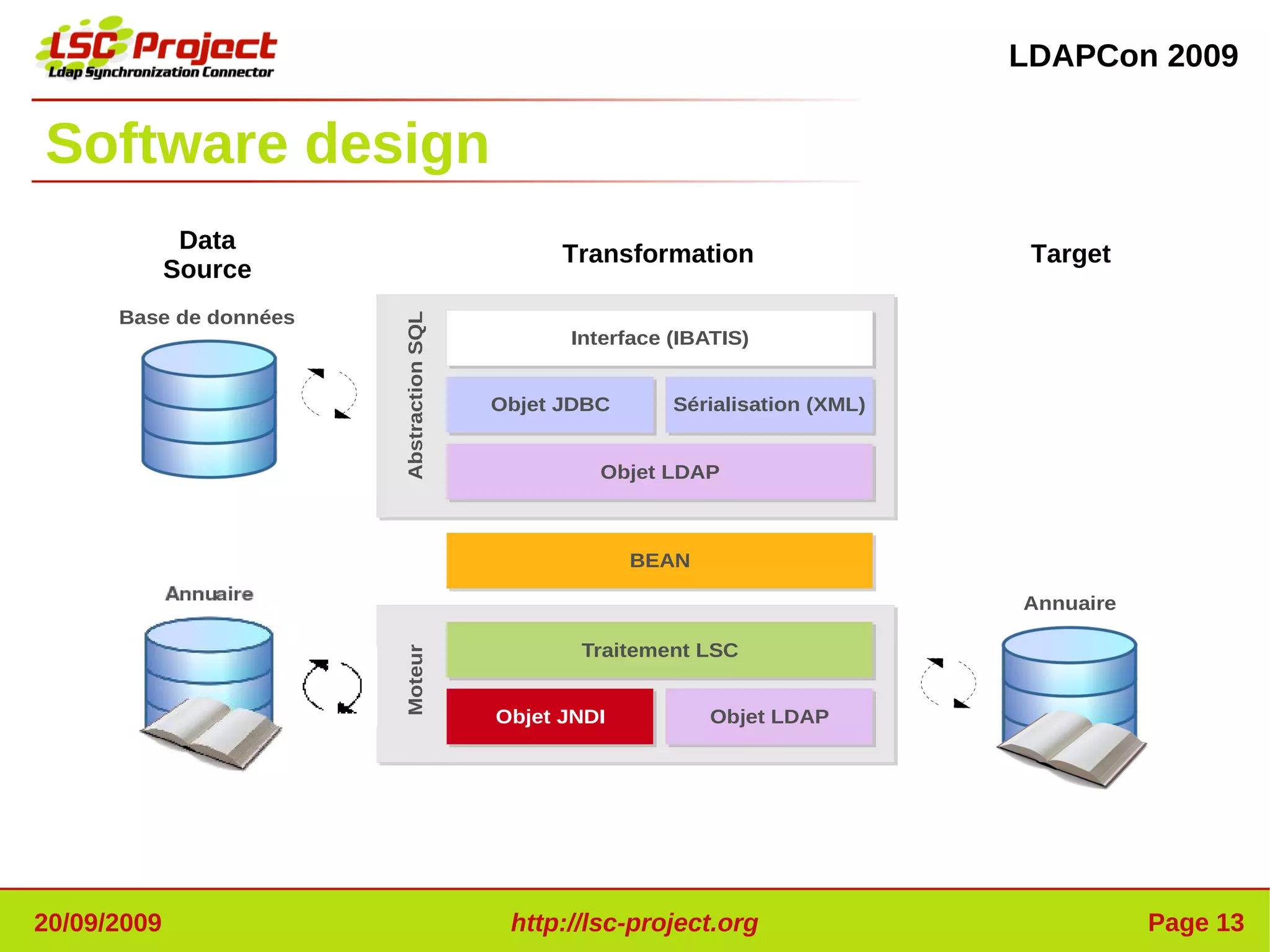
Software design
              Data
                                                Transformation                   Target
             Source
      Base de données


                        Abstraction SQL
                                                Interface (IBATIS)


                                          Objet JDBC      Sérialisation (XML)


                                                   Objet LDAP


                                                       BEAN

                                                                                Annuaire

                                                 Traitement LSC
                        Moteur


                                          Objet JNDI          Objet LDAP


20/09/2009                                 http://lsc-project.org                          Page 13
LDAPCon 2009


Example: MySQL to OpenLDAP
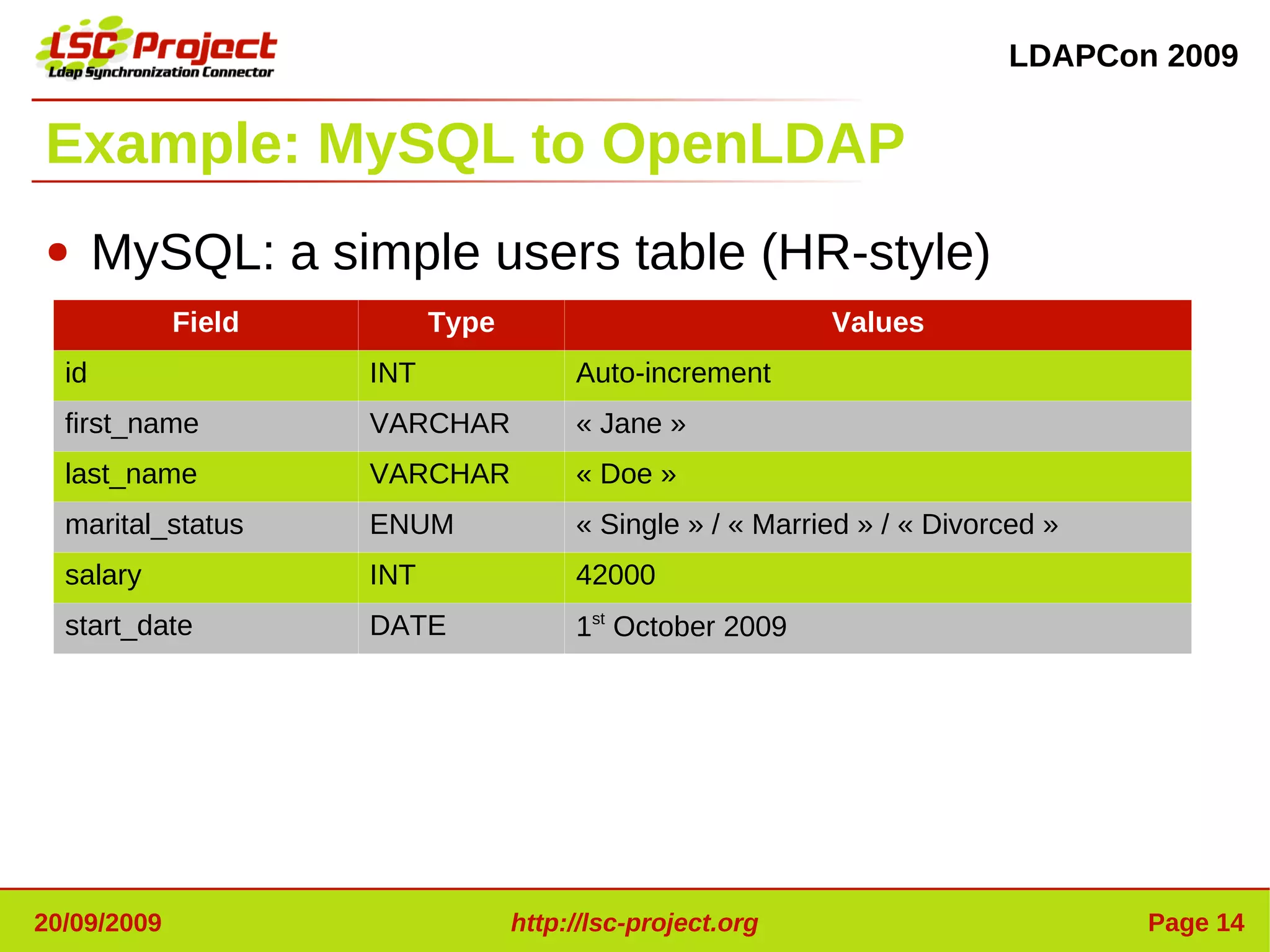
●      MySQL: a simple users table (HR-style)
             Field         Type                            Values
  id                 INT               Auto-increment
  first_name         VARCHAR           « Jane »
  last_name          VARCHAR           « Doe »
  marital_status     ENUM              « Single » / « Married » / « Divorced »
  salary             INT               42000
  start_date         DATE              1st October 2009


20/09/2009                        http://lsc-project.org                         Page 14
LDAPCon 2009


Example: MySQL to OpenLDAP
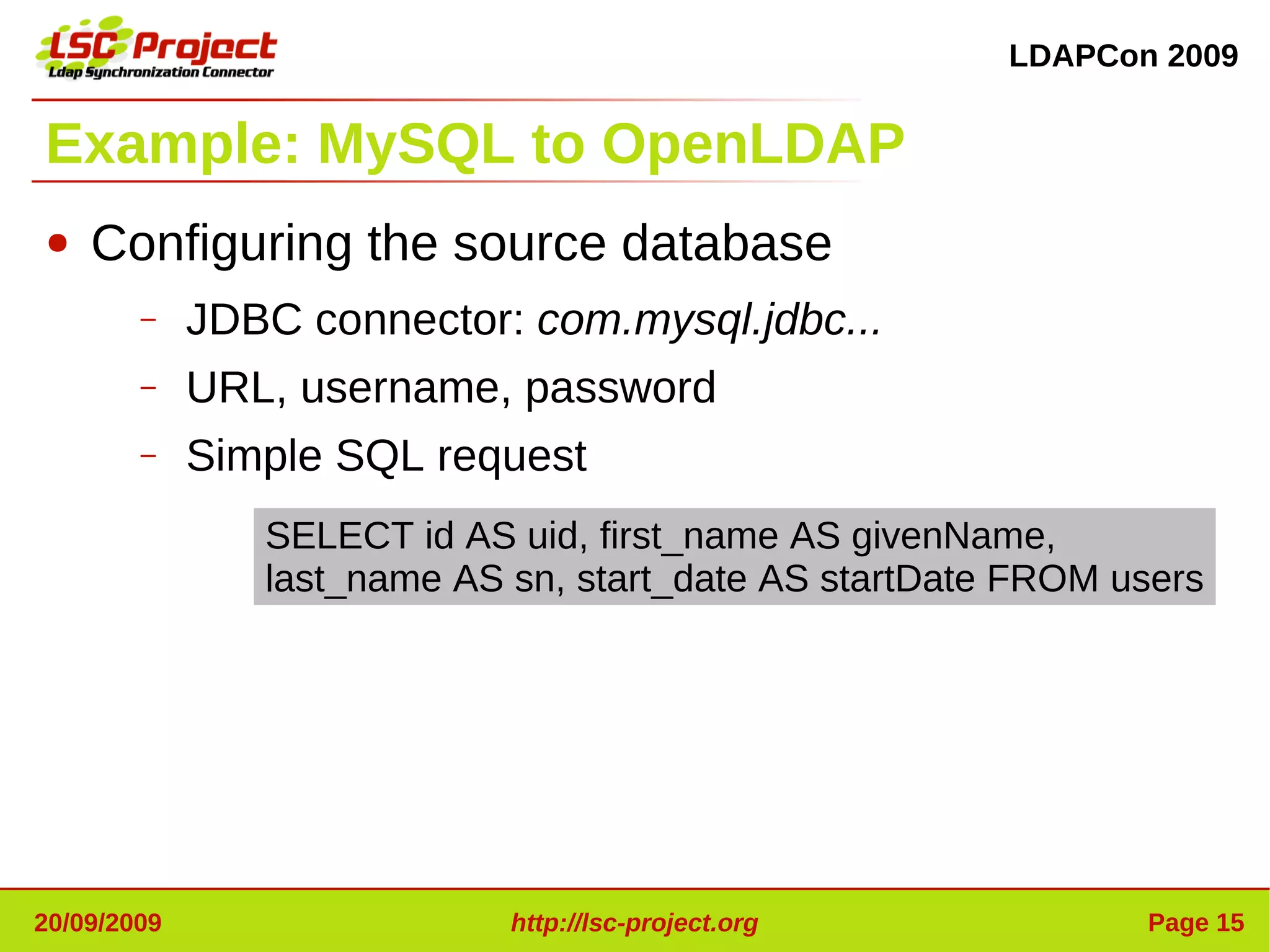
●   Configuring the source database
        –    JDBC connector: com.mysql.jdbc...
        –    URL, username, password
        –    Simple SQL request
                SELECT id AS uid, first_name AS givenName,
                last_name AS sn, start_date AS startDate FROM users


20/09/2009                   http://lsc-project.org            Page 15
LDAPCon 2009


Example: MySQL to OpenLDAP
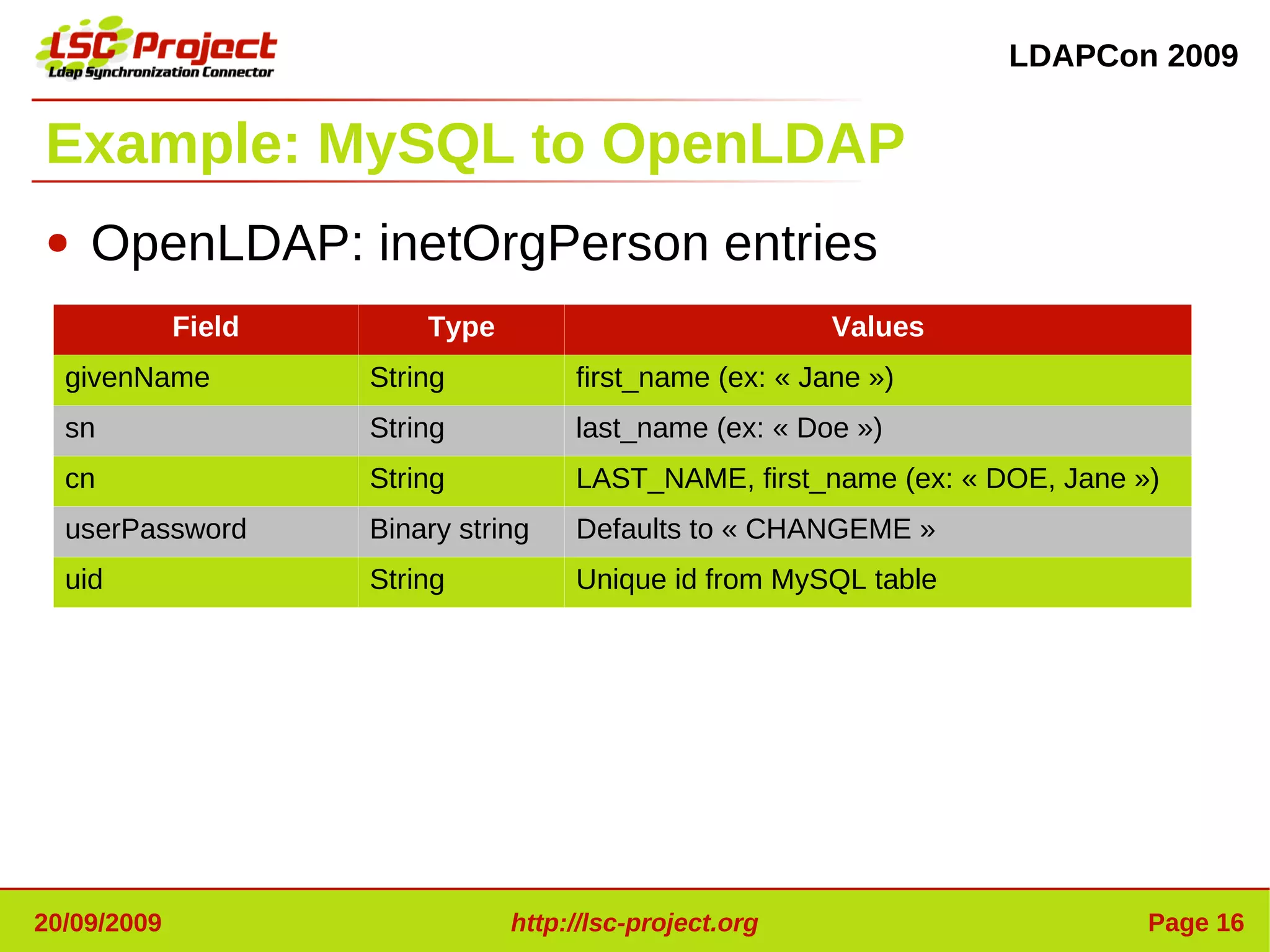
●   OpenLDAP: inetOrgPerson entries
             Field       Type                            Values
  givenName          String          first_name (ex: « Jane »)
  sn                 String          last_name (ex: « Doe »)
  cn                 String          LAST_NAME, first_name (ex: « DOE, Jane »)
  userPassword       Binary string   Defaults to « CHANGEME »
  uid                String          Unique id from MySQL table


20/09/2009                      http://lsc-project.org                       Page 16
LDAPCon 2009


Example: MySQL to OpenLDAP
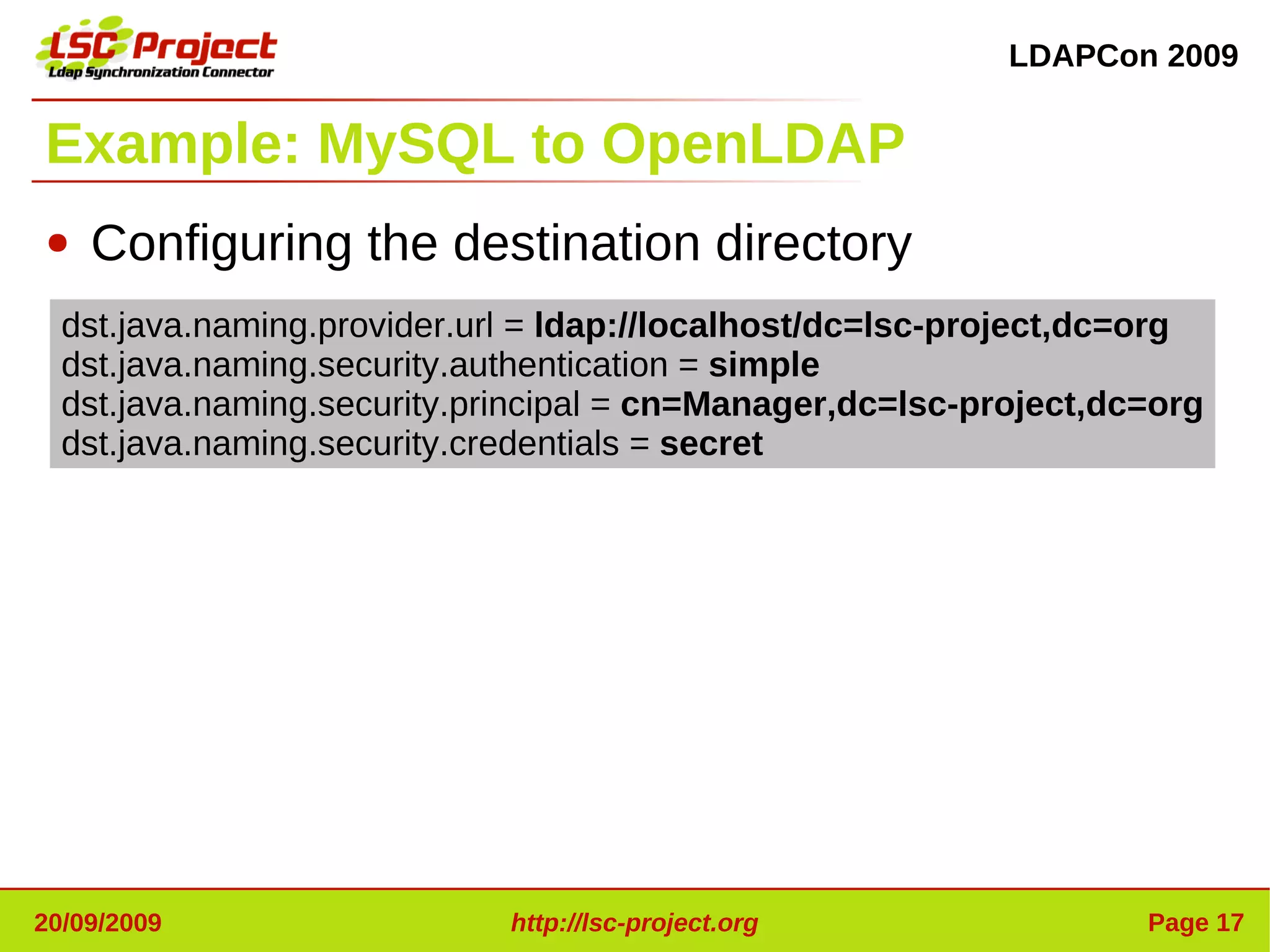
●   Configuring the destination directory
  dst.java.naming.provider.url = ldap://localhost/dc=lsc-project,dc=org
  dst.java.naming.security.authentication = simple
  dst.java.naming.security.principal = cn=Manager,dc=lsc-project,dc=org
  dst.java.naming.security.credentials = secret


20/09/2009                   http://lsc-project.org                Page 17
LDAPCon 2009


Example: MySQL to OpenLDAP
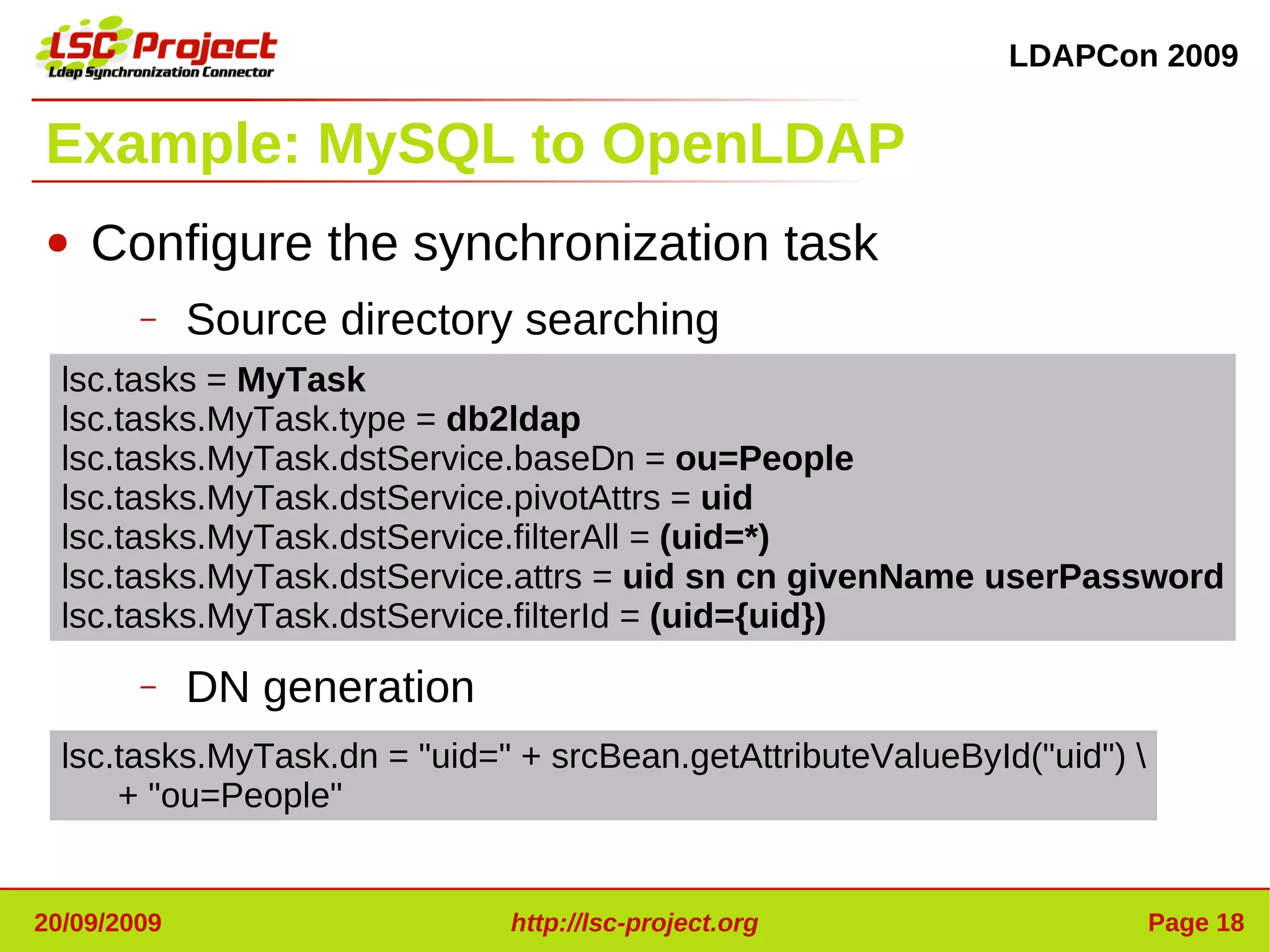
●   Configure the synchronization task
        –    Source directory searching
  lsc.tasks = MyTask
  lsc.tasks.MyTask.type = db2ldap
  lsc.tasks.MyTask.dstService.baseDn = ou=People
  lsc.tasks.MyTask.dstService.pivotAttrs = uid
  lsc.tasks.MyTask.dstService.filterAll = (uid=*)
  lsc.tasks.MyTask.dstService.attrs = uid sn cn givenName userPassword
  lsc.tasks.MyTask.dstService.filterId = (uid={uid})
        –    DN generation
  lsc.tasks.MyTask.dn = "uid=" + srcBean.getAttributeValueById("uid") 
      + "ou=People"


20/09/2009                    http://lsc-project.org                      Page 18
LDAPCon 2009


Example: MySQL to OpenLDAP
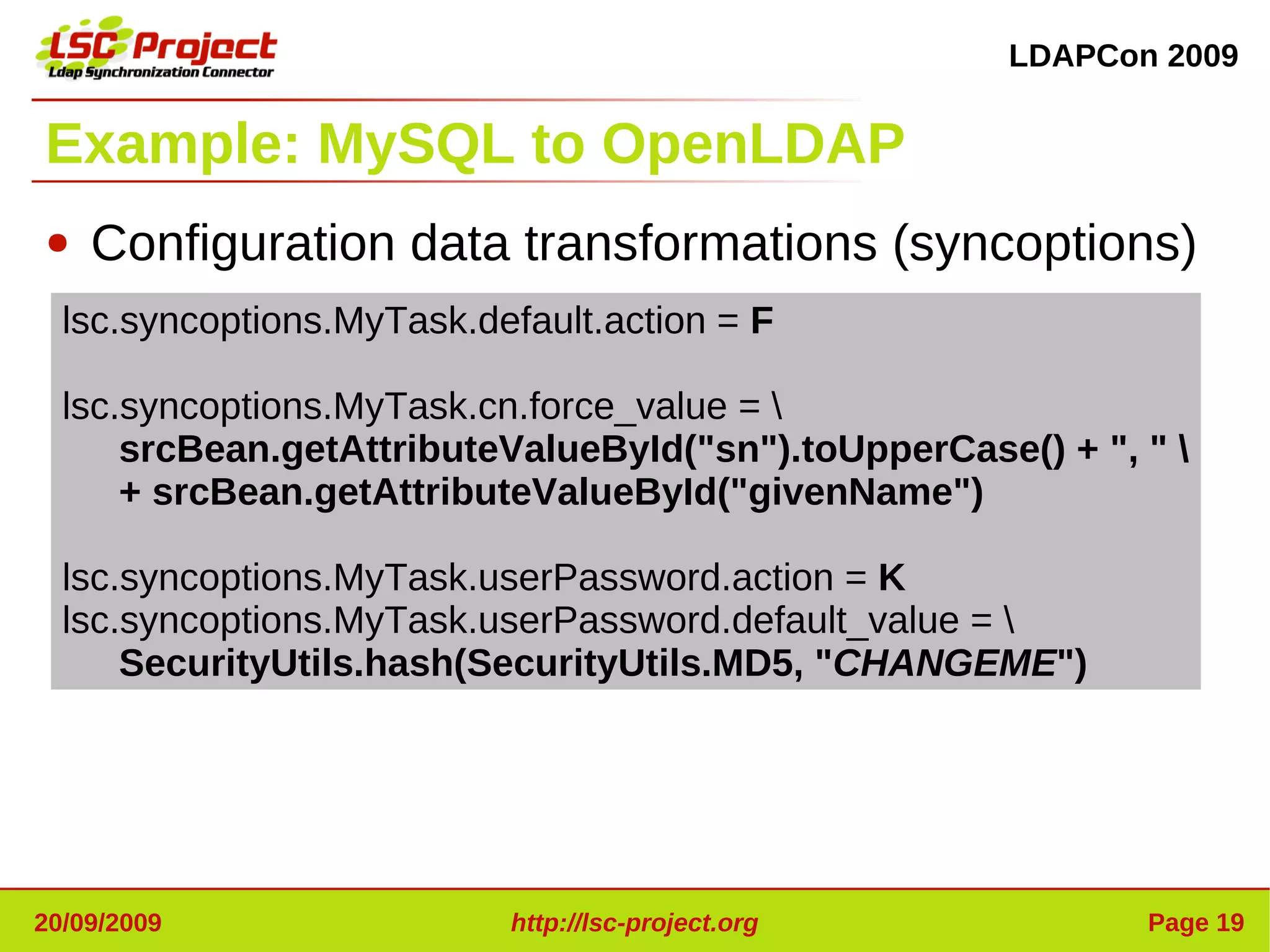
●   Configuration data transformations (syncoptions)
  lsc.syncoptions.MyTask.default.action = F

  lsc.syncoptions.MyTask.cn.force_value = 
      srcBean.getAttributeValueById("sn").toUpperCase() + ", " 
      + srcBean.getAttributeValueById("givenName")

  lsc.syncoptions.MyTask.userPassword.action = K
  lsc.syncoptions.MyTask.userPassword.default_value = 
      SecurityUtils.hash(SecurityUtils.MD5, "CHANGEME")


20/09/2009                 http://lsc-project.org            Page 19
LDAPCon 2009


Features overview
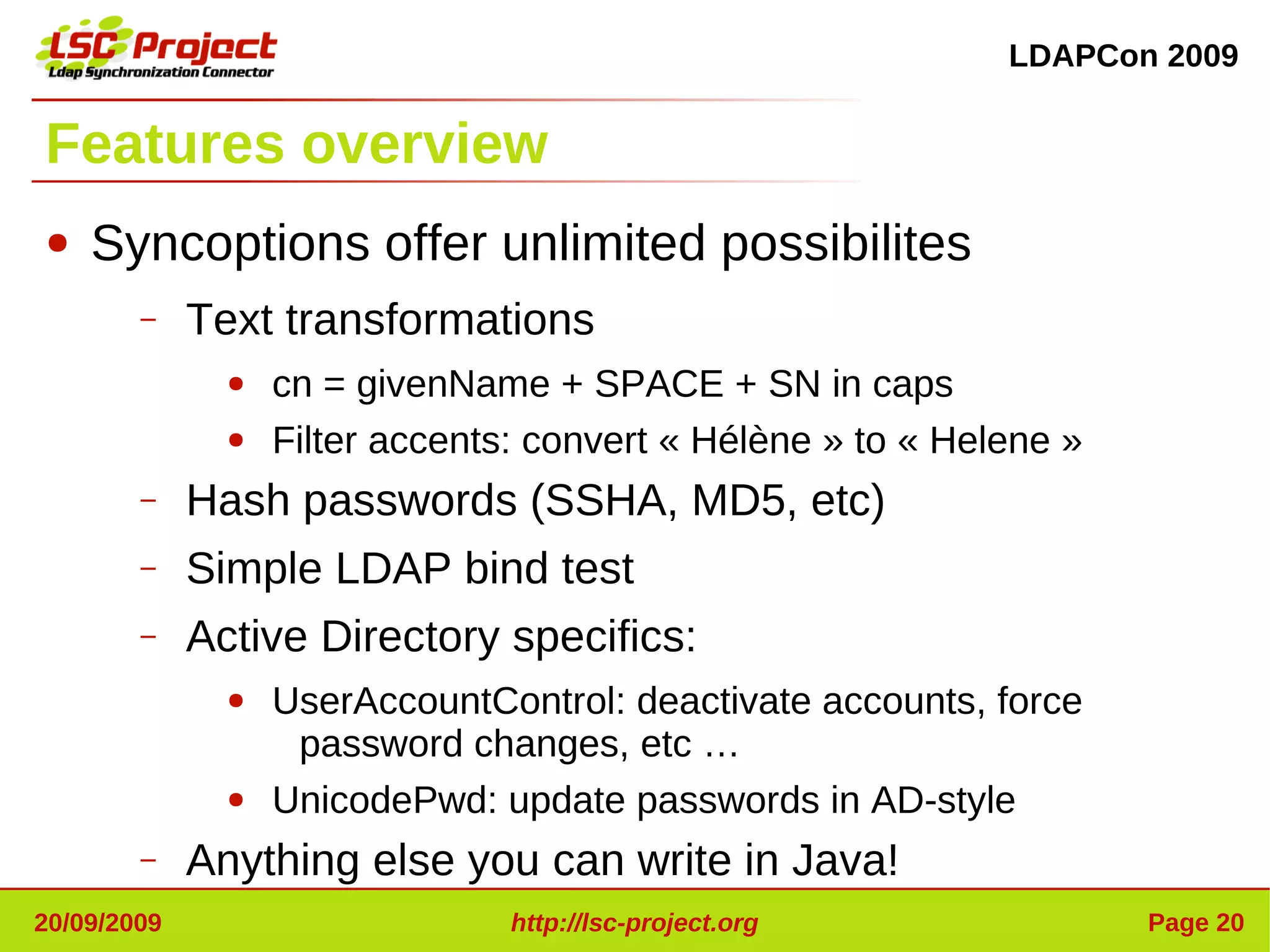
●   Syncoptions offer unlimited possibilites
        –    Text transformations
               ●   cn = givenName + SPACE + SN in caps
               ●   Filter accents: convert « Hélène » to « Helene »
        –    Hash passwords (SSHA, MD5, etc)
        –    Simple LDAP bind test
        –    Active Directory specifics:
               ●   UserAccountControl: deactivate accounts, force
                    password changes, etc …
               ●   UnicodePwd: update passwords in AD-style
        –    Anything else you can write in Java!
20/09/2009                       http://lsc-project.org               Page 20
LDAPCon 2009


Features overview
●   Operation conditions
        –    Perform ADDs / MODIFYs / MODRDNs / DELETEs
              conditionally

●   Use-cases:
        –    Update-only synchronizations
              (never create, never delete)
        –    Only update the password if it's changed
              (perform a LDAP bind operation to check on the fly)
        –    Delete an account after 60 days of inactivity

20/09/2009                   http://lsc-project.org           Page 21
LDAPCon 2009


Features overview
●   Attribute-level priorities for update
        –    FORCE: replace the destination value whatever
        –    KEEP: leave the destination value as-is
        –    DEFAULT: value to use if the destination is empty
        –    CREATE: default value for new entries

●   Use cases:
        –    Provide a default password but don't squash real one
        –    Force phone numbers if we're authoritative for them

20/09/2009                   http://lsc-project.org           Page 22
LDAPCon 2009


Features overview
●   Detailed and configurable logging
        –    LDIF format (fully RFC-compliant)
        –    CSV format


●   Audit or play back modifications


20/09/2009                   http://lsc-project.org          Page 23
LDAPCon 2009


Perspectives
●   Project is currently in stable status
        –    Version 1.1.0 released
●   Ideas for improvement are everywhere:
        –    Implement directory-specific replication systems
               ●   LDAP sync (RFC 4533) for OpenLDAP, ApacheDS
               ●   DirSync for Microsoft AD
               ●   Others?
        –    Support other scripting languages
        –    Plugins to integrate into entreprise workflows
        –    Anything else …
20/09/2009                    http://lsc-project.org             Page 24
LDAPCon 2009


Try it out! Get involved!
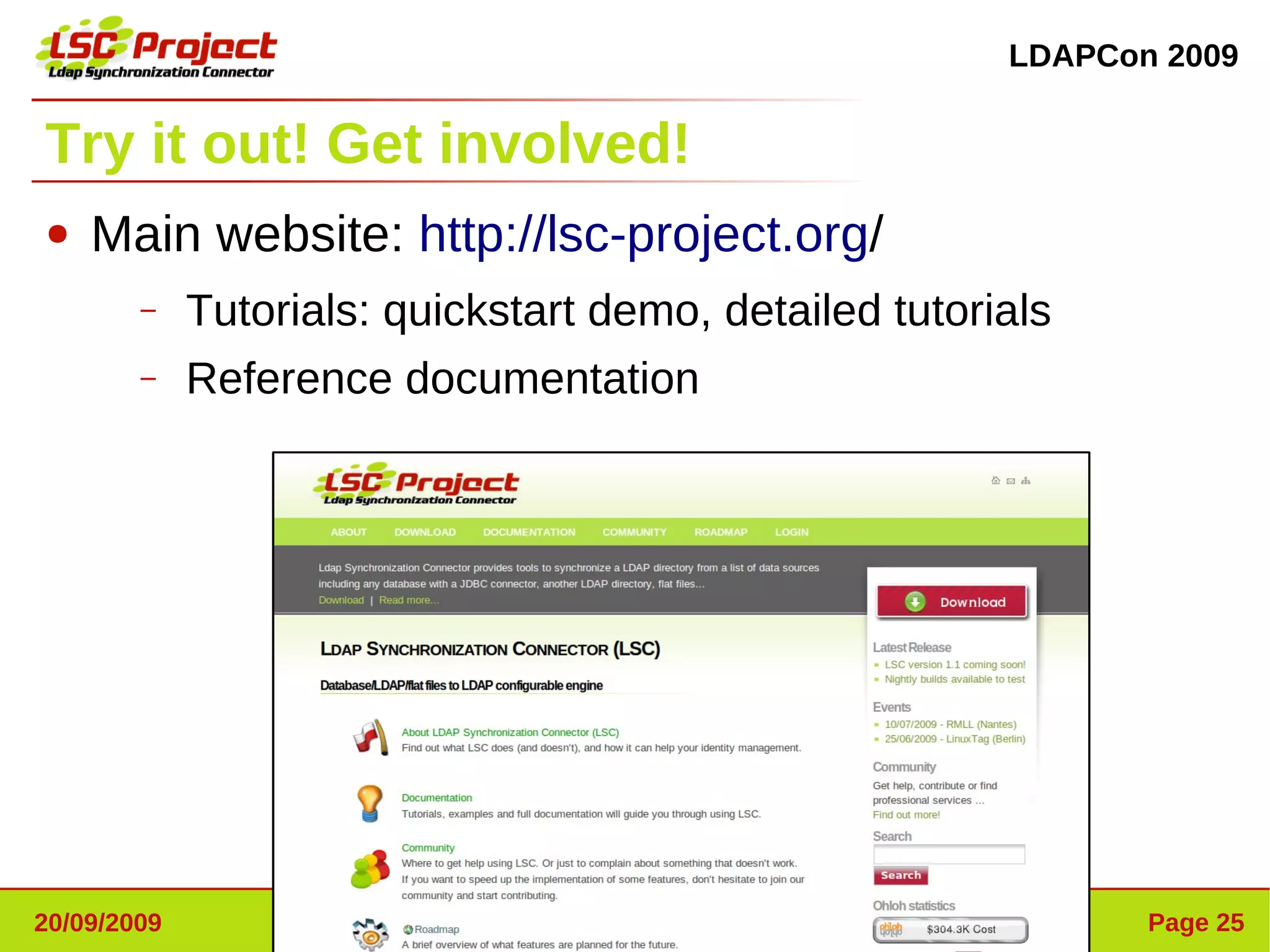
●   Main website: http://lsc-project.org/
        –    Tutorials: quickstart demo, detailed tutorials
        –    Reference documentation


20/09/2009                    http://lsc-project.org           Page 25
LDAPCon 2009


Try it out! Get involved!
●   Getting help (keep in touch!)
        –    Mailing lists: http://lists.lsc-project.org/
        –    IRC: #lsc-project on Freenode

●   Development tools:
        –    Redmine forge: http://tools.lsc-project.org/
        –    Bugtracker, SVN repository …
        –    Continuous build server
               ●   Lots of tests based on OpenDS


20/09/2009                     http://lsc-project.org              Page 26
LDAPCon 2009


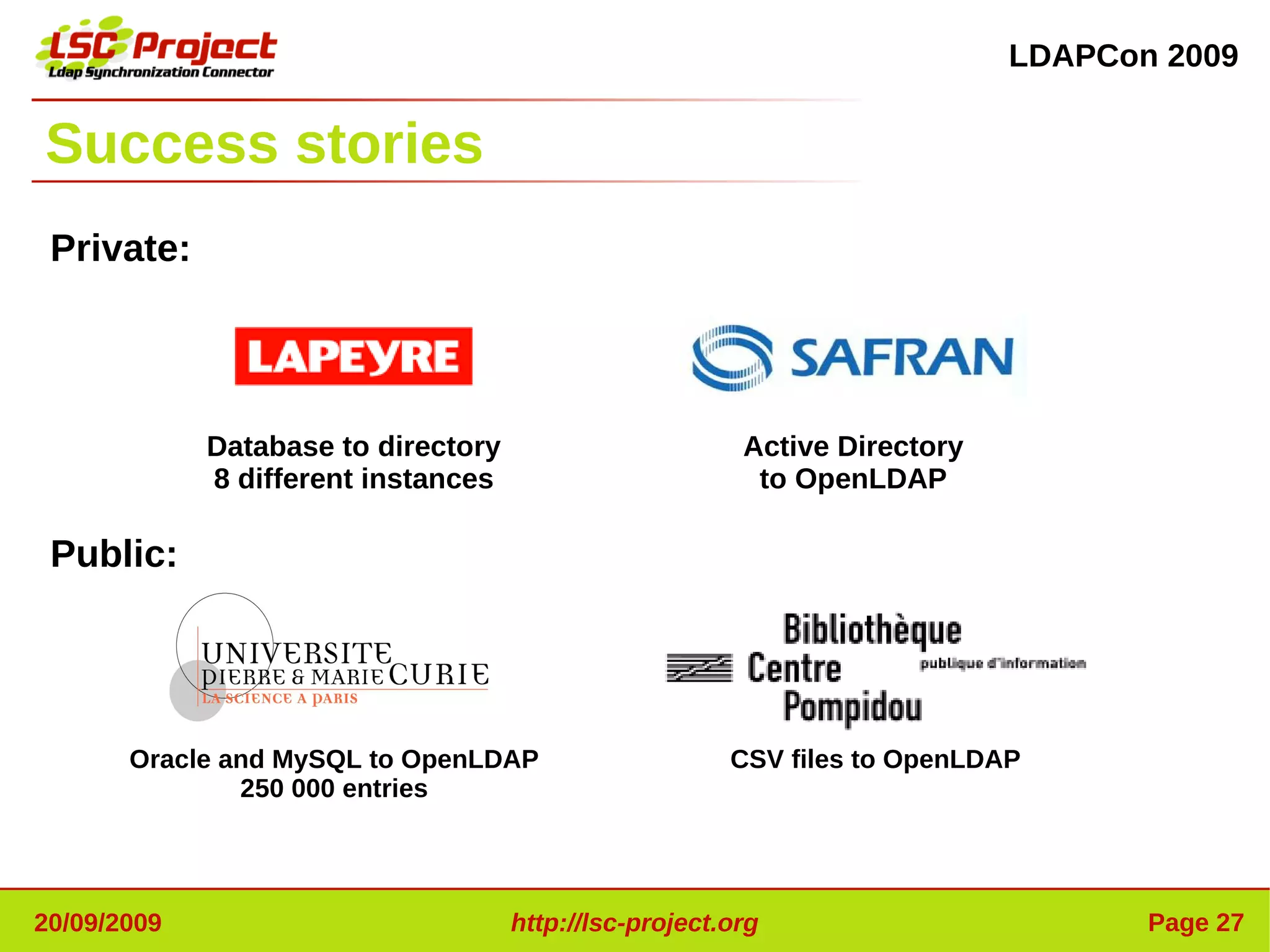
Success stories
 Private:


             Database to directory                       Active Directory
             8 different instances                        to OpenLDAP

 Public:


       Oracle and MySQL to OpenLDAP                     CSV files to OpenLDAP
               250 000 entries


20/09/2009                           http://lsc-project.org                        Page 27
LDAPCon 2009


             Thanks for your attention!
                 Any questions?


                   Jonathan Clarke
               jonathan@phillipoux.net


20/09/2009          http://lsc-project.org          Page 28

LDAP Synchronization Connector presentation at LDAPCon 2009

  • 1.
    LDAPCon 2009 20/09/2009 Jonathan Clarke jonathan@phillipoux.net 20/09/2009 http://lsc-project.org Page 1
  • 2.
    LDAPCon 2009 Introduction ● LDAP directories are commonly used to store identity information ● Provisioning for identity management is easy … – Just put all employee information in a directory! ● Simple, right? … well, yes, but … – « HR already has software that only stores identity  information in a database » – « We use Active Directory for our desktops and we  need users' identities there too » – « XYZ software already uses a different directory » 20/09/2009 http://lsc-project.org Page 2
  • 3.
    LDAPCon 2009 Introduction ● Several different identity repositories – How to make sure the same changes apply? ● New employees ● Name changes (marriage), transfers... ● Employees leaving ● Manual synchronization? – Leads to a mess, leaving old accounts active … ● Automatic synchronization? 20/09/2009 http://lsc-project.org Page 3
  • 4.
    LDAPCon 2009 Introduction ● Automatic synchronization – It already exists, and works great ● Directory- / database-specific replication ● Application-specific connectors (AD, SAP, etc) – What about the rest? ● Between different databases, directories, files? ● Different data models? ● Using standards: LDAP, SQL, etc...? 20/09/2009 http://lsc-project.org Page 4
  • 5.
    LDAPCon 2009 About LSCProject ● What is LSC? – LDAP Synchronization Connector – Open Source project – BSD licence – Written in Java – 4 years in the making – 1 year ago LSC-project.org created – 6 regular contributors ● Website: http://lsc-project.org 20/09/2009 http://lsc-project.org Page 5
  • 6.
    LDAPCon 2009 Goals –functionality ● Read/write to any database or LDAP directory – Standard LDAPv3 operations – JDBC connectors for databases ● Transform data on-the-fly – Adapt to a different data model – JavaScript based engine to manipulate data ● Adjustable updates: default, keep, force or merge 20/09/2009 http://lsc-project.org Page 6
  • 7.
    LDAPCon 2009 Goals –usability ● Quickly implement a new synchronization ● Highly configurable – What exactly do we read? – Powerful transformations (correctness is important) – What exactly do we write? ● Run fast (performance is important) ● Easy to setup 20/09/2009 http://lsc-project.org Page 7
  • 8.
    LDAPCon 2009 Philosophy ● Make it possible, now! ● Make it more stable and safer – Open Source benefits over home-grown scripts – More secure and better tested – Don't reinvent a buggy wheel! ● Make it faster and simpler – Faster than writing home-grown scripts – Provide methods for IAM and directory-specific tasks ● This is not the ultimate solution … 20/09/2009 http://lsc-project.org Page 8
  • 9.
    LDAPCon 2009 LSC synchronizationprinciples ● Two levels of information per identity 1. Existence – equivalent to an account (LDAP entry) 2. Identity specific details – names, phone numbers (LDAP attributes and values) ● A unique ID: the pivot attribute(s) ● Synchronization operations ● Create: Add entries from source to destination ● Delete: Delete entries from destination not in source ● Update: Compare and set specific details 20/09/2009 http://lsc-project.org Page 9
  • 10.
    LDAPCon 2009 LSC synchronizationprinciples ● First step: sync – Get a list of all pivots from the source – For each pivot ● Read the source object ● Search for the destination object with pivot ● Build up desired destination object by applying transformations to source object ● If the destination object exists, calculate modifications ● Apply: create or modify 20/09/2009 http://lsc-project.org Page 10
  • 11.
    LDAPCon 2009 LSC synchronizationprinciples ● Second step: clean (optional) – Get a list of all pivots from the destination – For each pivot ● Search for the source object with pivot ● If the source object doesn't exists, delete from destination ● Apply: delete 20/09/2009 http://lsc-project.org Page 11
  • 12.
    LDAPCon 2009 Defining asynchronization ● Source type: LDAP / SQL database / CSV file ? ● Population: Which users? Which pivot? ● Information: Attributes? Transformations? 20/09/2009 http://lsc-project.org Page 12
  • 13.
    LDAPCon 2009 Software design Data Transformation Target Source Base de données Abstraction SQL Interface (IBATIS) Objet JDBC Sérialisation (XML) Objet LDAP BEAN Annuaire Traitement LSC Moteur Objet JNDI Objet LDAP 20/09/2009 http://lsc-project.org Page 13
  • 14.
    LDAPCon 2009 Example: MySQLto OpenLDAP ● MySQL: a simple users table (HR-style) Field Type Values id INT Auto-increment first_name VARCHAR « Jane » last_name VARCHAR « Doe » marital_status ENUM « Single » / « Married » / « Divorced » salary INT 42000 start_date DATE 1st October 2009 20/09/2009 http://lsc-project.org Page 14
  • 15.
    LDAPCon 2009 Example: MySQLto OpenLDAP ● Configuring the source database – JDBC connector: com.mysql.jdbc... – URL, username, password – Simple SQL request SELECT id AS uid, first_name AS givenName, last_name AS sn, start_date AS startDate FROM users 20/09/2009 http://lsc-project.org Page 15
  • 16.
    LDAPCon 2009 Example: MySQLto OpenLDAP ● OpenLDAP: inetOrgPerson entries Field Type Values givenName String first_name (ex: « Jane ») sn String last_name (ex: « Doe ») cn String LAST_NAME, first_name (ex: « DOE, Jane ») userPassword Binary string Defaults to « CHANGEME » uid String Unique id from MySQL table 20/09/2009 http://lsc-project.org Page 16
  • 17.
    LDAPCon 2009 Example: MySQLto OpenLDAP ● Configuring the destination directory dst.java.naming.provider.url = ldap://localhost/dc=lsc-project,dc=org dst.java.naming.security.authentication = simple dst.java.naming.security.principal = cn=Manager,dc=lsc-project,dc=org dst.java.naming.security.credentials = secret 20/09/2009 http://lsc-project.org Page 17
  • 18.
    LDAPCon 2009 Example: MySQLto OpenLDAP ● Configure the synchronization task – Source directory searching lsc.tasks = MyTask lsc.tasks.MyTask.type = db2ldap lsc.tasks.MyTask.dstService.baseDn = ou=People lsc.tasks.MyTask.dstService.pivotAttrs = uid lsc.tasks.MyTask.dstService.filterAll = (uid=*) lsc.tasks.MyTask.dstService.attrs = uid sn cn givenName userPassword lsc.tasks.MyTask.dstService.filterId = (uid={uid}) – DN generation lsc.tasks.MyTask.dn = "uid=" + srcBean.getAttributeValueById("uid") + "ou=People" 20/09/2009 http://lsc-project.org Page 18
  • 19.
    LDAPCon 2009 Example: MySQLto OpenLDAP ● Configuration data transformations (syncoptions) lsc.syncoptions.MyTask.default.action = F lsc.syncoptions.MyTask.cn.force_value = srcBean.getAttributeValueById("sn").toUpperCase() + ", " + srcBean.getAttributeValueById("givenName") lsc.syncoptions.MyTask.userPassword.action = K lsc.syncoptions.MyTask.userPassword.default_value = SecurityUtils.hash(SecurityUtils.MD5, "CHANGEME") 20/09/2009 http://lsc-project.org Page 19
  • 20.
    LDAPCon 2009 Features overview ● Syncoptions offer unlimited possibilites – Text transformations ● cn = givenName + SPACE + SN in caps ● Filter accents: convert « Hélène » to « Helene » – Hash passwords (SSHA, MD5, etc) – Simple LDAP bind test – Active Directory specifics: ● UserAccountControl: deactivate accounts, force password changes, etc … ● UnicodePwd: update passwords in AD-style – Anything else you can write in Java! 20/09/2009 http://lsc-project.org Page 20
  • 21.
    LDAPCon 2009 Features overview ● Operation conditions – Perform ADDs / MODIFYs / MODRDNs / DELETEs conditionally ● Use-cases: – Update-only synchronizations (never create, never delete) – Only update the password if it's changed (perform a LDAP bind operation to check on the fly) – Delete an account after 60 days of inactivity 20/09/2009 http://lsc-project.org Page 21
  • 22.
    LDAPCon 2009 Features overview ● Attribute-level priorities for update – FORCE: replace the destination value whatever – KEEP: leave the destination value as-is – DEFAULT: value to use if the destination is empty – CREATE: default value for new entries ● Use cases: – Provide a default password but don't squash real one – Force phone numbers if we're authoritative for them 20/09/2009 http://lsc-project.org Page 22
  • 23.
    LDAPCon 2009 Features overview ● Detailed and configurable logging – LDIF format (fully RFC-compliant) – CSV format ● Audit or play back modifications 20/09/2009 http://lsc-project.org Page 23
  • 24.
    LDAPCon 2009 Perspectives ● Project is currently in stable status – Version 1.1.0 released ● Ideas for improvement are everywhere: – Implement directory-specific replication systems ● LDAP sync (RFC 4533) for OpenLDAP, ApacheDS ● DirSync for Microsoft AD ● Others? – Support other scripting languages – Plugins to integrate into entreprise workflows – Anything else … 20/09/2009 http://lsc-project.org Page 24
  • 25.
    LDAPCon 2009 Try itout! Get involved! ● Main website: http://lsc-project.org/ – Tutorials: quickstart demo, detailed tutorials – Reference documentation 20/09/2009 http://lsc-project.org Page 25
  • 26.
    LDAPCon 2009 Try itout! Get involved! ● Getting help (keep in touch!) – Mailing lists: http://lists.lsc-project.org/ – IRC: #lsc-project on Freenode ● Development tools: – Redmine forge: http://tools.lsc-project.org/ – Bugtracker, SVN repository … – Continuous build server ● Lots of tests based on OpenDS 20/09/2009 http://lsc-project.org Page 26
  • 27.
    LDAPCon 2009 Success stories Private: Database to directory Active Directory 8 different instances to OpenLDAP Public: Oracle and MySQL to OpenLDAP CSV files to OpenLDAP 250 000 entries 20/09/2009 http://lsc-project.org Page 27
  • 28.
    LDAPCon 2009 Thanks for your attention! Any questions? Jonathan Clarke jonathan@phillipoux.net 20/09/2009 http://lsc-project.org Page 28