Identity and
Access
Management
Erik Paulsson
https://www.linkedin.com/in/erikpaulsson
Agenda / Topics
• Basics
o What is IAM?
o What to do right after creating an AWS account
o What are the main components of IAM?
• What not to do
o Don’t be that person / company…
• Intermediate
o Least privilege access permissions
o How to manage / distribute AWS creds
o How to write code that auto-discovers AWS creds
o AWS Services that support IAM and at what level
• Advanced
o Temporary credentials / Avoiding long-lived creds
o AWS account federation / SSO
What is AWS IAM?
• Identity and Access Management is an AWS service
that enables you to provide fine grained access
control to:
o Interact with AWS services on behalf of your AWS account
o Interact with AWS resources created in your AWS account
• The main components are:
o IAM Users
o IAM Groups
o IAM Roles
o IAM Polices
IAM Users
• Can have username / password to login to the AWS
Console
• Can have AWS credentials for making API calls to
interact with AWS services
• New IAM users have no permissions to do anything,
implicit deny all. Permissions must be explicitly
granted.
• An IAM user doesn't necessarily have to represent
an actual person. An IAM user is really just an
identity with associated permission.
o An IAM User with only AWS creds can be created so the creds can be
used by an application to make API calls into AWS.
IAM Groups
• A collection of IAM Users
• You assign permissions to the IAM Group, all IAM
Users in the Group inherit those permissions.
o Implicit deny of permissions applies to IAM Groups as well
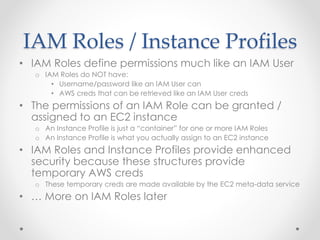
IAM Roles / Instance Profiles
• IAM Roles define permissions much like an IAM User
o IAM Roles do NOT have:
• Username/password like an IAM User can
• AWS creds that can be retrieved like an IAM User creds
• The permissions of an IAM Role can be granted /
assigned to an EC2 instance
o An Instance Profile is just a “container” for one or more IAM Roles
o An Instance Profile is what you actually assign to an EC2 instance
• IAM Roles and Instance Profiles provide enhanced
security because these structures provide
temporary AWS creds
o These temporary creds are made available by the EC2 meta-data service
• … More on IAM Roles later
IAM Policies
• When you create an IAM Group, User, or Role in
your AWS account, you associate an IAM policy
with it, which specifies the permissions that you want
to grant.
• IAM Polices are JSON formatted documents that
define AWS permissions
• Working with IAM Policies
Security firsts for new
AWS accounts
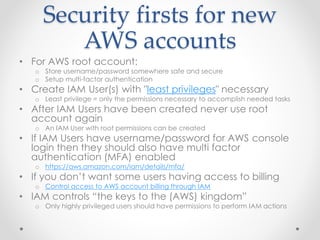
• For AWS root account:
o Store username/password somewhere safe and secure
o Setup multi-factor authentication
• Create IAM User(s) with "least privileges" necessary
o Least privilege = only the permissions necessary to accomplish needed tasks
• After IAM Users have been created never use root
account again
o An IAM User with root permissions can be created
• If IAM Users have username/password for AWS console
login then they should also have multi factor
authentication (MFA) enabled
o https://aws.amazon.com/iam/details/mfa/
• If you don’t want some users having access to billing
o Control access to AWS account billing through IAM
• IAM controls “the keys to the (AWS) kingdom”
o Only highly privileged users should have permissions to perform IAM actions
Getting AWS credentials
onto EC2 instances
• Always use an IAM Role / Instance Profile
• Never ever..... ever
o Self manage credentials for EC2 instances (environment variables, etc)
o Put AWS credentials into source code or config files
• Don't make yourself or company a victim like these
guys:
o Key slurping bots crawl github, use creds to run EC2 instances for bitcoin
mining
• http://www.theregister.co.uk/2015/01/06/dev_blunder_shows_github_
crawling_with_keyslurping_bots
o Companies have gone out of business because they were careless with
their AWS creds
• CodeSpaces had EVERYTHING deleted
o http://arstechnica.com/security/2014/06/aws-console-breach-
leads-to-demise-of-service-with-proven-backup-plan/
…continued
Getting creds onto EC2 instances
• Use IAM Instance Profile assigned to EC2 instance
• An Instance Profile is created from an IAM Role
• The instance profile must be assigned to an EC2 instance
when it is launched
• AWS credentials retrieved through the EC2 metadata service
o curl http://169.254.169.254/latest/meta-data/iam/security-credentials/<instance-
profile-name>
• These temporary credentials never have to be shared or
managed by developers
• These temporary AWS credentials are automatically rotated so
instance always has valid credentials
• http://docs.aws.amazon.com/IAM/latest/UserGuide/roles-
usingrole-instanceprofile.html
• http://docs.aws.amazon.com/IAM/latest/UserGuide/roles-
usingrole-ec2instance.html
How can code use
Instance Profile creds?
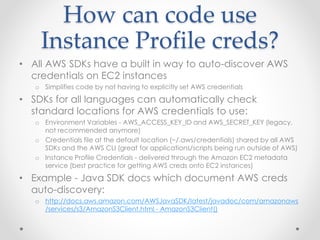
• All AWS SDKs have a built in way to auto-discover AWS
credentials on EC2 instances
o Simplifies code by not having to explicitly set AWS credentials
• SDKs for all languages can automatically check
standard locations for AWS credentials to use:
o Environment Variables - AWS_ACCESS_KEY_ID and AWS_SECRET_KEY (legacy,
not recommended anymore)
o Credentials file at the default location (~/.aws/credentials) shared by all AWS
SDKs and the AWS CLI (great for applications/scripts being run outside of AWS)
o Instance Profile Credentials - delivered through the Amazon EC2 metadata
service (best practice for getting AWS creds onto EC2 instances)
• Example - Java SDK docs which document AWS creds
auto-discovery:
o http://docs.aws.amazon.com/AWSJavaSDK/latest/javadoc/com/amazonaws
/services/s3/AmazonS3Client.html - AmazonS3Client()
Local development
• If you are running scripts or an application locally that
needs to call AWS APIs then store AWS creds in the AWS
“credentials” file:
o http://blogs.aws.amazon.com/security/post/Tx3D6U6WSFGOK2H/A-New-and-
Standardized-Way-to-Manage-Credentials-in-the-AWS-SDKs
• Allows you to define multiple sets of credentials each
identified by a profile name
• A “default” profile name can be defined so a profile
doesn’t have to be specified in your code/script
• AWS CLI (command line interface)
o http://docs.aws.amazon.com/cli/latest/userguide/cli-chap-getting-
started.html#cli-multiple-profiles
o aws s3 cp ./awesome.tgz s3://mybucket/path/to/awesome/files/ (uses default
profile defined in ~/.aws/credentials file)
o aws s3 cp ./awesome.tgz s3://mybucket/path/to/awesome/files/ --profile user2
(uses user2 profile defined in ~/.aws/credentials file)
IAM least privilege rights
• "Anything" with AWS access should have the
minimal rights it needs to accomplish its specific
actions
• "Anything" with AWS access refers to the following:
o IAM Users or Groups
o IAM Roles / Instance Profiles
• IAM Roles can be assumed by end users
• Instance Profiles can be assigned to EC2 instances
o Your applications or scripts (which use IAM Role or User creds)
• Example: if an application only needs read access
to files in S3, then create an IAM Role with only
“GetObject” rights on S3.
S3 IAM Policies
• Granting access to an S3 bucket (Simple)
• Granting access to specific “folders” in S3 bucket
• S3 Actions
{
"Version": "2012-10-17",
"Statement": [
{
"Effect": "Allow",
"Action": ["s3:ListBucket"],
"Resource": ["arn:aws:s3:::test"]
},
{
"Effect": "Allow",
"Action": [
"s3:PutObject",
"s3:GetObject",
"s3:DeleteObject"
],
"Resource": ["arn:aws:s3:::test/*"]
}
]
}
Amazon Resource Names
(ARNs)
• ARNs are unique identifiers for AWS resources.
• Format of an ARN:
o arn:partition:service:region:account-id:resource
o arn:partition:service:region:account-id:resourcetype/resource
o arn:partition:service:region:account-id:resourcetype:resource
• Details of ARNs for each AWS Service
o http://docs.aws.amazon.com/general/latest/gr/aws-arns-and-
namespaces.html
Elements of an IAM
Policy
• Main elements of an IAM Policy
o Version
o Statement
• Main element of the policy
• Contains an array of statements
• Each statement defines whether permissions are allowed or denied
for certain service actions against particular resources. These are
defined by the values of the following elements in each statement:
o Effect – Allow or Deny
o Action – array of service actions
o Resource – array of ARNs that actions can occur on
o Principal – identifies who/what is allowed/denied access
• Details on IAM Policy elements
o http://docs.aws.amazon.com/IAM/latest/UserGuide/reference_policies_e
lements.html
Advanced uses of
IAM Roles
• IAM Roles can be “assumed” by:
o IAM Users in the either the same or different AWS account
o AWS services (EC2 instances or even another IAM Role)
o External users authenticated outside of AWS (Federation)
• IAM Roles provide enhanced security:
o Temporary credentials
• If credentials do get compromised they won’t be valid for long
• “Long-lived” credentials are bad… mmmmmkkk
o Users can be logged into AWS console without username/password
o Temporary credentials + Least privilege permissions!!!
AWS Federation
• My real world scenario
o Many AWS accounts
o Many users needing access to 1 or many AWS accounts
o Management of many of the “same” IAM Users and Groups across many
AWS accounts
• Equals…
o Maintenance nightmare
o Potential for security lapses when employee leaves company
• What AWS accounts did the employee have access to?
• Have to delete IAM User from each AWS account
• Most mid to large companies have a central
Identity Provider
o Active Directory
o Federation could also use social login providers
…continued
AWS Federation
• We took a web application that uses SSO via SAML to authenticate with
our corp AD
o Runs in AWS on EC2 instance with Instance Profile that has rights to “assume” Roles
o The IAM Roles that can be “assumed” can exist in any AWS account as long as a trust relationship is
created.
o IAM Roles are kept track of in the application DB
o For each user of this web application 0 or more IAM Roles can be mapped to a user
o The application can then retrieve temporary credentials from a Role on behalf of a user of the web
application
• AWS creds can be returned to user for local use
• AWS console access can be granted based on permissions of the IAM Role
• Simplified solution
o Delete all IAM Users across all AWS accounts
o Replace all IAM Groups with IAM Roles in each AWS account
o One set of users (web application users) that can be granted access to any IAM Role from any AWS
account.
o Enhances security
• If a user leaves the company they are removed from corporate AD, no longer have access to web
application and therefore no more access to any AWS accounts
• TEMPORARY AWS creds (only last 1 hour, AWS allowed max… for now)
• Creating a URL that Enables Federated Access to the AWS Management
Console
o Java example code
AWS Console
Federated Username
• Federated Login/Identifier uses the name of the IAM Role
that was used plus a specified identifier.
• It is cutoff in this image
• AutomationFederationRoles-AutomationAdmins-1VGJS9PG5J8JO/erik.paulsson
AWS Federation
Local dev with temp creds
• It is a pain for developers and cloud admins to work locally
when AWS creds expire
o Every hour have to:
• Retrieve new AWS creds from web application
• Copy/paste into local AWS credentials file
• Solution
o Wrote small GUI tool
• Local thick client since it needs to write to file system
• User authenticates to same web application using SSO still
• Tool retrieves new credentials on hourly schedule from web application REST
APIs
• Writes these AWS credentials to local AWS credentials file
o Tool allows users to retrieve creds for 0 or more of the IAM Roles they are
allowed to use
o A credentials profile name can be assigned to each
o Used NW.js to build client (formerly known as “node-webkit”)
• Single code base
• Compiles to self executable for all platforms (Linux, Mac, Win)
• No run-time dependencies (JRE, python, etc)
o Just download and run
Other Links
• Advanced Assume Role using “policy” parameter:
o http://docs.aws.amazon.com/STS/latest/APIReference/API_AssumeRole.h
tml
• IDC White Paper: You can be more secure in the
cloud than in your own data center
• AWS in Plain English
o https://www.expeditedssl.com/aws-in-plain-english

AWS IAM and security

  • 1.
  • 2.
    Agenda / Topics •Basics o What is IAM? o What to do right after creating an AWS account o What are the main components of IAM? • What not to do o Don’t be that person / company… • Intermediate o Least privilege access permissions o How to manage / distribute AWS creds o How to write code that auto-discovers AWS creds o AWS Services that support IAM and at what level • Advanced o Temporary credentials / Avoiding long-lived creds o AWS account federation / SSO
  • 3.
    What is AWSIAM? • Identity and Access Management is an AWS service that enables you to provide fine grained access control to: o Interact with AWS services on behalf of your AWS account o Interact with AWS resources created in your AWS account • The main components are: o IAM Users o IAM Groups o IAM Roles o IAM Polices
  • 4.
    IAM Users • Canhave username / password to login to the AWS Console • Can have AWS credentials for making API calls to interact with AWS services • New IAM users have no permissions to do anything, implicit deny all. Permissions must be explicitly granted. • An IAM user doesn't necessarily have to represent an actual person. An IAM user is really just an identity with associated permission. o An IAM User with only AWS creds can be created so the creds can be used by an application to make API calls into AWS.
  • 5.
    IAM Groups • Acollection of IAM Users • You assign permissions to the IAM Group, all IAM Users in the Group inherit those permissions. o Implicit deny of permissions applies to IAM Groups as well
  • 6.
    IAM Roles /Instance Profiles • IAM Roles define permissions much like an IAM User o IAM Roles do NOT have: • Username/password like an IAM User can • AWS creds that can be retrieved like an IAM User creds • The permissions of an IAM Role can be granted / assigned to an EC2 instance o An Instance Profile is just a “container” for one or more IAM Roles o An Instance Profile is what you actually assign to an EC2 instance • IAM Roles and Instance Profiles provide enhanced security because these structures provide temporary AWS creds o These temporary creds are made available by the EC2 meta-data service • … More on IAM Roles later
  • 7.
    IAM Policies • Whenyou create an IAM Group, User, or Role in your AWS account, you associate an IAM policy with it, which specifies the permissions that you want to grant. • IAM Polices are JSON formatted documents that define AWS permissions • Working with IAM Policies
  • 8.
    Security firsts fornew AWS accounts • For AWS root account: o Store username/password somewhere safe and secure o Setup multi-factor authentication • Create IAM User(s) with "least privileges" necessary o Least privilege = only the permissions necessary to accomplish needed tasks • After IAM Users have been created never use root account again o An IAM User with root permissions can be created • If IAM Users have username/password for AWS console login then they should also have multi factor authentication (MFA) enabled o https://aws.amazon.com/iam/details/mfa/ • If you don’t want some users having access to billing o Control access to AWS account billing through IAM • IAM controls “the keys to the (AWS) kingdom” o Only highly privileged users should have permissions to perform IAM actions
  • 9.
    Getting AWS credentials ontoEC2 instances • Always use an IAM Role / Instance Profile • Never ever..... ever o Self manage credentials for EC2 instances (environment variables, etc) o Put AWS credentials into source code or config files • Don't make yourself or company a victim like these guys: o Key slurping bots crawl github, use creds to run EC2 instances for bitcoin mining • http://www.theregister.co.uk/2015/01/06/dev_blunder_shows_github_ crawling_with_keyslurping_bots o Companies have gone out of business because they were careless with their AWS creds • CodeSpaces had EVERYTHING deleted o http://arstechnica.com/security/2014/06/aws-console-breach- leads-to-demise-of-service-with-proven-backup-plan/
  • 10.
    …continued Getting creds ontoEC2 instances • Use IAM Instance Profile assigned to EC2 instance • An Instance Profile is created from an IAM Role • The instance profile must be assigned to an EC2 instance when it is launched • AWS credentials retrieved through the EC2 metadata service o curl http://169.254.169.254/latest/meta-data/iam/security-credentials/<instance- profile-name> • These temporary credentials never have to be shared or managed by developers • These temporary AWS credentials are automatically rotated so instance always has valid credentials • http://docs.aws.amazon.com/IAM/latest/UserGuide/roles- usingrole-instanceprofile.html • http://docs.aws.amazon.com/IAM/latest/UserGuide/roles- usingrole-ec2instance.html
  • 11.
    How can codeuse Instance Profile creds? • All AWS SDKs have a built in way to auto-discover AWS credentials on EC2 instances o Simplifies code by not having to explicitly set AWS credentials • SDKs for all languages can automatically check standard locations for AWS credentials to use: o Environment Variables - AWS_ACCESS_KEY_ID and AWS_SECRET_KEY (legacy, not recommended anymore) o Credentials file at the default location (~/.aws/credentials) shared by all AWS SDKs and the AWS CLI (great for applications/scripts being run outside of AWS) o Instance Profile Credentials - delivered through the Amazon EC2 metadata service (best practice for getting AWS creds onto EC2 instances) • Example - Java SDK docs which document AWS creds auto-discovery: o http://docs.aws.amazon.com/AWSJavaSDK/latest/javadoc/com/amazonaws /services/s3/AmazonS3Client.html - AmazonS3Client()
  • 12.
    Local development • Ifyou are running scripts or an application locally that needs to call AWS APIs then store AWS creds in the AWS “credentials” file: o http://blogs.aws.amazon.com/security/post/Tx3D6U6WSFGOK2H/A-New-and- Standardized-Way-to-Manage-Credentials-in-the-AWS-SDKs • Allows you to define multiple sets of credentials each identified by a profile name • A “default” profile name can be defined so a profile doesn’t have to be specified in your code/script • AWS CLI (command line interface) o http://docs.aws.amazon.com/cli/latest/userguide/cli-chap-getting- started.html#cli-multiple-profiles o aws s3 cp ./awesome.tgz s3://mybucket/path/to/awesome/files/ (uses default profile defined in ~/.aws/credentials file) o aws s3 cp ./awesome.tgz s3://mybucket/path/to/awesome/files/ --profile user2 (uses user2 profile defined in ~/.aws/credentials file)
  • 13.
    IAM least privilegerights • "Anything" with AWS access should have the minimal rights it needs to accomplish its specific actions • "Anything" with AWS access refers to the following: o IAM Users or Groups o IAM Roles / Instance Profiles • IAM Roles can be assumed by end users • Instance Profiles can be assigned to EC2 instances o Your applications or scripts (which use IAM Role or User creds) • Example: if an application only needs read access to files in S3, then create an IAM Role with only “GetObject” rights on S3.
  • 14.
    S3 IAM Policies •Granting access to an S3 bucket (Simple) • Granting access to specific “folders” in S3 bucket • S3 Actions { "Version": "2012-10-17", "Statement": [ { "Effect": "Allow", "Action": ["s3:ListBucket"], "Resource": ["arn:aws:s3:::test"] }, { "Effect": "Allow", "Action": [ "s3:PutObject", "s3:GetObject", "s3:DeleteObject" ], "Resource": ["arn:aws:s3:::test/*"] } ] }
  • 15.
    Amazon Resource Names (ARNs) •ARNs are unique identifiers for AWS resources. • Format of an ARN: o arn:partition:service:region:account-id:resource o arn:partition:service:region:account-id:resourcetype/resource o arn:partition:service:region:account-id:resourcetype:resource • Details of ARNs for each AWS Service o http://docs.aws.amazon.com/general/latest/gr/aws-arns-and- namespaces.html
  • 16.
    Elements of anIAM Policy • Main elements of an IAM Policy o Version o Statement • Main element of the policy • Contains an array of statements • Each statement defines whether permissions are allowed or denied for certain service actions against particular resources. These are defined by the values of the following elements in each statement: o Effect – Allow or Deny o Action – array of service actions o Resource – array of ARNs that actions can occur on o Principal – identifies who/what is allowed/denied access • Details on IAM Policy elements o http://docs.aws.amazon.com/IAM/latest/UserGuide/reference_policies_e lements.html
  • 17.
    Advanced uses of IAMRoles • IAM Roles can be “assumed” by: o IAM Users in the either the same or different AWS account o AWS services (EC2 instances or even another IAM Role) o External users authenticated outside of AWS (Federation) • IAM Roles provide enhanced security: o Temporary credentials • If credentials do get compromised they won’t be valid for long • “Long-lived” credentials are bad… mmmmmkkk o Users can be logged into AWS console without username/password o Temporary credentials + Least privilege permissions!!!
  • 18.
    AWS Federation • Myreal world scenario o Many AWS accounts o Many users needing access to 1 or many AWS accounts o Management of many of the “same” IAM Users and Groups across many AWS accounts • Equals… o Maintenance nightmare o Potential for security lapses when employee leaves company • What AWS accounts did the employee have access to? • Have to delete IAM User from each AWS account • Most mid to large companies have a central Identity Provider o Active Directory o Federation could also use social login providers
  • 19.
    …continued AWS Federation • Wetook a web application that uses SSO via SAML to authenticate with our corp AD o Runs in AWS on EC2 instance with Instance Profile that has rights to “assume” Roles o The IAM Roles that can be “assumed” can exist in any AWS account as long as a trust relationship is created. o IAM Roles are kept track of in the application DB o For each user of this web application 0 or more IAM Roles can be mapped to a user o The application can then retrieve temporary credentials from a Role on behalf of a user of the web application • AWS creds can be returned to user for local use • AWS console access can be granted based on permissions of the IAM Role • Simplified solution o Delete all IAM Users across all AWS accounts o Replace all IAM Groups with IAM Roles in each AWS account o One set of users (web application users) that can be granted access to any IAM Role from any AWS account. o Enhances security • If a user leaves the company they are removed from corporate AD, no longer have access to web application and therefore no more access to any AWS accounts • TEMPORARY AWS creds (only last 1 hour, AWS allowed max… for now) • Creating a URL that Enables Federated Access to the AWS Management Console o Java example code
  • 20.
    AWS Console Federated Username •Federated Login/Identifier uses the name of the IAM Role that was used plus a specified identifier. • It is cutoff in this image • AutomationFederationRoles-AutomationAdmins-1VGJS9PG5J8JO/erik.paulsson
  • 21.
    AWS Federation Local devwith temp creds • It is a pain for developers and cloud admins to work locally when AWS creds expire o Every hour have to: • Retrieve new AWS creds from web application • Copy/paste into local AWS credentials file • Solution o Wrote small GUI tool • Local thick client since it needs to write to file system • User authenticates to same web application using SSO still • Tool retrieves new credentials on hourly schedule from web application REST APIs • Writes these AWS credentials to local AWS credentials file o Tool allows users to retrieve creds for 0 or more of the IAM Roles they are allowed to use o A credentials profile name can be assigned to each o Used NW.js to build client (formerly known as “node-webkit”) • Single code base • Compiles to self executable for all platforms (Linux, Mac, Win) • No run-time dependencies (JRE, python, etc) o Just download and run
  • 22.
    Other Links • AdvancedAssume Role using “policy” parameter: o http://docs.aws.amazon.com/STS/latest/APIReference/API_AssumeRole.h tml • IDC White Paper: You can be more secure in the cloud than in your own data center • AWS in Plain English o https://www.expeditedssl.com/aws-in-plain-english

Editor's Notes