ACTIVE DIRECTORY
Active Directory is a Directory Service which Contains Information of All User Accounts and Shared Recourses on a Network. Active Directory is a Centralized Hierarchical Directory Database ACTIVE  DIRECTORY
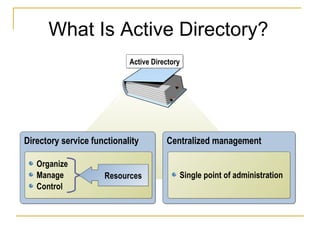
What Is Active Directory? Directory service functionality Organize Manage Control Centralized management Single point of administration Active Directory Resources
1.Provide User Logon and Authentication Services 2.To organize and manage:  User Accounts Computers Groups and Network Resources 3 Enables authorized Users to easily locate: Network Resources PURPOSE OF ACTIVE DIRECTORY
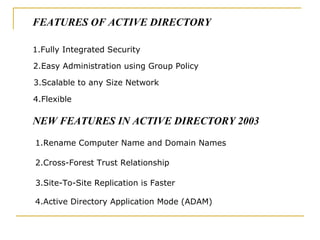
1.Fully Integrated Security 2.Easy Administration using Group Policy 3.Scalable to any Size Network 4.Flexible 1.Rename Computer Name and Domain Names 2.Cross-Forest Trust Relationship 3.Site-To-Site Replication is Faster 4.Active Directory Application Mode (ADAM) FEATURES OF ACTIVE DIRECTORY NEW FEATURES IN ACTIVE DIRECTORY 2003
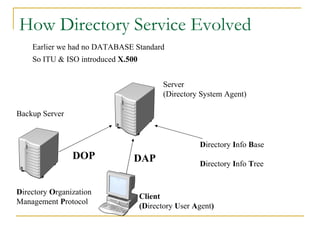
How Directory Service Evolved Server  (Directory System Agent) D irectory  I nfo  B ase D irectory  I nfo  T ree Backup Server Client  (D irectory  U ser  A gent ) DAP DOP D irectory  O rganization Management  P rotocol Earlier we had no DATABASE Standard  So ITU & ISO introduced  X.500
DAP  Directory Access Protocol is  based on OSI Layers  LDAP  Lightweight Directory Access Protocol based on TCP/IP Layer DAP was introduced in BANYAN VINES It named the Database as STREET TALK LDAP was first Introduced in NOVELL  Novell named it NDS ( Network Directory Services
Logical Structure of Active Directory FOREST TREE  Parent/Root   Child/Branch
Domains: Trees, Forests, Trusts, and Outs Active Directory is made up of one or more domains. Creating the initial domain controller in a network also creates the domain—you cannot have a domain without at least one domain controller. Each domain in the directory is identified by a DNS domain name. You use the Active Directory Domains and Trusts tool to manage domains. Domains: Trees, Forests Active Directory is made up of one or more domains.  Creating the initial domain controller in a network also creates the domain—you cannot have a domain without at least one domain controller. Each domain in the directory is identified by a DNS domain name.  You use the Active Directory Domains and Trusts tool to manage domains.
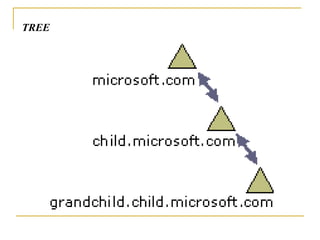
In the Windows 2003 operating system, a tree is a set of one or more domains with contiguous names.  If more than one domain exists, you can combine the multiple domains into hierarchical tree structures.  The first domain created is the root domain of the first tree.  Additional domains in the same domain tree are child domains. A domain immediately above another domain in the same domain tree is its parent. TREE
TREE
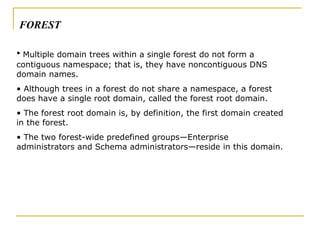
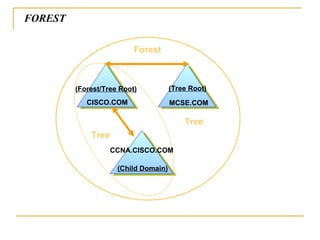
Multiple domain trees within a single forest do not form a contiguous namespace; that is, they have noncontiguous DNS domain names.  Although trees in a forest do not share a namespace, a forest does have a single root domain, called the forest root domain.  The forest root domain is, by definition, the first domain created in the forest.  The two forest-wide predefined groups—Enterprise administrators and Schema administrators—reside in this domain. FOREST
Tree Forest Tree FOREST (Forest/Tree Root) CISCO.COM MCSE.COM (Tree Root) CCNA.CISCO.COM (Child Domain)
Physical Components of Active Directory Domain Controllers Sites
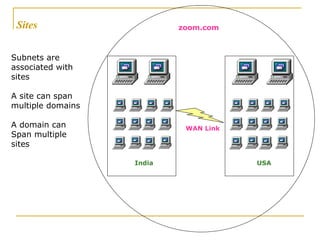
Sites Subnets are associated with sites A site can span multiple domains A domain can Span multiple sites zoom.com India USA WAN Link

Active directory

  • 1.
  • 2.
    Active Directory isa Directory Service which Contains Information of All User Accounts and Shared Recourses on a Network. Active Directory is a Centralized Hierarchical Directory Database ACTIVE DIRECTORY
  • 3.
    What Is ActiveDirectory? Directory service functionality Organize Manage Control Centralized management Single point of administration Active Directory Resources
  • 4.
    1.Provide User Logonand Authentication Services 2.To organize and manage: User Accounts Computers Groups and Network Resources 3 Enables authorized Users to easily locate: Network Resources PURPOSE OF ACTIVE DIRECTORY
  • 5.
    1.Fully Integrated Security2.Easy Administration using Group Policy 3.Scalable to any Size Network 4.Flexible 1.Rename Computer Name and Domain Names 2.Cross-Forest Trust Relationship 3.Site-To-Site Replication is Faster 4.Active Directory Application Mode (ADAM) FEATURES OF ACTIVE DIRECTORY NEW FEATURES IN ACTIVE DIRECTORY 2003
  • 6.
    How Directory ServiceEvolved Server (Directory System Agent) D irectory I nfo B ase D irectory I nfo T ree Backup Server Client (D irectory U ser A gent ) DAP DOP D irectory O rganization Management P rotocol Earlier we had no DATABASE Standard So ITU & ISO introduced X.500
  • 7.
    DAP DirectoryAccess Protocol is based on OSI Layers LDAP Lightweight Directory Access Protocol based on TCP/IP Layer DAP was introduced in BANYAN VINES It named the Database as STREET TALK LDAP was first Introduced in NOVELL Novell named it NDS ( Network Directory Services
  • 8.
    Logical Structure ofActive Directory FOREST TREE Parent/Root Child/Branch
  • 9.
    Domains: Trees, Forests,Trusts, and Outs Active Directory is made up of one or more domains. Creating the initial domain controller in a network also creates the domain—you cannot have a domain without at least one domain controller. Each domain in the directory is identified by a DNS domain name. You use the Active Directory Domains and Trusts tool to manage domains. Domains: Trees, Forests Active Directory is made up of one or more domains. Creating the initial domain controller in a network also creates the domain—you cannot have a domain without at least one domain controller. Each domain in the directory is identified by a DNS domain name. You use the Active Directory Domains and Trusts tool to manage domains.
  • 10.
    In the Windows2003 operating system, a tree is a set of one or more domains with contiguous names. If more than one domain exists, you can combine the multiple domains into hierarchical tree structures. The first domain created is the root domain of the first tree. Additional domains in the same domain tree are child domains. A domain immediately above another domain in the same domain tree is its parent. TREE
  • 11.
  • 12.
    Multiple domain treeswithin a single forest do not form a contiguous namespace; that is, they have noncontiguous DNS domain names. Although trees in a forest do not share a namespace, a forest does have a single root domain, called the forest root domain. The forest root domain is, by definition, the first domain created in the forest. The two forest-wide predefined groups—Enterprise administrators and Schema administrators—reside in this domain. FOREST
  • 13.
    Tree Forest TreeFOREST (Forest/Tree Root) CISCO.COM MCSE.COM (Tree Root) CCNA.CISCO.COM (Child Domain)
  • 14.
    Physical Components ofActive Directory Domain Controllers Sites
  • 15.
    Sites Subnets areassociated with sites A site can span multiple domains A domain can Span multiple sites zoom.com India USA WAN Link