LCD & LED TV Technologies
Presentation on
Department of Computer Science & Engineering
Faculty of Engineering
University of Development Alternative (UODA)
Submitted to
Md. Ashek Al Aziz
Assistant professor
Dept. of Computer Science & Engineering
Faculty of Engineering
University of Development Alternative (UODA)
Participants
Mohammad Ali Khan
ID: 011131035
Jakir Hossain
ID:011131036
Sadia Afrin
ID: 011131016
Jafrin Akter
ID: 011131039
Contents
• What’s Liquid Crystals (LC)
• What’s Liquid Crystals Display (LCD)
• Different types of LCDs
• LCD Display Technology
• Advantages & Disadvantages of LCD
• Applications of LCD
• What’s LED
• Type of DRIVING LED
• Some Types of LEDs
• Advantages & Disadvantages of LED
• Applications of LED
• Difference Between LCD & LED
Liquid Crystals (LC)
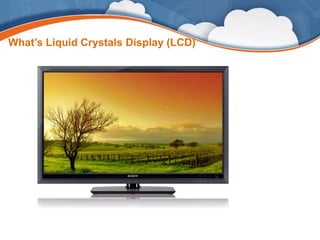
What’s Liquid Crystals Display (LCD)
Different types of LCDs
There are Two type of LCDs available
1.Passive Matrix LCDs
2.Active Matrix LCDs
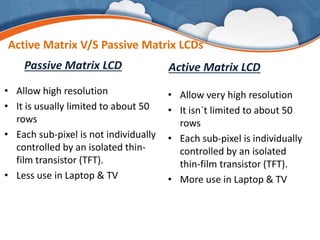
Active Matrix V/S Passive Matrix LCDs
Passive Matrix LCD Active Matrix LCD
• Allow very high resolution
• It isn`t limited to about 50
rows
• Each sub-pixel is individually
controlled by an isolated
thin-film transistor (TFT).
• More use in Laptop & TV
• Allow high resolution
• It is usually limited to about 50
rows
• Each sub-pixel is not individually
controlled by an isolated thin-
film transistor (TFT).
• Less use in Laptop & TV
LCD Display Technology
• Technology Enhancements:
– Better color through corrected CCFLs, LEDs
– Improved black levels (compensating films)
– Higher contrast (pulsed backlights)
– Wider viewing angles (compensating films)
– Higher resolution (1920x1080)
– Improved LC twist times
Advantages & Disadvantages of LCD
LCD Advantages
 Brightness
 Emissions
 Geometric Distortion
 Screen Shape
LCD Disadvantages
 Aspect Ratio
 Contrast
 Viewing Angle
Applications of LCD
Thin Film Transistor (TFT)
Alpha-numeric display
Back lighting systems
For brighter displays
What’s LED
Type of DRIVING LED
Two type of DRIVING LED
 Analog LED Drive Circuits
 Digital LED Drive Circuits
Some Types of LEDs
Bargraph 7-segment Starburst Dot matrix
Advantages & Disadvantages of LED
Advantages
• It is very cheap.
• Very simple electronic circuits.
• It is reliable.
• It is efficient
• Life span : Around 100,000 hours
• Screen size : Up to 90 inches
Disadvantages
• Restriction to only 16 hexadecimal figures.
• Low quality LEDs may cause pollution to environment.
• May result in more e-wastes.
Applications of LED
 Smartphone
 Tablet Pc
 Ebook
 Ultrabook/Notebook
 Video Camera
 Media Player
 Portable Game
 GPS
 Automotive
 LED TV
 Lighting
 Smart Metering
Difference Between LCD & LED
LED
• Power Consumption is
less
• Faster response rate
time
• Sizes Available
17inches and 70inches.
• Color Accuracy is less
• Cannot be extremely
slim
LCD
• Power Consumption is
more
• Slower response rate
time
• Sizes Available
15inches to 65 inches
• Color Accuracy is more
• Can be extremely slim
Lcd & led tv technologies

Lcd & led tv technologies

  • 1.
    LCD & LEDTV Technologies Presentation on Department of Computer Science & Engineering Faculty of Engineering University of Development Alternative (UODA)
  • 2.
    Submitted to Md. AshekAl Aziz Assistant professor Dept. of Computer Science & Engineering Faculty of Engineering University of Development Alternative (UODA)
  • 3.
    Participants Mohammad Ali Khan ID:011131035 Jakir Hossain ID:011131036 Sadia Afrin ID: 011131016 Jafrin Akter ID: 011131039
  • 4.
    Contents • What’s LiquidCrystals (LC) • What’s Liquid Crystals Display (LCD) • Different types of LCDs • LCD Display Technology • Advantages & Disadvantages of LCD • Applications of LCD • What’s LED • Type of DRIVING LED • Some Types of LEDs • Advantages & Disadvantages of LED • Applications of LED • Difference Between LCD & LED
  • 5.
  • 6.
  • 7.
    Different types ofLCDs There are Two type of LCDs available 1.Passive Matrix LCDs 2.Active Matrix LCDs
  • 8.
    Active Matrix V/SPassive Matrix LCDs Passive Matrix LCD Active Matrix LCD • Allow very high resolution • It isn`t limited to about 50 rows • Each sub-pixel is individually controlled by an isolated thin-film transistor (TFT). • More use in Laptop & TV • Allow high resolution • It is usually limited to about 50 rows • Each sub-pixel is not individually controlled by an isolated thin- film transistor (TFT). • Less use in Laptop & TV
  • 9.
    LCD Display Technology •Technology Enhancements: – Better color through corrected CCFLs, LEDs – Improved black levels (compensating films) – Higher contrast (pulsed backlights) – Wider viewing angles (compensating films) – Higher resolution (1920x1080) – Improved LC twist times
  • 10.
    Advantages & Disadvantagesof LCD LCD Advantages  Brightness  Emissions  Geometric Distortion  Screen Shape LCD Disadvantages  Aspect Ratio  Contrast  Viewing Angle
  • 11.
    Applications of LCD ThinFilm Transistor (TFT) Alpha-numeric display Back lighting systems For brighter displays
  • 12.
  • 13.
    Type of DRIVINGLED Two type of DRIVING LED  Analog LED Drive Circuits  Digital LED Drive Circuits
  • 14.
    Some Types ofLEDs Bargraph 7-segment Starburst Dot matrix
  • 15.
    Advantages & Disadvantagesof LED Advantages • It is very cheap. • Very simple electronic circuits. • It is reliable. • It is efficient • Life span : Around 100,000 hours • Screen size : Up to 90 inches Disadvantages • Restriction to only 16 hexadecimal figures. • Low quality LEDs may cause pollution to environment. • May result in more e-wastes.
  • 16.
    Applications of LED Smartphone  Tablet Pc  Ebook  Ultrabook/Notebook  Video Camera  Media Player  Portable Game  GPS  Automotive  LED TV  Lighting  Smart Metering
  • 17.
    Difference Between LCD& LED LED • Power Consumption is less • Faster response rate time • Sizes Available 17inches and 70inches. • Color Accuracy is less • Cannot be extremely slim LCD • Power Consumption is more • Slower response rate time • Sizes Available 15inches to 65 inches • Color Accuracy is more • Can be extremely slim