LIQUID CRYSTAL DISPLAY
DEFINITION
Liquid Crystal Display (LCD) is a thin , flat panel
used for displaying information such as text
,images and moving picture.
Its is used in Computers, Televisions, calculators
etc.
UnPolarization Light
Light emitted by the sun, by a lamp in the
classroom, or by a candle flame is unpolarized
light.
Because light waves traverse in all the
directions.
Polarization
The process of transforming unpolarized light
into polarized light is known as polarization.
(i.e.) Polarized light waves are light waves in
which the vibrations occur in a single plane.
WORKING PRINCIPLE
WORKING PRINCIPLE
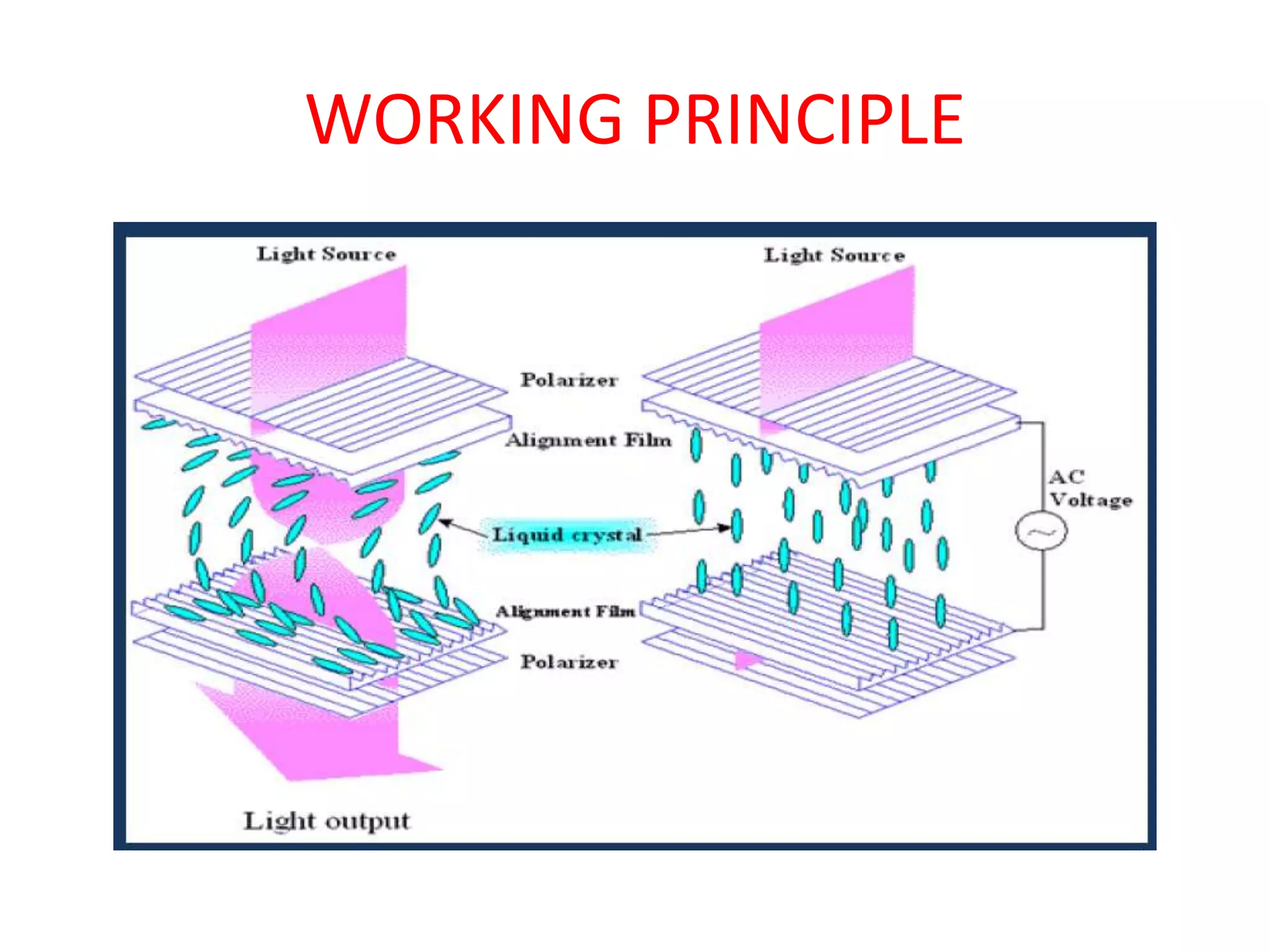
LCD ‘s are made of organic molecules when any
electric field is applied the crystals present in
the LCD rearrange themselves because they
are in liquid state.
Whenever Light enters through the first layer, it
gets polarized because of the polarized
crystals. Afterwards a dark spot appears on
the screen.
PROS OF LCD
1) Smaller size
2) Lower power consumption.
3) Lighter weight
4) Longer life
5) No Suffer in Problem.
CONS OF LCD
1) Cost is higher than CRT monitors.
2) Narrow Viewing angle.
LED
WHAT IS DIODE
A diode is an electronic component with two
electrodes called the anode and the cathode.
The fundamental property of a diode is they
conduct electric current in only one direction.
WHAT IS Light Emitting Diodes
A light-emitting diode (LED) is a semiconductor
device that emits visible light when an electric
current passes through it.
WORKING PRINCIPLE OF LED
When 2 materials one with full of electrons and
the other filled with holes brought close
contact to each other and when electric field
is applied the electrons move from valence
band to conduction band resulting in emitting
of light.
PROS OF LED
1) Higher brightness.
2) Light weight
3) No viewing angle differences.
4) The screen size is up to 90inches which is
higher than other displaying devices.
PROS OF LED
1) Consumes more power than LCD’s

Liquid crystal display

  • 1.
  • 2.
    DEFINITION Liquid Crystal Display(LCD) is a thin , flat panel used for displaying information such as text ,images and moving picture. Its is used in Computers, Televisions, calculators etc.
  • 3.
    UnPolarization Light Light emittedby the sun, by a lamp in the classroom, or by a candle flame is unpolarized light. Because light waves traverse in all the directions.
  • 4.
    Polarization The process oftransforming unpolarized light into polarized light is known as polarization. (i.e.) Polarized light waves are light waves in which the vibrations occur in a single plane.
  • 5.
  • 6.
    WORKING PRINCIPLE LCD ‘sare made of organic molecules when any electric field is applied the crystals present in the LCD rearrange themselves because they are in liquid state. Whenever Light enters through the first layer, it gets polarized because of the polarized crystals. Afterwards a dark spot appears on the screen.
  • 7.
    PROS OF LCD 1)Smaller size 2) Lower power consumption. 3) Lighter weight 4) Longer life 5) No Suffer in Problem.
  • 8.
    CONS OF LCD 1)Cost is higher than CRT monitors. 2) Narrow Viewing angle.
  • 9.
  • 10.
    WHAT IS DIODE Adiode is an electronic component with two electrodes called the anode and the cathode. The fundamental property of a diode is they conduct electric current in only one direction.
  • 11.
    WHAT IS LightEmitting Diodes A light-emitting diode (LED) is a semiconductor device that emits visible light when an electric current passes through it.
  • 12.
    WORKING PRINCIPLE OFLED When 2 materials one with full of electrons and the other filled with holes brought close contact to each other and when electric field is applied the electrons move from valence band to conduction band resulting in emitting of light.
  • 13.
    PROS OF LED 1)Higher brightness. 2) Light weight 3) No viewing angle differences. 4) The screen size is up to 90inches which is higher than other displaying devices.
  • 14.
    PROS OF LED 1)Consumes more power than LCD’s