Government Engineering 
College, Sector 28, 
Gandhinagar 
Electronics 
CREATED BY:- ENROLLMENT NO. 
MODI SHAIL 130130117054 
MODI MEET 130130117053 
MODI ABHISHEK 130130117052 
OZA DRONE 130130117060 
PARMAR JINAL 130130117062 
MISHRA POOJA 130130117050
Case Study on 
LED TV 
For Engineering Systems 
Department of Instrumentation & Control
INDEX 
Sr. No. Topic Page no. 
1. Introduction 4 
2. Types of LCD 5 
3. EDGE LIT 6 
4. FULL ARRAY 7 
5. Features 8
Introduction 
Buying a TV has become as complicated as selecting the right mobile phone plan. Before 
large flat panel displays invaded our lives, the only real question when purchasing a CRT 
(cathode ray tube) TV was how big did you want it and how much space did you have in 
your room to house it? Sure, there were some quality issues but mostly it was dictated by 
how many diagonal inches you could get for your buck. While some of that justification 
still rings true with today's TVs, now there's the issue of plasma versus LCD to contend 
with, and just when you had that sorted out, LED TVs have entered the arena as an 
option. However, there still seems to be a fair bit of confusion surrounding what exactly 
an LED TV is. Well, basically, it's another form of LCD TV that uses LEDs to provide its 
light source. 
All LCD TVs are backlit because LCDs are a transmissive type of display technology, which 
means they don't produce their own light. So for an LCD television to produce an image on the 
flat panel display, its pixels have to be backlit by a separate lighting source. Currently, most 
LCD TVs used CCFL technology (cold cathode fluorescent lamps) as their backlight source. 
They deliver good colors and brightness, and decent contrast, but not great blacks - the domain 
of the plasma TV. But TVs utilizing brighter LED backlighting can achieve much better blacks, 
as well as brighter colors and even greater contrast ratios (Toshiba Regza 55X1 is boasting 
5,000,000:1). NB: Contrast is measured from the darkest lit area of the screen to the brightest 
area to give a ratio. 
But just in case you thought your selection choice was now made easy, there are a couple of 
LED options - full matrix LED and edge lit LED TVs. Let's go through the differences and look 
at what some of the manufacturers are using as their preferred backlighting choice. 
The LED TV is a more advanced version of the LCD TV. While both types of TV on 
LCD technology and have flat-panel designs. 
"LED TVs are slimmer, brighter, and more detailed than your traditional LCD TV." LED 
TVs function by illuminating LCD panels with LED backlighting. However, not all LED 
TVs utilize the same type of LED backlighting. 
A LCD screen is composed of 2 parts, the actual liquid crystal display and a light source 
at the back of the screen (called backlight). A light diffuser is placed between the 
backlight and the LCD screen to uniform the source of light equally across the screen.
Types of LED 
There are 2 main types of backlights used in LCD screens. 
1. CCFL 
2. LED 
CCFL 
LCDs with CCFL backlight are on their way out of the market. Manufacturers are now 
only producing them for their lower end and smaller models. They are getting replaced 
by LED TVs. They have the same screen but have LED lights instead of a CCFL tube for 
the backlight 
LED 
LCD stands for “liquid crystal display” and technically, both LED and LCD TVs are 
liquid crystal displays. 
The basic technology is the same in that both television types have two layers of 
polarized glass through which the liquid crystals both block and pass light. 
So really, LED TVs are a subset of LCD TVs. 
LED, which stands for “light emitting diodes,” differs from general LCD TVs in that 
LCDs use fluorescent lights while LEDs use those light emitting diodes. 
Also, the placement of the lights on an LED TV can different. 
The fluorescent lights in an LCD TV are always behind the screen. 
But, On an LED TV, the light emitting diodes can be placed either behind the screen or 
around its edges. 
The difference in lights and in lighting placement has generally meant that LED TVs can 
be thinner than LCDs, although this is starting to change. 
It has also meant that LED TVs run with greater energy efficiency and can provide a 
clearer, better picture than the general LCD TVs. 
Because of difference in lights and lightning placement there are two types 
1. EDGE LIT 
2. FULL ARRAY LIT
3. Edge lit 
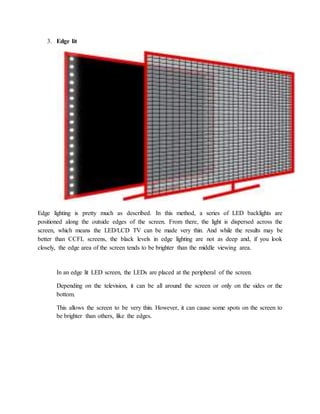
Edge lighting is pretty much as described. In this method, a series of LED backlights are 
positioned along the outside edges of the screen. From there, the light is dispersed across the 
screen, which means the LED/LCD TV can be made very thin. And while the results may be 
better than CCFL screens, the black levels in edge lighting are not as deep and, if you look 
closely, the edge area of the screen tends to be brighter than the middle viewing area. 
In an edge lit LED screen, the LEDs are placed at the peripheral of the screen. 
Depending on the television, it can be all around the screen or only on the sides or the 
bottom. 
This allows the screen to be very thin. However, it can cause some spots on the screen to 
be brighter than others, like the edges.
Full array 
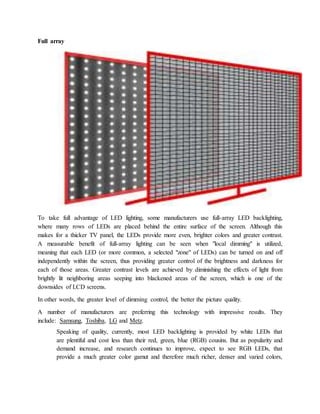
To take full advantage of LED lighting, some manufacturers use full-array LED backlighting, 
where many rows of LEDs are placed behind the entire surface of the screen. Although this 
makes for a thicker TV panel, the LEDs provide more even, brighter colors and greater contrast. 
A measurable benefit of full-array lighting can be seen when "local dimming" is utilized, 
meaning that each LED (or more common, a selected "zone" of LEDs) can be turned on and off 
independently within the screen, thus providing greater control of the brightness and darkness for 
each of those areas. Greater contrast levels are achieved by diminishing the effects of light from 
brightly lit neighboring areas seeping into blackened areas of the screen, which is one of the 
downsides of LCD screens. 
In other words, the greater level of dimming control, the better the picture quality. 
A number of manufacturers are preferring this technology with impressive results. They 
include: Samsung, Toshiba, LG and Metz. 
Speaking of quality, currently, most LED backlighting is provided by white LEDs that 
are plentiful and cost less than their red, green, blue (RGB) cousins. But as popularity and 
demand increase, and research continues to improve, expect to see RGB LEDs, that 
provide a much greater color gamut and therefore much richer, denser and varied colors,
being incorporated into TVs. Already a couple of manufacturers 
including Sony and Sharp have models with RGB LEDs. 
This method is considered the best LED backlight type, but can only be found on a very 
limited number of models. 
In a full array LED screen, the LEDs are distributed evenly behind the entire screen. This 
produces a more uniform backlight and it provides a more effective use of local dimming, 
where it can change the luminosity of only a specific part of the screen. 
A LED screen as normally referred is actually a LCD screen, but instead of having a 
normal CCFL backlight, it uses light-emitting diodes (LEDs) as a source of light behind 
the screen. 
A LED is more energy efficient and a lot smaller than a CCFL, enabling a thinner 
television screen. 
Marketing made a lot of fuss about LED TVs, but it is only the backlight is changing, so 
there is actually no picture quality improvement over a normal LCD screen. It is more of 
a natural improvement instead of a game changer. It is still a better backlight, so 
manufacturers are putting it on their best LCD panels, making it worth the upgrade. 
Features of LED backlit LCD TVs 
 An LED TV achieves deeper blacks as well as emitting brighter images, thereby producing 
better contrast ratios; 
 They are slimmer (especially edge-LED lighting systems); 
 They deliver better viewing angles than other LCD TVs; 
 LEDs are long-lasting; 
 LEDs are more energy efficient than their CCFL counterparts, and better than plasma Tvs 
and much better than CRTs; 
 LEDs don't use mercury like some other backlighting methods.

Led tv ec ic

  • 1.
    Government Engineering College,Sector 28, Gandhinagar Electronics CREATED BY:- ENROLLMENT NO. MODI SHAIL 130130117054 MODI MEET 130130117053 MODI ABHISHEK 130130117052 OZA DRONE 130130117060 PARMAR JINAL 130130117062 MISHRA POOJA 130130117050
  • 2.
    Case Study on LED TV For Engineering Systems Department of Instrumentation & Control
  • 3.
    INDEX Sr. No.Topic Page no. 1. Introduction 4 2. Types of LCD 5 3. EDGE LIT 6 4. FULL ARRAY 7 5. Features 8
  • 4.
    Introduction Buying aTV has become as complicated as selecting the right mobile phone plan. Before large flat panel displays invaded our lives, the only real question when purchasing a CRT (cathode ray tube) TV was how big did you want it and how much space did you have in your room to house it? Sure, there were some quality issues but mostly it was dictated by how many diagonal inches you could get for your buck. While some of that justification still rings true with today's TVs, now there's the issue of plasma versus LCD to contend with, and just when you had that sorted out, LED TVs have entered the arena as an option. However, there still seems to be a fair bit of confusion surrounding what exactly an LED TV is. Well, basically, it's another form of LCD TV that uses LEDs to provide its light source. All LCD TVs are backlit because LCDs are a transmissive type of display technology, which means they don't produce their own light. So for an LCD television to produce an image on the flat panel display, its pixels have to be backlit by a separate lighting source. Currently, most LCD TVs used CCFL technology (cold cathode fluorescent lamps) as their backlight source. They deliver good colors and brightness, and decent contrast, but not great blacks - the domain of the plasma TV. But TVs utilizing brighter LED backlighting can achieve much better blacks, as well as brighter colors and even greater contrast ratios (Toshiba Regza 55X1 is boasting 5,000,000:1). NB: Contrast is measured from the darkest lit area of the screen to the brightest area to give a ratio. But just in case you thought your selection choice was now made easy, there are a couple of LED options - full matrix LED and edge lit LED TVs. Let's go through the differences and look at what some of the manufacturers are using as their preferred backlighting choice. The LED TV is a more advanced version of the LCD TV. While both types of TV on LCD technology and have flat-panel designs. "LED TVs are slimmer, brighter, and more detailed than your traditional LCD TV." LED TVs function by illuminating LCD panels with LED backlighting. However, not all LED TVs utilize the same type of LED backlighting. A LCD screen is composed of 2 parts, the actual liquid crystal display and a light source at the back of the screen (called backlight). A light diffuser is placed between the backlight and the LCD screen to uniform the source of light equally across the screen.
  • 5.
    Types of LED There are 2 main types of backlights used in LCD screens. 1. CCFL 2. LED CCFL LCDs with CCFL backlight are on their way out of the market. Manufacturers are now only producing them for their lower end and smaller models. They are getting replaced by LED TVs. They have the same screen but have LED lights instead of a CCFL tube for the backlight LED LCD stands for “liquid crystal display” and technically, both LED and LCD TVs are liquid crystal displays. The basic technology is the same in that both television types have two layers of polarized glass through which the liquid crystals both block and pass light. So really, LED TVs are a subset of LCD TVs. LED, which stands for “light emitting diodes,” differs from general LCD TVs in that LCDs use fluorescent lights while LEDs use those light emitting diodes. Also, the placement of the lights on an LED TV can different. The fluorescent lights in an LCD TV are always behind the screen. But, On an LED TV, the light emitting diodes can be placed either behind the screen or around its edges. The difference in lights and in lighting placement has generally meant that LED TVs can be thinner than LCDs, although this is starting to change. It has also meant that LED TVs run with greater energy efficiency and can provide a clearer, better picture than the general LCD TVs. Because of difference in lights and lightning placement there are two types 1. EDGE LIT 2. FULL ARRAY LIT
  • 6.
    3. Edge lit Edge lighting is pretty much as described. In this method, a series of LED backlights are positioned along the outside edges of the screen. From there, the light is dispersed across the screen, which means the LED/LCD TV can be made very thin. And while the results may be better than CCFL screens, the black levels in edge lighting are not as deep and, if you look closely, the edge area of the screen tends to be brighter than the middle viewing area. In an edge lit LED screen, the LEDs are placed at the peripheral of the screen. Depending on the television, it can be all around the screen or only on the sides or the bottom. This allows the screen to be very thin. However, it can cause some spots on the screen to be brighter than others, like the edges.
  • 7.
    Full array Totake full advantage of LED lighting, some manufacturers use full-array LED backlighting, where many rows of LEDs are placed behind the entire surface of the screen. Although this makes for a thicker TV panel, the LEDs provide more even, brighter colors and greater contrast. A measurable benefit of full-array lighting can be seen when "local dimming" is utilized, meaning that each LED (or more common, a selected "zone" of LEDs) can be turned on and off independently within the screen, thus providing greater control of the brightness and darkness for each of those areas. Greater contrast levels are achieved by diminishing the effects of light from brightly lit neighboring areas seeping into blackened areas of the screen, which is one of the downsides of LCD screens. In other words, the greater level of dimming control, the better the picture quality. A number of manufacturers are preferring this technology with impressive results. They include: Samsung, Toshiba, LG and Metz. Speaking of quality, currently, most LED backlighting is provided by white LEDs that are plentiful and cost less than their red, green, blue (RGB) cousins. But as popularity and demand increase, and research continues to improve, expect to see RGB LEDs, that provide a much greater color gamut and therefore much richer, denser and varied colors,
  • 8.
    being incorporated intoTVs. Already a couple of manufacturers including Sony and Sharp have models with RGB LEDs. This method is considered the best LED backlight type, but can only be found on a very limited number of models. In a full array LED screen, the LEDs are distributed evenly behind the entire screen. This produces a more uniform backlight and it provides a more effective use of local dimming, where it can change the luminosity of only a specific part of the screen. A LED screen as normally referred is actually a LCD screen, but instead of having a normal CCFL backlight, it uses light-emitting diodes (LEDs) as a source of light behind the screen. A LED is more energy efficient and a lot smaller than a CCFL, enabling a thinner television screen. Marketing made a lot of fuss about LED TVs, but it is only the backlight is changing, so there is actually no picture quality improvement over a normal LCD screen. It is more of a natural improvement instead of a game changer. It is still a better backlight, so manufacturers are putting it on their best LCD panels, making it worth the upgrade. Features of LED backlit LCD TVs  An LED TV achieves deeper blacks as well as emitting brighter images, thereby producing better contrast ratios;  They are slimmer (especially edge-LED lighting systems);  They deliver better viewing angles than other LCD TVs;  LEDs are long-lasting;  LEDs are more energy efficient than their CCFL counterparts, and better than plasma Tvs and much better than CRTs;  LEDs don't use mercury like some other backlighting methods.