The document discusses LCD and LED screens, detailing their inventions, characteristics, advantages, and applications. LCD screens, developed by Joseph A. Castellano, use liquid crystals and are known for being bright and energy-efficient, while LED screens, created by James P. Mitchell, use an array of light-emitting diodes for high-resolution displays. Both technologies have specific advantages and disadvantages, and they are utilized in various applications, including watches, mobile phones, and signage.
LCD SCREEN
• TheLCD screen was invented by JOSEPH A.CASTELLANO at year between
1880’s - 1960’s.
• The full form of LCD was LIQUID CRYSTAL DISPLAY.
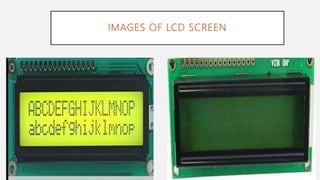
• It is a flat panel display or other electronically modulated optical device
that uses modulating properties of liquid crystals.
• These liquid crystals do not emit light directly , instead using a backlight or
reflector.
• It is to produce or display the images in color or monochrome.
• LCD’s are available to display arbitary images that means as like in general
purpose computer display.
3.
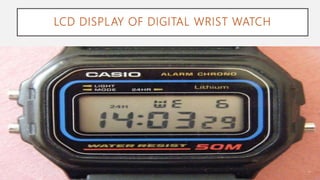
• It alsodisplays with fixed images with low information content
which can
be displayed or hidden such as preset words , digits , seven
segment
display as in a digital watch.
• They use the same basic technology , except the arbitrary images
are
made up of a large number of small pixels while other displays
have
larger elements.
• EXAMPLE - Digital Wrist Watch, LCD Television, Calculators , etc.,
GENERAL CHARACTERISTICS OFLCD
SCREEN
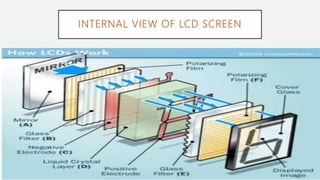
• Each pixel of an LCD display typically consists of a layer of
molecules
aligned between two transparent electrodes and also two
polarizing
filters.
• The axes of transmission of which are perpendicular to each other.
• Without the liquid crystal between the polarizing filters and when
the
light passing through first filter would be blocked by the second
polarizer.
8.
ADVANTAGES OF LCDSCREEN
• Produces very bright images due to high peak intensity and
suitable
for environments that are brightly lit.
• Life span is about 50,000 – 1,00,000 Hours.
• Viewing Angle is possible upto 165 degree.
• Less power consumption.
9.
DISADVANTAGES OF LCDSCREEN
• The cost of the LCD screen is very expensive.
• It has only limited and required viewing angles.
• Low quality of image.
• Slower response of time and operation.
10.
APPLICATIONS OF LCDSCREEN
• They were used in wide range of applications : -
-Parking Meters
-Digital Watches.
-Digital Thermometers.
-Mobile Phones and Pagers.etc.,
11.
LED SCREEN
• TheLED screen was invented and developed by James P.
Mitchell.
• The full form of LED was LIGHT EMITTING DIODE.
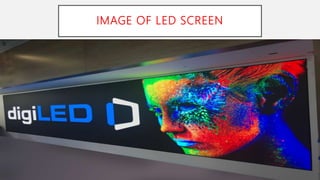
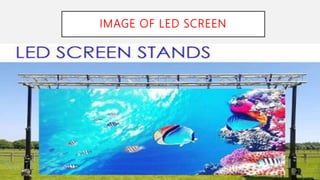
• A LED display is a flat panel display which uses an array of led’s
as a pixels for video display.
• Their brightness allows them to be used outdoors when they are
visible in the sun for store signs and billboards.
• And also in recent years they have also commonly used in
destination signs on public transport vehicles and as well as in
variable message signs on highways.
• It is also for stage lightnings and for decorative purposes.
GENERAL CHARACTERISTICS OFLED
SCREEN
• For this type of purposes diodes are emitted with three
colours
which are RED , GREEN , BLUE ranges.
• They together form a cluster are placed next to each other
LED
screen
• The distance between adjacent pixels(pitch) determines the
resolution of the received image.
15.
ADVANTAGES OF LEDSCREEN
• It has high resolution and displays more quality images.
• It is immune or resistant towards surface contaminants like
dirt , grease and moisture, etc.,
• It is also durable and resistance towards scratches and
damages.
16.
DISADVANTAGES OF LEDSCREEN
• The disadvantage is that it only works when touched by
a conductive device.
• Some capacitive touches can cause erratic behavior
when it is
touched with more than one input.
17.
APPLICATIONS OF LEDSCREEN
• It is widely used in many applications .They are
- Offices and Call Centers
- In the Transportation Roads.
- In clubs , pubs ,party places , theatres.
- In mobile devices
- Digital scoreboards in the sports stadiums.
- In Traffic Management Areas.