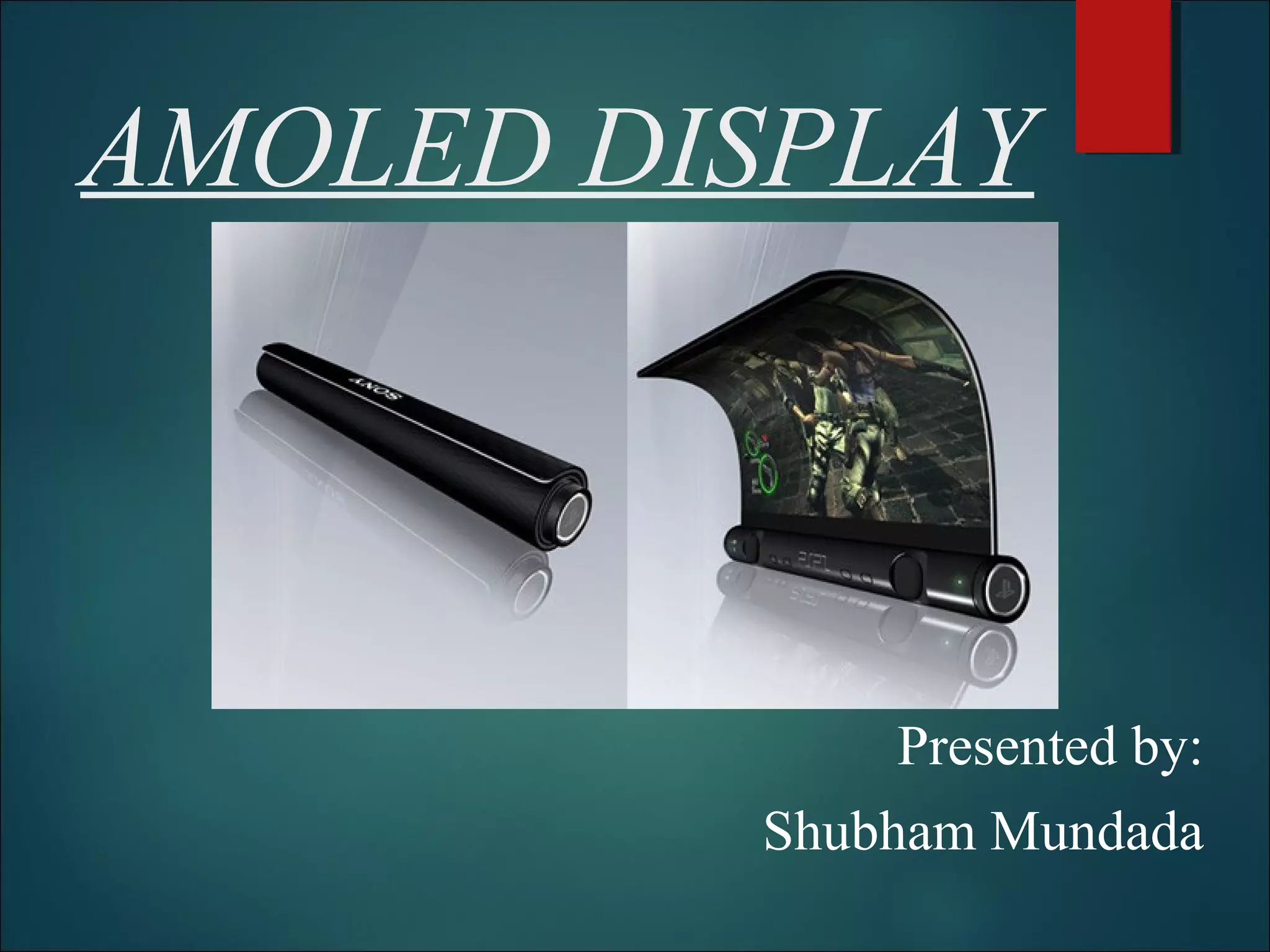
AMOLED DISPLAY
Presented by:
Shubham Mundada
CONTENT
 Introduction
 History
 Principle
 AMOLED Components
 Working
 Manufacturing of AMOLED
 Comparison
 Applications and future prospects
 Advantages
 Disadvantages
 Conclusion
INTRODUCTION
 Active-Matrix OLED (Active-matrix organic light-
emitting diode or AMOLED) is a display technology .
 AMOLED is type of OLED .
 OLED describes specific type of thin display
technology and Active-Matrix refers to the technology
behind the addressing of pixels.
 An OLED is any LED whose emissive
electroluminescent layer comprises a film of organic
compounds
 The layer usually contains a polymer substance that
allows suitable organic compounds to be deposited.
 They are deposited in rows and columns onto a flat carrier
by a simple printing process.
 The resulting matrix of pixels can emit light of different
colors.
 AMOLEDs have full layers of cathode, organic molecules
and anode, but the anode layer overlays a thin film
transistor (TFT) array that forms a matrix. The TFT array itself is
the circuitry that determines which pixels get turned on to
form an image.
 AMOLEDs consume less power than PMOLEDs because the
TFT array requires less power than external circuitry, so they
are efficient for large displays. AMOLEDs also have faster
refresh rates suitable for video. The best uses for AMOLEDs
are computer monitors, large-screen TVs and electronic
signs or billboards.
HISTORY
 The first EL from a an organic molecule, anthracene,
was reported by Pope and coworkers in 1963 .
 The active matrix technology is invented by Bernard
Lechner in 1975
PRINCIPLE
 Electroluminescence (EL) is an optical 
phenomenon and electrical phenomenon in which 
a material emits light in response to an electric 
current passed through it, or to a strong electric 
field
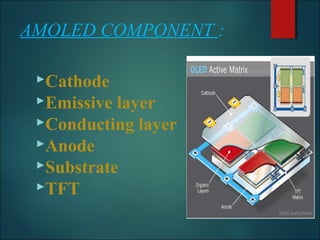
AMOLED COMPONENT :
Cathode
Emissive layer
Conducting layer
Anode
Substrate
TFT
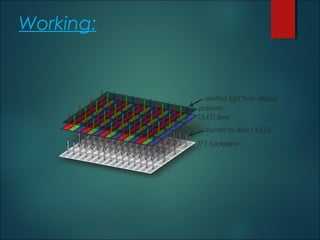
Working:
 The AMOLED display consists of a matrix of OLED pixels, each
having an anode, cathode and a layer of organic material
between them.
 These pixels are activated by a thin film transistor array which
controls the current to each pixel, enabling it to be activated
and when current flows through it, light is generated.
 Typically two transistors are used for each pixel - one to
turn the charge to the pixel on and off, and a second to
provide the constant current.
 This eliminates the need for the very high currents
required for passive matrix OLED operation
Manufacturing Of
AMOLED
 The biggest part of manufacturing AMOLEDs is
applying the organic layers to the substrate. This can
be done in three ways:
 Vacuum deposition or vacuum thermal evaporation
(VTE)
 Organic vapor phase deposition (OVPD)
 Inkjet printing
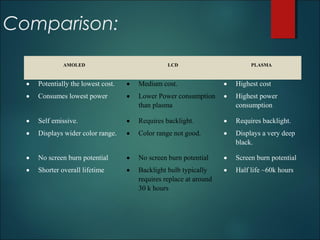
AMOLED LCD PLASMA
• Potentially the lowest cost. • Medium cost. • Highest cost
• Consumes lowest power • Lower Power consumption
than plasma
• Highest power
consumption
• Self emissive. • Requires backlight. • Requires backlight.
• Displays wider color range. • Color range not good. • Displays a very deep
black.
• No screen burn potential • No screen burn potential • Screen burn potential
• Shorter overall lifetime • Backlight bulb typically
requires replace at around
30 k hours
• Half life ~60k hours
Comparison:
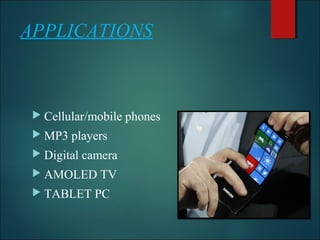
APPLICATIONS
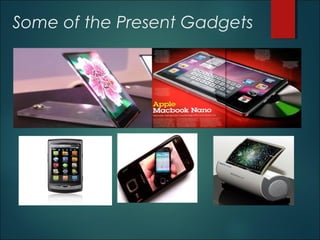
 Cellular/mobile phones
 MP3 players
 Digital camera
 AMOLED TV
 TABLET PC
Some of the Present Gadgets
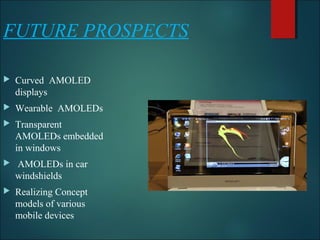
FUTURE PROSPECTS
 Curved AMOLED
displays
 Wearable AMOLEDs
 Transparent
AMOLEDs embedded
in windows
 AMOLEDs in car
windshields
 Realizing Concept
models of various
mobile devices
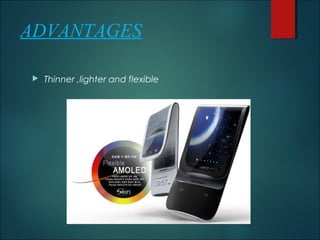
ADVANTAGES
 Thinner ,lighter and flexible
 Higher contrast ratio and sun readability
 Large viewing angle
 Brightness
 Less Power consumption
 Faster response
DISADVANTAGES
•Lifetime
•Efficiency of Blue OLED
•Susceptible to Water
CONCLUSION
 Limited use caused by degradation of
materials.
 AMOLED will replace current LED and
LCD technologies
 Flexibility and thinness will enable many
applications
THANK YOU

AMOLED Display

  • 1.
  • 2.
    CONTENT  Introduction  History Principle  AMOLED Components  Working  Manufacturing of AMOLED  Comparison  Applications and future prospects  Advantages  Disadvantages  Conclusion
  • 3.
    INTRODUCTION  Active-Matrix OLED(Active-matrix organic light- emitting diode or AMOLED) is a display technology .  AMOLED is type of OLED .  OLED describes specific type of thin display technology and Active-Matrix refers to the technology behind the addressing of pixels.  An OLED is any LED whose emissive electroluminescent layer comprises a film of organic compounds  The layer usually contains a polymer substance that allows suitable organic compounds to be deposited.
  • 4.
     They aredeposited in rows and columns onto a flat carrier by a simple printing process.  The resulting matrix of pixels can emit light of different colors.  AMOLEDs have full layers of cathode, organic molecules and anode, but the anode layer overlays a thin film transistor (TFT) array that forms a matrix. The TFT array itself is the circuitry that determines which pixels get turned on to form an image.  AMOLEDs consume less power than PMOLEDs because the TFT array requires less power than external circuitry, so they are efficient for large displays. AMOLEDs also have faster refresh rates suitable for video. The best uses for AMOLEDs are computer monitors, large-screen TVs and electronic signs or billboards.
  • 5.
    HISTORY  The firstEL from a an organic molecule, anthracene, was reported by Pope and coworkers in 1963 .  The active matrix technology is invented by Bernard Lechner in 1975
  • 6.
  • 7.
    AMOLED COMPONENT : Cathode Emissivelayer Conducting layer Anode Substrate TFT
  • 8.
  • 9.
     The AMOLEDdisplay consists of a matrix of OLED pixels, each having an anode, cathode and a layer of organic material between them.  These pixels are activated by a thin film transistor array which controls the current to each pixel, enabling it to be activated and when current flows through it, light is generated.  Typically two transistors are used for each pixel - one to turn the charge to the pixel on and off, and a second to provide the constant current.  This eliminates the need for the very high currents required for passive matrix OLED operation
  • 10.
    Manufacturing Of AMOLED  Thebiggest part of manufacturing AMOLEDs is applying the organic layers to the substrate. This can be done in three ways:  Vacuum deposition or vacuum thermal evaporation (VTE)  Organic vapor phase deposition (OVPD)  Inkjet printing
  • 11.
    AMOLED LCD PLASMA •Potentially the lowest cost. • Medium cost. • Highest cost • Consumes lowest power • Lower Power consumption than plasma • Highest power consumption • Self emissive. • Requires backlight. • Requires backlight. • Displays wider color range. • Color range not good. • Displays a very deep black. • No screen burn potential • No screen burn potential • Screen burn potential • Shorter overall lifetime • Backlight bulb typically requires replace at around 30 k hours • Half life ~60k hours Comparison:
  • 12.
    APPLICATIONS  Cellular/mobile phones MP3 players  Digital camera  AMOLED TV  TABLET PC
  • 13.
    Some of thePresent Gadgets
  • 14.
    FUTURE PROSPECTS  CurvedAMOLED displays  Wearable AMOLEDs  Transparent AMOLEDs embedded in windows  AMOLEDs in car windshields  Realizing Concept models of various mobile devices
  • 15.
  • 16.
     Higher contrastratio and sun readability  Large viewing angle  Brightness  Less Power consumption  Faster response
  • 17.
  • 18.
    CONCLUSION  Limited usecaused by degradation of materials.  AMOLED will replace current LED and LCD technologies  Flexibility and thinness will enable many applications
  • 19.