The buzz of LED VS LCD                in the market is actually the brainchild of clever marketing
strategies from large TV manufacturers, to promote the sale of their new LED televisions and
also push the sale of LCD televisions even further. However, these LED televisions in reality, are
not a new kind or new generation TV. They are almost similar to the LCD televisions where they
share almost a similar screen in which we see the picture. The main difference between these two
televisions is that LED televisions use LED or Light Emitting Diodes to light the screen while
LCD televisions use cold-cathode fluorescent lights or mostly known as CFL lights to light the
screen on it. Therefore, you can see that there might not be that much of a difference in the
feature evaluation of LED VS LCD and it might also be a big waste of time thinking about the
winner in an LED VS LCD encounter.

However, there are a few differences between the LED and LCD televisions which are still
adding fuel to this burning clash of LED VS LCD television. Among them, the most important
one is the thickness of these televisions. LEDs, since they use LED lights, can be thinner than
other LCDs as well as the plasma televisions. So, this is a winning blow from the new LED
televisions. In addition to that, since LED televisions use LED lights, the picture is more clear
and crisp in an LED television. According to this, pure white is brighter and dark black is deeper
in an LED television compared to the LCD televisions. This is not the end of LED VS LCD war.
Compared to LEDs, LCD televisions are quite cheaper; at least by 100 to 200 dollars. So, people
on a budget always pick the LCD from an LED VS LCD dilemma and to be honest, this is an
easy decision for them considering the price. Besides that, the LCD televisions are available in
almost any departmental store and are very easy to fix or replace. So LCDs have again got some
advantages over the LEDs in the battle of LED VS LCD.

However, these features are not enough to make the verdict on the LED VS LCD. It is evident
that in the fight of LED VS LCD, it will be very difficult to declare the universal winner that
everyone will accept and it will be a waste of time arguing which is the best between these two.

While the giant display in a sports stadium, for example, is made up of thousands of LEDs that
are used to directly produce a picture, "LED" TVs are actually LCDs. That's right, they're not
LED TVs at all. These so-called LED TVs use a series of LEDs to light up the panel. But what is
backlighting anyway?


LCD - screens

Introduction to LCD screens
        A liquid crystal display (LCD) is a flat panel display that uses the light modulating
        properties of fluorescent liquid crystals (FLCs). Fluorescent Liquid Crystals do not emit
        light directly and the first types of LCD screens had low contrast levels. LCD panels
create dark tones by blocking the backlight passing through the panel and whilst this doesn't
always create true blacks, newer LCD's employ different types of technology allowing for better
contrast and better blacks through the use of LED (light emitting diode) backlighting.
So LCD screens and LED screens are the same types of screens, but they employ different types
of technology.

LCD - Colour Accuracy
       The LCD picture quality has historically suffered from poor black levels, but the newest
       (and often more expensive)versions are much improved. Typically price and quality go
       hand-in-hand and this is true in regards of most hardware.

LCD - Contrast and Black levels
        LCD panels create dark tones by blocking the backlight passing through the panel. This
        method of displaying the colour black suffers due to the issue of light leakage. Newer and
        higher end LCD's do however produce good black levels whilst entry level units should
not be your first choice. Also take care buying second hand LCD screens as the possibility of
them having dead pixels is also higher.

LCD - Viewing Angles
       LCD screens are known to have issues regarding viewing angles, as light and other
       colour changes occour if you are not placed solidly in front of the screen. Higher-end
       models based on In-Plane Switching (IPS) technology, Super-IPS and Alpha-IPS are
known to perform dramatically better in this area and should be considered when looking into
buying a LCD screen.

LCD - Gaming
       LCD screens are also rumoured to have response time as being an issue, but almost all
       newer LCD screens have adequate response time to deal with fast motion and have
       software that also deals with this issue. “Ghosting” is therefore only often an issue in the
lowest end models. To further boost image fluidity, many vendors have also introduced 100Hz to
800Hz motion engines. Some of them are implemented using frame interpolation and/or
backlight-scanning processing.

       LCD - Longevity
       Most manufacturers are claiming approximately 100,000 hours lifetime for their screens
       and this seems to be independent of what type they are, however it is rumoured that LED
       screens have a habit of outliving LCD screens.

LCD - Conclusion
LCD screens are very mainstream and newer models boast better performance but at a
        higher price tag. However with LED screens to complement gamers and plasma screens
        to suit movie enthusiasts, it is worth taking a deep breath and considering if the low
prices of LCD screens will satisfy you in the long run. Simply stated quality and price often go
hand-in-hand.


       LCD screens are the most inexpensive flat screens you’ll find on the market
       Higher resolution than comparable-sized plasmas
       No danger of Burn in
       Typically weigh less than LED and plasma screens


       Entry models often have bad black levels
       Contrast rates are not as prominent as LED and Plasma screens
       Energy usage is high and they are not as environmentally friendly as LED screens
       Limited viewing angle, causing colour, saturation, contrast and brightness to vary
       Smearing and ghosting artifacts caused by slow response times
       Many cheaper LCD screens are only able to display 262,000 colours.
       “Dead” or “stuck” pixels may occur in low end-models

       ntroduction to LED screens
       LED screens are simply LCD screens that use tiny light emitting diodes (LED) for back
       lighting instead of the cathode fluorescent lamps (CFL) lighting traditionally used for
       LCDs. Both types of screens employ the liquid crystal diode (LCD) technology front
panel containing the “twisting crystals” which define LCD technology.

LED screens feature two main forms of back lighting, edge lighting and local dimming. Edge
lighting has LEDs around the edge of the panel and this allows for extremely thin construction.
Local dimming back lighting features banks of LED lights behind the panel and these banks can
be controlled to lower the amount of back lighting in dark areas of the screen and raise it in
bright areas for higher contrast and more realistic blacks.

LED - Colour Accuracy
LED screens with RGB coloured lights or a colour wheel to affect the backlight colour,
       have an advantage in displaying realistic colour.


LED - Contrast and Black levels
       Local dimming LED screens employ back lighting to dim the back light in areas where
       the screen should be dark, resulting in more depth and a more “true” black colour, than
       that of many LCD screens.

LED - Viewing Angles
       What seems to have the greatest impact upon the viewing angle is the quality of the clear
       glass panel on the front of either LCDs or LED screens. The thicker and higher quality
       glass panels offer a better viewing angle and less glare.

LED - Gaming
       The biggest difference here is somewhat unrelated to the technology but rather dependent
       upon whether or not the screen has a game mode, that cuts down on the amount of picture
       processing. Without the game mode there can be noticeable input lag, since the screens
processing ability is not able to keep up with the speed of the game, resulting in what is
commonly known as “ghosting”. Since LED screens often cost more, they often have a gaming
mode feature.

       LED - Longevity
       Most manufacturers are claiming approximately 100,000 hours lifetime for their screens
       and this seems to be independent of what type they are, however it is rumoured that LED
       screens have a habit of outliving LCD screens.

       LED - Conclusion
       LED screens will eventually become more mainstream since they seem to outmatch LCD
       screens in many ways, but at a slightly higher cost.
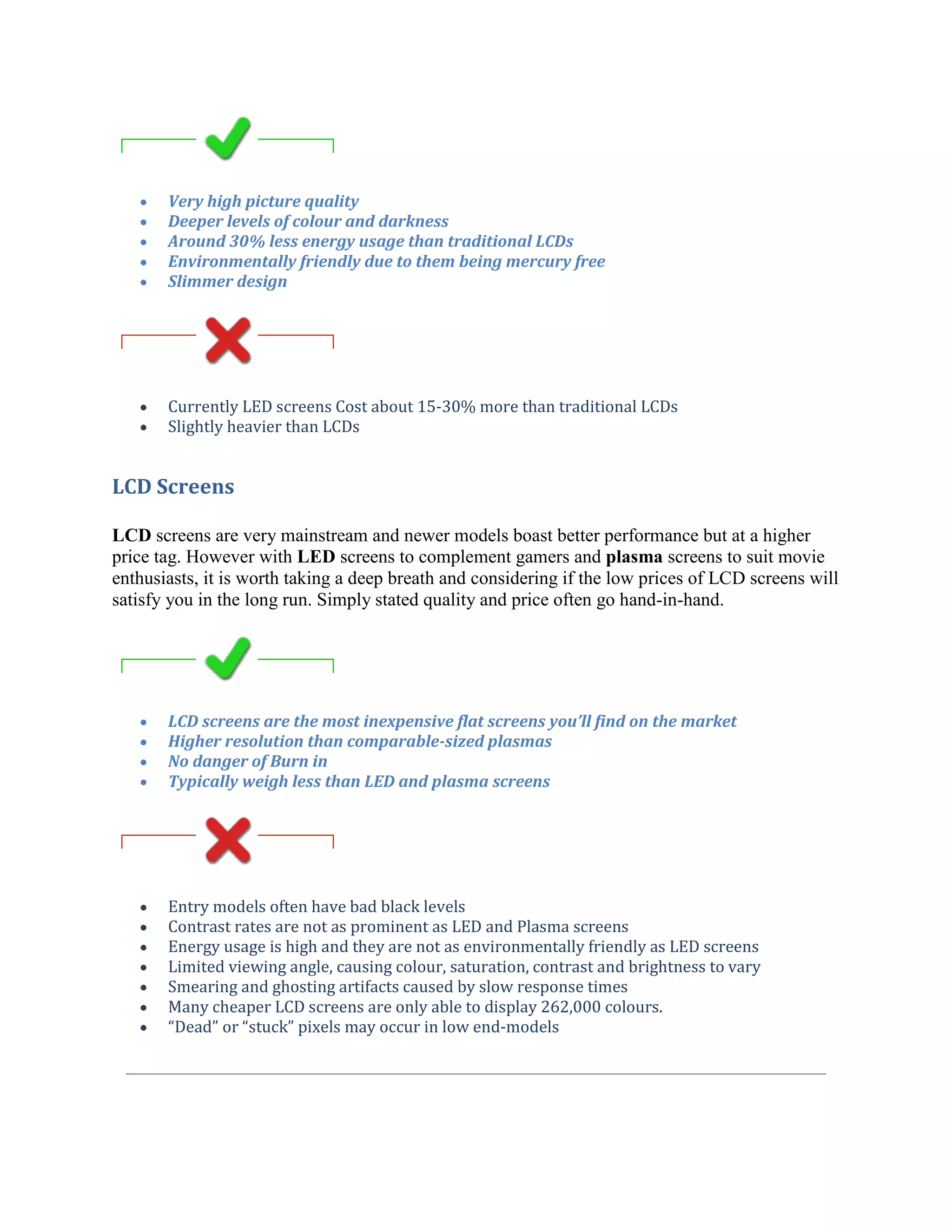
Very high picture quality
       Deeper levels of colour and darkness
       Around 30% less energy usage than traditional LCDs
       Environmentally friendly due to them being mercury free
       Slimmer design


       Currently LED screens Cost about 15-30% more than traditional LCDs
       Slightly heavier than LCDs


LCD Screens

LCD screens are very mainstream and newer models boast better performance but at a higher
price tag. However with LED screens to complement gamers and plasma screens to suit movie
enthusiasts, it is worth taking a deep breath and considering if the low prices of LCD screens will
satisfy you in the long run. Simply stated quality and price often go hand-in-hand.


       LCD screens are the most inexpensive flat screens you’ll find on the market
       Higher resolution than comparable-sized plasmas
       No danger of Burn in
       Typically weigh less than LED and plasma screens


       Entry models often have bad black levels
       Contrast rates are not as prominent as LED and Plasma screens
       Energy usage is high and they are not as environmentally friendly as LED screens
       Limited viewing angle, causing colour, saturation, contrast and brightness to vary
       Smearing and ghosting artifacts caused by slow response times
       Many cheaper LCD screens are only able to display 262,000 colours.
       “Dead” or “stuck” pixels may occur in low end-models
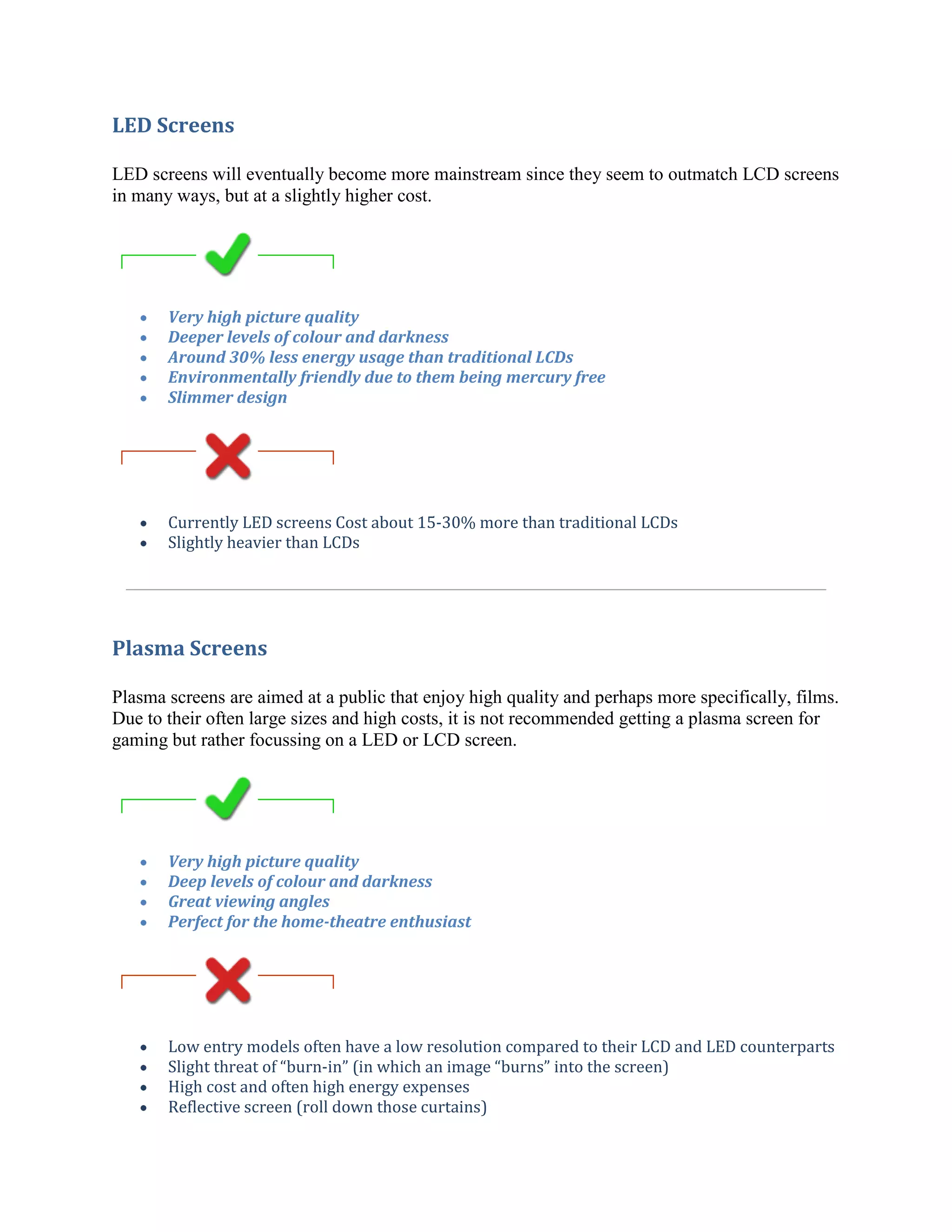
LED Screens

LED screens will eventually become more mainstream since they seem to outmatch LCD screens
in many ways, but at a slightly higher cost.


       Very high picture quality
       Deeper levels of colour and darkness
       Around 30% less energy usage than traditional LCDs
       Environmentally friendly due to them being mercury free
       Slimmer design


       Currently LED screens Cost about 15-30% more than traditional LCDs
       Slightly heavier than LCDs


Plasma Screens

Plasma screens are aimed at a public that enjoy high quality and perhaps more specifically, films.
Due to their often large sizes and high costs, it is not recommended getting a plasma screen for
gaming but rather focussing on a LED or LCD screen.


       Very high picture quality
       Deep levels of colour and darkness
       Great viewing angles
       Perfect for the home-theatre enthusiast


       Low entry models often have a low resolution compared to their LCD and LED counterparts
       Slight threat of “burn-in” (in which an image “burns” into the screen)
       High cost and often high energy expenses
       Reflective screen (roll down those curtains)
Lcdvsled

Lcdvsled

  • 1.
    The buzz ofLED VS LCD in the market is actually the brainchild of clever marketing strategies from large TV manufacturers, to promote the sale of their new LED televisions and also push the sale of LCD televisions even further. However, these LED televisions in reality, are not a new kind or new generation TV. They are almost similar to the LCD televisions where they share almost a similar screen in which we see the picture. The main difference between these two televisions is that LED televisions use LED or Light Emitting Diodes to light the screen while LCD televisions use cold-cathode fluorescent lights or mostly known as CFL lights to light the screen on it. Therefore, you can see that there might not be that much of a difference in the feature evaluation of LED VS LCD and it might also be a big waste of time thinking about the winner in an LED VS LCD encounter. However, there are a few differences between the LED and LCD televisions which are still adding fuel to this burning clash of LED VS LCD television. Among them, the most important one is the thickness of these televisions. LEDs, since they use LED lights, can be thinner than other LCDs as well as the plasma televisions. So, this is a winning blow from the new LED televisions. In addition to that, since LED televisions use LED lights, the picture is more clear and crisp in an LED television. According to this, pure white is brighter and dark black is deeper in an LED television compared to the LCD televisions. This is not the end of LED VS LCD war. Compared to LEDs, LCD televisions are quite cheaper; at least by 100 to 200 dollars. So, people on a budget always pick the LCD from an LED VS LCD dilemma and to be honest, this is an easy decision for them considering the price. Besides that, the LCD televisions are available in almost any departmental store and are very easy to fix or replace. So LCDs have again got some advantages over the LEDs in the battle of LED VS LCD. However, these features are not enough to make the verdict on the LED VS LCD. It is evident that in the fight of LED VS LCD, it will be very difficult to declare the universal winner that everyone will accept and it will be a waste of time arguing which is the best between these two. While the giant display in a sports stadium, for example, is made up of thousands of LEDs that are used to directly produce a picture, "LED" TVs are actually LCDs. That's right, they're not LED TVs at all. These so-called LED TVs use a series of LEDs to light up the panel. But what is backlighting anyway? LCD - screens Introduction to LCD screens A liquid crystal display (LCD) is a flat panel display that uses the light modulating properties of fluorescent liquid crystals (FLCs). Fluorescent Liquid Crystals do not emit light directly and the first types of LCD screens had low contrast levels. LCD panels create dark tones by blocking the backlight passing through the panel and whilst this doesn't always create true blacks, newer LCD's employ different types of technology allowing for better contrast and better blacks through the use of LED (light emitting diode) backlighting.
  • 2.
    So LCD screensand LED screens are the same types of screens, but they employ different types of technology. LCD - Colour Accuracy The LCD picture quality has historically suffered from poor black levels, but the newest (and often more expensive)versions are much improved. Typically price and quality go hand-in-hand and this is true in regards of most hardware. LCD - Contrast and Black levels LCD panels create dark tones by blocking the backlight passing through the panel. This method of displaying the colour black suffers due to the issue of light leakage. Newer and higher end LCD's do however produce good black levels whilst entry level units should not be your first choice. Also take care buying second hand LCD screens as the possibility of them having dead pixels is also higher. LCD - Viewing Angles LCD screens are known to have issues regarding viewing angles, as light and other colour changes occour if you are not placed solidly in front of the screen. Higher-end models based on In-Plane Switching (IPS) technology, Super-IPS and Alpha-IPS are known to perform dramatically better in this area and should be considered when looking into buying a LCD screen. LCD - Gaming LCD screens are also rumoured to have response time as being an issue, but almost all newer LCD screens have adequate response time to deal with fast motion and have software that also deals with this issue. “Ghosting” is therefore only often an issue in the lowest end models. To further boost image fluidity, many vendors have also introduced 100Hz to 800Hz motion engines. Some of them are implemented using frame interpolation and/or backlight-scanning processing. LCD - Longevity Most manufacturers are claiming approximately 100,000 hours lifetime for their screens and this seems to be independent of what type they are, however it is rumoured that LED screens have a habit of outliving LCD screens. LCD - Conclusion
  • 3.
    LCD screens arevery mainstream and newer models boast better performance but at a higher price tag. However with LED screens to complement gamers and plasma screens to suit movie enthusiasts, it is worth taking a deep breath and considering if the low prices of LCD screens will satisfy you in the long run. Simply stated quality and price often go hand-in-hand. LCD screens are the most inexpensive flat screens you’ll find on the market Higher resolution than comparable-sized plasmas No danger of Burn in Typically weigh less than LED and plasma screens Entry models often have bad black levels Contrast rates are not as prominent as LED and Plasma screens Energy usage is high and they are not as environmentally friendly as LED screens Limited viewing angle, causing colour, saturation, contrast and brightness to vary Smearing and ghosting artifacts caused by slow response times Many cheaper LCD screens are only able to display 262,000 colours. “Dead” or “stuck” pixels may occur in low end-models ntroduction to LED screens LED screens are simply LCD screens that use tiny light emitting diodes (LED) for back lighting instead of the cathode fluorescent lamps (CFL) lighting traditionally used for LCDs. Both types of screens employ the liquid crystal diode (LCD) technology front panel containing the “twisting crystals” which define LCD technology. LED screens feature two main forms of back lighting, edge lighting and local dimming. Edge lighting has LEDs around the edge of the panel and this allows for extremely thin construction. Local dimming back lighting features banks of LED lights behind the panel and these banks can be controlled to lower the amount of back lighting in dark areas of the screen and raise it in bright areas for higher contrast and more realistic blacks. LED - Colour Accuracy
  • 4.
    LED screens withRGB coloured lights or a colour wheel to affect the backlight colour, have an advantage in displaying realistic colour. LED - Contrast and Black levels Local dimming LED screens employ back lighting to dim the back light in areas where the screen should be dark, resulting in more depth and a more “true” black colour, than that of many LCD screens. LED - Viewing Angles What seems to have the greatest impact upon the viewing angle is the quality of the clear glass panel on the front of either LCDs or LED screens. The thicker and higher quality glass panels offer a better viewing angle and less glare. LED - Gaming The biggest difference here is somewhat unrelated to the technology but rather dependent upon whether or not the screen has a game mode, that cuts down on the amount of picture processing. Without the game mode there can be noticeable input lag, since the screens processing ability is not able to keep up with the speed of the game, resulting in what is commonly known as “ghosting”. Since LED screens often cost more, they often have a gaming mode feature. LED - Longevity Most manufacturers are claiming approximately 100,000 hours lifetime for their screens and this seems to be independent of what type they are, however it is rumoured that LED screens have a habit of outliving LCD screens. LED - Conclusion LED screens will eventually become more mainstream since they seem to outmatch LCD screens in many ways, but at a slightly higher cost.
  • 5.
    Very high picturequality Deeper levels of colour and darkness Around 30% less energy usage than traditional LCDs Environmentally friendly due to them being mercury free Slimmer design Currently LED screens Cost about 15-30% more than traditional LCDs Slightly heavier than LCDs LCD Screens LCD screens are very mainstream and newer models boast better performance but at a higher price tag. However with LED screens to complement gamers and plasma screens to suit movie enthusiasts, it is worth taking a deep breath and considering if the low prices of LCD screens will satisfy you in the long run. Simply stated quality and price often go hand-in-hand. LCD screens are the most inexpensive flat screens you’ll find on the market Higher resolution than comparable-sized plasmas No danger of Burn in Typically weigh less than LED and plasma screens Entry models often have bad black levels Contrast rates are not as prominent as LED and Plasma screens Energy usage is high and they are not as environmentally friendly as LED screens Limited viewing angle, causing colour, saturation, contrast and brightness to vary Smearing and ghosting artifacts caused by slow response times Many cheaper LCD screens are only able to display 262,000 colours. “Dead” or “stuck” pixels may occur in low end-models
  • 6.
    LED Screens LED screenswill eventually become more mainstream since they seem to outmatch LCD screens in many ways, but at a slightly higher cost. Very high picture quality Deeper levels of colour and darkness Around 30% less energy usage than traditional LCDs Environmentally friendly due to them being mercury free Slimmer design Currently LED screens Cost about 15-30% more than traditional LCDs Slightly heavier than LCDs Plasma Screens Plasma screens are aimed at a public that enjoy high quality and perhaps more specifically, films. Due to their often large sizes and high costs, it is not recommended getting a plasma screen for gaming but rather focussing on a LED or LCD screen. Very high picture quality Deep levels of colour and darkness Great viewing angles Perfect for the home-theatre enthusiast Low entry models often have a low resolution compared to their LCD and LED counterparts Slight threat of “burn-in” (in which an image “burns” into the screen) High cost and often high energy expenses Reflective screen (roll down those curtains)