Layering


   Prepared by
   Devendra shahu
   Class roll no. 17
   B.Sc.Ag 8th sem.
Introduction
• Roots are formed on a stem
• root while still attached to the
  parent plant
Contd.
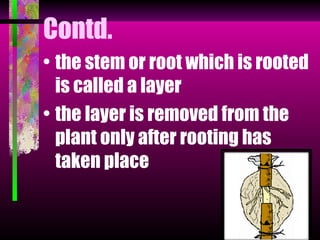
• the stem or root which is rooted
  is called a layer
• the layer is removed from the
  plant only after rooting has
  taken place
Contd.
• Layering is the process of
  developing new plantlets
  in which root formation
  takes place on layered
  portion of stem before they
  are severed from mother
  plant.
Principles of Layering
• Through notching or girdling,The
  downward tranlocation of carbohydrates,
  hormones and other organic substances is
  interrupted by the removal of the bark .
• This carbohydrates, hormones and other
  organic substances are accumulated in the
  girdled site where dormant adventitious
  buds regenerates and give rise to root.
Simple Layering
• a branch from the parent plant
  is bent to the ground
• covered with soil at one point
• terminal end remains exposed
Simple Layering
Eg. Climbing rose, Rhododendron
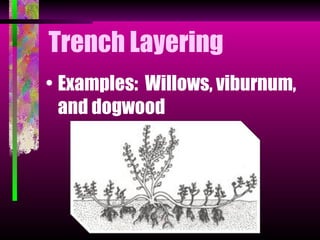
Trench Layering
• parent plant is bent to the
  ground and covered.
• Shoots arise from buried buds
  and roots form under soil
Trench Layering
• Examples:  Willows, viburnum,
  and dogwood
Serpentine Layering
• Similar to trench layering but
 the branch is alternatively
  covered with soil.
• and exposed over their entire
  length.
Serpentine Layering
Eg. grapes, wisteria
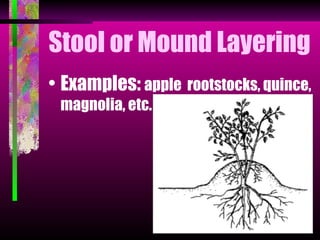
Stool or Mound Layering
• parent plant is cut back to the
  soil level
• entire plant is mounded with
  soil
• forms numerous shoots and
  roots
Stool or Mound Layering
• Examples: apple rootstocks, quince,
 magnolia, etc.
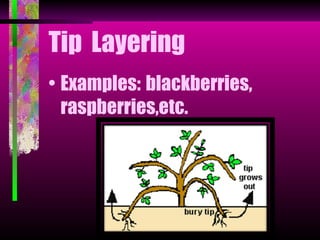
Tip Layering
• the tip of the stem or branches
  are bent down
• burried in the soil to the depth
  of 5-7.5cm.
Tip Layering
• Examples: blackberries,
  raspberries,etc.
Air Layering
• Ancient Chinese practiced air
  layering
• process eliminates burying
  part of the plant in the soil
Air Layering
• instead, a part of the stem is
  girdled
• cut all the way around
• the cut is surrounded by moist
  sphagnum or peat moss
Air Layering
• Moss is wrapped with plastic to
  hold in place
• roots grow from the wound on
  the stem
Air Layering
• Plants that propagate well this
  way:
• Rubber Tree
• Persian Lime
• Magnolia
Air Layering
• When rooting is complete
• 4-6 weeks
• cut layer BELOW roots and
  transplant
• Parent portion will continue to
  grow and form new branches
Equipment Used


Pruning Knife


                Secateur
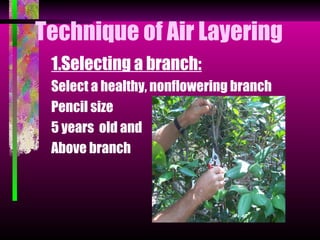
Technique of Air Layering
 1.Selecting a branch:
 Select a healthy, nonflowering branch
 Pencil size
 5 years old and
 Above branch
Technique of Air Layering
2. Make two incisions in the bark, one inch
  apart, around the diameter Of the branch
  and connect
  with another
  incision
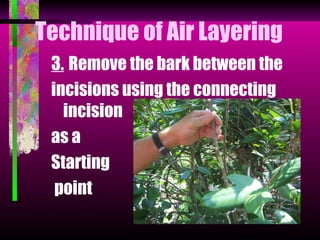
Technique of Air Layering
 3. Remove the bark between the
 incisions using the connecting
   incision
 as a
 Starting
  point
Technique of Air Layering
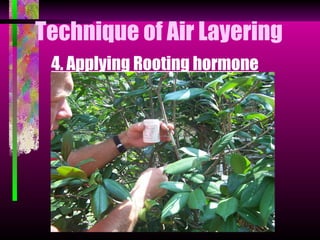
 4. Applying Rooting hormone
Technique of Air Layering


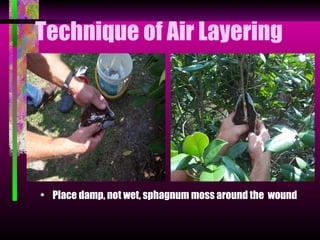
• Place damp, not wet, sphagnum moss around the wound
Technique of Air Layering


• Compress and shape sphagnum moss to
  cover the wound - about one to two inches
  on either side of the wound.
Technique of Air Layering


• Cover with plastic.
Advantages and
Disadvantages
• relatively simple
• requires more time
• requires a lot of work by hand
• fewer plants can be started
  from each parent plant
Advantages and
Disadvantages
• usually very successful
• some plants layer naturally -
  raspberry
Thank you

Layering

  • 1.
    Layering Prepared by Devendra shahu Class roll no. 17 B.Sc.Ag 8th sem.
  • 2.
    Introduction • Roots areformed on a stem • root while still attached to the parent plant
  • 3.
    Contd. • the stemor root which is rooted is called a layer • the layer is removed from the plant only after rooting has taken place
  • 4.
    Contd. • Layering isthe process of developing new plantlets in which root formation takes place on layered portion of stem before they are severed from mother plant.
  • 5.
    Principles of Layering •Through notching or girdling,The downward tranlocation of carbohydrates, hormones and other organic substances is interrupted by the removal of the bark . • This carbohydrates, hormones and other organic substances are accumulated in the girdled site where dormant adventitious buds regenerates and give rise to root.
  • 6.
    Simple Layering • abranch from the parent plant is bent to the ground • covered with soil at one point • terminal end remains exposed
  • 7.
    Simple Layering Eg. Climbingrose, Rhododendron
  • 8.
    Trench Layering • parentplant is bent to the ground and covered. • Shoots arise from buried buds and roots form under soil
  • 9.
    Trench Layering • Examples: Willows, viburnum, and dogwood
  • 10.
    Serpentine Layering • Similarto trench layering but the branch is alternatively covered with soil. • and exposed over their entire length.
  • 11.
  • 12.
    Stool or MoundLayering • parent plant is cut back to the soil level • entire plant is mounded with soil • forms numerous shoots and roots
  • 13.
    Stool or MoundLayering • Examples: apple rootstocks, quince, magnolia, etc.
  • 14.
    Tip Layering • thetip of the stem or branches are bent down • burried in the soil to the depth of 5-7.5cm.
  • 15.
    Tip Layering • Examples:blackberries, raspberries,etc.
  • 16.
    Air Layering • AncientChinese practiced air layering • process eliminates burying part of the plant in the soil
  • 17.
    Air Layering • instead,a part of the stem is girdled • cut all the way around • the cut is surrounded by moist sphagnum or peat moss
  • 18.
    Air Layering • Mossis wrapped with plastic to hold in place • roots grow from the wound on the stem
  • 19.
    Air Layering • Plantsthat propagate well this way: • Rubber Tree • Persian Lime • Magnolia
  • 20.
    Air Layering • Whenrooting is complete • 4-6 weeks • cut layer BELOW roots and transplant • Parent portion will continue to grow and form new branches
  • 21.
  • 22.
    Technique of AirLayering 1.Selecting a branch: Select a healthy, nonflowering branch Pencil size 5 years old and Above branch
  • 23.
    Technique of AirLayering 2. Make two incisions in the bark, one inch apart, around the diameter Of the branch and connect with another incision
  • 24.
    Technique of AirLayering 3. Remove the bark between the incisions using the connecting incision as a Starting point
  • 25.
    Technique of AirLayering 4. Applying Rooting hormone
  • 26.
    Technique of AirLayering • Place damp, not wet, sphagnum moss around the wound
  • 27.
    Technique of AirLayering • Compress and shape sphagnum moss to cover the wound - about one to two inches on either side of the wound.
  • 28.
    Technique of AirLayering • Cover with plastic.
  • 29.
    Advantages and Disadvantages • relativelysimple • requires more time • requires a lot of work by hand • fewer plants can be started from each parent plant
  • 30.
    Advantages and Disadvantages • usuallyvery successful • some plants layer naturally - raspberry
  • 31.