Wednesday, Sept. 10
1.  Turn in Homework – 5 Questions (Will return first two
homework assignments on Monday) (3 minutes)
2.  Field Trip Forms – Go over for 9/25, discuss Monday (5)
3.  Self-Assessment – Discuss questions/grading (hw) (5)
4.  Homework for Monday – Hand out reading and
assignments (5)
5.  Poinsettia Watchdogs – update on crop and refer to
schedule (5)
6.  Asexual Propagation (15)
7.  Chapter 2 – (35)
Asexual
(Vegetative)
Propagation
Vegetative reproduction is defined as the production of new plants
from the vegetative parts like leaf, stem, roots of the parent plant.
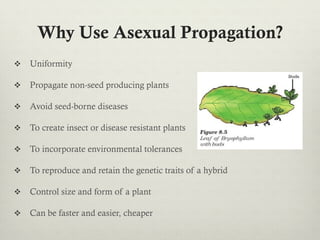
Why Use Asexual Propagation?
v  Uniformity
v  Propagate non-seed producing plants
v  Avoid seed-borne diseases
v  To create insect or disease resistant plants
v  To incorporate environmental tolerances
v  To reproduce and retain the genetic traits of a hybrid
v  Control size and form of a plant
v  Can be faster and easier, cheaper
Disadvantages of Asexual
Propagation
v  Uniformity (may not be desired)
v  Short storage time (live cuttings)
v  Bulky (vs. seeds)
v  Systemic infections can be spread easily, as the plants
are clones (genetically identical)
Types of Asexual Propagation
v  Specialized parts
v  Cuttings
v  Layering
v  Grafting
v  Tissue culture (micropropagation)
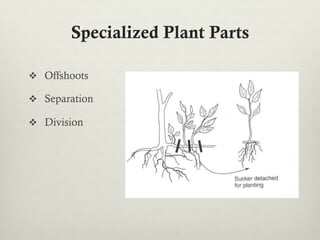
Specialized Plant Parts
v  Offshoots
v  Separation
v  Division
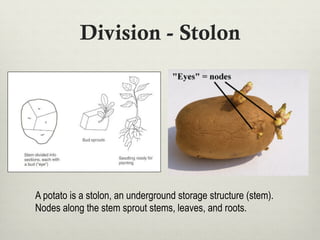
Division - Stolon
A potato is a stolon, an underground storage structure (stem).
Nodes along the stem sprout stems, leaves, and roots.
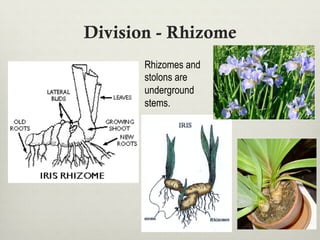
Division - Rhizome
Rhizomes and
stolons are
underground
stems.
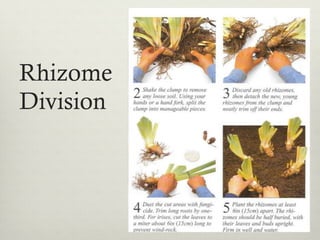
Rhizome
Division
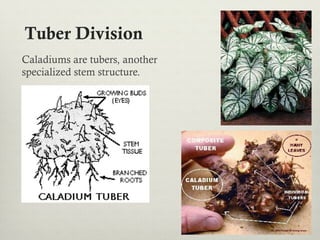
Tuber Division
Caladiums are tubers, another
specialized stem structure.
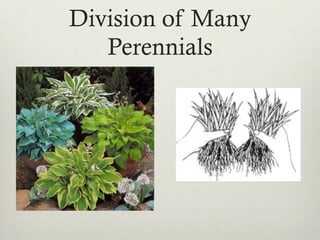
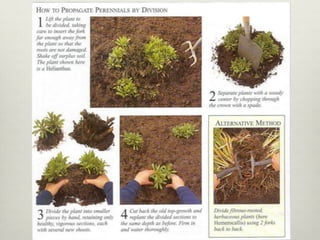
Division of Many
Perennials
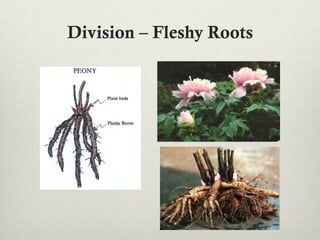
Division – Fleshy Roots
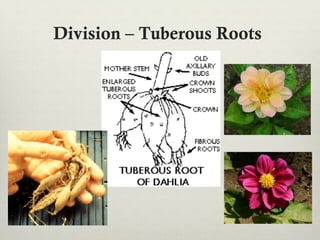
Division – Tuberous Roots
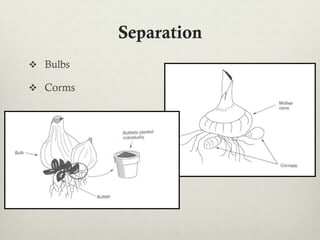
Separation
v  Bulbs
v  Corms
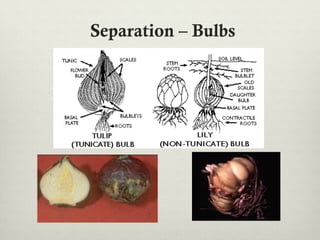
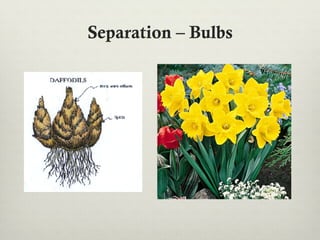
Separation – Bulbs
Separation – Bulbs
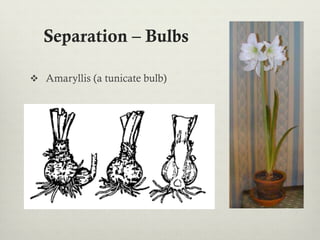
Separation – Bulbs
v  Amaryllis (a tunicate bulb)
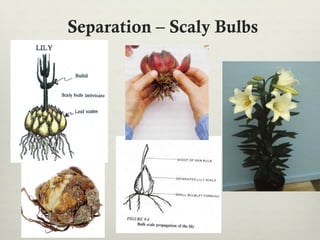
Separation – Scaly Bulbs
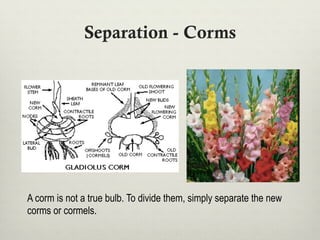
Separation - Corms
A corm is not a true bulb. To divide them, simply separate the new
corms or cormels.
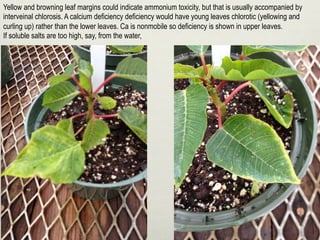
Yellow and browning leaf margins could indicate ammonium toxicity, but that is usually accompanied by
interveinal chlorosis. A calcium deficiency deficiency would have young leaves chlorotic (yellowing and
curling up) rather than the lower leaves. Ca is nonmobile so deficiency is shown in upper leaves.
If soluble salts are too high, say, from the water,
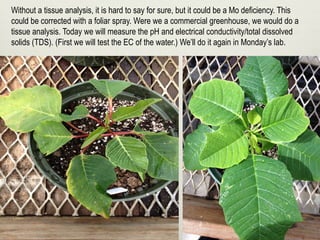
Without a tissue analysis, it is hard to say for sure, but it could be a Mo deficiency. This
could be corrected with a foliar spray. Were we a commercial greenhouse, we would do a
tissue analysis. Today we will measure the pH and electrical conductivity/total dissolved
solids (TDS). (First we will test the EC of the water.) We’ll do it again in Monday’s lab.
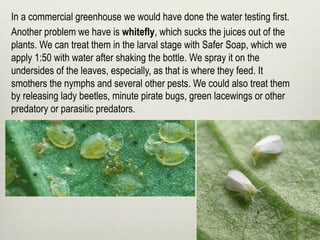
In a commercial greenhouse we would have done the water testing first.
Another problem we have is whitefly, which sucks the juices out of the
plants. We can treat them in the larval stage with Safer Soap, which we
apply 1:50 with water after shaking the bottle. We spray it on the
undersides of the leaves, especially, as that is where they feed. It
smothers the nymphs and several other pests. We could also treat them
by releasing lady beetles, minute pirate bugs, green lacewings or other
predatory or parasitic predators.
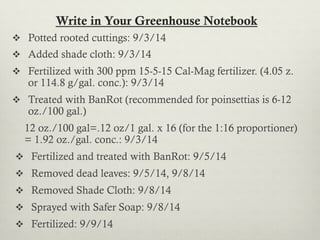
Write in Your Greenhouse Notebook
v  Potted rooted cuttings: 9/3/14
v  Added shade cloth: 9/3/14
v  Fertilized with 300 ppm 15-5-15 Cal-Mag fertilizer. (4.05 z.
or 114.8 g/gal. conc.): 9/3/14
v  Treated with BanRot (recommended for poinsettias is 6-12
oz./100 gal.)
12 oz./100 gal=.12 oz/1 gal. x 16 (for the 1:16 proportioner)
= 1.92 oz./gal. conc.: 9/3/14
v  Fertilized and treated with BanRot: 9/5/14
v  Removed dead leaves: 9/5/14, 9/8/14
v  Removed Shade Cloth: 9/8/14
v  Sprayed with Safer Soap: 9/8/14
v  Fertilized: 9/9/14
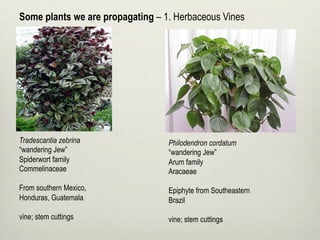
Tradescantia zebrina
“wandering Jew”
Spiderwort family
Commelinaceae
From southern Mexico,
Honduras, Guatemala
vine; stem cuttings
Philodendron cordatum
“wandering Jew”
Arum family
Aracaeae
Epiphyte from Southeastern
Brazil
vine; stem cuttings
Some plants we are propagating – 1. Herbaceous Vines
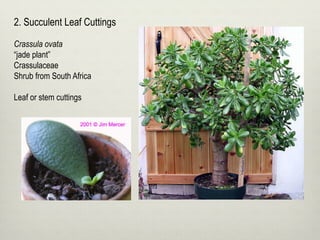
2. Succulent Leaf Cuttings
Crassula ovata
“jade plant”
Crassulaceae
Shrub from South Africa
Leaf or stem cuttings
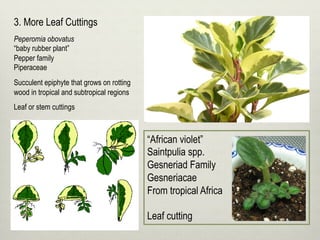
3. More Leaf Cuttings
Peperomia obovatus
“baby rubber plant”
Pepper family
Piperaceae
Succulent epiphyte that grows on rotting
wood in tropical and subtropical regions
Leaf or stem cuttings
“African violet”
Saintpulia spp.
Gesneriad Family
Gesneriacae
From tropical Africa
Leaf cutting
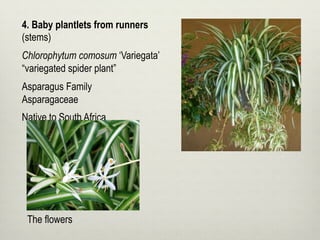
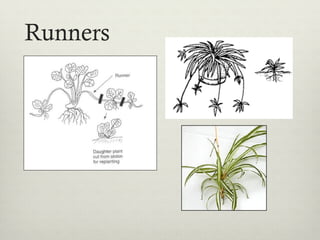
4. Baby plantlets from runners
(stems)
Chlorophytum comosum ‘Variegata’
“variegated spider plant”
Asparagus Family
Asparagaceae
Native to South Africa
The flowers
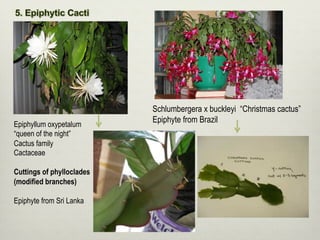
Epiphyllum oxypetalum
“queen of the night”
Cactus family
Cactaceae
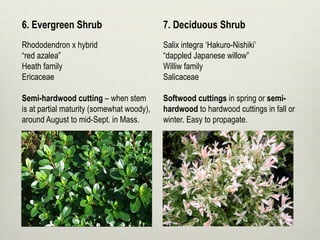
Cuttings of phylloclades
(modified branches)
Epiphyte from Sri Lanka
Schlumbergera x buckleyi “Christmas cactus”
Epiphyte from Brazil
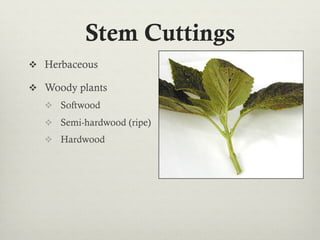
6. Evergreen Shrub 7. Deciduous Shrub
Rhododendron x hybrid
“red azalea”
Heath family
Ericaceae
Semi-hardwood cutting – when stem
is at partial maturity (somewhat woody),
around August to mid-Sept. in Mass.
Salix integra ‘Hakuro-Nishiki’
“dappled Japanese willow”
Williw family
Salicaceae
Softwood cuttings in spring or semi-
hardwood to hardwood cuttings in fall or
winter. Easy to propagate.
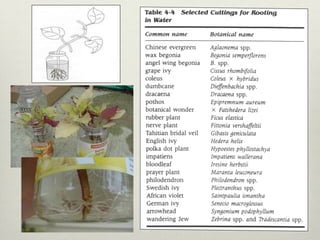
Stem Cuttings
v  Herbaceous
v  Woody plants
v  Softwood
v  Semi-hardwood (ripe)
v  Hardwood
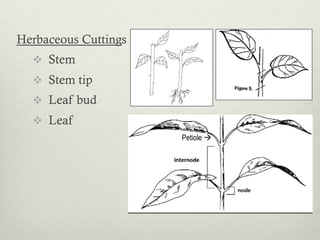
Herbaceous Cuttings
v  Stem
v  Stem tip
v  Leaf bud
v  Leaf
Petiole à
Stem Cuttings
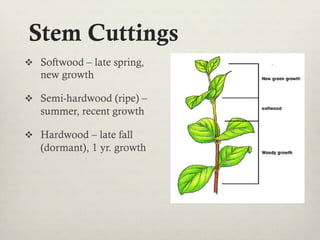
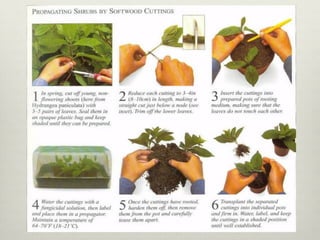
v  Softwood – late spring,
new growth
v  Semi-hardwood (ripe) –
summer, recent growth
v  Hardwood – late fall
(dormant), 1 yr. growth
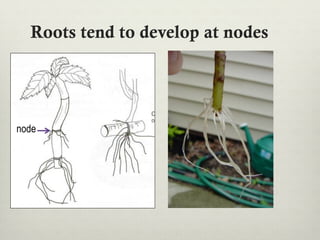
Roots tend to develop at nodes
node
Cutting principles
v  Age of material
v  Correct seasonal timing
v  Sterile rooting medium, sanitation
v  High humidity
v  No direct sun
v  Shoots without flowers or flower buds
v  Node near base of cutting
v  Rooting hormones
v  Basal wounding of woody cuttings
v  Remove leaves in contact with rooting medium
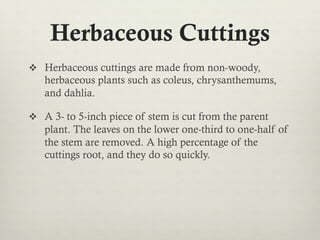
Herbaceous Cuttings
v  Herbaceous cuttings are made from non-woody,
herbaceous plants such as coleus, chrysanthemums,
and dahlia.
v  A 3- to 5-inch piece of stem is cut from the parent
plant. The leaves on the lower one-third to one-half of
the stem are removed. A high percentage of the
cuttings root, and they do so quickly.
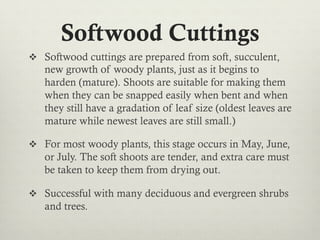
Softwood Cuttings
v  Softwood cuttings are prepared from soft, succulent,
new growth of woody plants, just as it begins to
harden (mature). Shoots are suitable for making them
when they can be snapped easily when bent and when
they still have a gradation of leaf size (oldest leaves are
mature while newest leaves are still small.)
v  For most woody plants, this stage occurs in May, June,
or July. The soft shoots are tender, and extra care must
be taken to keep them from drying out.
v  Successful with many deciduous and evergreen shrubs
and trees.
Semi-Hardwood Cuttings
v  Semi-hardwood cuttings are usually prepared from
partially mature wood of the current season’s growth,
just after a flush of growth. This type of cutting
normally is made from mid-July to early fall. The
wood is reasonably firm and the leaves of mature size.
v  Many broadleaf evergreen shrubs and some conifers
are propagated by this method.
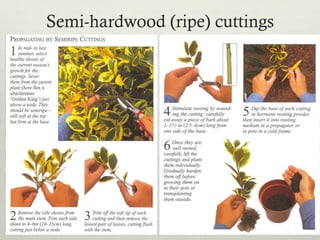
Semi-hardwood (ripe) cuttings
Hardwood Cuttings
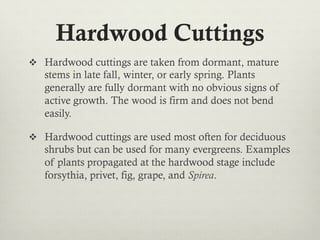
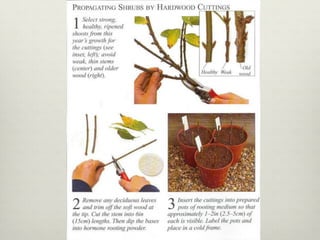
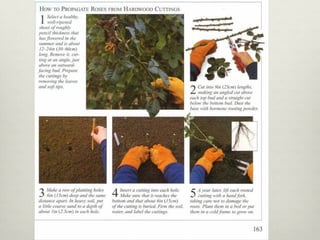
v  Hardwood cuttings are taken from dormant, mature
stems in late fall, winter, or early spring. Plants
generally are fully dormant with no obvious signs of
active growth. The wood is firm and does not bend
easily.
v  Hardwood cuttings are used most often for deciduous
shrubs but can be used for many evergreens. Examples
of plants propagated at the hardwood stage include
forsythia, privet, fig, grape, and Spirea.
Procedures for Rooting Stem Cuttings
²  Cuttings should generally consist of the current or past
season’s growth.
²  Avoid material with flower buds if possible. Remove
any flowers and flower buds when preparing cuttings
so the cutting’s energy can be used in producing new
roots rather than flowers.
²  Take cuttings from healthy, disease-free plants,
preferably from the upper part of the plant.
²  Avoid taking cuttings from plants that show symptoms
of mineral nutrient deficiency or that have been
fertilized heavily
²  The stock plant should not be under moisture stress. In
general, cuttings taken from young plants root in
higher percentages than cuttings taken from older,
more mature plants. Cuttings from lateral shoots often
root better than cuttings from terminal shoots.
Procedures for Rooting Stem Cuttings
²  Early morning is the best time to take cuttings,
because the plant is fully turgid. Keep the cuttings cool
and moist until they are stuck. If there will be a delay
in sticking cuttings, store them in a plastic bag in a
refrigerator.
²  Terminal parts of the stem are best, but a long shoot
can be divided into several cuttings, generally 4 to 6”
long. Use a sharp, thin-bladed pocket knife or sharp
pruning shears. If necessary, dip the cutting tool in
rubbing alcohol or a mixture of 1 part bleach to 9
parts water to prevent transmitting diseases from
infected plant parts to healthy ones.
Procedures for Rooting Stem Cuttings
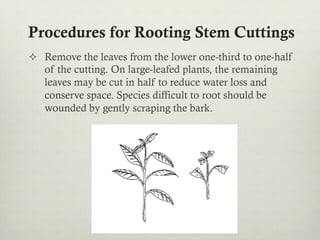
²  Remove the leaves from the lower one-third to one-half
of the cutting. On large-leafed plants, the remaining
leaves may be cut in half to reduce water loss and
conserve space. Species difficult to root should be
wounded by gently scraping the bark.
Procedures for Rooting Stem Cuttings
²  Treating cuttings with root-promoting compounds can
stimulate rooting of some plants that might otherwise
be difficult to root.
²  Prevent possible contamination of the entire supply of
rooting hormone by putting some in a separate
container before treating cuttings.
²  Any material that remains after treatment should be
discarded and not returned to the original container.
Be sure to tap the cuttings to remove excess hormone
when using a powder formulation.
Using Rooting Hormones
Rooting Media
²  The rooting medium should be sterile, low in fertility,
and well-drained to provide sufficient aeration. It
should also retain enough moisture so that watering
does not have to be done too frequently. Materials
commonly used are coarse sand, a mixture of one part
peat and one part perlite (by volume), or one part peat
and one part sand (by volume).
²  Vermiculite by itself is not recommended, because it
compacts and tends to hold too much moisture.
²  Media should be watered while being used.
Sticking Cuttings
²  Insert cuttings 1/3 to 1/2 their length into the medium.
²  Maintain the vertical orientation of the stem (do not
insert the cuttings upside down). Make sure the buds are
pointed up.
²  Space cuttings just far enough apart to allow all leaves to
receive sunlight. Water again after inserting the cuttings if
the containers or frames are 3 or more inches in depth.
²  Cover the cuttings with plastic and place in indirect light.
Avoid direct sun. Keep the medium moist until the
cuttings have rooted. Rooting will be improved if the
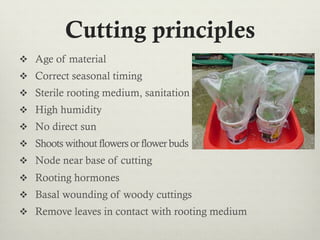
cuttings are misted on a regular basis.
Rooting Time
²  Rooting time varies with the type of cutting, the
species being rooted, and environmental conditions.
Conifers require more time than broadleaf plants. Late
fall or early winter is a good time to root conifers.
Once rooted, they may be left in the rooting structure
until spring.
²  Newly rooted cuttings should not be transplanted
directly into the landscape. Instead, transplant them
into containers or into a bed. Growing them to a larger
size before transplanting to a permanent location will
increase the chances for survival.
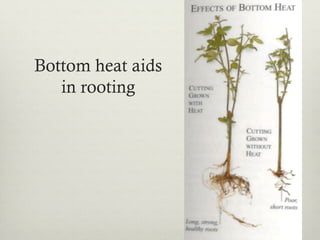
Bottom heat aids
in rooting
Good Sources on Plant Propagation
For Further Reading
§  Bryant, G. 1995. Propagation Handbook. Stackpole Books:
Mechanicsburg, Pennsylvania.
§  Dirr, M. A. and C. W. Heuser, Jr. 1987. The Reference Manual of
Woody Plant Propagation: From Seed to Tissue Culture. Varsity
Press: Athens, Georgia.
§  Hartmann, H. T., D. E. Kester, F. T. Davies and R. L. Geneve.
1996. Plant Propagation, Principles and Practices. 6th ed.
Prentice Hall: Upper Saddle River, New Jersey.
§  McMillan Browse, P. D. A. 1978. Plant Propagation. Simon and
Schuster: New York.
§  Toogood, A. 1993. Plant Propagation Made Easy. Timber Press:
Portland, Oregon
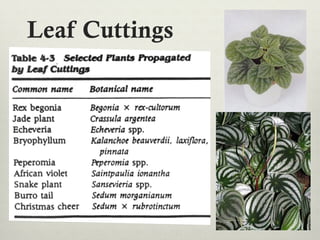
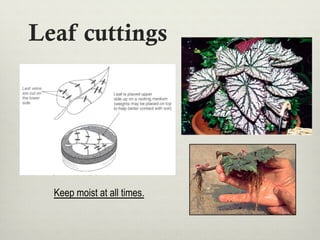
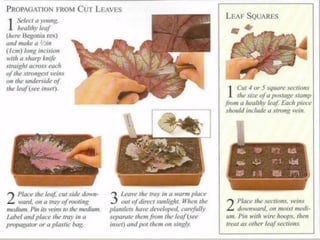
Leaf Cuttings
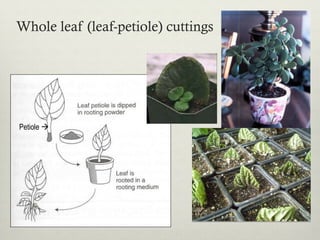
Whole leaf (leaf-petiole) cuttings
Petiole à
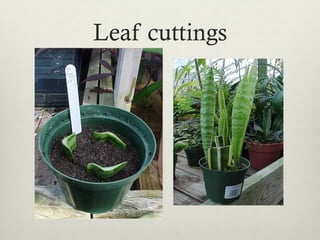
Leaf cuttings
Keep moist at all times.
Leaf cuttings
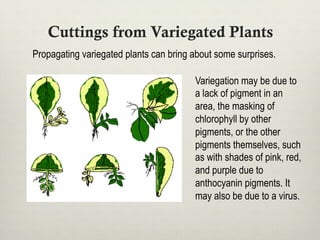
Cuttings from Variegated Plants
Variegation may be due to
a lack of pigment in an
area, the masking of
chlorophyll by other
pigments, or the other
pigments themselves, such
as with shades of pink, red,
and purple due to
anthocyanin pigments. It
may also be due to a virus.
Propagating variegated plants can bring about some surprises.
Runners
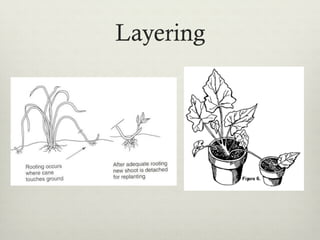
Layering
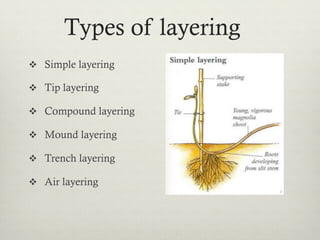
Types of layering
v  Simple layering
v  Tip layering
v  Compound layering
v  Mound layering
v  Trench layering
v  Air layering
Tip layering
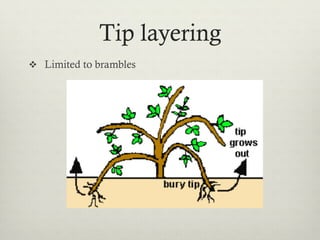
v  Limited to brambles
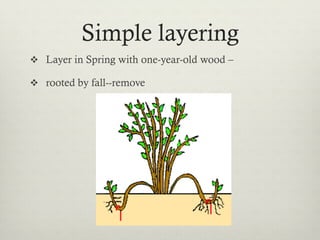
Simple layering
v  Layer in Spring with one-year-old wood –
v  rooted by fall--remove
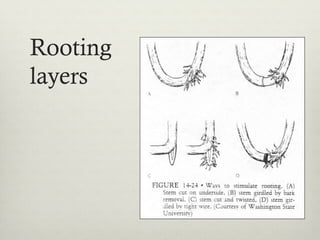
Rooting
layers
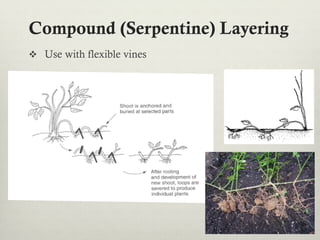
Compound (Serpentine) Layering
v  Use with flexible vines
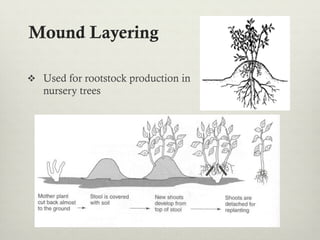
Mound Layering
v  Used for rootstock production in
nursery trees
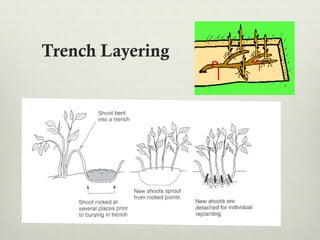
Trench Layering
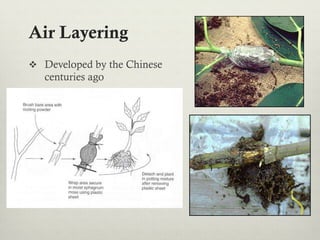
Air Layering
v  Developed by the Chinese
centuries ago
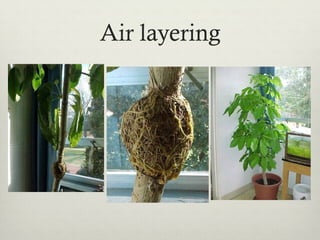
Air layering
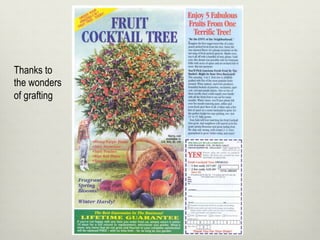
Thanks to
the wonders
of grafting
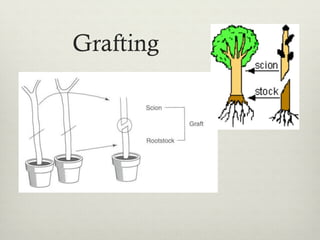
Grafting
Why graft?
v  Incorporate disease, insect resistance
v  Incorporate temperature tolerance
v  Quickly increase # of a desirable type
v  Change cultivar of fruit in an orchard
v  Control form (dwarfing, weeping, tree mums & roses)
v  Repair bark damage
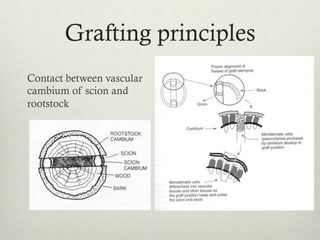
Grafting principles
Contact between vascular
cambium of scion and
rootstock
Grafting principles
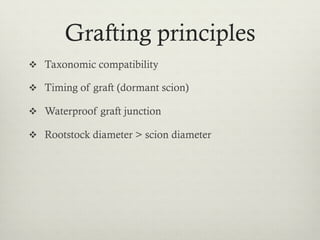
v  Taxonomic compatibility
v  Timing of graft (dormant scion)
v  Waterproof graft junction
v  Rootstock diameter > scion diameter
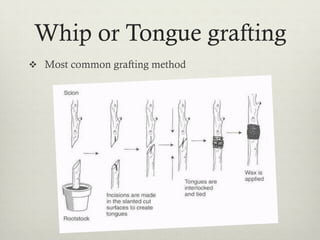
Whip or Tongue grafting
v  Most common grafting method
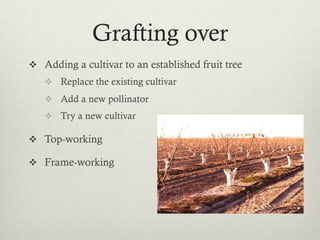
Grafting over
v  Adding a cultivar to an established fruit tree
v  Replace the existing cultivar
v  Add a new pollinator
v  Try a new cultivar
v  Top-working
v  Frame-working
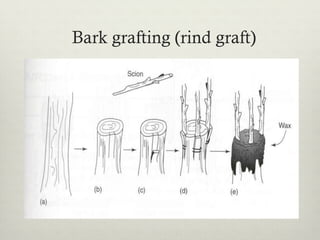
Bark grafting (rind graft)
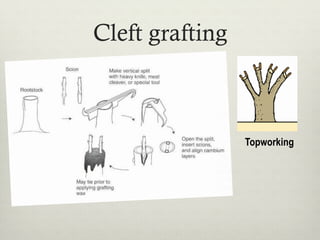
Cleft grafting
Topworking
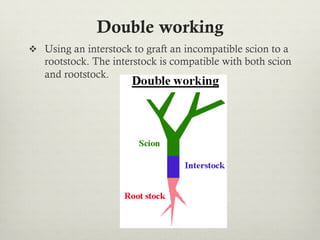
Double working
v  Using an interstock to graft an incompatible scion to a
rootstock. The interstock is compatible with both scion
and rootstock.
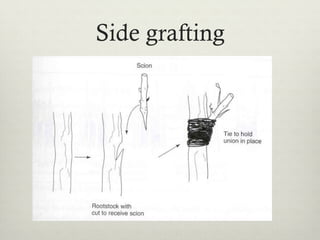
Side grafting
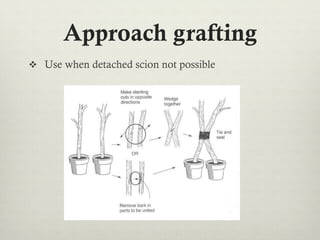
Approach grafting
v  Use when detached scion not possible
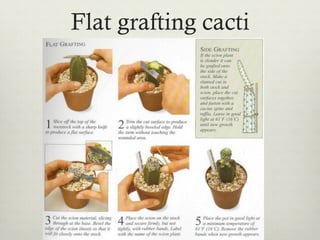
Flat grafting cacti
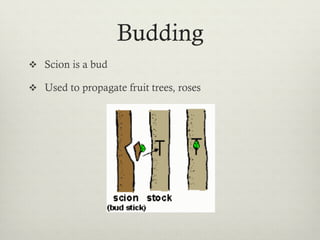
Budding
v  Scion is a bud
v  Used to propagate fruit trees, roses
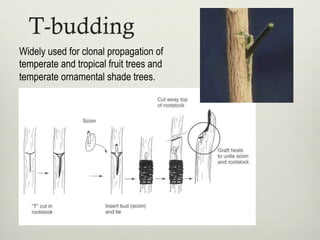
T-budding
Widely used for clonal propagation of
temperate and tropical fruit trees and
temperate ornamental shade trees.
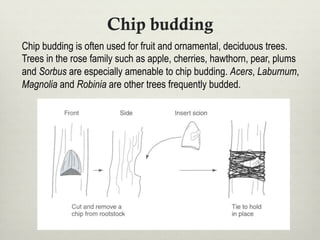
Chip budding
Chip budding is often used for fruit and ornamental, deciduous trees.
Trees in the rose family such as apple, cherries, hawthorn, pear, plums
and Sorbus are especially amenable to chip budding. Acers, Laburnum,
Magnolia and Robinia are other trees frequently budded.
Patch budding
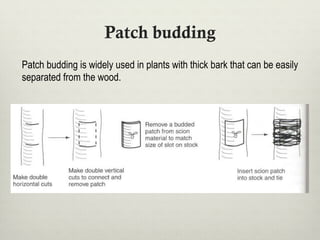
Patch budding is widely used in plants with thick bark that can be easily
separated from the wood.
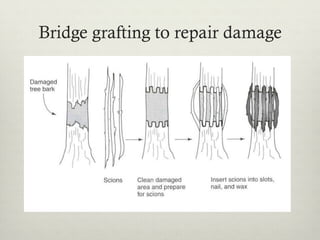
Bridge grafting to repair damage
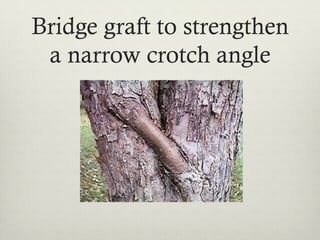
Bridge graft to strengthen
a narrow crotch angle
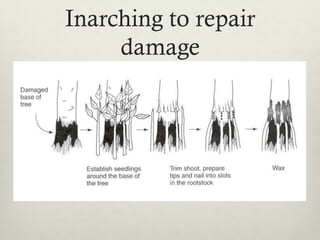
Inarching to repair
damage
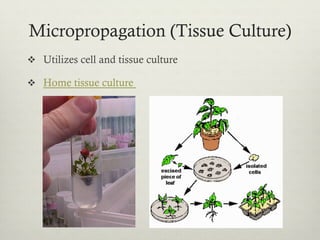
Micropropagation (Tissue Culture)
v  Utilizes cell and tissue culture
v  Home tissue culture

Asexualprop2

  • 1.
    Wednesday, Sept. 10 1. Turn in Homework – 5 Questions (Will return first two homework assignments on Monday) (3 minutes) 2.  Field Trip Forms – Go over for 9/25, discuss Monday (5) 3.  Self-Assessment – Discuss questions/grading (hw) (5) 4.  Homework for Monday – Hand out reading and assignments (5) 5.  Poinsettia Watchdogs – update on crop and refer to schedule (5) 6.  Asexual Propagation (15) 7.  Chapter 2 – (35)
  • 2.
    Asexual (Vegetative) Propagation Vegetative reproduction isdefined as the production of new plants from the vegetative parts like leaf, stem, roots of the parent plant.
  • 3.
    Why Use AsexualPropagation? v  Uniformity v  Propagate non-seed producing plants v  Avoid seed-borne diseases v  To create insect or disease resistant plants v  To incorporate environmental tolerances v  To reproduce and retain the genetic traits of a hybrid v  Control size and form of a plant v  Can be faster and easier, cheaper
  • 4.
    Disadvantages of Asexual Propagation v Uniformity (may not be desired) v  Short storage time (live cuttings) v  Bulky (vs. seeds) v  Systemic infections can be spread easily, as the plants are clones (genetically identical)
  • 5.
    Types of AsexualPropagation v  Specialized parts v  Cuttings v  Layering v  Grafting v  Tissue culture (micropropagation)
  • 6.
    Specialized Plant Parts v Offshoots v  Separation v  Division
  • 7.
    Division - Stolon Apotato is a stolon, an underground storage structure (stem). Nodes along the stem sprout stems, leaves, and roots.
  • 8.
    Division - Rhizome Rhizomesand stolons are underground stems.
  • 9.
  • 10.
    Tuber Division Caladiums aretubers, another specialized stem structure.
  • 11.
  • 14.
  • 15.
  • 16.
  • 17.
  • 18.
  • 19.
    Separation – Bulbs v Amaryllis (a tunicate bulb)
  • 20.
  • 21.
    Separation - Corms Acorm is not a true bulb. To divide them, simply separate the new corms or cormels.
  • 22.
    Yellow and browningleaf margins could indicate ammonium toxicity, but that is usually accompanied by interveinal chlorosis. A calcium deficiency deficiency would have young leaves chlorotic (yellowing and curling up) rather than the lower leaves. Ca is nonmobile so deficiency is shown in upper leaves. If soluble salts are too high, say, from the water,
  • 23.
    Without a tissueanalysis, it is hard to say for sure, but it could be a Mo deficiency. This could be corrected with a foliar spray. Were we a commercial greenhouse, we would do a tissue analysis. Today we will measure the pH and electrical conductivity/total dissolved solids (TDS). (First we will test the EC of the water.) We’ll do it again in Monday’s lab.
  • 24.
    In a commercialgreenhouse we would have done the water testing first. Another problem we have is whitefly, which sucks the juices out of the plants. We can treat them in the larval stage with Safer Soap, which we apply 1:50 with water after shaking the bottle. We spray it on the undersides of the leaves, especially, as that is where they feed. It smothers the nymphs and several other pests. We could also treat them by releasing lady beetles, minute pirate bugs, green lacewings or other predatory or parasitic predators.
  • 25.
    Write in YourGreenhouse Notebook v  Potted rooted cuttings: 9/3/14 v  Added shade cloth: 9/3/14 v  Fertilized with 300 ppm 15-5-15 Cal-Mag fertilizer. (4.05 z. or 114.8 g/gal. conc.): 9/3/14 v  Treated with BanRot (recommended for poinsettias is 6-12 oz./100 gal.) 12 oz./100 gal=.12 oz/1 gal. x 16 (for the 1:16 proportioner) = 1.92 oz./gal. conc.: 9/3/14 v  Fertilized and treated with BanRot: 9/5/14 v  Removed dead leaves: 9/5/14, 9/8/14 v  Removed Shade Cloth: 9/8/14 v  Sprayed with Safer Soap: 9/8/14 v  Fertilized: 9/9/14
  • 26.
    Tradescantia zebrina “wandering Jew” Spiderwortfamily Commelinaceae From southern Mexico, Honduras, Guatemala vine; stem cuttings Philodendron cordatum “wandering Jew” Arum family Aracaeae Epiphyte from Southeastern Brazil vine; stem cuttings Some plants we are propagating – 1. Herbaceous Vines
  • 27.
    2. Succulent LeafCuttings Crassula ovata “jade plant” Crassulaceae Shrub from South Africa Leaf or stem cuttings
  • 28.
    3. More LeafCuttings Peperomia obovatus “baby rubber plant” Pepper family Piperaceae Succulent epiphyte that grows on rotting wood in tropical and subtropical regions Leaf or stem cuttings “African violet” Saintpulia spp. Gesneriad Family Gesneriacae From tropical Africa Leaf cutting
  • 29.
    4. Baby plantletsfrom runners (stems) Chlorophytum comosum ‘Variegata’ “variegated spider plant” Asparagus Family Asparagaceae Native to South Africa The flowers
  • 30.
    Epiphyllum oxypetalum “queen ofthe night” Cactus family Cactaceae Cuttings of phylloclades (modified branches) Epiphyte from Sri Lanka Schlumbergera x buckleyi “Christmas cactus” Epiphyte from Brazil
  • 31.
    6. Evergreen Shrub7. Deciduous Shrub Rhododendron x hybrid “red azalea” Heath family Ericaceae Semi-hardwood cutting – when stem is at partial maturity (somewhat woody), around August to mid-Sept. in Mass. Salix integra ‘Hakuro-Nishiki’ “dappled Japanese willow” Williw family Salicaceae Softwood cuttings in spring or semi- hardwood to hardwood cuttings in fall or winter. Easy to propagate.
  • 32.
    Stem Cuttings v  Herbaceous v Woody plants v  Softwood v  Semi-hardwood (ripe) v  Hardwood
  • 33.
    Herbaceous Cuttings v  Stem v Stem tip v  Leaf bud v  Leaf Petiole à
  • 34.
    Stem Cuttings v  Softwood– late spring, new growth v  Semi-hardwood (ripe) – summer, recent growth v  Hardwood – late fall (dormant), 1 yr. growth
  • 35.
    Roots tend todevelop at nodes node
  • 36.
    Cutting principles v  Ageof material v  Correct seasonal timing v  Sterile rooting medium, sanitation v  High humidity v  No direct sun v  Shoots without flowers or flower buds v  Node near base of cutting v  Rooting hormones v  Basal wounding of woody cuttings v  Remove leaves in contact with rooting medium
  • 37.
    Herbaceous Cuttings v  Herbaceouscuttings are made from non-woody, herbaceous plants such as coleus, chrysanthemums, and dahlia. v  A 3- to 5-inch piece of stem is cut from the parent plant. The leaves on the lower one-third to one-half of the stem are removed. A high percentage of the cuttings root, and they do so quickly.
  • 38.
    Softwood Cuttings v  Softwoodcuttings are prepared from soft, succulent, new growth of woody plants, just as it begins to harden (mature). Shoots are suitable for making them when they can be snapped easily when bent and when they still have a gradation of leaf size (oldest leaves are mature while newest leaves are still small.) v  For most woody plants, this stage occurs in May, June, or July. The soft shoots are tender, and extra care must be taken to keep them from drying out. v  Successful with many deciduous and evergreen shrubs and trees.
  • 40.
    Semi-Hardwood Cuttings v  Semi-hardwoodcuttings are usually prepared from partially mature wood of the current season’s growth, just after a flush of growth. This type of cutting normally is made from mid-July to early fall. The wood is reasonably firm and the leaves of mature size. v  Many broadleaf evergreen shrubs and some conifers are propagated by this method.
  • 41.
  • 42.
    Hardwood Cuttings v  Hardwoodcuttings are taken from dormant, mature stems in late fall, winter, or early spring. Plants generally are fully dormant with no obvious signs of active growth. The wood is firm and does not bend easily. v  Hardwood cuttings are used most often for deciduous shrubs but can be used for many evergreens. Examples of plants propagated at the hardwood stage include forsythia, privet, fig, grape, and Spirea.
  • 46.
    Procedures for RootingStem Cuttings ²  Cuttings should generally consist of the current or past season’s growth. ²  Avoid material with flower buds if possible. Remove any flowers and flower buds when preparing cuttings so the cutting’s energy can be used in producing new roots rather than flowers. ²  Take cuttings from healthy, disease-free plants, preferably from the upper part of the plant.
  • 47.
    ²  Avoid takingcuttings from plants that show symptoms of mineral nutrient deficiency or that have been fertilized heavily ²  The stock plant should not be under moisture stress. In general, cuttings taken from young plants root in higher percentages than cuttings taken from older, more mature plants. Cuttings from lateral shoots often root better than cuttings from terminal shoots. Procedures for Rooting Stem Cuttings
  • 48.
    ²  Early morningis the best time to take cuttings, because the plant is fully turgid. Keep the cuttings cool and moist until they are stuck. If there will be a delay in sticking cuttings, store them in a plastic bag in a refrigerator. ²  Terminal parts of the stem are best, but a long shoot can be divided into several cuttings, generally 4 to 6” long. Use a sharp, thin-bladed pocket knife or sharp pruning shears. If necessary, dip the cutting tool in rubbing alcohol or a mixture of 1 part bleach to 9 parts water to prevent transmitting diseases from infected plant parts to healthy ones. Procedures for Rooting Stem Cuttings
  • 49.
    ²  Remove theleaves from the lower one-third to one-half of the cutting. On large-leafed plants, the remaining leaves may be cut in half to reduce water loss and conserve space. Species difficult to root should be wounded by gently scraping the bark. Procedures for Rooting Stem Cuttings
  • 50.
    ²  Treating cuttingswith root-promoting compounds can stimulate rooting of some plants that might otherwise be difficult to root. ²  Prevent possible contamination of the entire supply of rooting hormone by putting some in a separate container before treating cuttings. ²  Any material that remains after treatment should be discarded and not returned to the original container. Be sure to tap the cuttings to remove excess hormone when using a powder formulation. Using Rooting Hormones
  • 51.
    Rooting Media ²  Therooting medium should be sterile, low in fertility, and well-drained to provide sufficient aeration. It should also retain enough moisture so that watering does not have to be done too frequently. Materials commonly used are coarse sand, a mixture of one part peat and one part perlite (by volume), or one part peat and one part sand (by volume). ²  Vermiculite by itself is not recommended, because it compacts and tends to hold too much moisture. ²  Media should be watered while being used.
  • 52.
    Sticking Cuttings ²  Insertcuttings 1/3 to 1/2 their length into the medium. ²  Maintain the vertical orientation of the stem (do not insert the cuttings upside down). Make sure the buds are pointed up. ²  Space cuttings just far enough apart to allow all leaves to receive sunlight. Water again after inserting the cuttings if the containers or frames are 3 or more inches in depth. ²  Cover the cuttings with plastic and place in indirect light. Avoid direct sun. Keep the medium moist until the cuttings have rooted. Rooting will be improved if the cuttings are misted on a regular basis.
  • 53.
    Rooting Time ²  Rootingtime varies with the type of cutting, the species being rooted, and environmental conditions. Conifers require more time than broadleaf plants. Late fall or early winter is a good time to root conifers. Once rooted, they may be left in the rooting structure until spring. ²  Newly rooted cuttings should not be transplanted directly into the landscape. Instead, transplant them into containers or into a bed. Growing them to a larger size before transplanting to a permanent location will increase the chances for survival.
  • 54.
  • 55.
    Good Sources onPlant Propagation For Further Reading §  Bryant, G. 1995. Propagation Handbook. Stackpole Books: Mechanicsburg, Pennsylvania. §  Dirr, M. A. and C. W. Heuser, Jr. 1987. The Reference Manual of Woody Plant Propagation: From Seed to Tissue Culture. Varsity Press: Athens, Georgia. §  Hartmann, H. T., D. E. Kester, F. T. Davies and R. L. Geneve. 1996. Plant Propagation, Principles and Practices. 6th ed. Prentice Hall: Upper Saddle River, New Jersey. §  McMillan Browse, P. D. A. 1978. Plant Propagation. Simon and Schuster: New York. §  Toogood, A. 1993. Plant Propagation Made Easy. Timber Press: Portland, Oregon
  • 56.
  • 57.
    Whole leaf (leaf-petiole)cuttings Petiole à
  • 59.
  • 61.
  • 62.
    Cuttings from VariegatedPlants Variegation may be due to a lack of pigment in an area, the masking of chlorophyll by other pigments, or the other pigments themselves, such as with shades of pink, red, and purple due to anthocyanin pigments. It may also be due to a virus. Propagating variegated plants can bring about some surprises.
  • 64.
  • 65.
  • 66.
    Types of layering v Simple layering v  Tip layering v  Compound layering v  Mound layering v  Trench layering v  Air layering
  • 67.
  • 68.
    Simple layering v  Layerin Spring with one-year-old wood – v  rooted by fall--remove
  • 69.
  • 70.
  • 71.
    Mound Layering v  Usedfor rootstock production in nursery trees
  • 72.
  • 73.
    Air Layering v  Developedby the Chinese centuries ago
  • 74.
  • 75.
  • 76.
  • 77.
    Why graft? v  Incorporatedisease, insect resistance v  Incorporate temperature tolerance v  Quickly increase # of a desirable type v  Change cultivar of fruit in an orchard v  Control form (dwarfing, weeping, tree mums & roses) v  Repair bark damage
  • 78.
    Grafting principles Contact betweenvascular cambium of scion and rootstock
  • 79.
    Grafting principles v  Taxonomiccompatibility v  Timing of graft (dormant scion) v  Waterproof graft junction v  Rootstock diameter > scion diameter
  • 80.
    Whip or Tonguegrafting v  Most common grafting method
  • 81.
    Grafting over v  Addinga cultivar to an established fruit tree v  Replace the existing cultivar v  Add a new pollinator v  Try a new cultivar v  Top-working v  Frame-working
  • 82.
  • 83.
  • 84.
    Double working v  Usingan interstock to graft an incompatible scion to a rootstock. The interstock is compatible with both scion and rootstock.
  • 85.
  • 86.
    Approach grafting v  Usewhen detached scion not possible
  • 87.
  • 88.
    Budding v  Scion isa bud v  Used to propagate fruit trees, roses
  • 89.
    T-budding Widely used forclonal propagation of temperate and tropical fruit trees and temperate ornamental shade trees.
  • 90.
    Chip budding Chip buddingis often used for fruit and ornamental, deciduous trees. Trees in the rose family such as apple, cherries, hawthorn, pear, plums and Sorbus are especially amenable to chip budding. Acers, Laburnum, Magnolia and Robinia are other trees frequently budded.
  • 91.
    Patch budding Patch buddingis widely used in plants with thick bark that can be easily separated from the wood.
  • 92.
    Bridge grafting torepair damage
  • 93.
    Bridge graft tostrengthen a narrow crotch angle
  • 94.
  • 95.
    Micropropagation (Tissue Culture) v Utilizes cell and tissue culture v  Home tissue culture