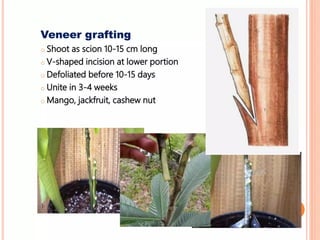
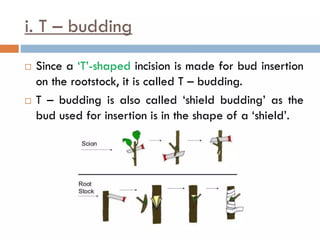
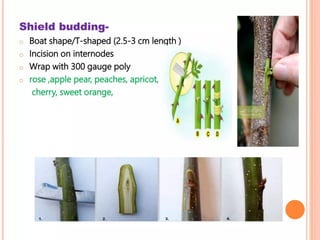
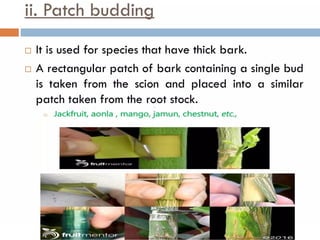
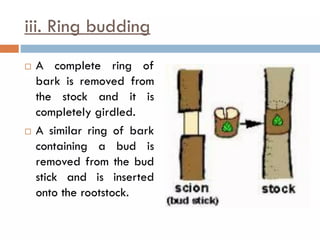
Use of vegetative
propagation methods
Cutting:
Most common type of asexual
propagation
Definition:
Separation of a portion (leaf part, stem, root
etc.) from mother plant and planting it in a
media suitably so that it may constitute a
new plant successfully is termed as cutting.
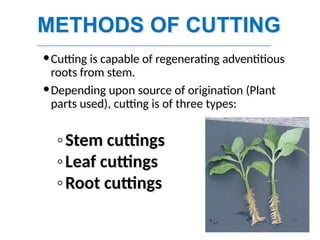
METHODS OF CUTTING
Cutting is capable of regenerating adventitious
roots from stem.
Depending upon source of origination (Plant
parts used), cutting is of three types:
◦Stem cuttings
◦Leaf cuttings
◦Root cuttings
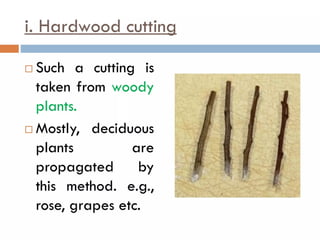
HARDWOOD CUTTING
 Cuttings made from past season's growth or wood
that has become mature and lignified are known as
hardwood cuttings.
 Prepared during dormant season.
 Extremely vigorous or too weak shoots should be
discarded.
 Hardwood cuttings may be 10 to 45 cm and the
diameter ranges from 0.5 to 2.5 cm or even more,
depending on the kind of plants.
 best cutting: 25-30 cm long with pencil thickness, with
at least 2 buds.
 Usually, one-year-old shoot is preferred, but in
some cases two-year-old wood is used.
 While preparing the cutting, a straight cut is given at
the base of shoot below the node while a slanting cut,
1 to 2 cm above the bud is given at the top of cutting.
 This helps in maintaining the polarity of the shoot and
if rain occurs, water does not accumulate on the tip of the
cutting, which saves the cutting from fungal infection.
 Eg: grape, hazelnut, chestnut, fig, quince,
pomegranate, mulberry, plum, olive, gooseberry and
apple etc. are commercially propagated by hard wood
cuttings.
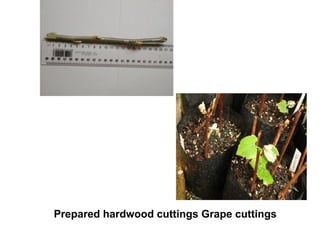
Prepared hardwood cuttings Grape cuttings
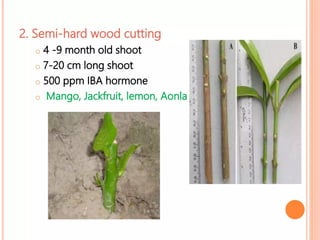
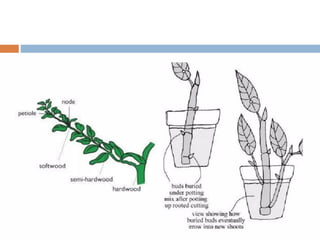
Semi-hardwood (greenwood) cuttings
Semi-hardwood cuttings are usually prepared
from partially mature wood of the current
season’s growth, just after a flush of growth.
The plant material is between the softwood and
woody stage. Wood is called semi-hardwood
when it is not soft and new, but is not quite old
enough to be hard and woody. When you bend
it between your fingers it will snap.
E.g., jackfruit, lemon, mango, guava, ornamental
shrub etc.
SOFTWOOD CUTTING
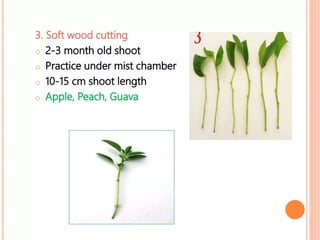
 Softwood cuttings are prepared from soft, succulent, new growth of
woody plants, which have not become hard or woody.
Proper choice of shoots for making softwood cuttings is an important factor. Very
fast growing, soft and tender shoots arc not suitable for making softwood
cuttings, as they tend to rot before rooting. Similarly thin, slender
and slow-growing shoots are also unsuitable. Moderately vigorous
shoots growing on healthy plants under full sunlight are
most suitable for making softwood cuttings.
Usually, some leaves should be retained with this type of cuttings.
Softwood cuttings generally root easier and quicker than other types, but
require more attention and sophisticated equipment.
HERBACEOUS CUTTING
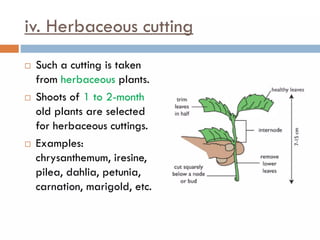
The herbaceous stem cuttings usually consist of the
terminal leafy portion of stems of herbaceous plants.
 Such cuttings are usually soft, tender and succulent.
 Easily liable to wilting, much care is to be taken to
prevent wilting.
 In general, 7 to 15 cm long terminal portion of
moderately vigorous shoots are selected for making
cuttings, and the leaves are removed from the basal
portion of the cuttings.
HERBACEOUS CUTTING
 The cuttings should be prepared just before they
are placed in the rooting medium.
Under favourable conditions, herbaceous cuttings
root within a relatively short time.
Although the use of auxins is not essential, they are
often used to obtain uniform rooting and a heavy root
system.
E.g., chrysanthemum, dahlia, coleus, carnation,
geranium, sweet potato, etc.
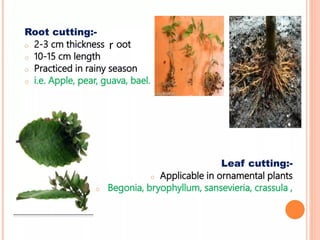
r
There are several different types of leaf cutting
depending on the type and amount of plant
material available.
A. Leaf bud cuttings
B. Leaf petiole cuttings
C. Non-petiole cuttings
D. Leaf portions
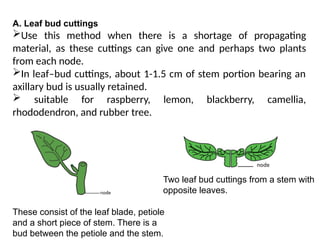
A. Leaf bud cuttings
Use this method when there is a shortage of propagating
material, as these cuttings can give one and perhaps two plants
from each node.
In leaf–bud cuttings, about 1-1.5 cm of stem portion bearing an
axillary bud is usually retained.
 suitable for raspberry, lemon, blackberry, camellia,
rhododendron, and rubber tree.
These consist of the leaf blade, petiole
and a short piece of stem. There is a
bud between the petiole and the stem.
Two leaf bud cuttings from a stem with
opposite leaves.
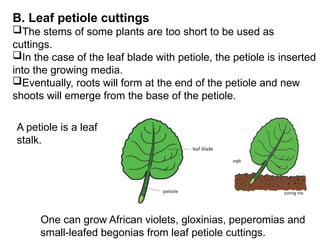
B. Leaf petiole cuttings
The stems of some plants are too short to be used as
cuttings.
In the case of the leaf blade with petiole, the petiole is inserted
into the growing media.
Eventually, roots will form at the end of the petiole and new
shoots will emerge from the base of the petiole.
One can grow African violets, gloxinias, peperomias and
small-leafed begonias from leaf petiole cuttings.
A petiole is a leaf
stalk.
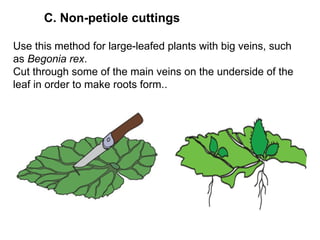
C. Non-petiole cuttings
Use this method for large-leafed plants with big veins, such
as Begonia rex.
Cut through some of the main veins on the underside of the
leaf in order to make roots form..
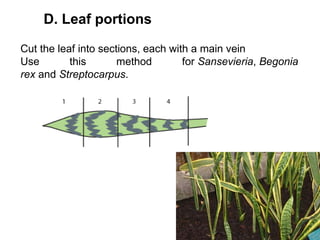
D. Leaf portions
Cut the leaf into sections, each with a main vein
Use this method for Sansevieria, Begonia
rex and Streptocarpus.
The stem which
is rooted is
called a layer
Methods of Layering
 Simple Layering
 Air Layering
 Compound or serpentine Layering
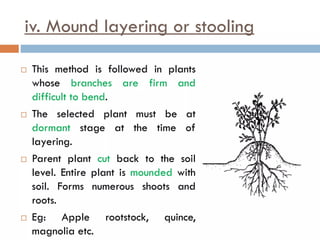
 Mound /Stool Layering
 Continuous or Trench Layering
 Tip layering
The most commercially used methods are mound
layering for multiplication of rootstocks and air
layering for some tropical fruits.
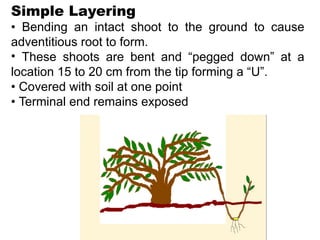
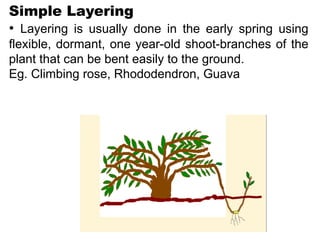
Simple Layering
• Bending an intact shoot to the ground to cause
adventitious root to form.
• These shoots are bent and “pegged down” at a
location 15 to 20 cm from the tip forming a “U”.
• Covered with soil at one point
• Terminal end remains exposed
Simple Layering
• Layering is usually done in the early spring using
flexible, dormant, one year-old shoot-branches of the
plant that can be bent easily to the ground.
Eg. Climbing rose, Rhododendron, Guava
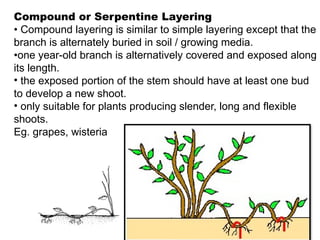
Compound or Serpentine Layering
• Compound layering is similar to simple layering except that the
branch is alternately buried in soil / growing media.
•one year-old branch is alternatively covered and exposed along
its length.
• the exposed portion of the stem should have at least one bud
to develop a new shoot.
• only suitable for plants producing slender, long and flexible
shoots.
Eg. grapes, wisteria
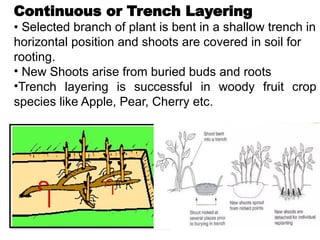
Continuous or Trench Layering
• Selected branch of plant is bent in a shallow trench in
horizontal position and shoots are covered in soil for
rooting.
• New Shoots arise from buried buds and roots
•Trench layering is successful in woody fruit crop
species like Apple, Pear, Cherry etc.
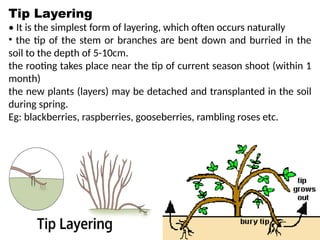
Tip Layering
• It is the simplest form of layering, which often occurs naturally
• the tip of the stem or branches are bent down and burried in the
soil to the depth of 5-10cm.
the rooting takes place near the tip of current season shoot (within 1
month)
the new plants (layers) may be detached and transplanted in the soil
during spring.
Eg: blackberries, raspberries, gooseberries, rambling roses etc.
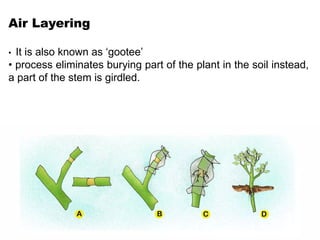
Air Layering
• It is also known as ‘gootee’
• process eliminates burying part of the plant in the soil instead,
a part of the stem is girdled.
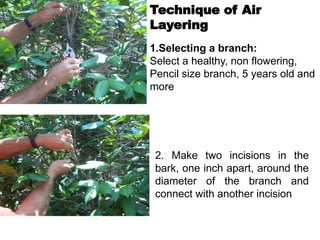
Technique of Air
Layering
1.Selecting a branch:
Select a healthy, non flowering,
Pencil size branch, 5 years old and
more
2. Make two incisions in the
bark, one inch apart, around the
diameter of the branch and
connect with another incision
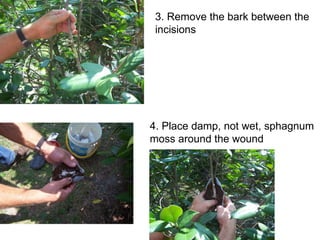
3. Remove the bark between the
incisions
4. Place damp, not wet, sphagnum
moss around the wound
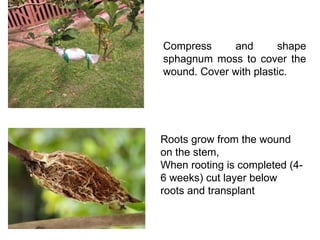
Compress and shape
sphagnum moss to cover the
wound. Cover with plastic.
Roots grow from the wound
on the stem,
When rooting is completed (4-
6 weeks) cut layer below
roots and transplant
THANK YOU

Use of vegetative propagation methods.pptx

  • 1.
  • 5.
    Cutting: Most common typeof asexual propagation Definition: Separation of a portion (leaf part, stem, root etc.) from mother plant and planting it in a media suitably so that it may constitute a new plant successfully is termed as cutting.
  • 6.
    METHODS OF CUTTING Cuttingis capable of regenerating adventitious roots from stem. Depending upon source of origination (Plant parts used), cutting is of three types: ◦Stem cuttings ◦Leaf cuttings ◦Root cuttings
  • 9.
    HARDWOOD CUTTING  Cuttingsmade from past season's growth or wood that has become mature and lignified are known as hardwood cuttings.  Prepared during dormant season.  Extremely vigorous or too weak shoots should be discarded.  Hardwood cuttings may be 10 to 45 cm and the diameter ranges from 0.5 to 2.5 cm or even more, depending on the kind of plants.  best cutting: 25-30 cm long with pencil thickness, with at least 2 buds.
  • 10.
     Usually, one-year-oldshoot is preferred, but in some cases two-year-old wood is used.  While preparing the cutting, a straight cut is given at the base of shoot below the node while a slanting cut, 1 to 2 cm above the bud is given at the top of cutting.  This helps in maintaining the polarity of the shoot and if rain occurs, water does not accumulate on the tip of the cutting, which saves the cutting from fungal infection.  Eg: grape, hazelnut, chestnut, fig, quince, pomegranate, mulberry, plum, olive, gooseberry and apple etc. are commercially propagated by hard wood cuttings.
  • 11.
  • 13.
    Semi-hardwood (greenwood) cuttings Semi-hardwoodcuttings are usually prepared from partially mature wood of the current season’s growth, just after a flush of growth. The plant material is between the softwood and woody stage. Wood is called semi-hardwood when it is not soft and new, but is not quite old enough to be hard and woody. When you bend it between your fingers it will snap. E.g., jackfruit, lemon, mango, guava, ornamental shrub etc.
  • 14.
    SOFTWOOD CUTTING  Softwoodcuttings are prepared from soft, succulent, new growth of woody plants, which have not become hard or woody. Proper choice of shoots for making softwood cuttings is an important factor. Very fast growing, soft and tender shoots arc not suitable for making softwood cuttings, as they tend to rot before rooting. Similarly thin, slender and slow-growing shoots are also unsuitable. Moderately vigorous shoots growing on healthy plants under full sunlight are most suitable for making softwood cuttings. Usually, some leaves should be retained with this type of cuttings. Softwood cuttings generally root easier and quicker than other types, but require more attention and sophisticated equipment.
  • 18.
    HERBACEOUS CUTTING The herbaceousstem cuttings usually consist of the terminal leafy portion of stems of herbaceous plants.  Such cuttings are usually soft, tender and succulent.  Easily liable to wilting, much care is to be taken to prevent wilting.  In general, 7 to 15 cm long terminal portion of moderately vigorous shoots are selected for making cuttings, and the leaves are removed from the basal portion of the cuttings.
  • 19.
    HERBACEOUS CUTTING  Thecuttings should be prepared just before they are placed in the rooting medium. Under favourable conditions, herbaceous cuttings root within a relatively short time. Although the use of auxins is not essential, they are often used to obtain uniform rooting and a heavy root system. E.g., chrysanthemum, dahlia, coleus, carnation, geranium, sweet potato, etc.
  • 20.
  • 21.
    There are severaldifferent types of leaf cutting depending on the type and amount of plant material available. A. Leaf bud cuttings B. Leaf petiole cuttings C. Non-petiole cuttings D. Leaf portions
  • 22.
    A. Leaf budcuttings Use this method when there is a shortage of propagating material, as these cuttings can give one and perhaps two plants from each node. In leaf–bud cuttings, about 1-1.5 cm of stem portion bearing an axillary bud is usually retained.  suitable for raspberry, lemon, blackberry, camellia, rhododendron, and rubber tree. These consist of the leaf blade, petiole and a short piece of stem. There is a bud between the petiole and the stem. Two leaf bud cuttings from a stem with opposite leaves.
  • 23.
    B. Leaf petiolecuttings The stems of some plants are too short to be used as cuttings. In the case of the leaf blade with petiole, the petiole is inserted into the growing media. Eventually, roots will form at the end of the petiole and new shoots will emerge from the base of the petiole. One can grow African violets, gloxinias, peperomias and small-leafed begonias from leaf petiole cuttings. A petiole is a leaf stalk.
  • 24.
    C. Non-petiole cuttings Usethis method for large-leafed plants with big veins, such as Begonia rex. Cut through some of the main veins on the underside of the leaf in order to make roots form..
  • 25.
    D. Leaf portions Cutthe leaf into sections, each with a main vein Use this method for Sansevieria, Begonia rex and Streptocarpus.
  • 26.
    The stem which isrooted is called a layer
  • 27.
    Methods of Layering Simple Layering  Air Layering  Compound or serpentine Layering  Mound /Stool Layering  Continuous or Trench Layering  Tip layering The most commercially used methods are mound layering for multiplication of rootstocks and air layering for some tropical fruits.
  • 28.
    Simple Layering • Bendingan intact shoot to the ground to cause adventitious root to form. • These shoots are bent and “pegged down” at a location 15 to 20 cm from the tip forming a “U”. • Covered with soil at one point • Terminal end remains exposed
  • 29.
    Simple Layering • Layeringis usually done in the early spring using flexible, dormant, one year-old shoot-branches of the plant that can be bent easily to the ground. Eg. Climbing rose, Rhododendron, Guava
  • 30.
    Compound or SerpentineLayering • Compound layering is similar to simple layering except that the branch is alternately buried in soil / growing media. •one year-old branch is alternatively covered and exposed along its length. • the exposed portion of the stem should have at least one bud to develop a new shoot. • only suitable for plants producing slender, long and flexible shoots. Eg. grapes, wisteria
  • 31.
    Continuous or TrenchLayering • Selected branch of plant is bent in a shallow trench in horizontal position and shoots are covered in soil for rooting. • New Shoots arise from buried buds and roots •Trench layering is successful in woody fruit crop species like Apple, Pear, Cherry etc.
  • 33.
    Tip Layering • Itis the simplest form of layering, which often occurs naturally • the tip of the stem or branches are bent down and burried in the soil to the depth of 5-10cm. the rooting takes place near the tip of current season shoot (within 1 month) the new plants (layers) may be detached and transplanted in the soil during spring. Eg: blackberries, raspberries, gooseberries, rambling roses etc.
  • 34.
    Air Layering • Itis also known as ‘gootee’ • process eliminates burying part of the plant in the soil instead, a part of the stem is girdled.
  • 35.
    Technique of Air Layering 1.Selectinga branch: Select a healthy, non flowering, Pencil size branch, 5 years old and more 2. Make two incisions in the bark, one inch apart, around the diameter of the branch and connect with another incision
  • 36.
    3. Remove thebark between the incisions 4. Place damp, not wet, sphagnum moss around the wound
  • 37.
    Compress and shape sphagnummoss to cover the wound. Cover with plastic. Roots grow from the wound on the stem, When rooting is completed (4- 6 weeks) cut layer below roots and transplant
  • 59.