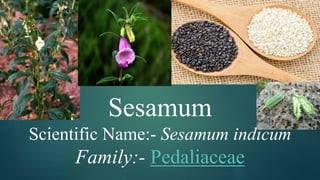
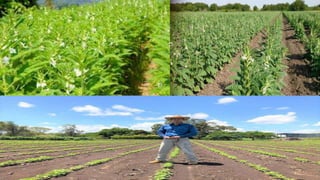
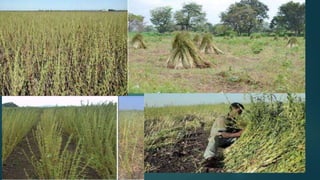
Sesamum
Scientific Name:- Sesamum indicum
Family:- Pedaliaceae
ORIGIN: Ethiopia Sesamum indicum
 DISTRIBUTION:- Major sesame producing countries are India, China,
Myanmar, Sudan, Pakisthan, Mexico, Ethiopia, Srilanka and Burma.
 In India, major sesame cultivating states are Gujarat, Rajasthan, Madhya
Pradesh, Uttar Pradesh, Tamilnadu and Maharashtra
 Major exporting countries are Sudan, Nigeria.
 India stands first in both area and production
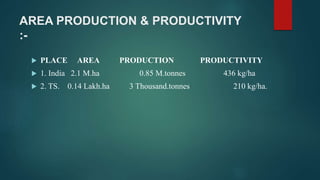
AREA PRODUCTION & PRODUCTIVITY
:-
 PLACE AREA PRODUCTION PRODUCTIVITY
 1. India 2.1 M.ha 0.85 M.tonnes 436 kg/ha
 2. TS. 0.14 Lakh.ha 3 Thousand.tonnes 210 kg/ha.
CLIMATE:-
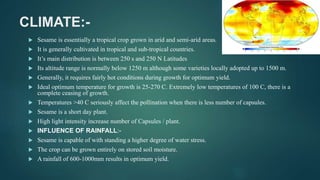
 Sesame is essentially a tropical crop grown in arid and semi-arid areas.
 It is generally cultivated in tropical and sub-tropical countries.
 It’s main distribution is between 250 s and 250 N Latitudes
 Its altitude range is normally below 1250 m although some varieties locally adopted up to 1500 m.
 Generally, it requires fairly hot conditions during growth for optimum yield.
 Ideal optimum temperature for growth is 25-270 C. Extremely low temperatures of 100 C, there is a
complete ceasing of growth.
 Temperatures >40 C seriously affect the pollination when there is less number of capsules.
 Sesame is a short day plant.
 High light intensity increase number of Capsules / plant.
 INFLUENCE OF RAINFALL:-
 Sesame is capable of with standing a higher degree of water stress.
 The crop can be grown entirely on stored soil moisture.
 A rainfall of 600-1000mm results in optimum yield.
VARIETIES:-
 Popular varieties in Andhra Pradesh -Gauri, Madhavi,YLM-11, YLM-17, .
 Latest Variety in Andhra Pradesh -Chandana (ICS-94)
 Brown seeded varieties -Grown in Coastal areas.
 Gauri, Madhavi, YLM-11, YLM-17, Varada, Usha, TMV-6 etc.
 White seeded varieties -Grown in Telangana area
 Rajeswari, Swetha, Pratap, RT-125, Mrug-1, TG-22, T-12, T-78 etc.,
 Black seeded varieties -Krishna, Soma, etc.,
 Reddish brown variety -Rama.
SOILS:-
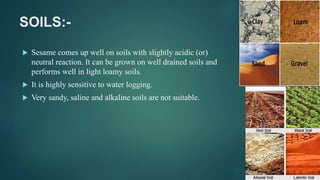
 Sesame comes up well on soils with slightly acidic (or)
neutral reaction. It can be grown on well drained soils and
performs well in light loamy soils.
 It is highly sensitive to water logging.
 Very sandy, saline and alkaline soils are not suitable.
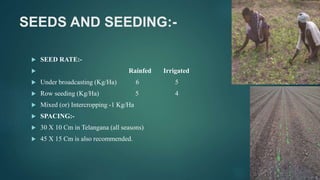
SEEDS AND SEEDING:-
 SEED RATE:-
 Rainfed Irrigated
 Under broadcasting (Kg/Ha) 6 5
 Row seeding (Kg/Ha) 5 4
 Mixed (or) Intercropping -1 Kg/Ha
 SPACING:-
 30 X 10 Cm in Telangana (all seasons)
 45 X 15 Cm is also recommended.
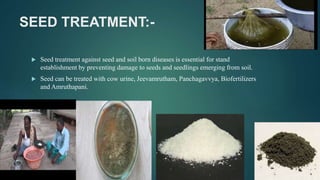
SEED TREATMENT:-
 Seed treatment against seed and soil born diseases is essential for stand
establishment by preventing damage to seeds and seedlings emerging from soil.
 Seed can be treated with cow urine, Jeevamrutham, Panchagavvya, Biofertilizers
and Amruthapani.
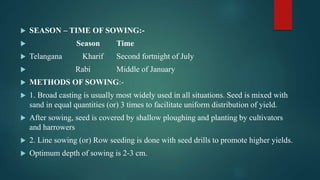
 SEASON – TIME OF SOWING:-
 Season Time
 Telangana Kharif Second fortnight of July
 Rabi Middle of January
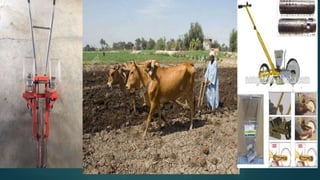
 METHODS OF SOWING:-
 1. Broad casting is usually most widely used in all situations. Seed is mixed with
sand in equal quantities (or) 3 times to facilitate uniform distribution of yield.
 After sowing, seed is covered by shallow ploughing and planting by cultivators
and harrowers
 2. Line sowing (or) Row seeding is done with seed drills to promote higher yields.
 Optimum depth of sowing is 2-3 cm.
MANURES and FERTILIZERS:-
 N-P-K REQUIREMENT:-
 Rainfed Irrigated
 N 40 60 ½ basal
 P 60 60 ½ (30-35 DAS)
 K 40 40
 Fertilizer in organic farming depends on the following factors:
 On nutrients such as those in the soil.
 On the nutrients from the rain.
 On top of the soil fertilizer.
 Above ground microorganisms (nitrogen fixing bacteria, phosphorus, solubilizer bacteria, potash solubilizer).
 Depends on the nutrients sprayed on the crops.
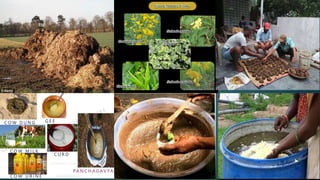
 10 tonnes of cattle manure per acre in the last Tillage.
 Spray the liquid Jeevamrutham once every 15 days.
 Spray 3% Panchagavvya at the time of Crop Season twice or thrice.
INTERCULTIVATION:-
 Sesame is sensitive to weed competition during the first 15-25 DAS. A
minimum of two weeding, one after 15 DAS and another 35 DAS are
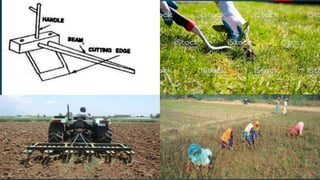
required to keep the field relatively weed free. Row seeded crop facilitates
use of blade harrows for intercultivations. Two intercultivations, 15 DAS
and 35 DAS followed by one hand weeding keeps the field free of weeds.
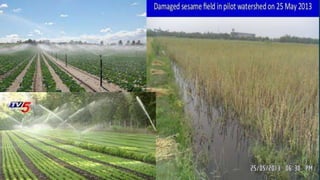
IRRIGATION:-
 Water requirement is 300-350mm. For rabi crop 5-6 irrigations are required.
 1st irrigation -at sowing
 2nd irrigation -3 WAS
 3rd irrigation -6 WAS
 4th irrigation -8 WAS
 5th irrigation -9 WAS
 CRITICAL STAGES FOR IRRIGATION:-
 For rabi / summer sesame, a pre sowing irrigation is necessary for optimum seed germination
and adequate stand establishment. Flower initiation and capsule filling stages are most
sensitive to water deficits.
SCHEDULING IRRIGATION:-
 Scheduling irrigations at 50% DASM is adequate. If irrigations are
scheduled based on IW/CPE ratio, a ratio of 0.6 is optimum under most
situations. Depending on soil type, weather conditions and crop duration,
irrigations may be given once in 12 to 15 days. If irrigation water is not a
limiting factor, flower initiation, maximum flowering and capsule filling
results in optimum seed yield. Depending on the duration, sesame water
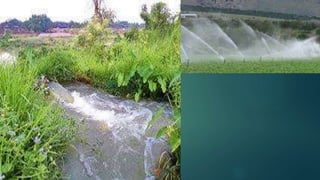
requirement ranges between 350 and 450mm. The crop is usually irrigated
by check basin method of irrigation.
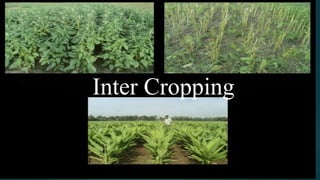
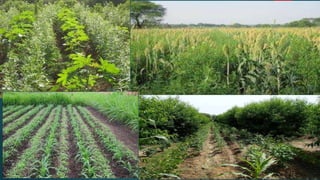
Inter Cropping
HARVESTING:-
 Depending on the variety, sesame crop takes 80-150 days for
maturity. The crop is harvested when the leaves, stems and capsules
begin to turn yellow and the lower leaves start shedding. To prevent
shedding of seed, the crop should not become dead ripe in the field.
The ripe plants are cut at the ground level carried to threshing yard,
stacked for a week in the sun with the cut ends upwards.
QUALITY CHARACTERS:-
 Sesame is the oldest oil seed crop of the world. The
seed has high food value because of the
 higher contents of good quality edible oil and
nutritious protein
SEED COMPOSITION:-
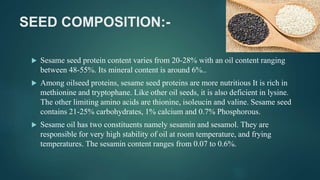
 Sesame seed protein content varies from 20-28% with an oil content ranging
between 48-55%. Its mineral content is around 6%..
 Among oilseed proteins, sesame seed proteins are more nutritious It is rich in
methionine and tryptophane. Like other oil seeds, it is also deficient in lysine.
The other limiting amino acids are thionine, isoleucin and valine. Sesame seed
contains 21-25% carbohydrates, 1% calcium and 0.7% Phosphorous.
 Sesame oil has two constituents namely sesamin and sesamol. They are
responsible for very high stability of oil at room temperature, and frying
temperatures. The sesamin content ranges from 0.07 to 0.6%.

Sesamum Corp Cultivation

  • 1.
    Sesamum Scientific Name:- Sesamumindicum Family:- Pedaliaceae
  • 3.
    ORIGIN: Ethiopia Sesamumindicum  DISTRIBUTION:- Major sesame producing countries are India, China, Myanmar, Sudan, Pakisthan, Mexico, Ethiopia, Srilanka and Burma.  In India, major sesame cultivating states are Gujarat, Rajasthan, Madhya Pradesh, Uttar Pradesh, Tamilnadu and Maharashtra  Major exporting countries are Sudan, Nigeria.  India stands first in both area and production
  • 4.
    AREA PRODUCTION &PRODUCTIVITY :-  PLACE AREA PRODUCTION PRODUCTIVITY  1. India 2.1 M.ha 0.85 M.tonnes 436 kg/ha  2. TS. 0.14 Lakh.ha 3 Thousand.tonnes 210 kg/ha.
  • 6.
    CLIMATE:-  Sesame isessentially a tropical crop grown in arid and semi-arid areas.  It is generally cultivated in tropical and sub-tropical countries.  It’s main distribution is between 250 s and 250 N Latitudes  Its altitude range is normally below 1250 m although some varieties locally adopted up to 1500 m.  Generally, it requires fairly hot conditions during growth for optimum yield.  Ideal optimum temperature for growth is 25-270 C. Extremely low temperatures of 100 C, there is a complete ceasing of growth.  Temperatures >40 C seriously affect the pollination when there is less number of capsules.  Sesame is a short day plant.  High light intensity increase number of Capsules / plant.  INFLUENCE OF RAINFALL:-  Sesame is capable of with standing a higher degree of water stress.  The crop can be grown entirely on stored soil moisture.  A rainfall of 600-1000mm results in optimum yield.
  • 7.
    VARIETIES:-  Popular varietiesin Andhra Pradesh -Gauri, Madhavi,YLM-11, YLM-17, .  Latest Variety in Andhra Pradesh -Chandana (ICS-94)  Brown seeded varieties -Grown in Coastal areas.  Gauri, Madhavi, YLM-11, YLM-17, Varada, Usha, TMV-6 etc.  White seeded varieties -Grown in Telangana area  Rajeswari, Swetha, Pratap, RT-125, Mrug-1, TG-22, T-12, T-78 etc.,  Black seeded varieties -Krishna, Soma, etc.,  Reddish brown variety -Rama.
  • 8.
    SOILS:-  Sesame comesup well on soils with slightly acidic (or) neutral reaction. It can be grown on well drained soils and performs well in light loamy soils.  It is highly sensitive to water logging.  Very sandy, saline and alkaline soils are not suitable.
  • 10.
    SEEDS AND SEEDING:- SEED RATE:-  Rainfed Irrigated  Under broadcasting (Kg/Ha) 6 5  Row seeding (Kg/Ha) 5 4  Mixed (or) Intercropping -1 Kg/Ha  SPACING:-  30 X 10 Cm in Telangana (all seasons)  45 X 15 Cm is also recommended.
  • 12.
    SEED TREATMENT:-  Seedtreatment against seed and soil born diseases is essential for stand establishment by preventing damage to seeds and seedlings emerging from soil.  Seed can be treated with cow urine, Jeevamrutham, Panchagavvya, Biofertilizers and Amruthapani.
  • 13.
     SEASON –TIME OF SOWING:-  Season Time  Telangana Kharif Second fortnight of July  Rabi Middle of January  METHODS OF SOWING:-  1. Broad casting is usually most widely used in all situations. Seed is mixed with sand in equal quantities (or) 3 times to facilitate uniform distribution of yield.  After sowing, seed is covered by shallow ploughing and planting by cultivators and harrowers  2. Line sowing (or) Row seeding is done with seed drills to promote higher yields.  Optimum depth of sowing is 2-3 cm.
  • 14.
    MANURES and FERTILIZERS:- N-P-K REQUIREMENT:-  Rainfed Irrigated  N 40 60 ½ basal  P 60 60 ½ (30-35 DAS)  K 40 40  Fertilizer in organic farming depends on the following factors:  On nutrients such as those in the soil.  On the nutrients from the rain.  On top of the soil fertilizer.  Above ground microorganisms (nitrogen fixing bacteria, phosphorus, solubilizer bacteria, potash solubilizer).  Depends on the nutrients sprayed on the crops.  10 tonnes of cattle manure per acre in the last Tillage.  Spray the liquid Jeevamrutham once every 15 days.  Spray 3% Panchagavvya at the time of Crop Season twice or thrice.
  • 16.
    INTERCULTIVATION:-  Sesame issensitive to weed competition during the first 15-25 DAS. A minimum of two weeding, one after 15 DAS and another 35 DAS are required to keep the field relatively weed free. Row seeded crop facilitates use of blade harrows for intercultivations. Two intercultivations, 15 DAS and 35 DAS followed by one hand weeding keeps the field free of weeds.
  • 19.
    IRRIGATION:-  Water requirementis 300-350mm. For rabi crop 5-6 irrigations are required.  1st irrigation -at sowing  2nd irrigation -3 WAS  3rd irrigation -6 WAS  4th irrigation -8 WAS  5th irrigation -9 WAS  CRITICAL STAGES FOR IRRIGATION:-  For rabi / summer sesame, a pre sowing irrigation is necessary for optimum seed germination and adequate stand establishment. Flower initiation and capsule filling stages are most sensitive to water deficits.
  • 21.
    SCHEDULING IRRIGATION:-  Schedulingirrigations at 50% DASM is adequate. If irrigations are scheduled based on IW/CPE ratio, a ratio of 0.6 is optimum under most situations. Depending on soil type, weather conditions and crop duration, irrigations may be given once in 12 to 15 days. If irrigation water is not a limiting factor, flower initiation, maximum flowering and capsule filling results in optimum seed yield. Depending on the duration, sesame water requirement ranges between 350 and 450mm. The crop is usually irrigated by check basin method of irrigation.
  • 23.
  • 25.
    HARVESTING:-  Depending onthe variety, sesame crop takes 80-150 days for maturity. The crop is harvested when the leaves, stems and capsules begin to turn yellow and the lower leaves start shedding. To prevent shedding of seed, the crop should not become dead ripe in the field. The ripe plants are cut at the ground level carried to threshing yard, stacked for a week in the sun with the cut ends upwards.
  • 27.
    QUALITY CHARACTERS:-  Sesameis the oldest oil seed crop of the world. The seed has high food value because of the  higher contents of good quality edible oil and nutritious protein
  • 28.
    SEED COMPOSITION:-  Sesameseed protein content varies from 20-28% with an oil content ranging between 48-55%. Its mineral content is around 6%..  Among oilseed proteins, sesame seed proteins are more nutritious It is rich in methionine and tryptophane. Like other oil seeds, it is also deficient in lysine. The other limiting amino acids are thionine, isoleucin and valine. Sesame seed contains 21-25% carbohydrates, 1% calcium and 0.7% Phosphorous.  Sesame oil has two constituents namely sesamin and sesamol. They are responsible for very high stability of oil at room temperature, and frying temperatures. The sesamin content ranges from 0.07 to 0.6%.